


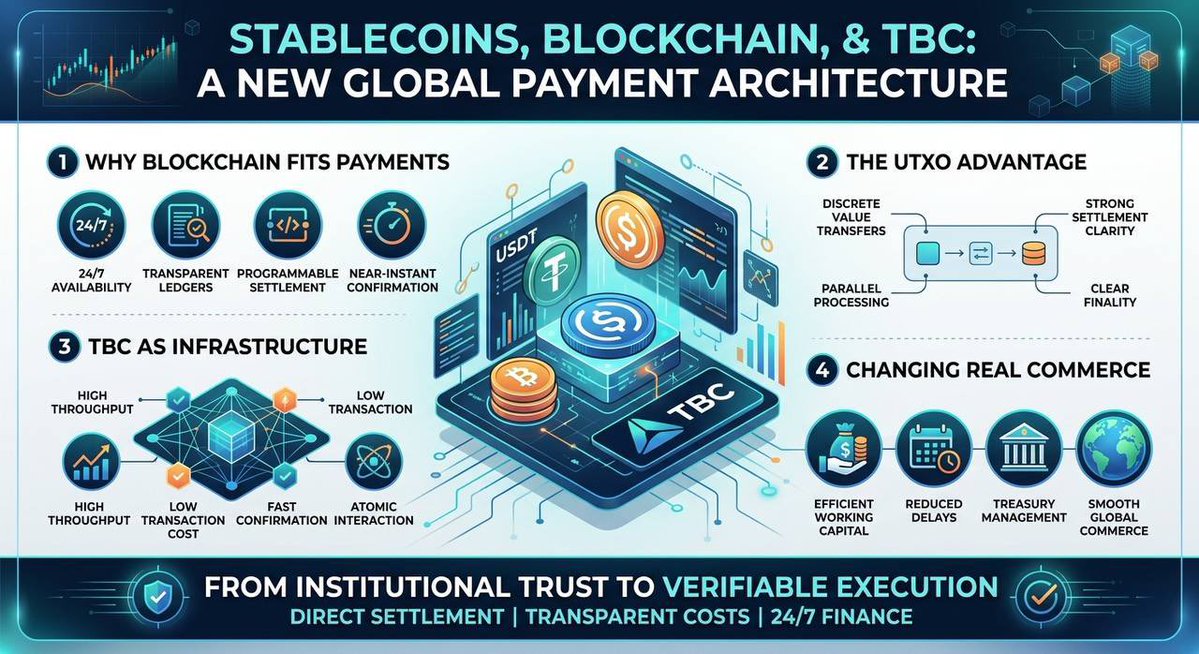
⚡ Stablecoins, Blockchain, and TBC: A New Architecture for Global Payments If the old cross-border payment system is defined by intermediaries, delay, and opacity, then the new model is being defined by three different principles: always-on settlement, low-cost transfer, and transparent execution. That is why blockchain-based payment rails are attracting so much attention. They do not just improve the old process. They redesign the payment stack from the ground up. 1️⃣ Why Blockchain Fits Cross-Border Payments So Well Cross-border payment has always had one basic requirement: move value across distance with certainty. Blockchain networks are uniquely suited to that goal because they operate with: 24/7 availability transparent ledgers programmable settlement near-instant confirmation compared with legacy banking rails Stablecoins pushed this even further. They combine the price stability needed for payments with the operational speed of digital assets. That changes the user experience completely. Instead of waiting through banking windows, intermediary cutoffs, and settlement delays, value can move continuously across time zones. 2️⃣ Why the UTXO Model Matters Not all blockchains are equally optimized for payments. The UTXO model brings a payment-native logic that is particularly relevant for cross-border use cases. Rather than relying on a constantly shared account state, UTXO-based systems treat transactions as discrete, self-contained value transfers. That creates several advantages: stronger settlement clarity less state contention more natural support for parallel processing clearer transaction finality once confirmed For payments, that matters enormously. A remittance user does not care about abstract blockchain design. They care about one thing: when the transaction is confirmed, is the money really there? UTXO-based architecture is compelling because it aligns well with that demand for finality and predictability. 3️⃣ Where TBC Enters the Picture TBC becomes interesting because it does not approach payments as a side use case. It approaches them as infrastructure. Its architecture points toward a payment network built around: high-throughput transaction processing very low transaction cost fast confirmation atomic cross-chain interaction native compatibility with a UTXO-style settlement logic In practical terms, that means a very different payment experience. Instead of routing money across multiple correspondent banks, a blockchain-native system can settle directly on-chain. Instead of forcing users into slow reconciliation cycles, the ledger itself becomes the settlement record. Instead of relying on custodial bridges for asset movement, atomic-swap style mechanisms can reduce counterparty exposure. That is not just an efficiency upgrade. It is a structural simplification. 4️⃣ Why This Could Change Real Commerce For exporters, importers, freelancers, and global suppliers, payments are not a background detail. They are operational infrastructure. If settlement becomes faster and cheaper, the impact is immediate: working capital circulates more efficiently international suppliers get paid with less delay treasury management improves small-value global commerce becomes more viable This is where TBC’s payment narrative becomes strongest. The opportunity is not merely to build another high-speed chain. It is to build a rail where global payments start to feel as simple as local transfers. 🚀 The Real Shift Legacy payment systems ask users to trust institutions. Blockchain payment networks ask users to verify execution. And TBC’s promise sits exactly in that transition: from layered settlement to direct settlement, from hidden costs to transparent costs, from banking-hour finance to internet-native finance. That is why the next chapter of cross-border payments may belong not to better paperwork, but to better rails.

Share


Source:Show original
Disclaimer: The information on this page may have been obtained from third parties and does not necessarily reflect the views or opinions of KuCoin. This content is provided for general informational purposes only, without any representation or warranty of any kind, nor shall it be construed as financial or investment advice. KuCoin shall not be liable for any errors or omissions, or for any outcomes resulting from the use of this information.
Investments in digital assets can be risky. Please carefully evaluate the risks of a product and your risk tolerance based on your own financial circumstances. For more information, please refer to our Terms of Use and Risk Disclosure.