


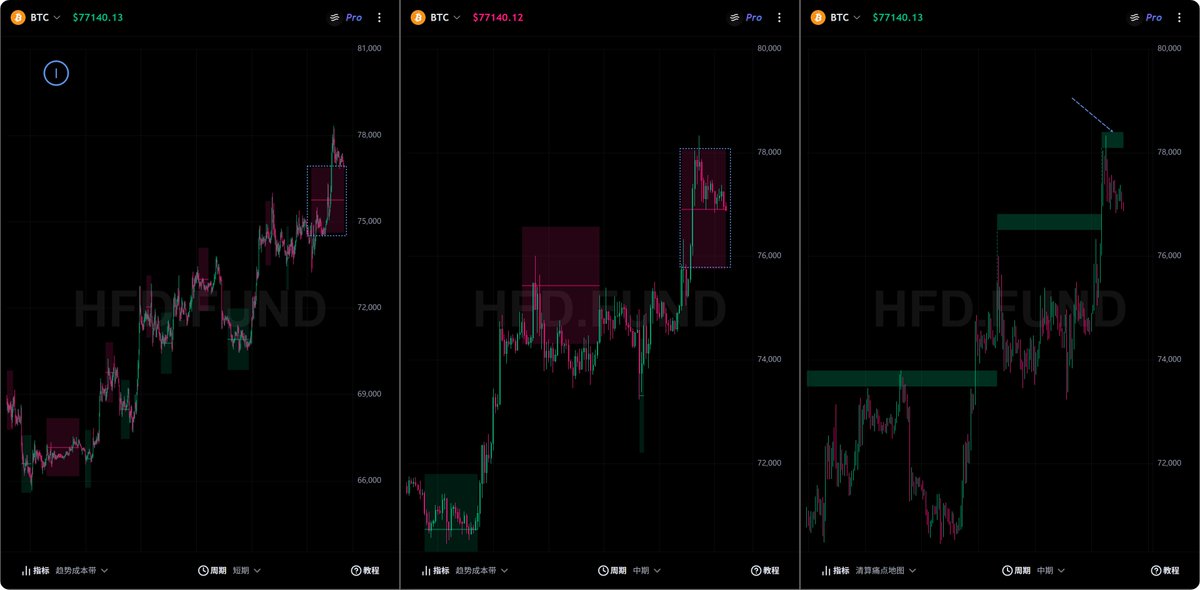
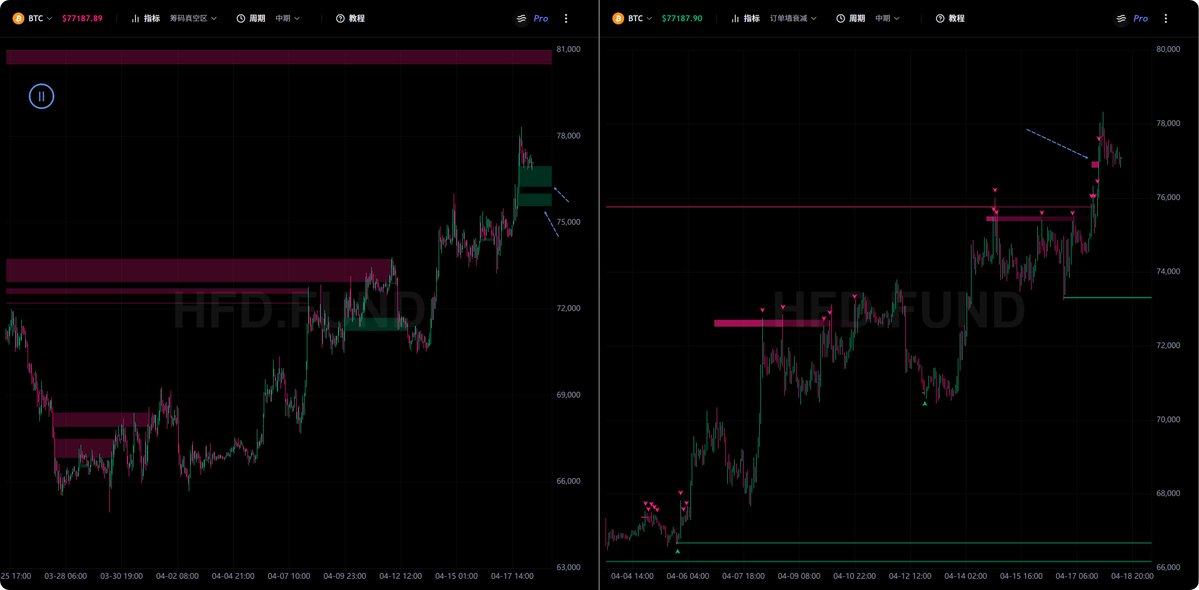
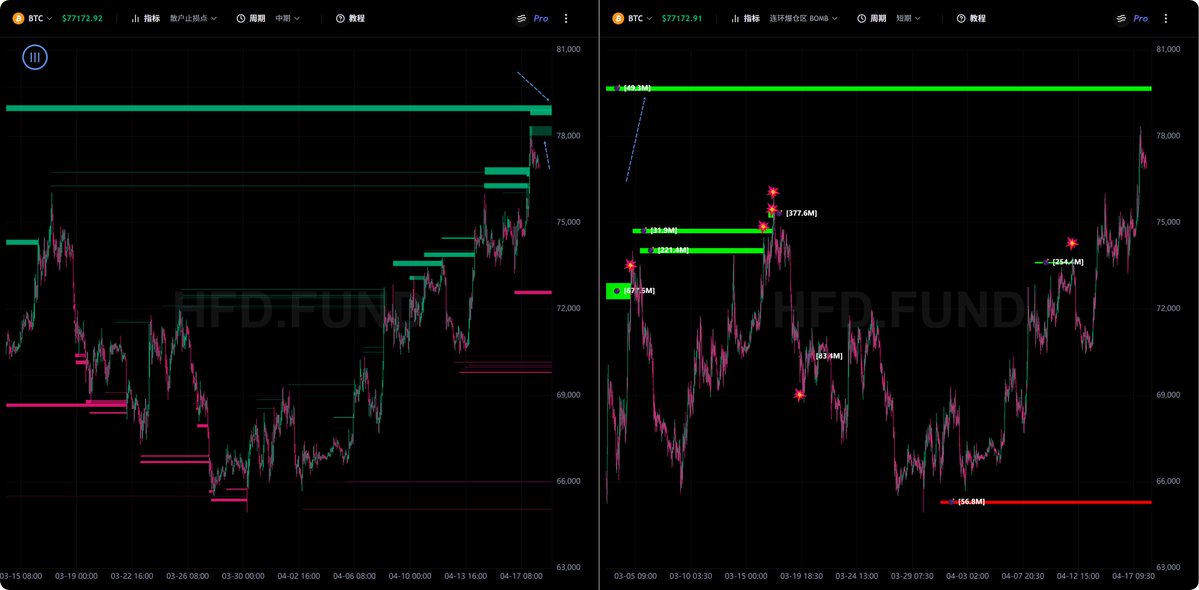
The recent uptrend has concluded. The market is currently in a high-range consolidation phase, with price oscillating between the upper boundary and the midline of the distribution cost band. What comes next? Let’s analyze the potential future direction using a comprehensive set of indicators. Trend Cost Band (Figure 1, Left): Short-term distribution trend: Upper boundary at 76,924, midline at 75,757, lower boundary at 74,635. Medium-term distribution trend: Upper boundary at 78,047, midline at 76,902, lower boundary at 75,780. The price has already broken below the short-term upper boundary and the medium-term midline. This strongly suggests the recent uptrend has likely ended. The next key level to watch is the medium-term lower boundary at 75,780 — a break below this would confirm a shift into the next accumulation phase, with price likely moving toward the mid-to-lower range of the short-term band. Liquidation Pain Zones (Figure 1, Right): The short-term liquidation zone has been fully penetrated. A significant medium-term liquidation zone remains near 78,400 — a level that must be broken upward for the trend to resume. This zone has not yet been breached, indicating potential upward momentum. Order Book Vacuum Zones (Figure 2, Left): Two major institutional limit-order accumulation zones exist in the medium term: 76,252–76,979 and 75,606–76,010. These areas require price retesting and filling. Given current conditions, a price decline to these levels is likely to trigger a rebound. Order Wall Decay (Figure 2, Right): Institutional limit-sell walls have been fully penetrated. The most recent medium-term order wall near 76,900 has also been broken. After a pullback, this level is unlikely to pose strong resistance on the next rally — it will likely be breached directly. Retail Stop-Loss Zones (Figure 3, Left): Two significant unbroken retail stop-loss clusters remain above: at 78,354 and 79,069. These must be cleared for a sustained upward move. Chain Liquidation Zones (Figure 3, Right): The closest short-term short concentration zone lies near 79,722. Although not massive in volume (~$49.3M), this area is highly vulnerable to liquidation. Overall Assessment: While upward resistance appears limited, a pullback is highly probable due to the following: 1. Increased selling pressure within the distribution trend — once price falls below the midline, the uptrend is effectively over. 2. Two major vacuum zones below are likely to be filled by price action in the absence of strong institutional buying — creating natural support. 3. The lowest point of these vacuum zones sits at 75,606, while medium- and short-term trend lower boundaries are at 75,780 and 74,635 respectively — all indicating strong attraction around the $75,000 level. Summary: The low is likely to fall below 74,635 to fill both vacuum zones. Institutions may aggressively push price below $75,000 to trigger panic selling before initiating accumulation — setting the stage for future support and a new uptrend. The next resistance targets following accumulation completion are sequentially: 78,354 → 78,400 → 79,069 → 79,722. Important Note: If price breaks below the lower boundary of the new accumulation phase after it begins, a deeper decline may follow — requiring a full recalibration of resistance levels above. Therefore, the precise initiation point of this next accumulation phase is a critical juncture.

Share


Source:Show original
Disclaimer: The information on this page may have been obtained from third parties and does not necessarily reflect the views or opinions of KuCoin. This content is provided for general informational purposes only, without any representation or warranty of any kind, nor shall it be construed as financial or investment advice. KuCoin shall not be liable for any errors or omissions, or for any outcomes resulting from the use of this information.
Investments in digital assets can be risky. Please carefully evaluate the risks of a product and your risk tolerance based on your own financial circumstances. For more information, please refer to our Terms of Use and Risk Disclosure.