


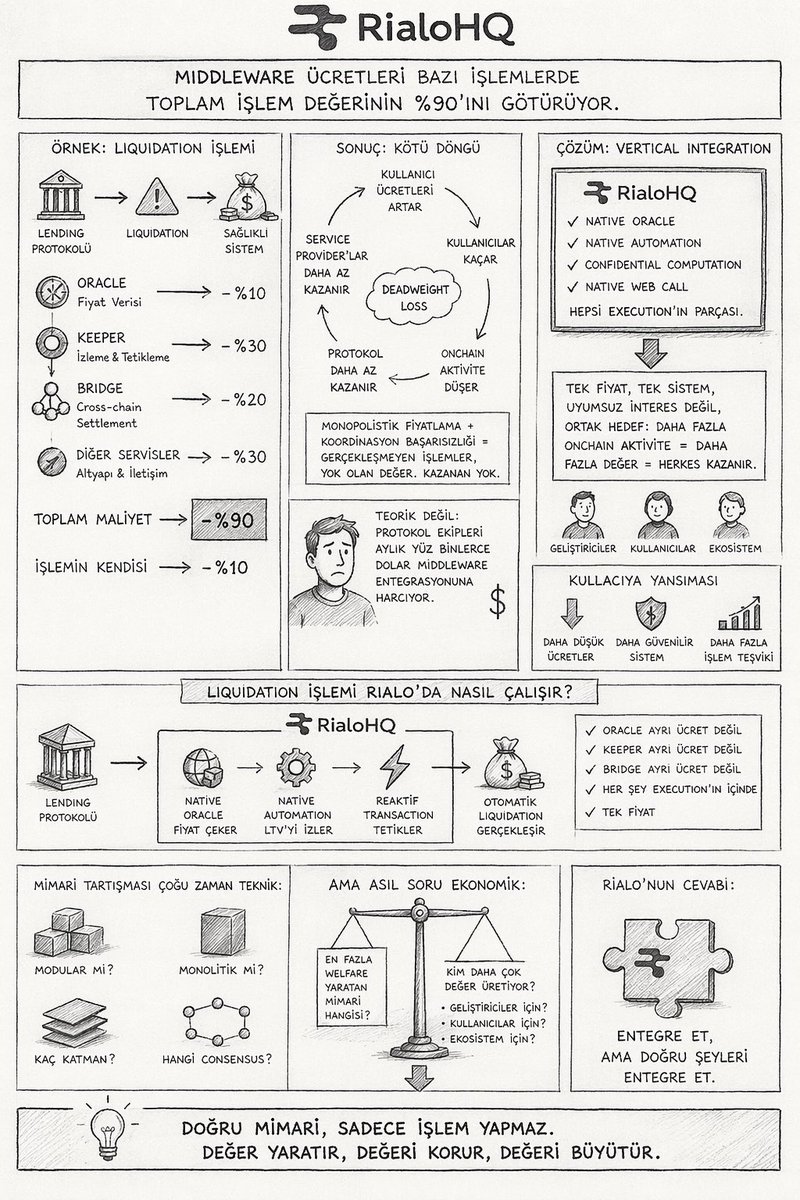
Middleware fees can consume up to 90% of the total transaction value. Read that again. A lending protocol is executing a liquidation. An oracle provides pricing, a keeper monitors and triggers the event, a bridge handles cross-chain settlement. Each charges its own fee. Each sets its own price. Each holds monopolistic power. The total cost sometimes exceeds the value of the transaction itself. At this point, the protocol has two choices: raise user fees or reduce liquidation frequency. Both are bad. The first drives users away; the second allows the system to accumulate toxic debt. In either case, on-chain activity declines, the protocol earns less, service providers earn less, and users suffer losses. In economics, this is called deadweight loss—transactions that should occur don’t, due to monopolistic pricing and coordination failure. Value that could have been created is destroyed. No one wins. This isn’t theoretical. Developer surveys show protocol teams spending hundreds of thousands of dollars monthly on middleware integrations. On high-throughput chains, it’s even worse—data is needed every millisecond, oracle updates are required every millisecond, and each has its own separate cost. Rialo sees this as a systemic problem—and offers a systemic solution: vertical integration. Incorporate the oracle. Incorporate automation. Incorporate confidential computation. Incorporate native web calls. These are no longer separate line items—they’re part of execution itself. What changes? When pricing is consolidated under one entity, incentives realign. The chain earns revenue from both execution and these services, but it also has a vested interest in increasing on-chain activity—because more activity = more revenue. This coordination is impossible with separate middleware providers; each only cares about its own margin, not the others’ users. Let’s return to the liquidation example. How does it look in Rialo? A native oracle fetches prices at regular intervals. Native automation continuously monitors LTV ratios. When collateral falls below the threshold, a reactive transaction automatically initiates liquidation. The oracle isn’t a separate fee. The keeper isn’t a separate fee. All are embedded within execution—single price. The impact on users: lower fees, a more reliable system, and stronger economic incentives to transact more. Most discussions about blockchain architecture focus on technical details: modular vs. monolithic, number of layers, consensus mechanism. But the real question is economic: which architecture creates the most welfare? Who generates the most value—for developers, for users, for the ecosystem? Rialo’s answer: integrate—but integrate the right things.

Share


Source:Show original
Disclaimer: The information on this page may have been obtained from third parties and does not necessarily reflect the views or opinions of KuCoin. This content is provided for general informational purposes only, without any representation or warranty of any kind, nor shall it be construed as financial or investment advice. KuCoin shall not be liable for any errors or omissions, or for any outcomes resulting from the use of this information.
Investments in digital assets can be risky. Please carefully evaluate the risks of a product and your risk tolerance based on your own financial circumstances. For more information, please refer to our Terms of Use and Risk Disclosure.