


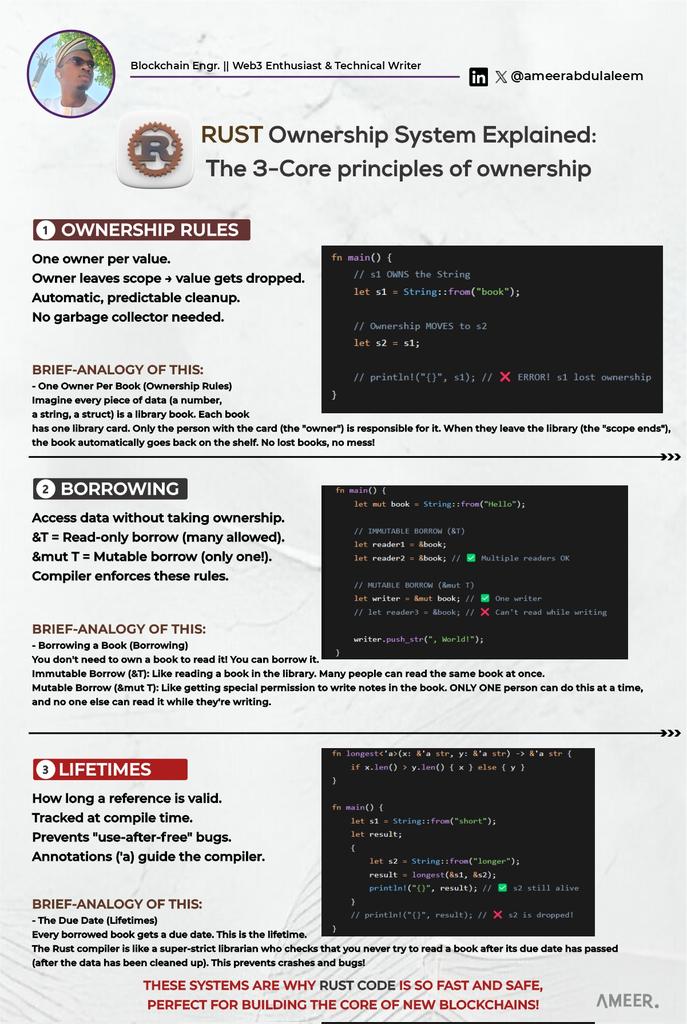
🔰Simplifying Rust's Ownership: The Foundation of Memory Safety Rust's ownership system is its most distinctive feature, often described as the language's "secret weapon" for achieving both safety and performance. While initially challenging for developers coming from languages with garbage collection, understanding ownership is the key to unlocking Rust's true potential for building robust blockchain infrastructure. Three Core Principles of Ownership: 1. Ownership Rules: The Single Source of Truth In Rust,every value has a single, clear owner at any given time. This ownership is tied to scope when the owner (typically a variable) goes out of scope, Rust automatically cleans up (or "drops") the value and frees its memory. This deterministic cleanup eliminates memory leaks without requiring a garbage collector, providing predictable performance critical for high-throughput blockchain nodes and validators. 2. Borrowing: Controlled Access Without Ownership Transfer Rather than transferring ownership whenever you need to use data,Rust allows borrowing through references. Immutable references (&T) let you read data without modifying it, while mutable references (&mut T) allow modification. The compiler enforces strict rules: you can have either multiple immutable references OR one mutable reference to the same data at any time, preventing data races at compile time. 3. Lifetimes: Tracking Validity Without Runtime Overhead Lifetimes are Rust's compile-time mechanism for ensuring references remain valid.They're annotations that tell the compiler how long references should live, ensuring you never use a reference to data that has been cleaned up. While often inferred by the compiler, explicit lifetime annotations ('a) are needed in complex cases, giving you fine-grained control without the runtime cost of garbage collection. The Library Card System Analogy: Think of Rust's ownership system like ahighly organized library: · Ownership Rules = Each book has one library card; when returned (scope ends), it's immediately reshelved · Borrowing = You can check out a book to read (&T) or with permission to write notes in it (&mut T) · Lifetimes = The due date stamped on your checkout slip, ensuring books don't disappear while borrowed Which aspect of Rust's ownership model did you find most challenging to master, and why? Share your learning journey below. #RustLang #MemorySafety #SystemsProgramming #Blockchain #Web3Development

Share


Source:Show original
Disclaimer: The information on this page may have been obtained from third parties and does not necessarily reflect the views or opinions of KuCoin. This content is provided for general informational purposes only, without any representation or warranty of any kind, nor shall it be construed as financial or investment advice. KuCoin shall not be liable for any errors or omissions, or for any outcomes resulting from the use of this information.
Investments in digital assets can be risky. Please carefully evaluate the risks of a product and your risk tolerance based on your own financial circumstances. For more information, please refer to our Terms of Use and Risk Disclosure.