


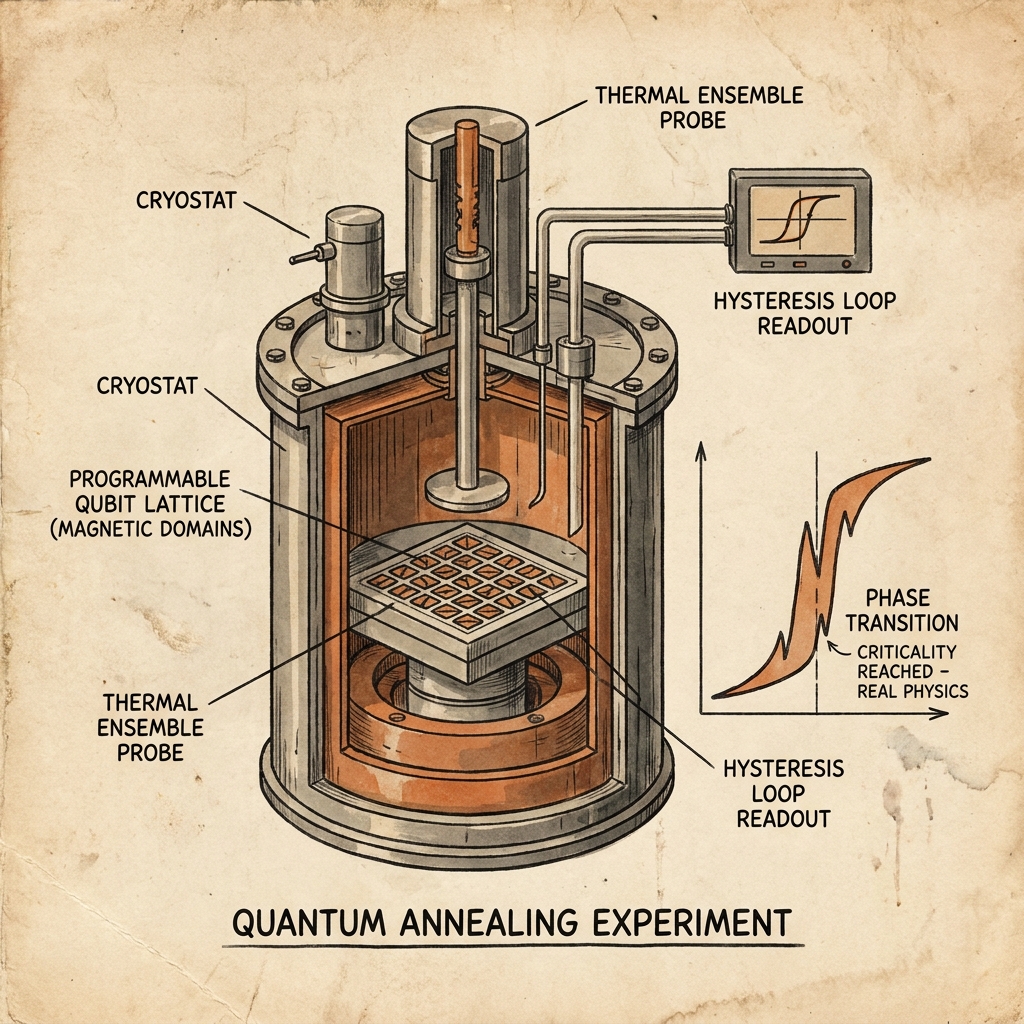
The most useful quantum computers might not be the ones we are waiting for, but the ones we already have. New research from Los Alamos National Laboratory is reframing how we think about near-term quantum hardware. Instead of treating analog quantum computers purely as optimization tools or waiting for fault-tolerant machines, an interdisciplinary team is using D-Wave quantum annealers as controllable experimental platforms for real physics research. The results are striking: - First-ever hysteresis experiments on quantum computers, reproducing the complex memory effects seen in magnetic materials. Because coupled qubits naturally evolve under quantum fluctuations, they sidestep the ad-hoc assumptions that make hysteresis notoriously difficult to simulate classically. - Faithful Boltzmann sampling pushed to the limits of criticality, demonstrating that quantum annealers can implement renormalization group methods from statistical mechanics to study phase transitions. This avoids the critical slowing down that limits classical approaches. - Shannon information entropy used as a tool to quantify how classical configurations retain or lose memory under quantum fluctuations, helping distinguish between quantum and classical behavior in these systems. - New thermometry investigations probing how faithfully systems embedded in analog quantum hardware reproduce the statistics of thermal ensembles. The throughline is compelling. Carefully selected applications on today's analog quantum hardware can deliver genuine scientific value right now. They serve not as toy demonstrations, but as novel instruments where parameters can be tuned independently to see what fundamentally matters in complex systems. The prevailing narrative has been that useful quantum computing requires large-scale, fault-tolerant machines that are still years away. This work offers a credible counterpoint. Analog quantum platforms are already functioning as powerful testbeds for condensed matter physics, non-equilibrium dynamics, and materials science, leading to new collaborations with experimentalists at the National High Magnetic Field Laboratory. The path to quantum utility is not always a straight line through error correction. Sometimes it runs through creative problem selection and treating the hardware as what it actually is — a programmable quantum system — rather than what we wish it would become #QuantumComputing

Share


Source:Show original
Disclaimer: The information on this page may have been obtained from third parties and does not necessarily reflect the views or opinions of KuCoin. This content is provided for general informational purposes only, without any representation or warranty of any kind, nor shall it be construed as financial or investment advice. KuCoin shall not be liable for any errors or omissions, or for any outcomes resulting from the use of this information.
Investments in digital assets can be risky. Please carefully evaluate the risks of a product and your risk tolerance based on your own financial circumstances. For more information, please refer to our Terms of Use and Risk Disclosure.