


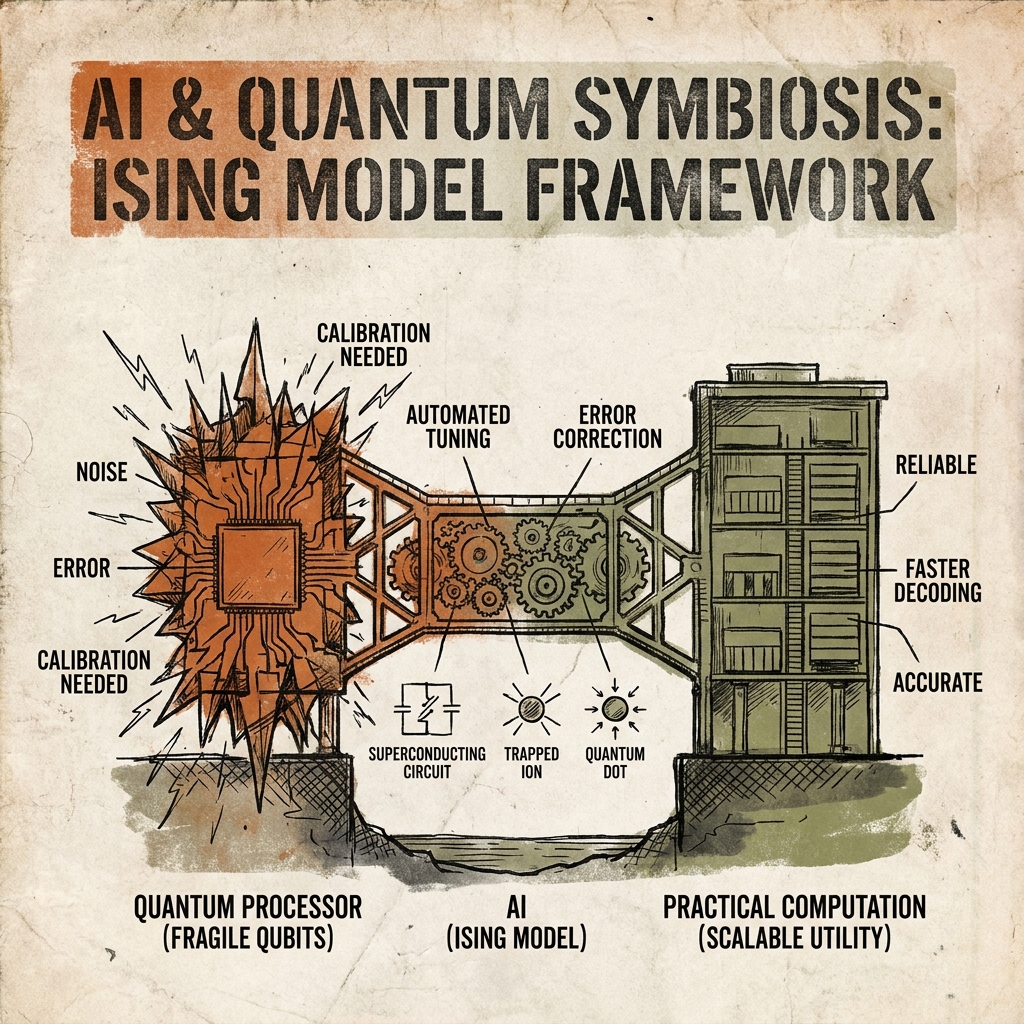
Nvidia just open-sourced what might be quantum computing's most practical AI contribution yet. The new Ising model family tackles the two hurdles keeping quantum processors from full utility: calibration and error correction. Qubits are inherently noisy. While today's best processors hit roughly one error per thousand operations, practical applications demand something closer to one in a trillion. Closing that enormous gap requires reducing hardware noise and catching errors before they compound. Ising calibration uses a vision language model architecture to automate processor tuning, compressing days of work into hours. Meanwhile, Ising decoding brings 3D convolutional neural networks to error correction. Benchmarked against PyMatching, the suite delivers decoding up to 2.5x faster and 3x more accurate. The breadth is particularly notable. The calibration model was trained across superconducting circuits, quantum dots, trapped ions, and neutral atoms. This cross-platform versatility is essential in an industry where diverse hardware approaches are still proving their viability. By offering an open-source framework complete with NIM microservices, training data, and local deployment options, the barrier to entry drops significantly. Institutions from Fermilab to IQM to Cornell are already adopting the suite. This fits a broader pattern of AI and quantum computing becoming deeply symbiotic. AI actively improves circuit design and error correction, while quantum processors show long-term promise for specific AI workloads. The convergence is materializing, even as quantum systems continue to require the specialized infrastructure that keeps them largely lab-bound for now. Tools that accelerate the transition from fragile qubits to reliable computation provide exactly the practical foundation the industry needs to scale #QuantumComputing

Share


Source:Show original
Disclaimer: The information on this page may have been obtained from third parties and does not necessarily reflect the views or opinions of KuCoin. This content is provided for general informational purposes only, without any representation or warranty of any kind, nor shall it be construed as financial or investment advice. KuCoin shall not be liable for any errors or omissions, or for any outcomes resulting from the use of this information.
Investments in digital assets can be risky. Please carefully evaluate the risks of a product and your risk tolerance based on your own financial circumstances. For more information, please refer to our Terms of Use and Risk Disclosure.