


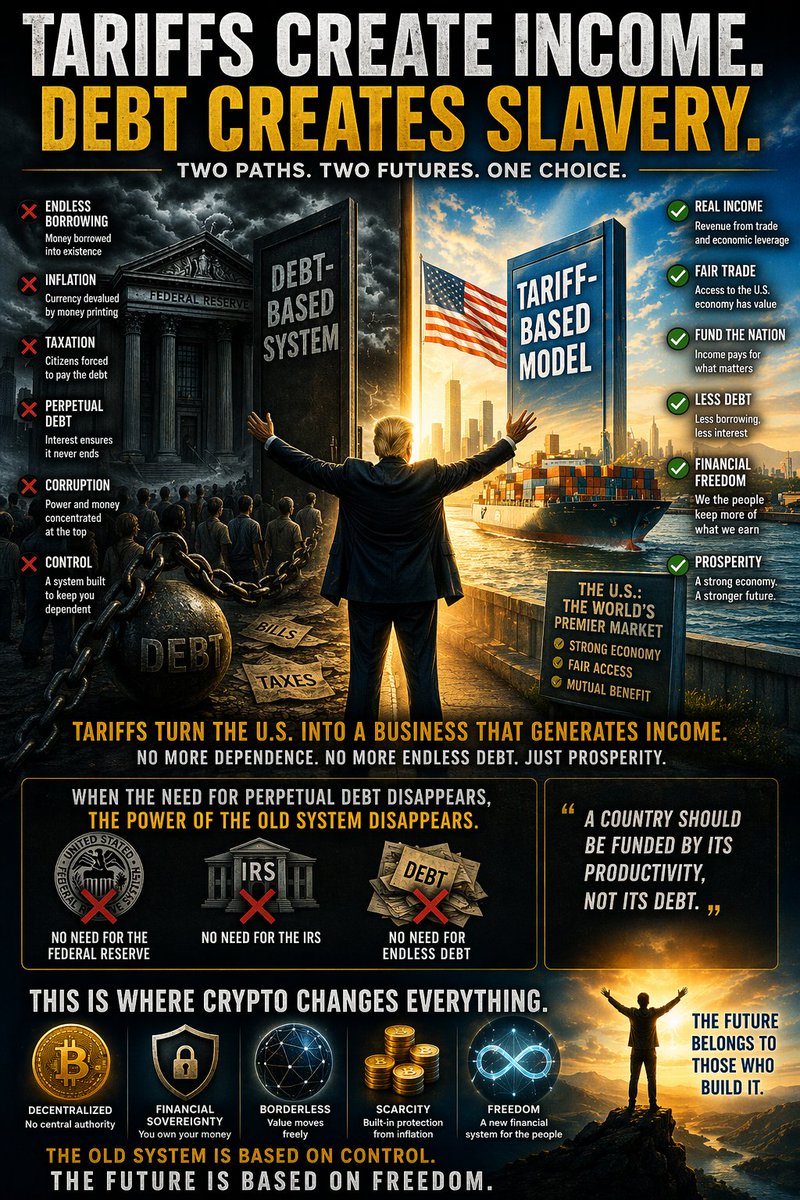
Now let’s talk about tariffs, because this is where the conversation really shifts. Many are angry due to increased costs but that's the short term pain for long term gain aspect that needs to be understood. People in this country have forgotten that you sometimes have to suffer a little before you prosper! Most people have been taught to think about the economy only through the lens of taxes, debt, borrowing, interest rates, and government spending. They have been conditioned to believe that this is simply how a modern country must operate. But what if that is not the only model? What if the system people accept as “normal” is actually the very thing keeping them financially trapped? A tariff-based model changes the conversation entirely. In simple terms, it treats the United States more like a business selling access to the largest consumer economy in the world. In that framework, access becomes the product, and tariffs become part of the revenue mechanism. Instead of relying so heavily on a debt-based monetary structure that constantly expands through borrowing, the country can generate revenue through trade and economic leverage. That matters more than most people realize. Because once a country begins generating real income from its economic position, the justification for endless borrowing starts to weaken. And once the need for endless borrowing weakens, the power of the institutions built around that borrowing begins to weaken too. This is the part many people miss. A debt-based system is not neutral. It creates dependence. It creates permanent obligation. It creates a cycle in which the public is always told more borrowing is necessary, more taxation is necessary, more inflation is unavoidable, and more sacrifice is required from ordinary people just to keep the machine running. But if a nation can generate stronger revenue through trade, production, and strategic economic policy, then it does not have to lean so heavily on a system that survives by creating debt and expanding it forever. And that is why the resistance to this idea is so intense. Because once people begin to understand that there may be another way to fund a nation besides trapping it in perpetual debt, they also begin to understand why institutions built around debt and taxation fight so hard to preserve the status quo. They do not want people asking questions. They do not want people thinking outside the existing framework. They do not want people realizing that endless debt may not be an unavoidable feature of life, but a design that benefits those who sit closest to the system itself. Even the name “Federal Reserve” has always struck many people as misleading, because it sounds as though it is simply a natural extension of government, when in practice the system functions very differently from what the average citizen assumes. That is why this conversation matters. Because if the need for perpetual borrowing begins to fade, then the relevance of the institutions built around that borrowing begins to fade as well. If government no longer has to constantly feed an expanding debt structure, then the grip of the debt-based model weakens. And when that grip weakens, people start to imagine what real financial freedom could actually look like. That is where crypto enters the picture in a very powerful way. Cryptocurrency is not just a speculative side story to all of this. It is a direct challenge to the assumptions of the old system. Why? Because crypto introduces an alternative to centralized monetary control. It introduces assets that do not need a central bank to exist. It introduces networks that do not need permission to move value. It introduces scarcity into a world built on endless expansion. It introduces financial sovereignty into a system that has long depended on dependence. So when you connect the dots, the bigger picture starts to come into focus. A tariff-based economic model can weaken the argument for endless borrowing. A reduced dependence on endless borrowing can weaken the institutions built around debt. And crypto provides a parallel financial system built on decentralization, scarcity, and direct ownership rather than perpetual expansion and centralized control. That is why these conversations are connected. One challenges the revenue structure of the old model. The other challenges the monetary structure of the old model. And both threaten the same thing: a system that has conditioned people to believe they must always be taxed more, inflated more, indebted more, and controlled more. That is why this moment matters. Because when people realize there are alternatives to debt dependency, the spell begins to break. They begin to see that maybe the future does not have to belong to central planners, endless money creation, and permanent financial extraction. Maybe the future belongs to systems built on productivity, leverage, scarcity, decentralization, and freedom. That is why tariffs matter in this conversation. That is why crypto matters in this conversation. And that is why the people defending the old system are so afraid of both. The real shift begins when people stop assuming the current model is the only model. Once that happens, everything changes! #Tariffs #Crypto #Bitcoin #FinancialFreedom #Decentralization

Share


Source:Show original
Disclaimer: The information on this page may have been obtained from third parties and does not necessarily reflect the views or opinions of KuCoin. This content is provided for general informational purposes only, without any representation or warranty of any kind, nor shall it be construed as financial or investment advice. KuCoin shall not be liable for any errors or omissions, or for any outcomes resulting from the use of this information.
Investments in digital assets can be risky. Please carefully evaluate the risks of a product and your risk tolerance based on your own financial circumstances. For more information, please refer to our Terms of Use and Risk Disclosure.