


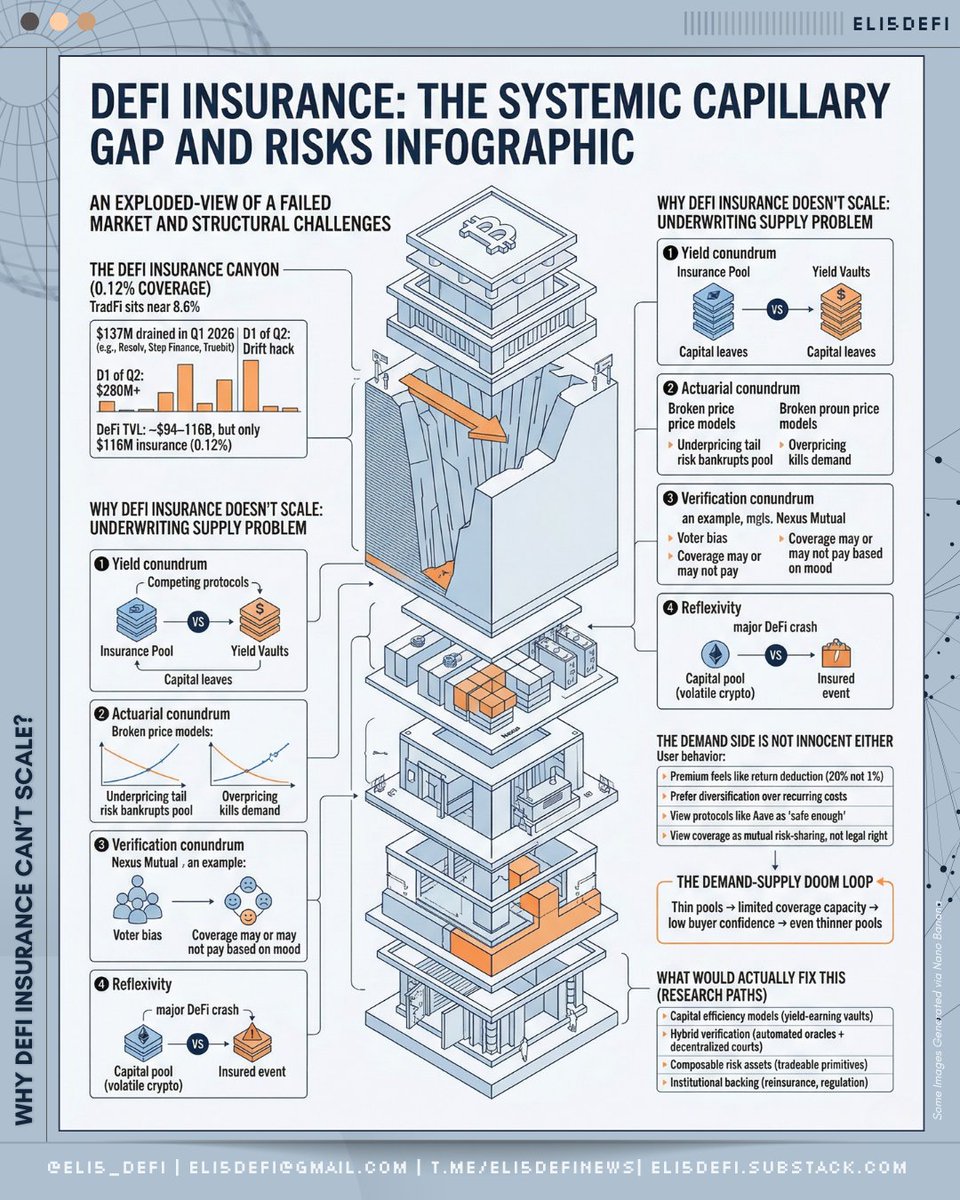
$137M was drained from DeFi in Q1 2026 alone. Resolv. Step Finance. Truebit. The list keeps growing. D1 of Q2: the $280M+ Drift hack. DeFi has ~$94–116B in TVL, but only $116M in insurance. About 0.12% coverage. TradFi sits near 8.6%. This is not a gap. It's a canyon. — ➠ Why DeFi insurance doesn't scale: The fundamental problem is not demand. It's supply of underwriting capital. Insurance requires patient, long-term capital that can withstand sudden large claims without withdrawing. That's the opposite of what DeFi liquidity providers do. They chase yield, rotate fast, and exit when things get complicated: ❶ Yield conundrum A staking or restaking protocol offers higher APY with lower perceived complexity than locking capital in an insurance pool. If premiums are thin relative to tail risk, rational capital leaves. ❷ Actuarial conundrum You cannot price crypto risk with traditional models. Short history. Correlated failures. One exploit cascades across ten protocols simultaneously. Underpricing tail risk bankrupts the pool. Overpricing kills demand. Most protocols guess somewhere in the middle and hope. ❸ Verification conundrum Nexus Mutual uses community voting on claims. Voters lose money when claims pay out, which creates bias. Pure on-chain triggers work for binary events but not complex exploits. The result: "coverage" that may or may not pay depending on community mood. ❹ Reflexivity The capital backing insurance is volatile crypto. A major DeFi crash tanks the insured event and the capital pool at the same time. The protection collapses exactly when it's needed most. — ➠ The Demand Side Is Not Innocent Either Users carry real blame here. ▸ A 1% annual premium on 5% yield feels like 20% of returns, not 1% of notional ▸ Crypto natives generally prefer diversification or ignoring tail risk over paying recurring costs ▸ Many view OG Battle Tested protocol like Aave as "safe enough" until they're not ▸ Most DeFi insurance is discretionary mutual risk-sharing, not guaranteed indemnity. That distinction matters. You're voting, not claiming a legal right. The demand-supply doom loop: Thin pools → limited coverage capacity → low buyer confidence → even thinner pools. — ➠ What Would Actually Fix This Research points to a few real paths forward: ▸ Capital efficiency models that let underwriting capital also earn yield (vaults, rebasing mechanisms) ▸ Hybrid verification: automated oracle triggers for clear events, decentralized courts for complex disputes ▸ Composable risk assets that turn insurance into a tradable DeFi primitive rather than a siloed product ▸ Institutional backing with reinsurance layers and regulatory clarity None of these are solved yet. — DeFi insurance technically works. The infrastructure around it doesn't. Capital incentives, pricing models, and verification systems all need to work simultaneously for this to scale. Until they do, DeFi insurance will remain what it is today: a product that works in isolated cases and fails the ecosystem as a whole. The protection gap is not an accident. It's the predictable output of unsolved structural problems.

Share


Source:Show original
Disclaimer: The information on this page may have been obtained from third parties and does not necessarily reflect the views or opinions of KuCoin. This content is provided for general informational purposes only, without any representation or warranty of any kind, nor shall it be construed as financial or investment advice. KuCoin shall not be liable for any errors or omissions, or for any outcomes resulting from the use of this information.
Investments in digital assets can be risky. Please carefully evaluate the risks of a product and your risk tolerance based on your own financial circumstances. For more information, please refer to our Terms of Use and Risk Disclosure.