





Large models have been continuously growing in size, and the mainstream view holds that more parameters bring models closer to human-like thinking. However, a paper published by a Zhejiang University team on April 1 in Nature Communications presents a different perspective (original article link: https://www.nature.com/articles/s41467-026-71267-5). They found that as model size increases (primarily SimCLR, CLIP, and DINOv2), the ability to recognize specific objects continues to improve, but the capacity to understand abstract concepts does not improve—and may even decline. When parameters increased from 22.06 million to 304.37 million, performance on concrete concept tasks rose from 74.94% to 85.87%, while performance on abstract concept tasks dropped from 54.37% to 52.82%.
Differences between human and model thinking
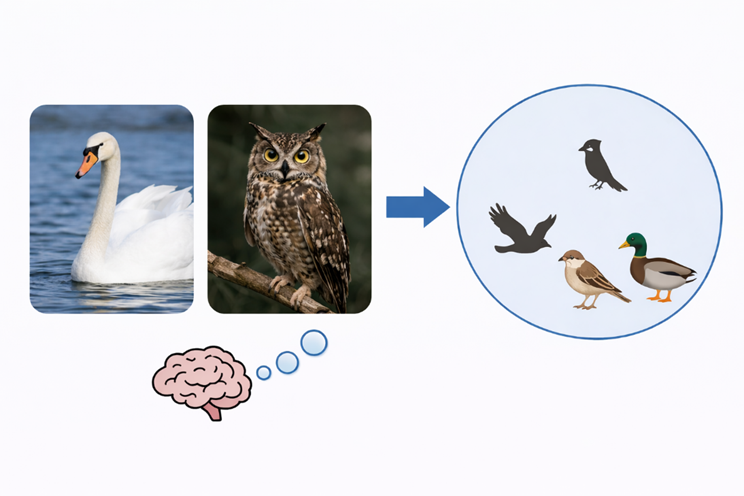
When the human brain processes concepts, it first forms a hierarchy of categories. Although swans and owls look different, people still classify them as birds. Above that, both birds and horses can be grouped under the broader category of animals. When people encounter something new, they often first ask themselves what it resembles from past experience and which category it likely belongs to. People continuously learn new concepts and organize their experiences into this framework to recognize new things and adapt to new situations.
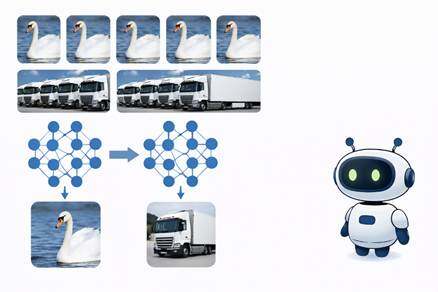
Models also perform classification, but they do so differently. They rely primarily on patterns that recur frequently in large-scale data—the more often a specific object appears, the easier it is for the model to recognize it. However, when it comes to broader categories, the model struggles more. It must identify commonalities among multiple objects and group them into the same category. Current models still have clear limitations in this area. As parameters continue to increase, performance on concrete concept tasks improves, but performance on abstract concept tasks sometimes declines.
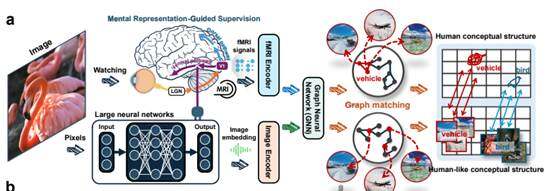
Both the human brain and models develop internal systems of categorization, but they emphasize different aspects. The brain’s higher visual regions naturally divide categories into broad groups such as biological and non-biological. In contrast, models can distinguish specific objects but struggle to consistently form these larger, overarching categories. This difference makes the human brain better at applying past experiences to new objects, allowing us to quickly classify unfamiliar things. Models, however, rely more heavily on existing knowledge and tend to get stuck on surface-level features when encountering new objects. The method proposed in the paper leverages this distinction by using brain signals to constrain the model’s internal structure, guiding it to align more closely with human-like categorization.
The solution from the Zhejiang University team
The solution proposed by the team is also unique: instead of continuing to add more parameters, they use a small amount of brain signals as supervision. These brain signals come from recorded neural activity when people view images. The original paper states that human conceptual structures are transferred to DNNs—meaning the model is taught as closely as possible how the human brain categorizes, generalizes, and groups similar concepts together.
The team conducted experiments using 150 known training categories and 50 unseen test categories. The results showed that as training progressed, the distance between the model and brain representations continuously decreased. This change occurred in both categories, indicating that the model was not learning individual samples, but rather beginning to acquire a concept organization more similar to that of the human brain.
After this training, the model demonstrated stronger learning capabilities with very few samples and improved performance in novel situations. In a task requiring the model to distinguish abstract concepts such as living and non-living entities with only minimal examples, the model achieved an average improvement of 20.5%, outperforming much larger parameter-sized baseline models. The team also conducted an additional 31 specialized tests, in which all model types showed improvements of nearly 10%.
Over the past few years, the model industry has followed the path of larger model sizes. The Zhejiang University team, however, chose a different direction—moving from "bigger is better" to "structured is smarter." While scaling up has proven useful, it primarily enhances performance on familiar tasks. The kind of abstract understanding and transfer ability that humans possess is equally crucial for AI, and this requires future AI systems to develop thought structures closer to the human brain. The value of this approach lies in refocusing the industry’s attention from mere scale expansion back to the nature of cognitive structure itself.
Neosoul and the Future
This opens up a greater possibility: AI evolution may not be limited to the model training phase. Model training determines how AI organizes concepts and forms higher-quality judgment structures. But once deployed into the real world, another layer of AI evolution is just beginning: how AI agents’ judgments are recorded, tested, and continuously refined through real-world competition, learning and evolving much like humans. This is precisely what Neosoul is doing. Neosoul doesn’t just have AI agents generate answers—it places them within a system of continuous prediction, validation, settlement, and selection, enabling them to constantly optimize themselves based on predictions versus outcomes, preserving superior structures and eliminating inferior ones. The shared goal of the Zhejiang University team and Neosoul is ultimately the same: to ensure AI doesn’t merely solve problems, but develops comprehensive thinking abilities and continuous self-evolution.