





Author: Zen, PANews
In today's generative AI applications, users often encounter fragmented conversational experiences. When switching between different models, the context from previous conversations typically cannot be carried over, requiring users to repeatedly provide the same information from scratch each time. For example, project details discussed on ChatGPT cannot be directly inherited when switching to Claude or other models, significantly affecting efficiency.
Moreover, the dialogue data of these large models is typically stored on servers of various platforms, leaving users without privacy protection and lacking control over their own data. These practical issues not only create a fragmented user experience but also raise concerns about user data sovereignty and security.
To address this pain point, the industry has begun exploring the concept of a "transferable, user-controlled memory layer," and blockchain technology may be the key to achieving this goal.
Blockchain-based open interoperability could potentially create a privacy-preserving memory layer, allowing AI context to be stored as digital assets. This would enable seamless transfer across multiple AI platforms, eliminating the need to "forget" past interactions every time a new tool is used, while ensuring data privacy and user sovereignty.
ZetaChain 2.0 Launches, Building a Universal Layer for AI and Web3
In response to the aforementioned demand, ZetaChain, a public blockchain project specialized in cross-chain interoperability, has seized the opportunity presented by the integration of AI and Web3. In its roadmap review at the end of 2025, ZetaChain announced its "2.0" plan, which will introduce new features tailored for the AI era, built upon its existing general cross-chain architecture.
On January 27, 2026, ZetaChain 2.0 officially launched, introducing its first AI product—Anuma, a privacy-centric large model aggregation application. According to the official announcement, ZetaChain 2.0 centers around the following three core capabilities:
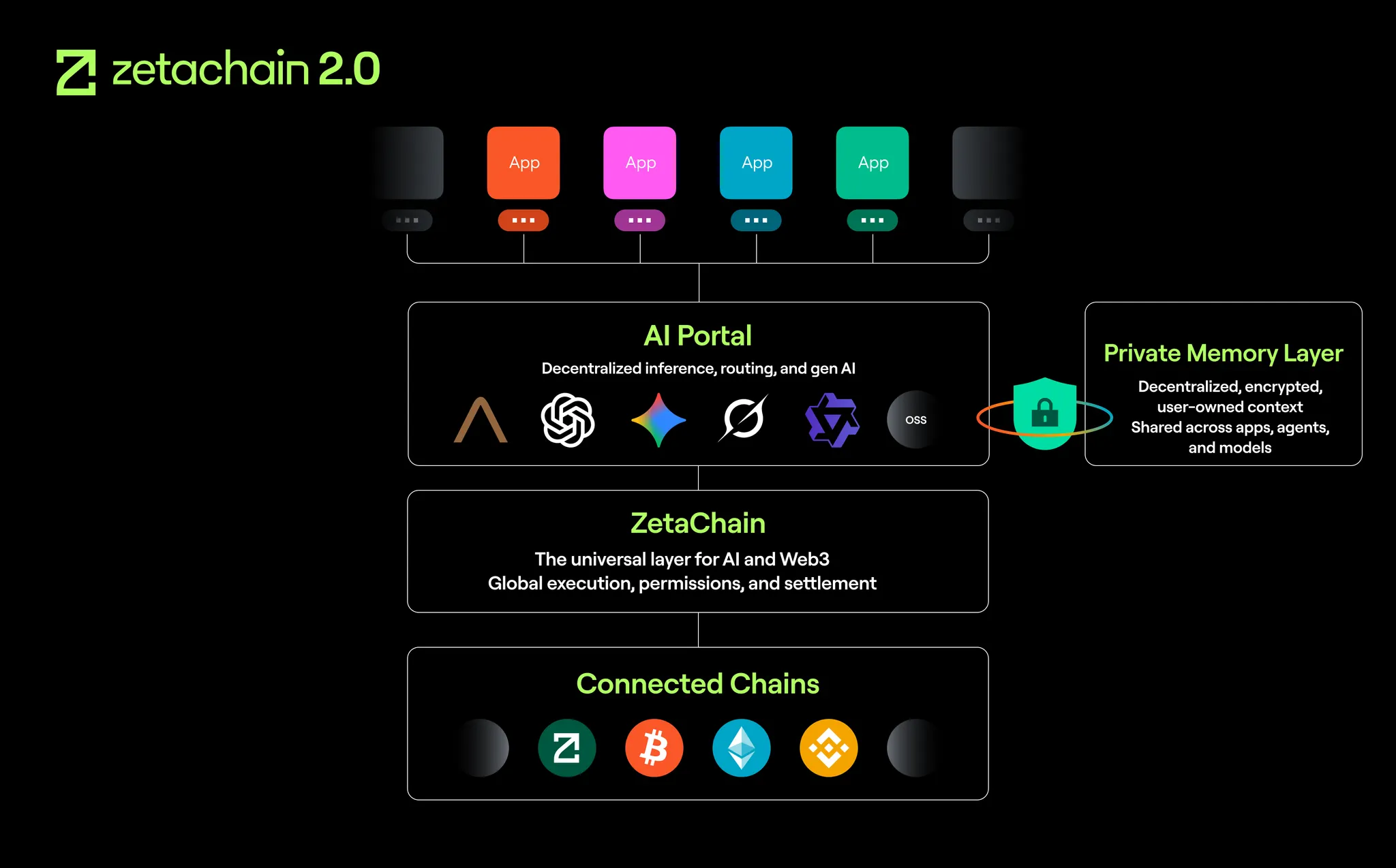
The Private Memory Layer is a protocol-level memory system specifically designed for AI interactions. Its goal is to bridge the context gap between AI tools, enabling users to truly own and control their digital memories. Based on the Private Memory Layer, all user conversations are encrypted and stored, with only the user holding the decryption key—neither the platform nor any third party can access the content. Valuable information generated across different models and at different times will be under the user's control, accumulating continuously and being transferable to new conversations at any time, without being monopolized by any single AI service.
The AI Portal is a unified routing and execution layer that enables applications to access multiple AI model providers without vendor lock-in, while providing built-in support for availability, fallback, and cost/performance optimization. The AI Portal handles the underlying model routing and context continuity, allowing users to freely choose different models such as ChatGPT, Anthropic Claude, Google Gemini, etc., to obtain responses based on their needs. Previous conversation memories are supported by a privacy-preserving memory layer.
In addition to the protocol itself, ZetaChain 2.0 has also developed a set of developer toolkits (SDKs) that incorporate key capabilities. Developers can directly integrate private persistent memory, cross-model switching, and monetization components into their own products. This SDK enables applications or AI agents to maintain continuous context across different models and selectively invoke the capabilities of various models as needed, significantly reducing the cost and complexity of building infrastructure in-house for teams.
From a mechanism design perspective, the above three core modules complement each other. The private memory layer provides privacy-first user memory and data support, the AI portal enables continuous interaction across major models, and the SDK ecosystem facilitates efficient and convenient participation and expansion by third-party developers. This also allows ZetaChain to evolve from a foundational cross-chain protocol into a general-purpose platform serving both Web3 and AI.
Anuma launches with privacy and user sovereignty at its core, and application is now open.
On the occasion of the official launch of ZetaChain 2.0, the project team also unveiled another major highlight: Anuma, the platform's first consumer-grade AI product. Currently, Anuma is in its private beta (private testing) phase, and access is gradually being opened through an invitation-based waitlist. Users can apply for early access by joining the public waitlist.
As a large model aggregation application, Anuma is built with integrations to multiple mainstream large models, allowing users to invoke different AI engines within a single conversation. It offers the convenience similar to aggregation tools like Poe, while supporting models such as OpenAI's GPT series and Anthropic's Claude.
When users ask questions, they can specify or switch the model used for the response. Switching between models only requires a click, without needing to switch to another application. Users can flexibly choose the most suitable model on Anuma based on the type of question to obtain answers, while the entire conversation remains continuous within the same window.
Technically, thanks to ZetaChain's private memory layer, every conversation in Anuma is encrypted and stored as personal memory, seamlessly migrating to new models or new sessions. When users start a new conversation or switch AI models within an existing conversation, Anuma securely injects the relevant context into the target model, enabling it to understand the previous background and user intent. This allows users to avoid repeatedly explaining the same background information across different AIs, significantly improving the efficiency of cross-model collaboration.
Traditional Web2 companies have long been despised for exploiting their centralized advantages to misuse user data. Issues like price discrimination against regular users and data trafficking persist despite repeated attempts to ban them. As a result, users' wariness and concerns about centralized platforms have extended to the rapidly developing field of AI.
Anuma places great emphasis on the privacy and user control of conversation content. The entire platform adopts an end-to-end encryption scheme to protect user data. Starting from when a user inputs a message in the frontend, the content is encrypted using the user's key before being passed to the privacy memory layer for storage. When context needs to be provided to the AI model, it is decrypted by the user's device or a trusted execution environment before being sent to the model. Throughout the entire process, conversation records are always stored or transmitted in encrypted form. Even ZetaChain nodes or servers cannot access the content.
This is in stark contrast to traditional AI chat services, where chat records are typically stored in plain text on servers, raising concerns about potential access or data breaches by the service providers. Anuma, on the other hand, leverages blockchain and encryption technologies to achieve a security level similar to that of Web3 wallet private key management, ensuring that only users can decipher their own data. This makes it a more secure option for AI applications in sensitive fields such as law and healthcare, allowing users to confidently engage in more private and confidential conversations.
In fact, before the launch of Anuma, there were already some AI chat products that aggregated multiple models on the market. Notable examples include Poe platform launched by Quora, often referred to as the "American version of Zhihu," as well as TypingMind from open-source communities.
Compared to the cloud service models and on-premises deployment of these two platforms, Anuma's on-chain encrypted storage offers a balanced approach that preserves both privacy and data sovereignty. In terms of usability and model diversity, Anuma eliminates the cumbersome configuration process of the TypingMind model, providing a convenient multi-model conversational experience similar to Poe.
Behind the Move into AI: ZetaChain's Technical Logic and Natural Evolution
The ZetaChain team's decision to launch version 2.0 and Anuma at this time is actually backed by substantial technical groundwork and a clear evolutionary logic.
As the first general-purpose L1 blockchain project, ZetaChain has focused on solving the fragmentation problem in the blockchain industry since its launch in 2021. It is committed to building a foundational network that connects all public blockchains. Built on the Cosmos SDK, ZetaChain natively supports interoperability with heterogeneous chains such as Ethereum, Bitcoin, and Cosmos.
ZetaChain simplifies cross-chain operations—traditionally requiring cross-chain bridges and token wrapping—into a single on-chain contract call through innovations like CAF, providing users with unified liquidity and a seamless experience. By the end of 2025, the ZetaChain mainnet has integrated ten major blockchain networks, including Bitcoin, covering millions of users, with a cumulative on-chain transaction count reaching 225 million.
On both the ecological and capital levels, ZetaChain has also gained widespread recognition. According to public data, the project has secured $27 million in funding, with investors including renowned institutions such as Blockchain.com, Jane Street, and Sky9 Capital. In 2024-2025, global technology and infrastructure giants such as Google Cloud, Deutsche Telekom, and Alibaba Cloud successively joined the network as validator nodes, endorsing its security and compliance.
In the second half of 2025, with the explosive growth of generative AI, the ZetaChain team realized that the multi-chain ecosystem in the blockchain industry and multi-model AI actually share similar pain points—both suffer from fragmentation across multiple platforms and systems, requiring a universal layer for integration. As a result, they proposed the strategic vision of an "AI Universal Platform," introducing blockchain's trusted computing and storage capabilities into the AI field to build blockchain infrastructure for the AI era.
ZetaChain 2.0 is the realization of this vision. It retains and enhances the original cross-chain capabilities while introducing new AI privacy memory and interactive features. This aligns with ZetaChain's consistent vision of making Web3 equally friendly for both humans and AI. The natural evolution from a "general-purpose blockchain" to an "AI general platform" not only follows the trend of technological convergence but also extends the project's mission.
"ZetaChain has achieved unified scalability at the blockchain experience level," said Ankur Nandwani, a core contributor to ZetaChain. "ZetaChain 2.0 extends the same approach to AI, enabling next-generation applications and agents to operate across models and blockchains, with private, authorized memory and global monetization channels by default."
What is the outlook for a new paradigm of deep integration between blockchain and AI?
The launch of ZetaChain 2.0 and its flagship product Anuma marks a significant attempt at the deep integration of blockchain and AI. Within this framework, we witness a new paradigm for multi-model AI applications: privacy-first, user-controlled, and cross-platform interoperable.
Of course, it should be objectively noted that Anuma is still in a very early private beta stage, and its overall ecosystem is just beginning to take shape. Many features and details still require feedback from a wide range of testers to be refined, such as support for more models, improvements in memory layer capacity and performance, and the expansion of third-party developer tools. This means that in the short term, Anuma is far from being able to replace the experience of established individual platforms, and some users will need time to adapt to this new mode of interaction.
However, it cannot be ignored that the direction represented by Anuma is groundbreaking. In the field of multi-model aggregation experiences, Anuma offers an approach distinct from those of major companies. Instead of centralized platforms monopolizing data and model invocation rights, Anuma returns the choice and memory to users, achieving trust-minimized coordination through blockchain technology.
With Anuma's public beta launch and ongoing feature iterations, more innovative applications may emerge on this platform, such as privacy-preserving AI advisors and cross-domain intelligent search assistants. As for how far this new trend of privacy-first, multi-model experiences can go, time will tell.