



As we move into 2026, X (Twitter) has been making frequent moves. While we may not be able to see if anxiety is written on Musk's face, we can see his anxiety expressed in his tweets.
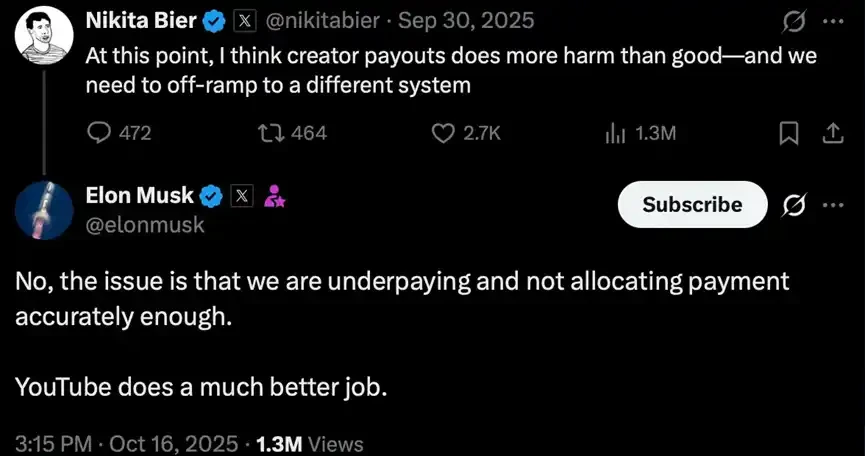
Musk said, "We still pay creators too little, and the distribution isn't as good as it could be. YouTube does this much better than we do."
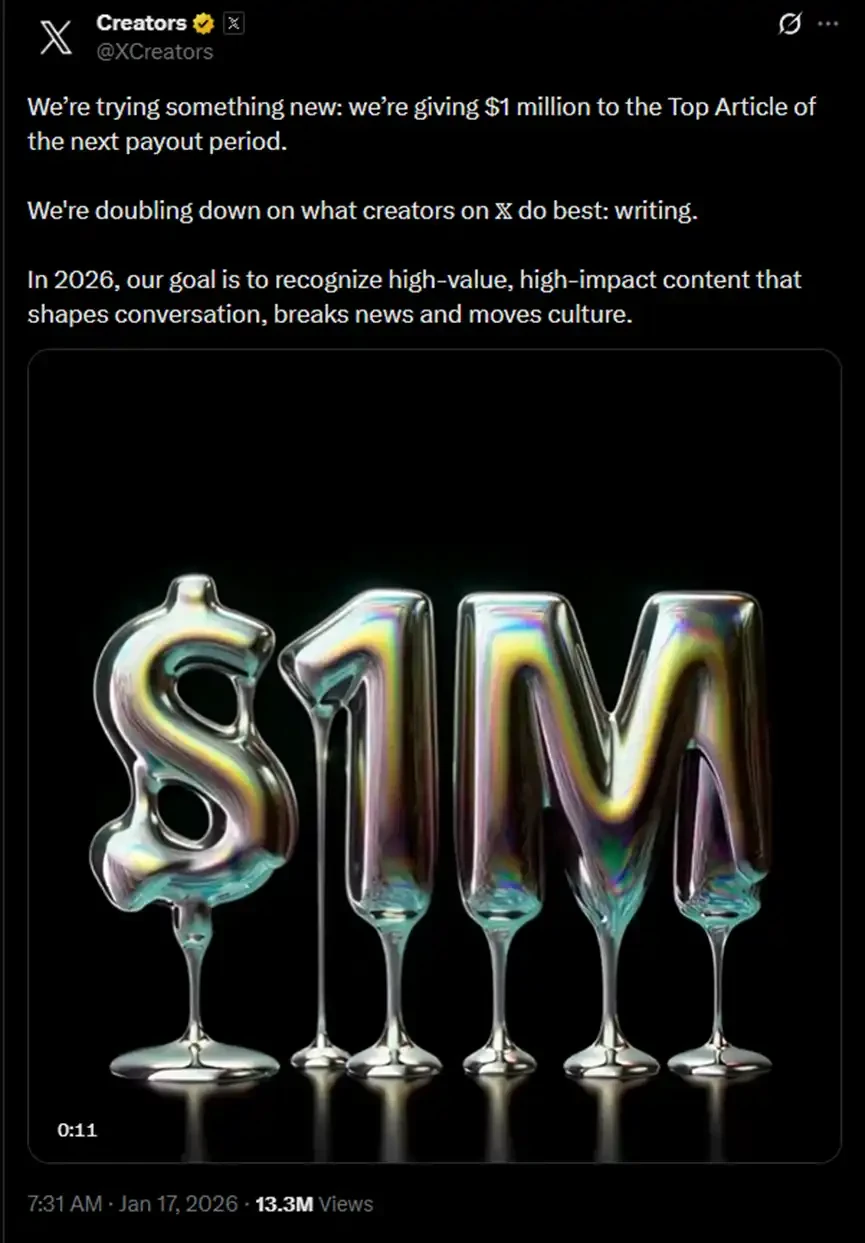
Last weekend, X officially launched a "Million Dollar Article Bounty Program," sparking a wave of enthusiasm for long-form content on the platform.
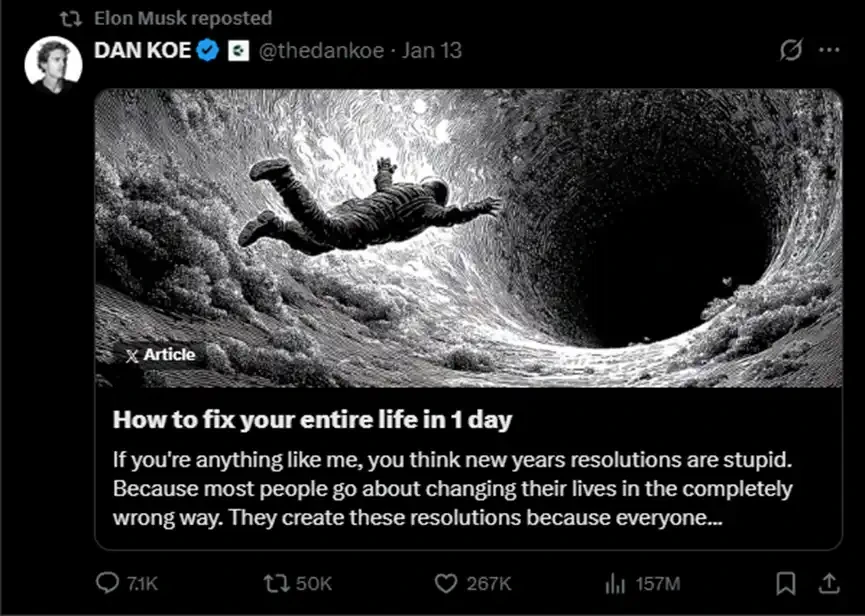
The article currently having the greatest impact is Dan Koehn's "How to Fix Your Life in One Day," which has been read over 150 million times and was retweeted by Elon Musk.
It has been several years since Musk acquired X. Why is he now aggressively promoting the platform's creator ecosystem this year? In today's world, where global users' reading habits are increasingly fragmented, why has he chosen to focus on long-form content? Can the revival of long-form content truly support Musk's ambitious vision for X as the "Everything App"?
Elon Musk's Anxiety
Every family has its own hard-to-read book, and geniuses also face anxieties unique to them. The relentless pressure from competitors and X's own financial performance have even left the experienced Ma unable to sit idly by.
X is facing intense competition in user growth and engagement, especially since Meta's Threads was launched in 2023. Threads has experienced rapid growth and has already surpassed or approached X in multiple metrics.
According to the latest data released by the data analytics company Similarweb at the beginning of January 2026, Threads' global mobile daily active users (DAU) have surpassed X, averaging 143.2 million, compared to 126.2 million for X. In terms of growth trends, X's global DAU has declined by 11.9% year-over-year, while Threads has achieved an impressive growth of 37.8%. Even in the U.S. market, X's stronghold, where X still leads Threads with a DAU of 21.2 million versus Threads' 19.5 million, the gap is rapidly narrowing. Threads is growing at an annual rate of 41.8%, while X is declining by 18.4%.
In terms of monthly active users (MAU), Threads has also performed impressively. As of January 2026, its MAU reached 320 million, having grown from 350 million to 400 million in 2025. In contrast, X still has around 611 million MAU, but since Musk's acquisition, it has cumulatively lost approximately 32 million users. This shifting trend undoubtedly puts significant pressure on Musk.
The decline in user data has directly impacted X's core revenue source—advertising. According to public data, X's global advertising revenue dropped to $2.5 billion in 2024, nearly halving from $4.4 billion in 2022. Although a slight recovery to $2.26 billion is projected for 2025, the overall downward trend remains evident. Some institutions predict that by 2027, revenue will only reach $2.7 billion at most.
Meanwhile, its competitor Threads is highly anticipated by capital markets. Analysts predict that Threads' advertising revenue could reach $11.3 billion by 2026, several times higher than X's projected revenue. Although X achieved quarterly revenue growth by the end of 2025, the company as a whole remains in a loss-making position due to high restructuring costs.
Although X Premium subscribers will experience significant growth in 2025, their revenue contribution will still fall far short of Elon Musk's initial goal of accounting for 50% of total revenue. Therefore, X has directly linked the growth of Premium subscriptions to creators' earnings. Not only will it offer higher revenue shares for creators, but it will also explicitly base earnings calculations on impressions from the Verified Home Timeline of paid users. This aims to incentivize creators to produce high-quality content that attracts paid users, thereby driving more users to subscribe to the Premium service.
As a result, we eventually saw this million-dollar article reward campaign initiated by "Old Ma," reminiscent of the fable of "buying a horse's bones for a thousand gold pieces." Chinese users jokingly say that Old Ma is launching a "New Concept Essay Contest" in the U.S. by 2026.
The Revival of Long-Form Content
Musk's decision to focus on long-form content as a breakthrough for X's creator ecosystem is not a sudden whim, but rather a strategic consideration based on his deep understanding of X's platform positioning.
Today, X's recommendation algorithm has a core metric known as "regret-free user time," which refers to the total duration users spend effectively engaging with a piece of content. Musk clearly pointed out that this mechanism naturally favors long-form content, as it can "accumulate more user seconds," thereby increasing the content's algorithmic weight and the platform's overall user engagement.
Long-form articles naturally increase user engagement time due to the depth, context, and complete narratives they provide, in sharp contrast to the quick-consumption model of short posts or short videos. Recent algorithm updates have further introduced a "content format weighting" mechanism, explicitly favoring long-form content that requires more creative effort and has a greater impact. This is not only an incentive for content creators but also a data-driven decision: high-quality long articles effectively reduce users' tendency to click through to external links, keeping them on the platform for longer periods. At the same time, they also provide more high-quality training data for Elon Musk's AI project, Grok AI.
Moreover, Musk repeatedly emphasized his desire to build X into the "number one news source on Earth," replacing traditional media by aggregating the "collective intelligence" in real time. The long-form article feature allows users to post "full articles or even entire books," enabling subject-matter experts, event witnesses, and in-depth creators to directly share their comprehensive insights on the platform, rather than fragmented information. At the same time, compared to other platforms that offer substantial subsidies for short videos, the incentive model for long-form articles is more easily monetized through a subscription model, thereby attracting more professional journalists and writers back to the X platform.
However, a question arises. You might wonder, given that today's global users have fragmented reading habits, what's the point of Steve Jobs pushing this "Renaissance"?
There is no denying that global users' digital reading habits are showing a clear trend toward fragmentation. Particularly under the impact of short-video platforms, younger generations such as Gen Z tend to engage in multiple short reading sessions each day, typically lasting 5 to 10 minutes each. However, data also reveals that overall reading volume is actually increasing. As a counter-movement, "slow, immersive reading" is on the rise, with people beginning to seek depth, emotional connection, and meaningful content consumption amid digital fatigue.
What X wants is not to become another entertainment platform like TikTok, but rather to become a "hub of daily life" deeply integrated into the lives of every American, similar to WeChat—that is, the "Everything App" that Musk has often mentioned. To achieve this, the platform must greatly enrich its content and service ecosystem, increasing users' "regret-free usage time," giving them more reasons to stay on the platform and accomplish more tasks there.
The Ambition of Everything App
All of Musk's efforts ultimately point toward a grand goal: transforming X into an "Everything App" akin to WeChat. However, to achieve this ambition, X still has a long way to go.
Compared to WeChat, X lags significantly in multiple key metrics. In terms of monthly active users (MAU), WeChat has over 1.4 billion users, while X has only 557 million, less than one-third of WeChat's user base. This massive difference in user numbers makes it difficult for X to achieve the strong "network effect" that WeChat enjoys—where users remain on the platform because all their friends, family, and daily services are integrated there. WeChat has become an essential part of daily life for many people, whereas in the eyes of most users, X is still primarily seen as a social media platform for news consumption and opinion sharing, still the same Twitter, the "Twitter of China."
In terms of user stickiness, the gap is equally significant. WeChat users spend an average of 82 minutes per day on the app, while X users only spend 30-35 minutes. The reason behind this is that WeChat allows users to accomplish a wide range of "productive" tasks within the app, such as chatting, making payments, shopping, and accessing municipal services. In contrast, content consumption on X is mainly passive scrolling, which easily leads to users "browsing and leaving" after a quick session.
Old Ma doesn't want X to become TikTok. Therefore, his first step is to move X away from an entertainment-driven user experience where users "scroll through and leave." He needs high-quality, in-depth content to enhance user engagement, attract and retain high-value users. Based on this content foundation, he can gradually integrate more services such as payments and e-commerce, ultimately paving the way toward becoming the "Everything App."
And how grand this dream is, how profound Musk's anxiety will be.