







World Liberty Financial [WLFI], a DeFi project backed by the President Donald Trump family, has initiated the voting on the controversial 4-year token unlock proposal.
In a statement on the 29th of April, the project said the voting for the proposal was now live. The team noted that the process will end by the 6th of May, calling it the “most significant governance proposals in WLFI history.”
For perspective, about 75 billion WLFI tokens are currently locked. If the proposal is passed, 62.3 billion WLFI tokens of this locked stash will not hit the market for at least two years.
The holdings belong to two groups: founders, team, and advisors on one end. The second group includes early supporters who bought during the presale period.
The first camp is allocated 45 billion WLFI, a mandatory 10% burn (4.5B tokens), and will face a 2-year cliff, followed by a 3-year vesting period. In other words, they’ll fully access their token by 2031.
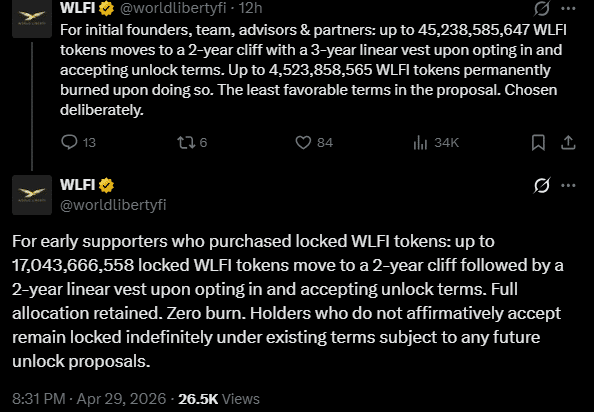
The second camp, controlling 17B tokens, will only fully access their stash by 2030 after a 2-year cliff followed by a 2-year period of phased release.
WLFI pushes forward despite Justin Sun’s lawsuit
Those who are unhappy with the proposal will likely remain unhappy ‘indefinitely,’ as the project put its,
Holders who do not affirmatively accept remain locked indefinitely under existing terms, subject to any future unlock proposals.
Some early investors, like Tron founder Justin Sun, initially slammed the unlock proposal as ‘world tyranny’ and extortion. He has since sued the firm.
Sun was a major investor in the project, but his tokens have been blacklisted, denying him even the right to vote on the proposal.
According to the team, however, Sun’s tokens were blacklisted because of his misconduct, with Eric Trump dismissing Sun’s lawsuit as ‘ridiculous.’
Still, the Trump-backed project continues to face serious ethics concerns. According to the Wall Street Journal (WSJ) report, the project announced a partnership with AB DAO, a sanctioned entity linked to pig-butchering scam networks.
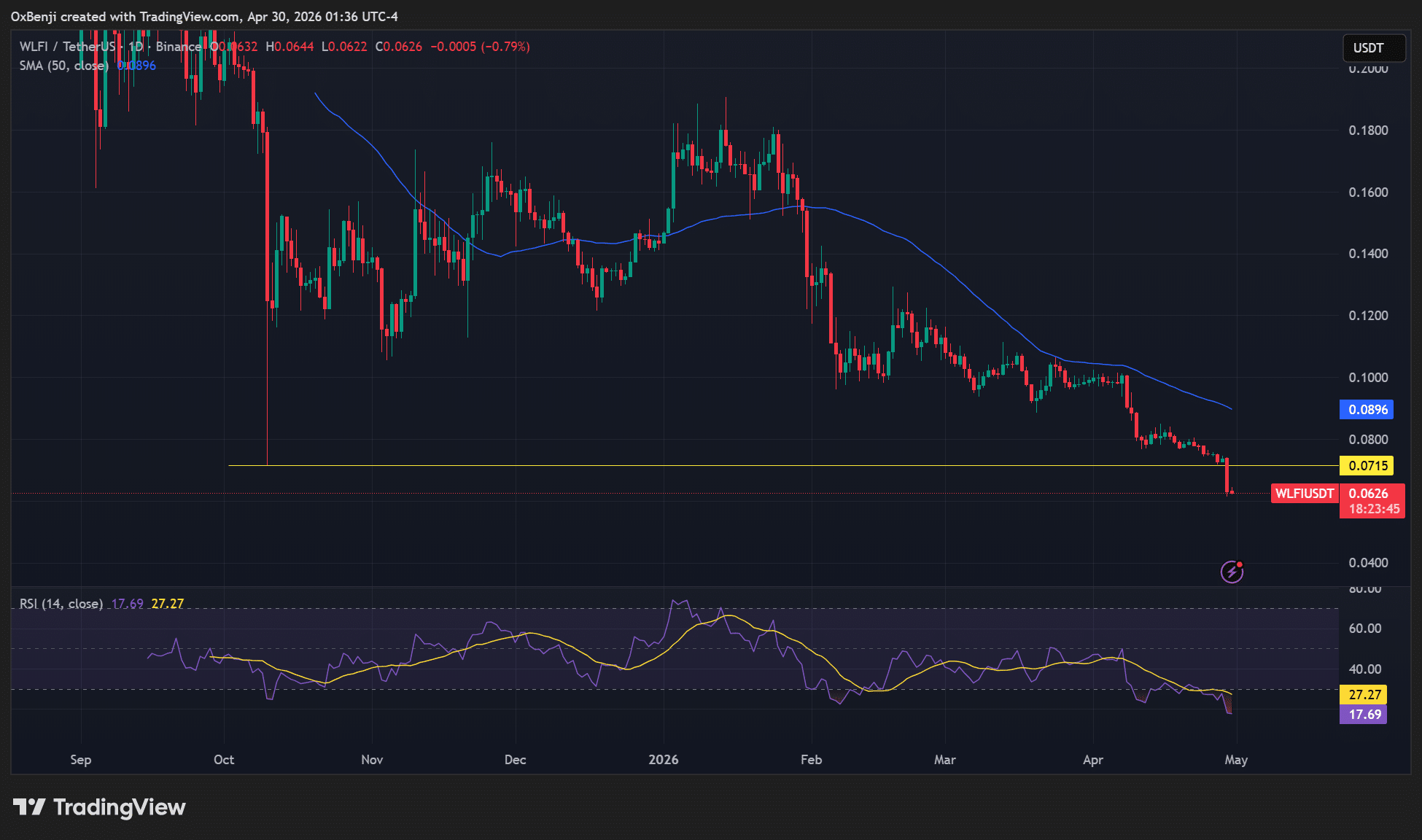
Meanwhile, WLFI’s price slumped 14% following the voting update. In fact, it marked a new all-time low of 0.062. It’s unclear whether the final passage of the proposal will send it lower.
Final Summary
- WLFI has pushed forward with its controversial token unlock plan that will allow full access by 2030 or 2031.
- Amid governance concerns and ethics scrutiny, WLFI’s price fell 14% to a new all-time low of $0.062.