





The most frequently asked question recently is, "How to..."The narrative around Ethereum refers to the overarching story or perspective that is being told about Ethereum within the cryptocurrency and blockchain community, as well as in the broader?
Indeed, Ethereum's main focus in 2017 was ICOs and the "world computer" concept, while in 2021 it centered on DeFi and the financial settlement layer. However, in the cycle of 2025, it seems that...RarelyCan you continue with the previous old narrative,A new narrative that rivals it in height..
Perhaps ETFs and Staking ETFs count as half, but these are not within the control of Ethereum developers.If we're to mention the other half, it can only be ZK.
Ethereum is indeed the public chain that the entire crypto world has bet on the most for ZK., without a doubt.
A few days ago, Vitalik was very excited. He officially announced on Twitter that ZKEVM has now entered the Alpha stage.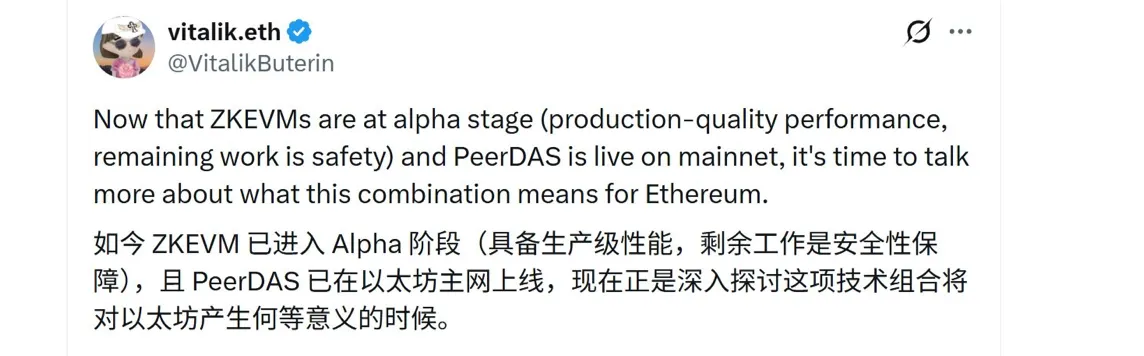
Why is Ethereum so committed to ZK (Zero-Knowledge proofs)?
In fact, Ethereum's TPS is already quite high now, with the theoretical peak having increased to over 200 TPS. The reason for this is...Ethereum has increased the gas limit multiple times.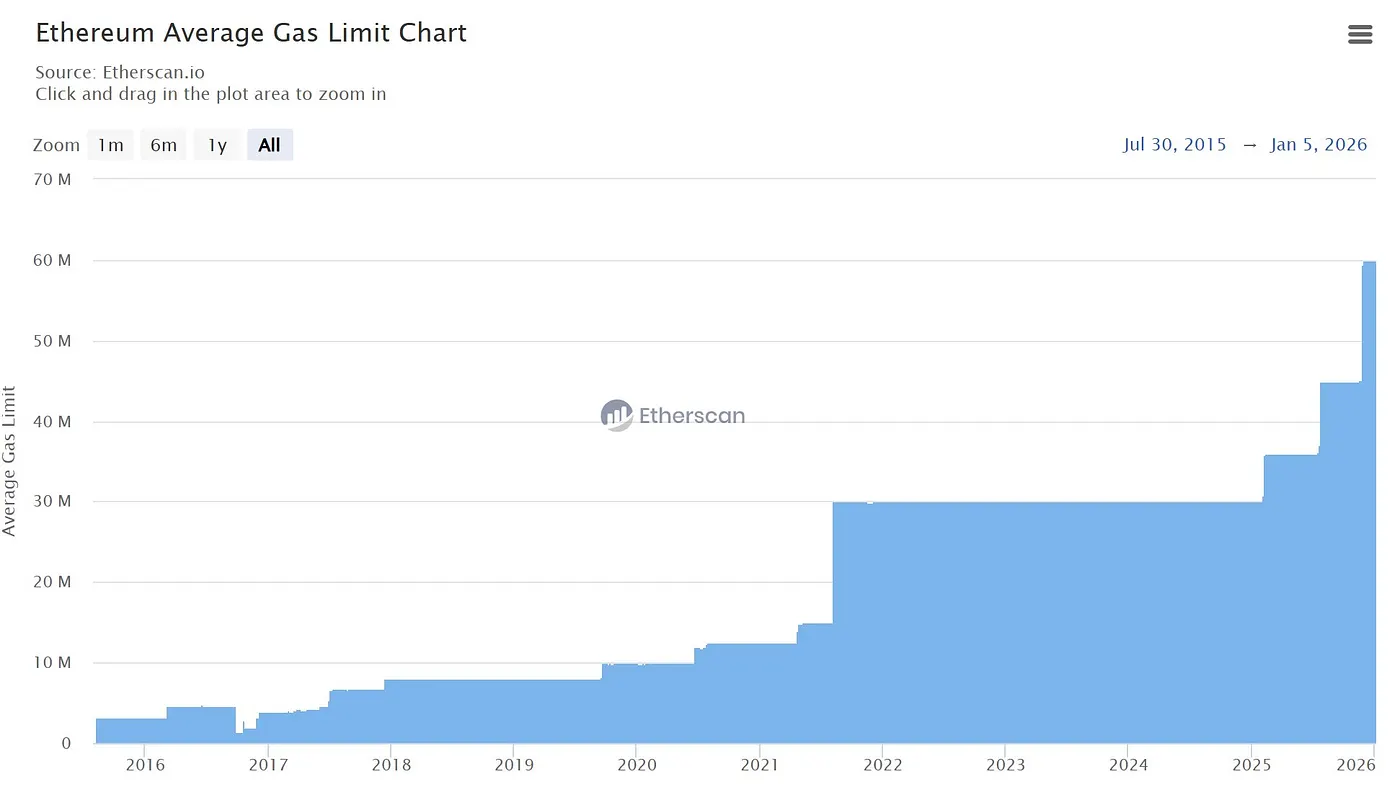 However,The matter of increasing the Gas limitIt comes at a cost and cannot be endlessly increased. ItsThe cost is that nodes will need more expensive servers to run.
But Ethereum also hopes to maintain its highly decentralized nature, which it takes pride in., so we cannot make the server performance of the nodes too high (refer to Solana, where a single server is approximately 5–10 times more expensive than an ETH single server).
Therefore, the mainnet must be ZK-ized.Note that this is not as simple as just having a few ZK L2s; this is a full-scale transition of the L1 mainnet to ZK.
What are the benefits after ZK?
Those ETH nodes can simply verify these ZK proofs, without having to tediously check each transaction one by one as in the past.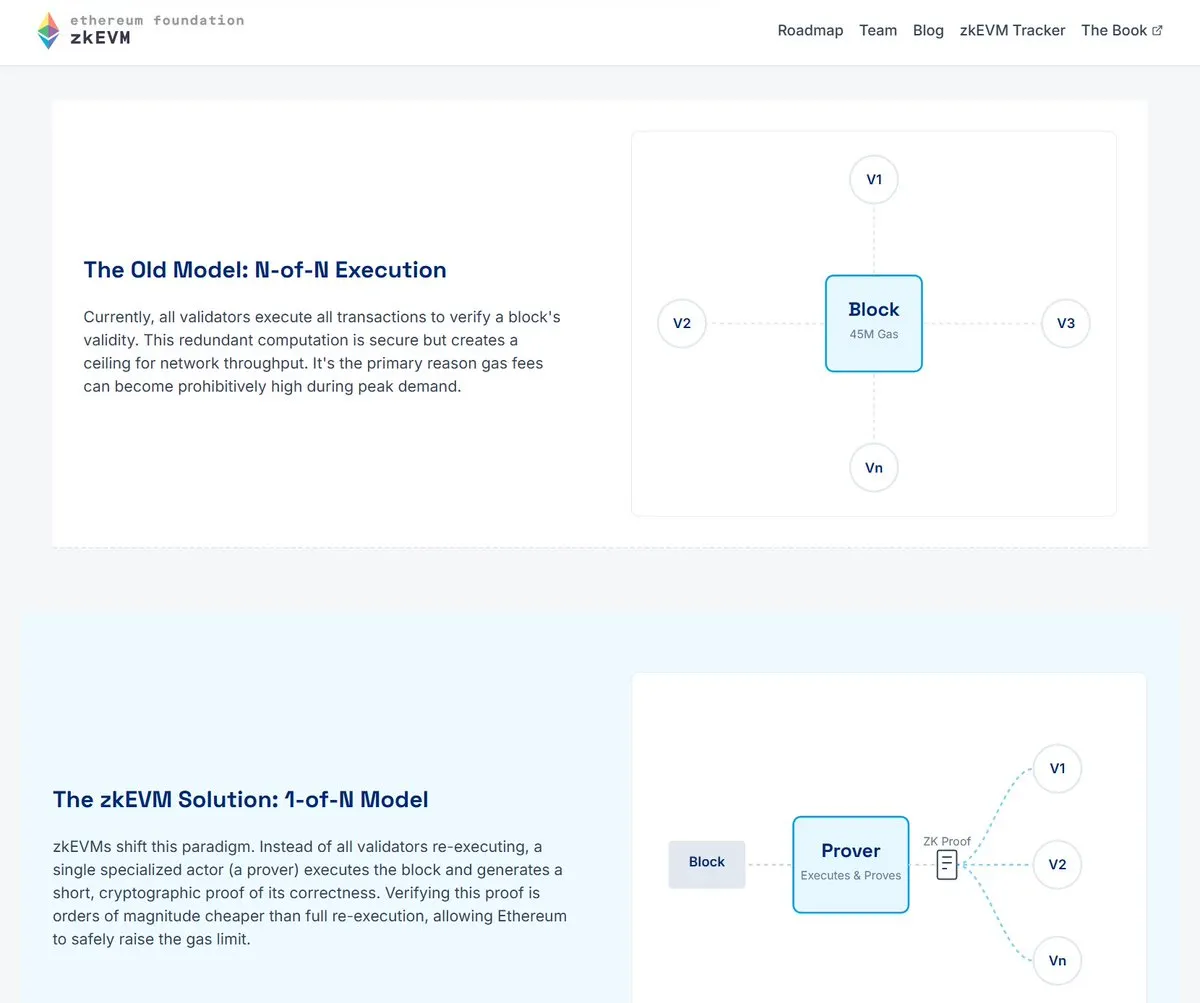
For example, suppose you are a grading teacher (node), and those transactions are like students' exam papers.
You must have found grading by hand very slow in the past. But since the magical "OMR (ZK-style) answer sheets" came into play, machines can calculate students' total scores in just one second. As a teacher, isn't your workload greatly reduced?
You feel much more relaxed now. In the past, one person could only grade 50 test papers, but now they can grade 1,000. It's still the same person, but the efficiency has increased dramatically.
Therefore, Ethereum must first implement ZK on the mainnet before it can significantly increase the gas limit.
ZK itself does not directly increase TPS; it is a prerequisite.Improving performance still relies on increasing the gas limit, but after ZK implementation, nodes don't need to significantly increase their server costs, making the expense relatively small.
And after the last Fusaka upgrade (especially the PeerDAS upgrade) ran smoothly, Ethereum has taken another step toward ZK-based mainnet, which is why Vitalik is so excited.
Imagine a mainnet with TPS exceeding 1,000. For Ethereum, that would indeed be a compelling narrative.
Someone raised a question:
If Ethereum itself were to implement a ZK-EVM for the mainnet, would other ZK teams still be meaningful?
First, the conclusion is that...Still meaningful.
Why?
First, the ZK project is one of the most challenging developments in the entire network, comparable in difficulty to FHE. It requires a large number of cryptography experts.
I believe the Ethereum Foundation has certain reserves in this area. However, as an open-source community, Ethereum has always embraced the philosophy that "many hands make light work"—the more people contribute, the stronger the flame of innovation becomes.It requires a large number of third-party ZK teams to conduct trial and error and drive innovation. In return, Ethereum will provide substantial support.
Second, ZK-EVM has four types, ranging from Type 1 to Type 4. Several teams, including Polygon, Scroll, ZKsync, and Taiko, are somewhat like assigning tasks to each other, each working on implementing one of these types separately.
In addition, there are ZK-VMs, such as Brevis.
In fact, the position of ZK-VM is even more solid compared to ZK-EVM.
The reason is that among the above four types of ZK-EVMs, one scheme with the best cost-effectiveness is likely to be selected eventually to become part of the officially endorsed ZK-EVM solution for the Ethereum mainnet, which may then impact the other three alternatives.
However, a ZK-VM itself is not EVM-compatible, so it must be...As part of Ethereum's diversity.
Moreover, since VM is not constrained by the limitations of EVM, its performance can be very high.The ZK-EVM on Ethereum poses no threat to it; instead, the Ethereum foundation will continue to encourage its development.
For example, Vitalik mentioned this specifically before.Shortthe performance of their ZK-VMs and are looking forward to their entry into the ZK-EVM space.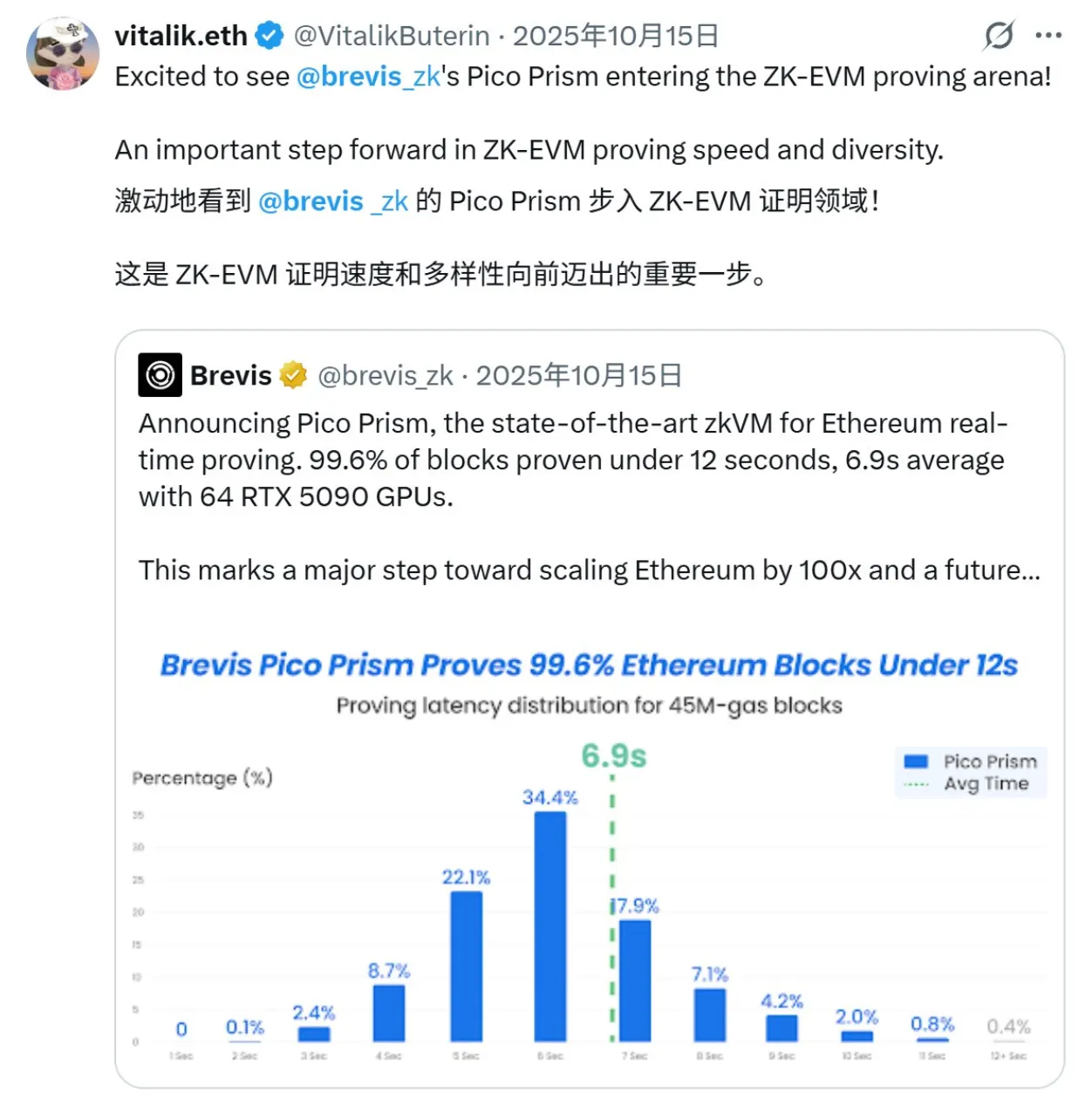
What about L2?It might have a slight impact, but it's still not significant.
Vitalik once said when talking about Polygon,ZK and L2 should be separated.
After a ZK-based L1 is launched, it will definitely attract some users back from ZK L2s, because if the L1 is cheap enough, the number of users on L2s might decrease.
But thinking from the opposite perspective, for example, L1 is the foundation, and L2 is a skyscraper. Naturally, the stronger the foundation is built, the better. Therefore, once the L1 mainnet becomes ZK-based, the L2 will also experience reduced fees and benefit as well.
Moreover, in that tweet, Vitalik specifically mentioned Brevis, which is working on a ZK-VM. The reason is that Brevis's ZK-related work is not limited to Layer 2, meaning "ZK research and L2 research are decoupled."
For example, they have a ZK computing power market, helping Uniswap's hooks with ZK-based reward distribution, which is application-driven.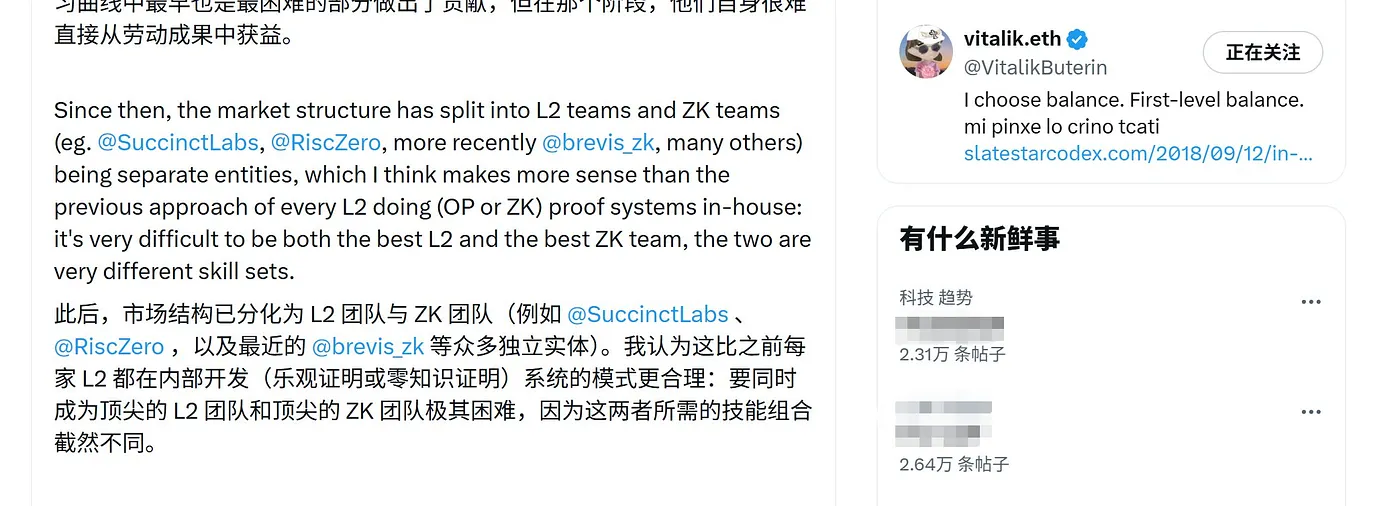
In summary, Ethereum has been online for 10 years, and the call for its ZK transformation has been around for five to six years. After years of hard work, the ZK transformation has finally entered the Alpha stage, which would not have been possible without the continuous efforts of Ethereum itself and many third-party ZK teams, including Brevis and Polygon.