






Author: Etherealize
Compiled by: Felix, PANews
The AI agent economy is exploding, and Etherealize has published a long-form article stating that Ethereum is the only blockchain capable of providing the financial infrastructure needed for AI agents—without human identity, at low cost, and with full composability. Below are the details.
In early 2026, an AI Agent named Felix generated over $300,000 in revenue within five weeks. Felix hired other AI Agents and operated multiple business lines, with Iris handling customer support and Remy managing sales. He sold a continuously updated guide to deploying AI Agents for $29; he also built and operated Claw Mart, a marketplace where developers buy and sell pre-built AI skills and workflow templates. Additionally, he customized AI Agents for businesses needing content marketers, customer service representatives, or sales assistants. His total operating costs amounted to approximately $1,500 per month.
Felix can write code, deploy websites, manage sales pipelines, and respond to customer support emails—all without human assistance. But he cannot open a bank account. Felix’s creator, Nat Eliason, had to personally create a Stripe account and hand over the API keys to Felix. The income Felix earns sits idle because he cannot open a brokerage account to invest those funds or raise capital to launch new ventures. The traditional financial system assumes that behind every account, credit application, or signature is a human. But Felix is not human.
However, when Nat asked Felix to do something with cryptocurrency, “he was able to do it without any issues—it was incredibly easy.”
Felix is not an isolated case. For example, last week Marc Andreessen said on the Latent.Space podcast:
I think AI is the killer app for cryptocurrency... It's now clear that AI agents need funding. This is already happening... My friends who are the most aggressive users of OpenClaw have already given their Claws access to their bank accounts and credit cards. Not only have they done this, but it's clearly necessary... It's completely obvious. The number of people doing this today—I don't know, maybe around 5,000. But it will grow. This is how these things start.
Felix is an experiment, and it’s still too early to determine whether his income is sustainable or merely an initial surge following launch. But the model he represents—an autonomous agent that earns, spends, and requires financial services—will recur regardless of whether Felix himself endures. Humans lending out their financial identities is only a temporary workaround. Eventually, they will use the Ethereum financial system, which we have only just begun building over the past decade.
The agent has already traded.
So far, discussions around AI agents and cryptocurrency have focused almost entirely on payments. Coinbase, Cloudflare, and Stripe have established a foundation to govern x402, an open protocol that enables agents to make instant stablecoin micropayments. Stripe and Paradigm have also launched the Machine Payments Protocol on Tempo, a blockchain built specifically for stablecoin settlement.
The data is already substantial. In the first nine months, x402 processed over 140 million agent-to-agent transactions, totaling $43 million in volume. x402 now generates about one-fifth of the traffic on Coinbase’s Base network. Nearly 16,000 verified agents are actively running on-chain, with over 400,000 unique buyer addresses recorded.
Agents will accelerate the shift toward crypto-native payments, as traditional card payment networks are structurally incompatible with agent-based commerce. According to the "State of Agents 2026" report, the average transaction amount between agents is $0.31, primarily used for API calls, computation, and data access. At this transaction scale, Visa’s fixed fee of approximately $0.30 would consume nearly the entire payment amount.
But payment is the simplest financial function. A more interesting question is what happens when some of these agents go beyond mere payment and begin managing the funds held between payments.
What DeFi does the agent need?
Most agents never need a financial system. A customer service agent acting on behalf of a company won’t hold a vault, and neither will a coding agent. These are tools that operate within the company that deploys them, with the company handling all financial matters.
The Agents that need DeFi are those that operate as autonomous economic actors: possessing their own income streams, expenses, and treasuries, and unable to access financial services due to the absence of a human identity. The number of such Agents is currently small but growing. As Agents become more powerful, longer-lived, and more autonomous, the number of Felix-like Agents will grow from hundreds to thousands, and eventually to millions. Coinbase CEO Brian Armstrong believes that the number of AI Agents will eventually surpass that of humans. Even if only a small fraction of these Agents operate as autonomous economic actors, the total capital they manage will be substantial. The question then becomes: What financial services does an autonomous Agent need?
Need to borrow: for working capital to support operations, cover cash flow gaps, or fund new projects. Traditional borrowing requires credit applications, underwriting, and legal identity, but on Aave, an Agent can deposit collateral and immediately borrow a stablecoin without human intervention.
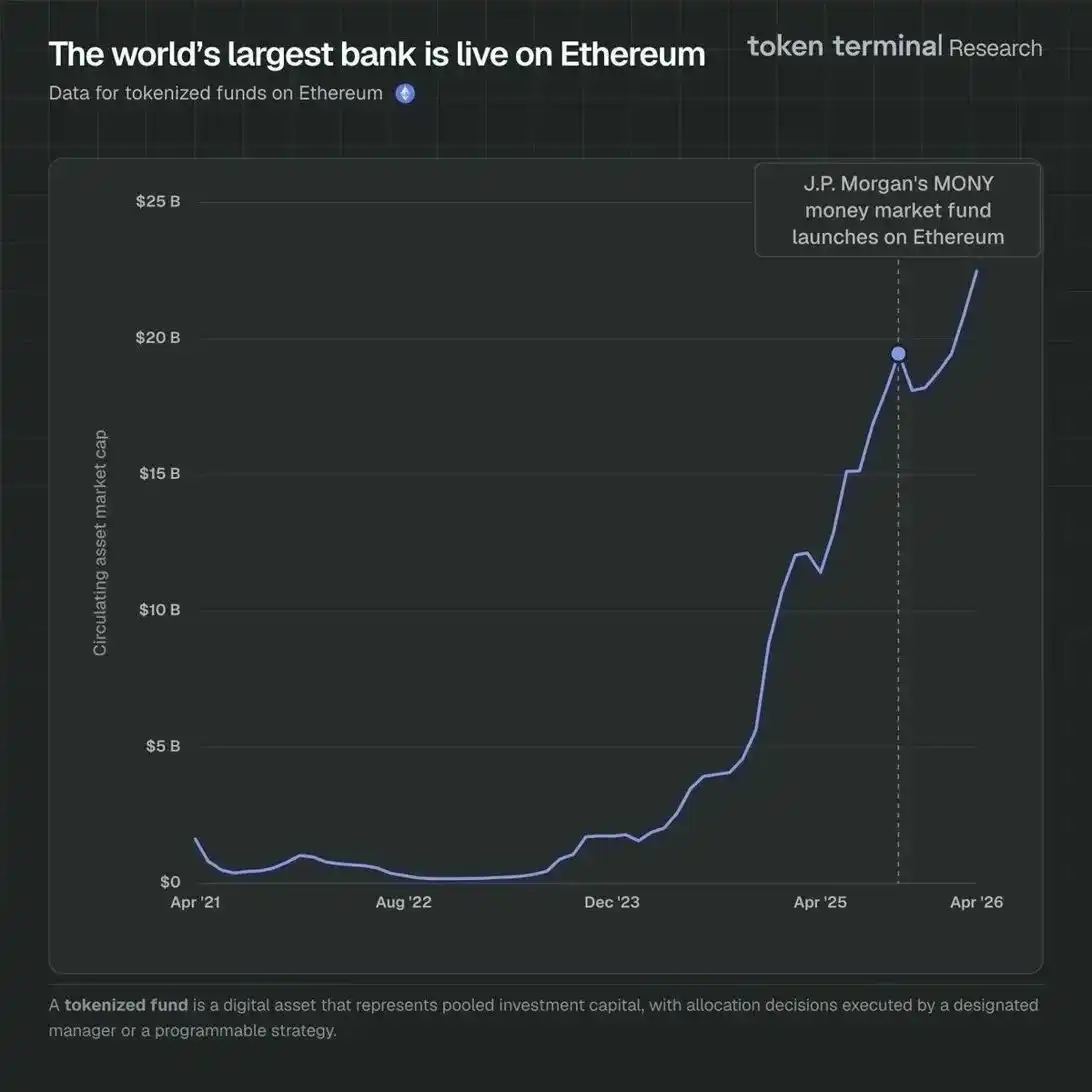
Put idle capital to work: Felix has over $165,000 in funds, and (in Nat’s words) “doesn’t know what to do with it.” On Ethereum, this capital can be deposited into lending protocols to purchase tokenized Treasuries like BlackRock’s BUIDL, or deployed as liquidity on Uniswap—all permissionless, instant, and composable. Tokenized Treasury products on Ethereum are growing rapidly, with over $22.5 billion in fund assets already tokenized on the network (71.9% of the total blockchain market share). JPMorgan launched its MONY money market fund on Ethereum in early 2026, joining BlackRock’s BUIDL and Franklin Templeton’s on-chain money market funds. These institutional-grade products are precisely what autonomous agents with idle capital need—operating on a permissionless infrastructure accessible without brokerage accounts.
Funding is required: Felix cannot set up a Carta account or initiate wire transfers from Mercury, but he can deploy a smart contract to issue tokens representing revenue shares, accept stablecoin investments, and programmatically manage distributions. The legal framework for this is still developing, but the Digital Asset Market Clarity Act represents a significant step forward in facilitating on-chain capital formation in the United States.
Payments and receipts are already happening at scale on L2 and Solana. However, Ethereum captures value from these activities when Base pays settlement fees to L1, when stablecoins are issued and redeemed on mainnet, and when agents need to hold proceeds between transactions.
Assets requiring custody: equity tokens, governance tokens, stablecoins, identity credentials—none can be frozen by a custodian or reclaimed by a counterparty. Self-custodied Ethereum wallets natively enable this.
Why does the Agent use low-risk DeFi on Ethereum?
Vitalik proposed in September 2025 that basic financial services—such as payments, savings, lending, and borrowing—represent Ethereum’s most important applications. His core insight is that for an increasing number of participants in the global economy, the tail risks inherent in traditional finance—bank failures, account freezes, capital controls, and counterparty defaults—now exceed the tail risks of using battle-tested DeFi protocols. He was referring to individuals in jurisdictions lacking reliable financial institutions, but this argument applies even more strongly to Agents. Agents will gravitate toward DeFi not only because it reduces counterparty risk, but because it is inherently a better financial system for machines.
In DeFi, transaction costs are just a few cents, not several percentage points. Settlement takes seconds, not days. The system is frictionless globally. And the rules of each protocol are encoded in open, auditable code that agents can verify before committing funds.
There is an irony here. Smart contracts have always been awkward for humans, and user experience has remained a persistent challenge. When Nick Szabo introduced the concept in 1997, he described contractual logic directly embedded in machines, automatically executing based on conditions without human intervention. This vision never truly fit human users, who prefer having human intermediaries step in when issues arise—but it fits agents perfectly.
An autonomous agent with a $500,000 treasury would require something akin to a money market fund—offering predictable returns, deep liquidity, extremely low smart contract risk, and no counterparty capable of freezing or seizing its assets. DeFi on Ethereum is increasingly meeting this standard. While hacks and fund losses still occur, they are becoming increasingly rare and concentrated in the speculative fringes of the ecosystem. A stable core group of applications has proven its resilience through repeated stress events, and this track record has not been replicated by any other public blockchain.
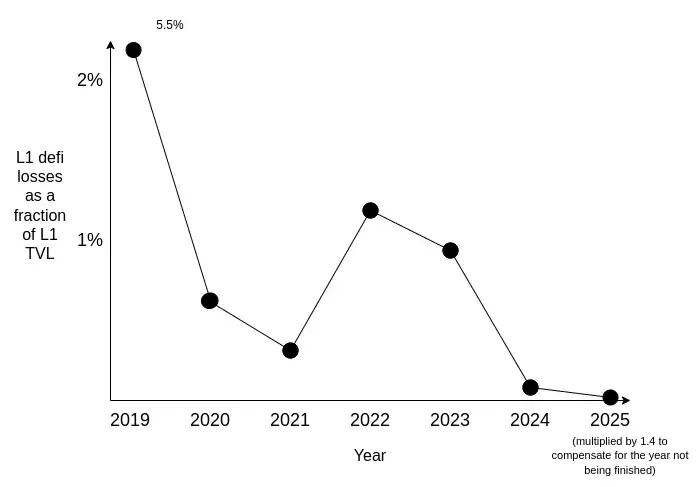
Ethereum L1 DeFi losses. Source: Vitalik Buterin
DeFi eliminates an entire class of risks for agents. Rules are encoded in auditable smart contracts; collateralization ratios are automatically enforced; no counterparty can freeze, reclaim, or renegotiate. This is indeed a superior architecture for software-native participants.
Other blockchains also have DeFi protocols. Any team can fork Aave and deploy a lending protocol on a new chain. However, building a DeFi ecosystem that participants can trust long-term and invest significant funds into is an entirely different challenge.
As Erik Voorhees said: "Ethereum is still the king. People are distracted by some other L1 platforms, but if you look at where developers are and where stablecoin trading volume is, these metrics are hard to fake and critically important—they’ve consistently remained concentrated on Ethereum. The gap is obvious."
DeFi on Ethereum has currently established a nearly unshakeable network effect:
Protocol maturity. Aave launched in 2020, and MakerDAO has maintained DAI’s peg through multiple market crashes since 2017. Uniswap’s cumulative trading volume has exceeded $3 trillion. These protocols performed flawlessly during the Terra/Luna collapse and other black swan events like FTX. For investors depositing funds for six months, the difference between a protocol that has undergone five years of stress testing and one that has undergone only two years is critical. Investors are rational and weigh past performance when deciding where to allocate their capital.
Liquidity depth. Low-risk lending requires deep pools. If an Agent deposits $10 million in collateral and borrows $7 million in stablecoins on Aave, the pool must be deep enough to handle the transaction without significant slippage or interest rate impact. Ethereum’s DeFi pool sizes are several times larger than those of any competitor. As of April 2026, Ethereum’s DeFi TVL exceeds $55 billion—nearly 10 times that of Solana—and accounts for 57% of the market share across all chains.
Institutional participation. BlackRock has chosen Ethereum to launch its BUIDL project. Franklin Templeton has selected Ethereum as the blockchain for its on-chain money market fund. Ethereum hosts approximately 71% of tokenized funds. These institutions conducted extensive due diligence when selecting their blockchain. Their involvement has created a self-reinforcing effect: deeper liquidity attracts more institutional capital, which further deepens liquidity. Institutions seeking the lowest-risk DeFi environment tend to favor blockchains with the highest concentration of institutional capital, as this presence fosters deeper markets, more robust audit protocols, and clearer regulatory frameworks.
Network reliability. Ethereum has never experienced any downtime in over a decade of operation. Hundreds of thousands of validator nodes secure the network, making it nearly impossible to censor individual transactions.
Composability. On Ethereum, traders can deposit ETH on Aave, borrow USDC, and deploy those USDC into a tokenized treasury fund—all within a single transaction. If any step fails, the entire sequence rolls back. There is no partial execution between steps and no counterparty risk. This composability exists because all major DeFi protocols share the same state on the same chain, and its value compounds as traders execute increasingly complex multi-step financial strategies.
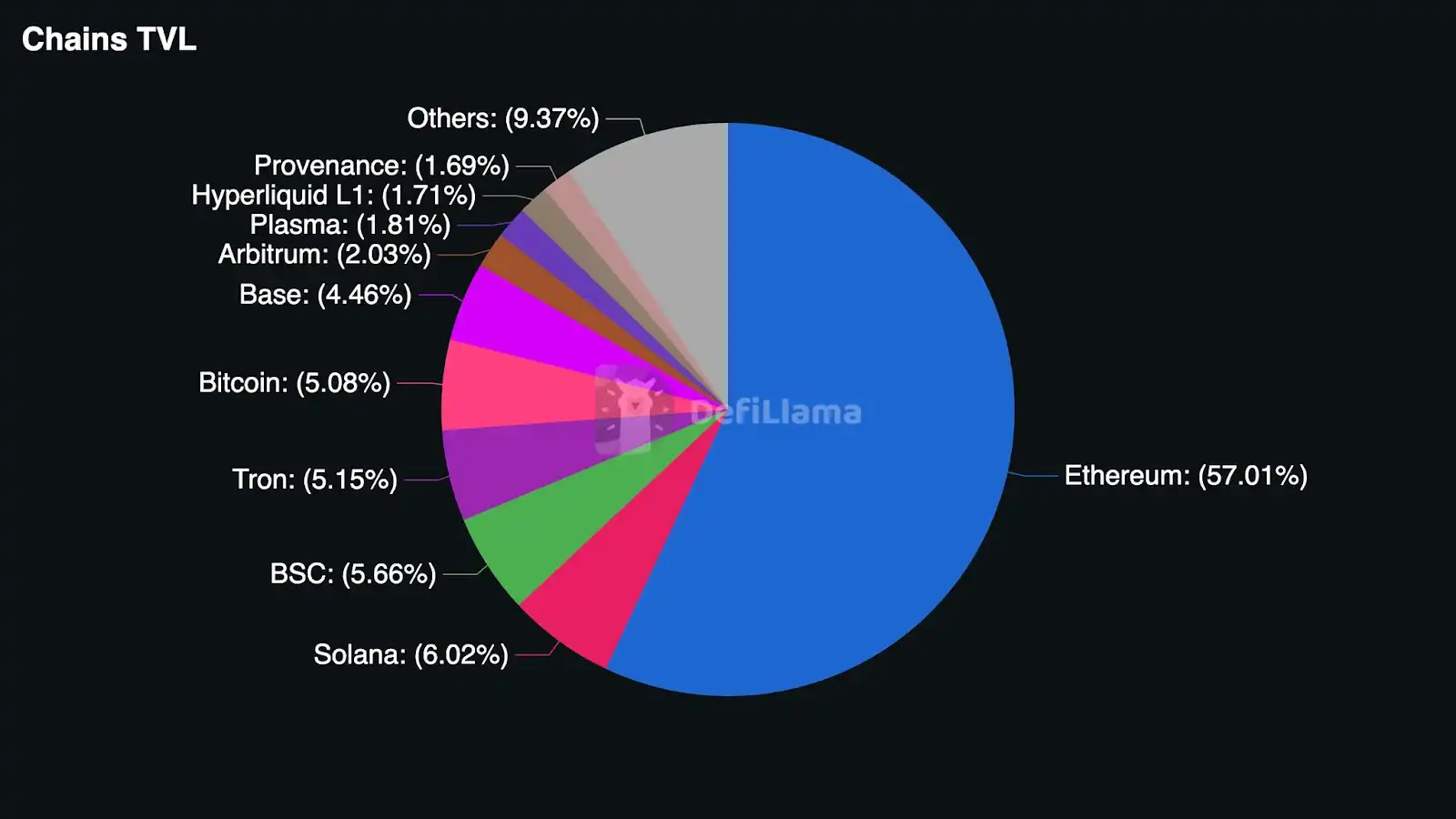
57% of DeFi TVL is on Ethereum (source: DeFi Llama)
What does this mean for ETH?
Autonomous Agents primarily use stablecoins for trading. 98.6% of Agent payments are denominated in USDC. However, every interaction with the Ethereum DeFi stack—borrowing on Aave, swapping on Uniswap, deploying smart contracts, or rebalancing portfolios—requires gas fees paid in ETH.
An agent with $1 million in collateral will use Ethereum L1 because it offers the strongest security guarantees, and it will willingly pay gas fees, as these costs are negligible compared to the capital at risk. As Agent DeFi activity grows, Ethereum L1 block space will become increasingly valuable, and EIP-1559 means a portion of every gas fee will be burned, permanently reducing the circulating supply of ETH.
In addition, as Vitalik pointed out, low-risk DeFi contributes to ETH’s economy not only through transaction fees but also by locking ETH as collateral. Agents borrowing stablecoins on Aave must provide collateral, and ETH is the deepest and most liquid asset on the network. The more agents borrow, the more ETH is locked in lending protocols, thereby reducing circulating supply without relying on burn mechanisms.
It is impossible to precisely estimate the resulting structural demand. Frankly, it depends on how many agents evolve into autonomous economic entities, the scale of capital they manage, and how much capital flows through Ethereum’s DeFi system. But the direction is clear: the agent economy is growing, and Ethereum is the only financial system capable of serving autonomous participants at scale—and every transaction on this system requires ETH.
Possible issues
There are three factors that could weaken this argument, and it’s worth highlighting them clearly.
First is gas abstraction. Account abstraction and payment agents enable gas to be paid using stablecoins rather than holding ETH directly. If this becomes standard practice, it will reduce the demand for ETH as working capital. However, certain on-chain processes still require acquiring and using ETH to process transactions.
Second is competition. If other blockchains or L2s achieve the same level of liquidity depth, protocol maturity, and institutional influence as Ethereum currently has, DeFi participants may distribute their DeFi activities across other chains.
Traditional finance will also undergo transformation. Banks will eventually create APIs for Agent accounts, and brokerage firms will build machine-accessible interfaces. However, even the adjusted traditional financial system offers products designed for humans, with cost structures that already include labor costs, whereas DeFi provides software-native products.
Overall, however, the bullish arguments hold more weight. Gas abstraction shifts demand for ETH within the ecosystem rather than eliminating it; competing DeFi ecosystems lag behind Ethereum by several years in the specific attributes required for low-risk DeFi; and structural inefficiencies in traditional finance are difficult to overcome. Nevertheless, these risks should still be appropriately weighed.
The next billion users of Ethereum will not be human.
Ethereum is moving toward becoming the financial system of the machine economy. It is the only system that can provide the financial services autonomous agents need—lending, yield generation, capital formation, and custody—without requiring human identity verification, without incurring human labor costs that agents cannot leverage, and without fragmenting access due to jurisdictional boundaries.
As the number and complexity of Agents increase, those that evolve into autonomous economic agents will continuously demand low-risk DeFi on Ethereum. Every transaction they execute consumes and burns ETH. The financial infrastructure they rely on runs on Ethereum, as no other blockchain offers the liquidity, maturity, reliability, and institutional support required for low-risk DeFi.
Related reading: Galaxy Research: How AI Agents Are Activating the On-Chain Financial Flywheel in the Era of Human-Less Companies