





Author: Gu Yu, ChainCatcher
In the recent crypto winter, one Web3 startup after another has withered like falling leaves. The euphoria of the bull market has vanished, replaced by cash flow crises, rampant hacks, and strategic confusion. Many companies that once shone brightly with top-tier teams and backing from leading VCs are now struggling to survive in the cold: some have rushed to pivot, others have sold at steep discounts, some have quietly shut down, and others have suffered devastating thefts.
Layoffs and a wave of departures followed, with several senior figures leaving their companies, including Tom Howard, Strategic Lead at CoinList, Abdul Rehman, DeFi Lead at Monad, Benjamin Speckien, Security Lead at Celo, and Aleksander Leonard Larsen, COO of Axie Infinity.
This is not merely a financial crisis, but a harsh reflection of industry consolidation. At its core, these phenomena stem from profound clashes within the Web3 ecosystem between technology and capital, product and market, vision and reality—each story revealing the confusion and defiance of market participants.
Layoffs
Layoffs are a common strategy for crypto projects during bear markets; by reducing staff in non-essential roles such as marketing and technology, projects can significantly cut labor costs and improve operational efficiency, thereby extending their survival timeline and preparing for the next bull market.
In early February, the prominent cryptocurrency exchange Berachain announced a 25% workforce reduction (up to 200 employees) and the closure of its exchange operations in the UK, EU, and Australia. Half a month later, senior executives including Chief Operating Officer Marshall Beard, Chief Financial Officer Dan Chen, and Chief Legal Officer Tyler Meade departed, with their responsibilities assumed by other members of the management team.
Just three months after its IPO, its stock price has dropped more than 60%, forcing it to adopt aggressive business contraction measures due to poor market conditions and declining revenue.
In early January, the Berachain Foundation also announced that it had laid off most of its retail marketing team, and chief developer Alberto will be leaving. The project acknowledged that retail-focused strategies have become significantly less effective across the cryptocurrency industry during 2024/2025.
In August 2025, modular rollups infrastructure developer Eclipse Labs announced a team restructuring, cutting 65% of its workforce. That same month, Lido announced a 15% reduction in staff due to cost pressures, while Sandbox’s founder stepped down and cut 50% of the team, shifting focus away from metaverse initiatives toward Web3 applications and a Launchpad program. In July 2025, Eigen Labs announced approximately 25% layoffs, refocusing its business on EigenCloud.
Layoffs appear to be a cost-control measure, but they more fundamentally reflect a company’s reassessment of its future revenue expectations. When management chooses to reduce team size, it is essentially determining that, under current market conditions, the returns from marginal expansion no longer justify the additional costs.
This also means that Web3 startups are shifting from a “growth-first” to a “survival-first” mindset. Efficiency issues that were masked during the bull market are now being amplified exponentially in the bear market. Organizational bloat, the effectiveness of marketing spend, and whether product iterations truly align with user needs will all come to light under cash flow pressure.
Transition
If layoffs represent a passive contraction, then transformation is an active adjustment. Even projects with sufficient financial backing must carefully evaluate whether their established strategic direction aligns with current market trends and user needs.
Many projects built their growth logic during the last cycle on the premise of abundant liquidity and high risk appetite. When these premises disappeared, the narratives became difficult to sustain. As a result, we are seeing many projects shift their focus toward expanding into areas such as payments, AI, and RWA, beyond basic on-chain infrastructure.
Polygon is a typical example. As an established Layer 2 project, Polygon has maintained a leading position in both technology and market terms, but due to growing market indifference toward the Layer 2 space and difficulty competing with non-EVM blockchains like Solana and Aptos, it decided in January to pivot toward the stablecoin sector, beginning with acquisitions to gain payment-related capabilities and resources.
In early January, Polygon Labs announced the acquisition of Coinme and Sequence to enhance its core infrastructure for regulated stablecoin payments and fund flows. Coinme provides regulated U.S. fiat on- and off-ramps, connecting cash and debit cards with digital assets within the existing regulatory framework, while Sequence abstracts operations such as bridging, trading, and gas fees from end users.
Polygon states that these acquisitions together form the foundation of an open funds stack, designed to enable regulated stablecoin payments and fund movements running on Polygon’s blockchain. Polygon Labs will become a profitable blockchain payments company.
Last month, the Solana ecosystem NFT marketplace Magic Eden announced it would gradually phase out support for EVM and Bitcoin Runes and Ordinals markets, redirecting its primary resources toward its newly launched prediction market project, Dicey.
The collective transformation of Bitcoin mining companies has also become a flagship case. In November 2025, Bitfarms announced it would shut down its Bitcoin mining operations over the next two years and repurpose its facilities into AI and high-performance data centers. Recently, Bitfarms also announced its rebranding to Keel Infrastructure, completely severing its corporate identity from "Bitcoin."
Cipher Mining announced in February that it would rebrand as Cipher Digital and sold its mining farm stakes to Canaan for approximately $40 million to focus on becoming a leading developer and operator of next-generation computing data centers.
Sell oneself
Even projects backed by substantial funding have been forced to consider selling out due to slow product progress and lack of confidence, with Farcaster, a decentralized social protocol, serving as a prime example.
In mid-January, the decentralized social protocol Farcaster announced its acquisition by Neynar, with ownership of the protocol contracts, codebase, applications, and Clanker transferring to Neynar, which will be responsible for future operations and maintenance. Simultaneously, the project team fully refunded $180 million in funding to investors.
Just a month ago, Farcaster co-founder Dan Romero announced a major strategic shift, abandoning the platform’s path of pursuing product-market fit through a “social-first” approach over the past four years, and instead pivoting to a wallet-centric growth model. But this acquisition indicates that Farcaster’s exploration in the wallet space also fell short of the team’s expectations.
Another decentralized social protocol, Lens Protocol, is in a similar situation. Due to ongoing declines in user activity, the original Lens team has announced that the protocol has been taken over by Mask Network, with the original team transitioning into technical advisors to focus on innovation in their core area of DeFi.
The cross-game avatar NFT platform Ready Player Me, previously favored by the industry for its $560 million funding round led by a16z, has seen a sharp decline in users as the NFT sector has cooled, with only five tweets posted on its X account over the past year. At the end of last year, Ready Player Me was acquired by streaming giant Netflix, allowing the team to exit successfully.
Stolen
Theft has become a fate for many high-TVL protocols, with hackers viewing them as prime targets; large-scale fund thefts occur almost weekly, causing severe losses to the protocols themselves or depositing users, and further eroding market and user trust.
In mid-February, the cross-chain bridge under the well-known DePin infrastructure IoTeX was hacked, resulting in the exposure of validator owners' private keys and unauthorized control of the bridge contract, causing losses of $4.4 million. Following the incident, IoTeX announced full compensation for all affected users, having minimal impact on project operations. However, for smaller and mid-sized projects, a hacker attack can be catastrophic.
In early February this year, following the theft of approximately $40 million from its treasury due to compromised executive devices, the Solana-based DeFi protocol Step Finance explored various possibilities including fundraising and acquisitions, but was unable to find a viable solution, leading to the difficult decision to immediately shut down all operations.
In early January, the blockchain computation scaling protocol TrueBit was attacked via an integer overflow vulnerability in its smart contract. The attacker exploited carefully crafted input parameters to trigger an overflow error in the token purchase price calculation function, enabling the massive minting of TRU protocol tokens at extremely low or zero cost. The attacker then immediately burned these tokens to extract substantial amounts of ETH from the pool, ultimately profiting $26.4 million, while the price of TRU plummeted to zero. After issuing a post-attack accountability announcement in January, the official TrueBit X account has not been updated since.
Shutdown
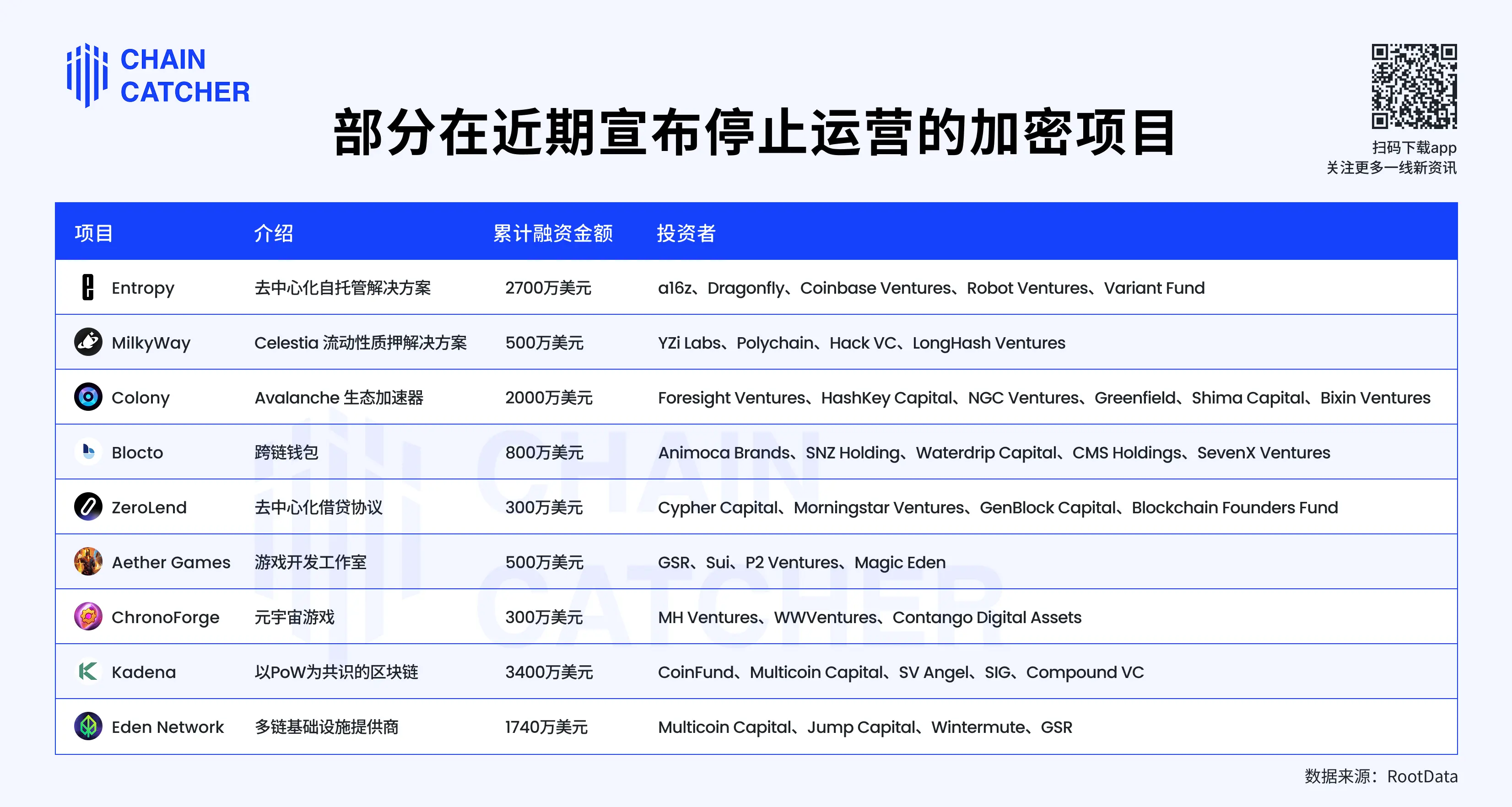
Compared to layoffs or transformations, more projects quietly collapse over prolonged struggles. They invest substantial funds and manpower into product development, marketing, and listing processes, but their resources and patience are gradually exhausted by one after another lackluster marketing campaign and underwhelming new product launches, ultimately forcing them to announce cessation of operations.
DappRadar, founded in 2018, was once the most popular app data analytics platform in the crypto industry. Despite raising over $7 million in funding, the platform decided in 2021 to issue a token to boost its cash flow due to challenges in monetizing its data platform. However, lacking practical utility, the token’s price continued to decline and failed to provide sustainable financial support.
We have made the difficult decision to shut down the DappRadar platform. Under current conditions, it is no longer financially sustainable to operate a project of this scale. After exhausting all possible options, we had to make this tough choice,” DappRadar stated in its announcement. “As we move on, we are confident that we stayed true to the right path, upheld our core principles, and contributed positive energy to the industry.”
In February this year, the multi-chain lending protocol ZeroLend officially announced the cessation of its operations after three years, stating: “Over the past period, several chains initially supported by ZeroLend have become inactive or experienced significantly reduced liquidity. In some cases, oracle providers also ceased support, making it increasingly difficult to operate markets reliably or generate sustainable revenue. Meanwhile, as the protocol grew in scale, it attracted greater attention from malicious actors, including hackers and scammers. Combined with the inherently low-profit, high-risk nature of lending protocols, this led to the protocol remaining in a long-term loss state.”
In December 2025, the cross-chain smart wallet Blocto announced it would cease operations: “Over the past few years, we have incurred over $5.5 million in losses to sustain community services. But this cannot continue indefinitely. Recognizing that our operating funds were about to run out, we began reaching out to Flow/Dapper’s leadership in June of this year, but were never granted a meeting. Each email exchange took weeks, while our remaining funds continued to deplete.”
Conclusion
In the early stages of Web3, narratives held far more power than the products themselves. A grand vision and a set of seemingly disruptive mechanisms were often enough to attract capital and users. However, as macro liquidity returns to rationality, investors and users are reassessing risk-reward ratios—only projects with clear cash flow logic, genuine user demand, reliable technical architecture, and compliance capabilities will endure through the cycle.
These real-world cases throughout the article serve as a cold mirror to the industry, revealing the structural fragilities accumulated during the rapid expansion of the Web3 ecosystem: overreliance on external liquidity, neglect of business闭环, and insufficient awareness of security and compliance.
However, this downturn is not the end, but rather a necessary stage in the industry’s maturation. Historically, nearly all technological revolutions have gone through similar phases: capital frenzy, bubble expansion, sharp correction, and rebuilt confidence—Web3 is no exception.
Therefore, rather than viewing these layoffs, transformations, hacks, and shutdowns as pessimistic signals, understand them as a necessary filtering process. As regulatory frameworks become clearer, infrastructure performance continues to improve, and the market self-cleanses, the teams and products that endure through this winter often possess stronger risk awareness and clearer business logic. Coupled with increasingly powerful AI capabilities that support and integrate with them, the new cycle of the crypto ecosystem remains more promising than ever before!
Related reading: “Institutions Embrace Crypto, But Practitioners Are Deeply Discouraged—Who Will Win?”