





Article by imToken
If one day Ethereum’s core development team were to vanish entirely, or if a sovereign nation demanded censorship of specific transactions, could Ethereum still remain open?
These questions may sound like extreme hypotheticals, but they are increasingly becoming realistic reference points for Ethereum protocol design.
In early March, Vitalik Buterin proposed a new framing, stating that the Ethereum community should see itself as part of a "sanctuary technologies" ecosystem: these free, open-source technologies enable people to live, work, communicate, manage risk, accumulate wealth, and collaborate toward shared goals while maximizing resilience against external pressures.
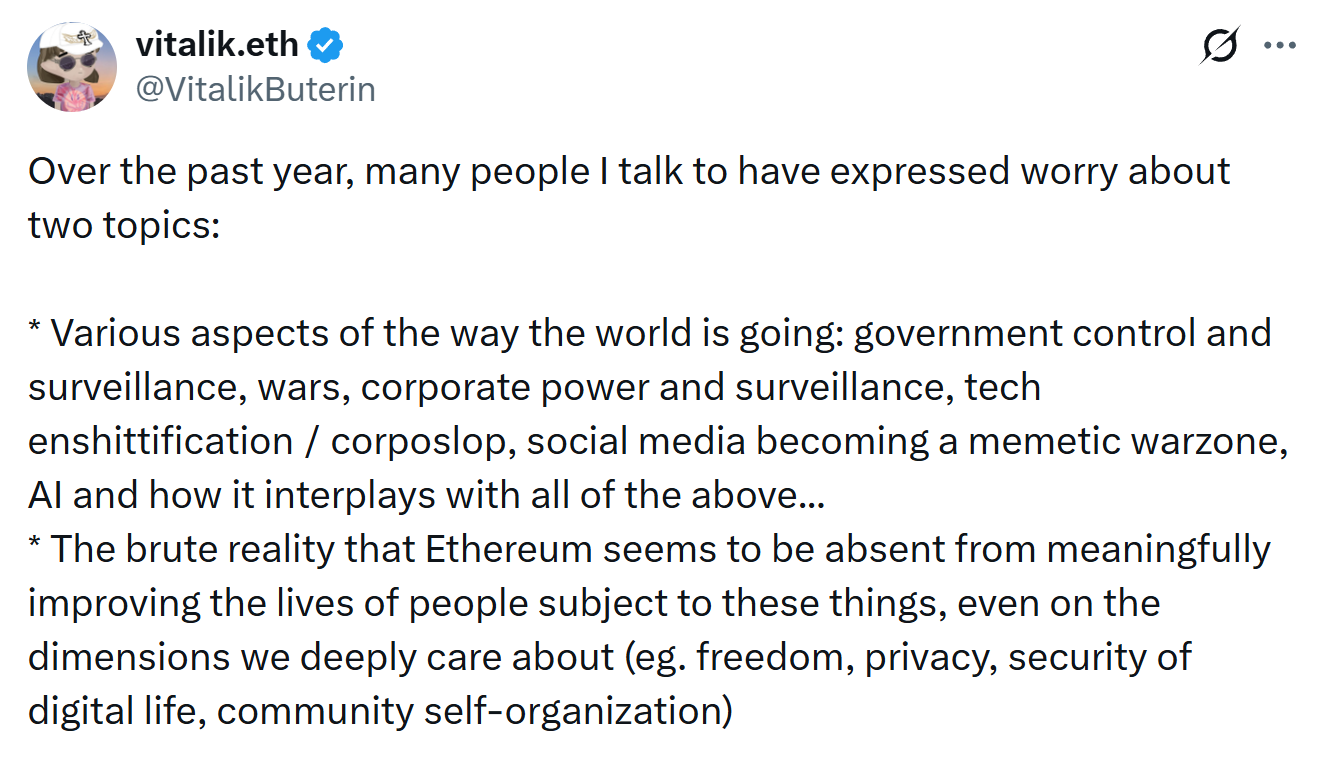
This wording may appear to be an abstract values upgrade, but when viewed in the context of Ethereum’s recent protocol evolution, it actually corresponds to very specific engineering challenges:
As block building becomes increasingly specialized, transaction ordering power grows more concentrated, and public mempools become more vulnerable to sandwiching and front-running, how can Ethereum continue to uphold its most fundamental principle as an open network—that users’ transactions should not be easily blocked by a select few?
I. Vitalik coined a new term: "Refuge Technology"
This time, Vitalik's approach carries a rare degree of candor.
He did not continue using grand phrases like “change the world,” but instead acknowledged that, to date, Ethereum’s improvement to the everyday lives of ordinary people remains limited—while on-chain financial efficiency may have increased and the application ecosystem has become more diverse, many of these achievements still remain confined within the internal cycle of the crypto world.
Therefore, he proposes a new framing: rather than viewing Ethereum as merely a financial network, it should be seen as part of a broader ecosystem of "sanctuary technologies."
According to his definition, such technologies typically share several common characteristics: they are open-source and free, accessible and replicable by anyone; they enable people to communicate, collaborate, manage risk, and handle wealth; and more importantly, they continue to function despite government pressure, corporate blockades, or other external interference.
Vitalik even offered a vivid analogy—true decentralized protocols should be more like a hammer than a subscription service. You buy the hammer, and it’s yours; it won’t suddenly stop working if the manufacturer goes out of business, nor will it ever pop up a notification saying, “This feature is no longer available in your region.”
Ultimately, if a technology is to serve as a safeguard, it cannot rely on a centralized organization for its continued existence, nor can it keep users in a permanently passive role of merely receiving services.
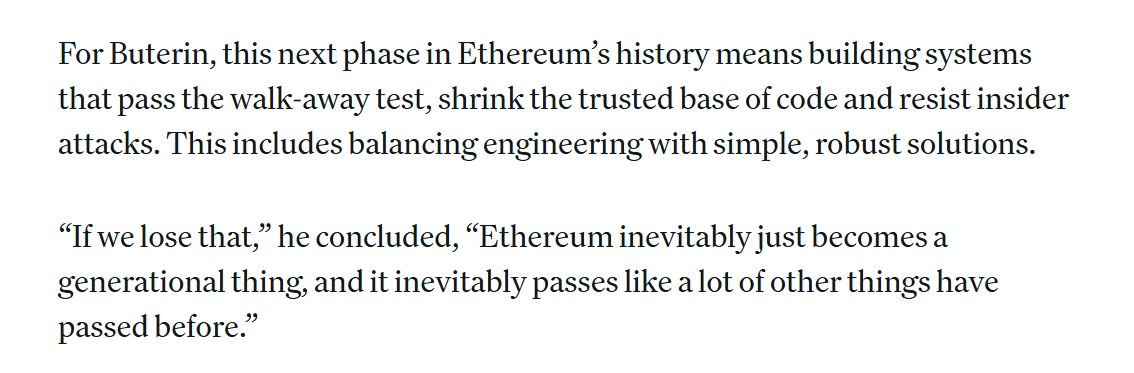
Image source: CoinDesk
This undoubtedly evokes Vitalik’s previously mentioned another benchmark for Ethereum’s long-term value: the walkaway test, which asks a very straightforward question—if all of Ethereum’s core developers disappeared tomorrow, would the protocol still function properly?
This is not a slogan, but an extremely strict decentralization standard, because what it truly asks is not whether there is a decentralized narrative today, but whether this system would still hold up in the worst-case future.
When viewed at the block production level, the answer becomes very specific: a chain seeking to pass the walkaway test must not allow the right to include transactions to remain concentrated in the hands of a few for extended periods, nor must it expose public transaction flows inherently to risks such as front-running, sandwiching, and censorship.
This is the context in which FOCIL and the encrypted mempool entered the core Ethereum discussions.
II. Anti-censorship returns to the protocol core: FOCIL + encrypted mempool
We need to carefully analyze the current issues facing Ethereum's public mempool.
Over the past few years, Ethereum has increasingly professionalized block building. To enhance efficiency and MEV extraction, the role of builders has become more critical—block production is no longer the idealized state where each validator independently builds blocks locally. While this shift brings clear practical benefits, the costs are equally apparent:
Once block construction rights become concentrated among a small number of powerful participants, censorship is no longer just a theoretical risk. In theory, any major builder could selectively refuse to include certain transactions, such as transfers originating from sanctioned Tornado Cash addresses.
In other words, the issue Ethereum faces today is no longer just about whether transaction fees are too high or throughput is sufficient, but whether the public transaction infrastructure remains trustworthy for ordinary users.
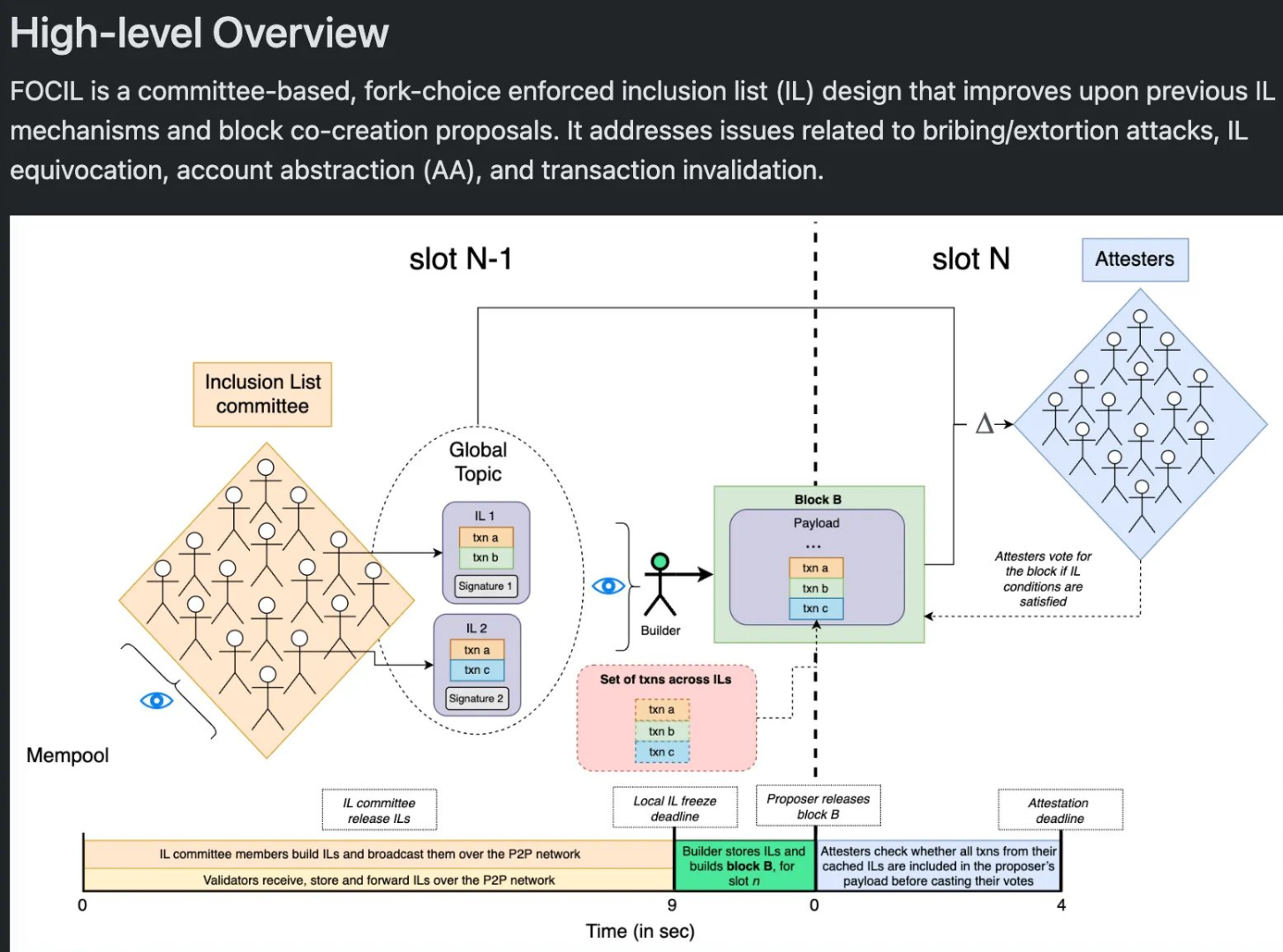
Therefore, FOCIL (Fork-Choice Enforced Inclusion Lists)—a direct response from the Ethereum protocol layer to censorship concerns—has a straightforward core idea: by introducing the Inclusion List mechanism, the timely inclusion of transactions is no longer entirely dependent on the unilateral discretion of the proposer or builder.
In each slot, an Inclusion List Committee is selected from the set of validators; committee members form lists of transactions to be included based on their respective mempools and broadcast these lists. The proposer of the next slot must construct a block that satisfies these list constraints, while attesters will only vote for blocks that meet these criteria.
In other words, FOCIL does not eliminate builders; instead, it strengthens the inclusion guarantee for valid transactions in the public mempool through a fork choice rule. This means builders can still perform transaction ordering optimizations and continue to enhance efficiency and revenue around MEV—but they no longer hold the power to decide whether a legitimate transaction qualifies for inclusion in a block.
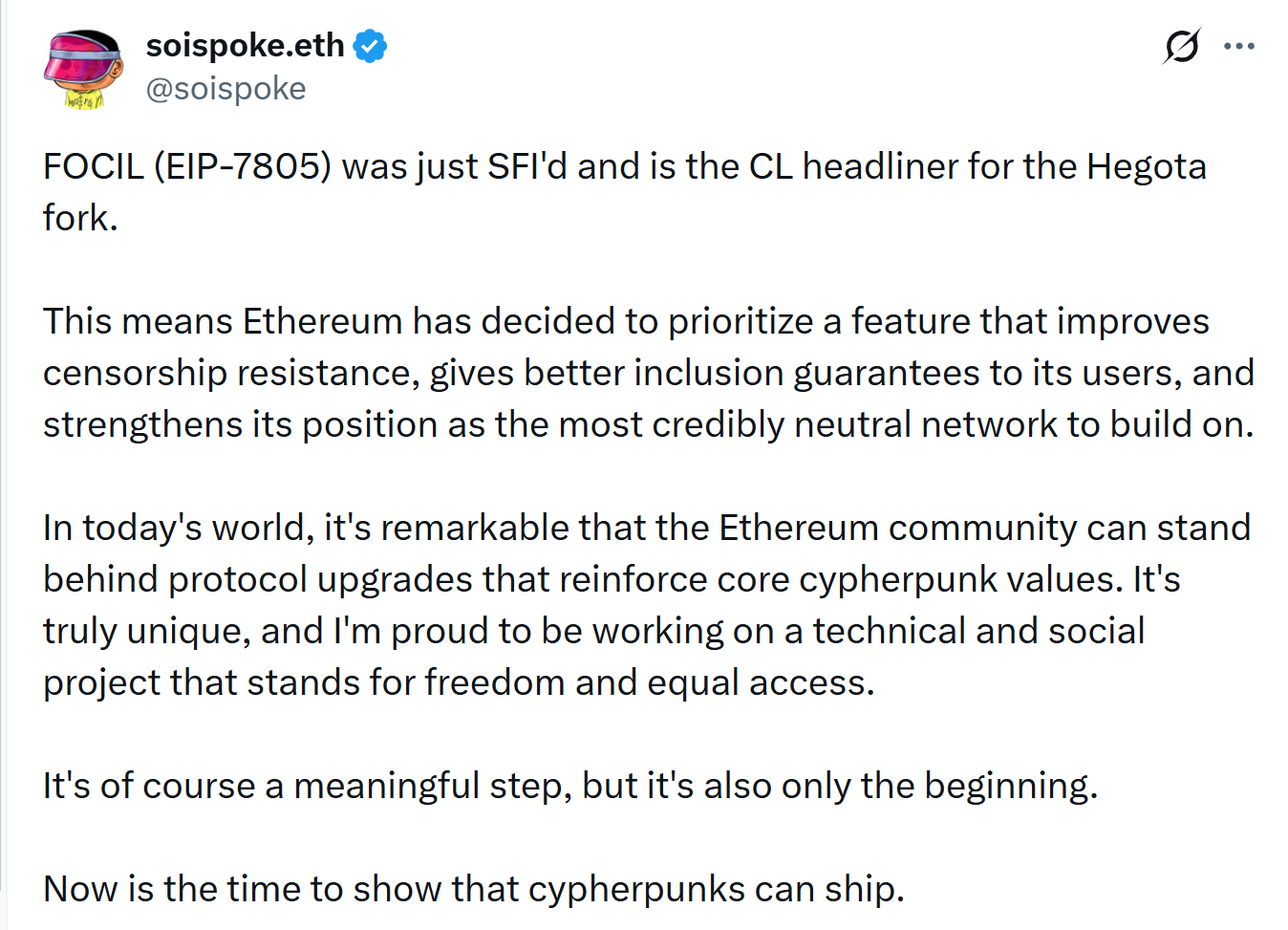
Although controversial, FOCIL has been confirmed as the core proposal for the consensus layer of the next major upgrade, Hegotá, and is expected to launch in the second half of 2026, following the Glamsterdam upgrade.
However, FOCIL does not address another equally critical issue: before a transaction is actually included in a block, has it already been exposed to the entire market? MEV searchers can then exploit this by front-running, sandwiching, or reordering—especially targeting DeFi transactions. For ordinary users, this means that even without censorship, they may still be selectively exploited before their transaction is even included in a block.
This is the root of the sandwich attack.
The main proposal currently under discussion in the community is LUCID, introduced by Ethereum Foundation researchers Anders Elowsson, Julian Ma, and Justin Florentine, along with EIP-8105 (Universal Enshrined Encrypted Mempool). The EIP-8105 team has recently announced full support for LUCID, and both teams are now collaborating to advance the initiative.
The core idea of an encrypted mempool is:
- When users send transactions, the transaction content is encrypted;
- Transactions are decrypted only after being included in a block and reaching a certain number of confirmations;
- Before this, searchers could not see trading intentions and were unable to perform sandwich attacks or front-running;
- The public mempool has therefore become "safe and available" again;
As researchers have stated, ePBS (Execution-layer Proposer-Builder Separation) combined with FOCIL and encrypted mempools forms the "Holy Trinity of Censorship Resistance," providing a comprehensive defense across the entire transaction supply chain.
FOCIL has now been confirmed for inclusion in Hegotá; the encrypted mempool solution (LUCID) is actively seeking to be added as another headline proposal for Hegotá.
III. What does all of this mean?
If we broaden our perspective, FOCIL and encrypted mempools are not merely new terms on yet another Ethereum upgrade checklist—they are more like a signal:
Ethereum is refocusing "censorship resistance" at the heart of its protocol design.
After all, although the blockchain industry often talks about "decentralization," most users only realize that decentralization is never the default state—but something that must be fought for through protocol code—when a transaction is actually censored, blocked, and erased from the network.
On February 20, Vitalik posted that there is significant synergy between the FOCIL mechanism and Ethereum’s account abstraction proposal EIP-8141 (based on EIP-7701). EIP-8141 elevates smart accounts—including multisig, post-quantum signatures, key rotation, and gas sponsorship—to the status of “first-class citizens,” meaning operations from these accounts can be directly packaged as on-chain transactions without additional wrapping.
Some may question: Does the added protocol complexity from FOCIL, along with potential efficiency losses from encrypted mempools, justify these costs?
This is precisely what makes "sanctuary technology" most noteworthy—the true unique value of blockchain may never have been just about putting assets on-chain or speeding up transactions, but whether it can continue to provide people with a permissionless, hard-to-shutdown, hard-to-revoke digital escape route under high-pressure conditions.
From this perspective, the significance of FOCIL and encrypted mempools becomes clear: they transform elements that previously relied on goodwill, market self-equilibrium, and the hope that nothing goes wrong into more robust protocol rules.
When countless users can freely live, work, communicate, manage risk, and build wealth on this “digital stable island” without fear of being expelled or censored by any centralized entity—only then will Ethereum have truly passed the “Walkaway Test.”
And this is the ultimate significance of shelter technology.