





Original Title: What happened to Ethereum?
Original Author: @paramonoww
Translated by: Peggy, BlockBeats
Editor's Note: Recently, Vitalik Buterin published a lengthy article stating that as Ethereum's L1 scalability has significantly improved and L2's progression toward "Phase 2" has long been delayed, the previous notion of viewing L2 as "Ethereum-branded sharding" is no longer viable. He emphasized that L1 is accelerating its return to the core axis of scalability and no longer requires L2 as a "crutch" for performance expansion.
This repositioning of L2 has sparked extensive discussions within the community. Beyond the price, this article turns the focus back to Ethereum itself: from the fading narrative of "ultrasonic money," the indecisive and fluctuating roadmap for Rollup, to the lack of financial incentives and the loss of core talents, the problems do not stem from external competition, but rather from unclear direction and internal structural inefficiencies.
As Vitalik reflects on the existing path and the Ethereum Foundation drives internal reforms, Ethereum now stands at the threshold of a pivotal turning point. Whether it can shift back from ideology to clear objectives and efficient execution will determine whether it regains its vitality or continues to drain the patience of the market.
Against this backdrop, Vitalik suggested that L2s should reposition their value propositions by differentiating themselves through privacy enhancements, deep optimization for specific applications, extreme scalability, non-financial use cases, ultra-low latency architectures, or built-in oracles. If they continue to handle ETH-related assets, they should at least reach Stage 1 and strive to strengthen interoperability with the Ethereum mainnet as much as possible.
The following is the original text:
This article was mainly inspired by a recent tweet from Vitalik about change and the current market conditions. Against the backdrop of an overall market downturn, it's actually difficult to assign blame to any one individual, and I have no intention of making such accusations.
I write this article from the perspective of someone who has collaborated with many Ethereum teams, represented a venture capital fund in investing in multiple protocols built on Ethereum, and has long been a strong supporter and advocate of Ethereum and its EVM ecosystem.
But unfortunately, I now find it very difficult to say the same thing. Because I feel that Ethereum is losing its direction (and I'm not the only one who feels this way).
I don't want to discuss the price movements of ETH, but I can't ignore the fact that as the second-largest cryptocurrency by market capitalization globally, ETH's performance is full of uncertainty. Regardless of how the global market moves, ETH's behavior increasingly resembles that of a stablecoin that is "de-anchoring."
This article aims to discuss: what has actually happened to Ethereum in recent years, and why more and more people are losing confidence—or have already completely lost confidence—in it. Ethereum is not losing to Solana or any other project; rather, Ethereum is losing to itself.
Rollup Centralization Roadmap
When Ethereum proposed its "rollup-centric roadmap," almost everyone was excited. The vision it painted was that rollups (and validiums) would be responsible for scaling, with most user transactions occurring on rollups, while Ethereum would serve as a verification layer—that is, it would primarily function as an L1 for rollups rather than directly serving users as an L1.
Compared to developing a brand-new L1, Rollups can be developed faster and at lower cost, making the future vision of "thousands of coexisting Rollups" both realistic and optimistic.
What else could possibly go wrong?
It turned out that almost every possible problem emerged: meaningless arguments, prioritizing ideology over real needs, prolonged internal conflicts within the community, identity crises, and hesitation and eventual delayed abandonment of the centralized vision for rollups.
Every place where problems could arise, they did. Most people in the community once regarded Max Resnick as a clueless and "evil" figure, only to later discover that he was almost always right on all key issues.
During Max's tenure at ConsenSys, he repeatedly pointed out the changes Ethereum needed to continue progressing. However, he was met almost exclusively with criticism, and received very little genuine support.
The most absurd moment is when the entire industry starts seriously discussing such a question: whether a certain L2 actually counts as part of Ethereum. For example:
Viewpoint A: "Base is an extension of Ethereum, and we make significant contributions to the Ethereum ecosystem."
Viewpoint B: "Base is not an extension of Ethereum; it is an independent ecosystem."
What on earth are we even discussing?
How exactly does this kind of discussion help Ethereum and its ecosystem move toward a better future? Why are people so seriously debating "What is Ethereum" and "What is not Ethereum"? Don't we have more important issues to address?
If we argue that rollups are an extension of Ethereum because they use ETH as gas — that makes sense; if we argue that rollups are not an extension of Ethereum, but rather applications built on top of Ethereum that benefit from it — that also makes sense.
Is that right? Actually, it's completely wrong.
This so-called "ideological discussion" is not actually a discussion, but rather two self-indulgent cliques hurling insults at each other, trying to prove that they are right. We don't need PvP; we need PvE. The issue is not "we are opposed to each other," but rather "we face the problems and the future together."
But unfortunately, many people prefer the psychological thrill of holding their views rather than even slightly considering that their opinions might not be entirely correct.
Technical ideology takes precedence over user needs.
Based Rollup, Booster Rollup, Native Rollup, Gigagas Rollup, Keystore Rollup.
Which one is better? Which one represents the future? How should they be connected?
"This one is the future." "No, that one is the future." "There's no reason not to develop Based Rollups." "Native Rollups are more aligned with Ethereum; they will replace the entire ecosystem."
All these arguments... yet in the end, Arbitrum and Base continue to win.
Technical superiority can indeed offer advantages, but the comparison shouldn't be as if we're distinguishing between apples and pears, or even oranges and oranges. These solutions are similar enough that users don't really care. Beyond the hype, no one actually pays attention to such minor details. Whether there's one more or one fewer precompile won't determine the outcome.
"Oh, we are the truly Ethereum-aligned ones. We are closer to Ethereum and embody its core values. Users will definitely choose us."
May I ask: What specific values are you referring to? And which group of users would choose you because of these values?
@0xFacet has become the first Stage 2 Rollup, setting a benchmark as a model of "Ethereum-aligned" design.
But where is it now? Where are its users? Where are the developers? Where are the technology KOLs? Where are those supporters who once loudly championed the Ethereum ecosystem and alignment narratives? How many people have even heard of Facet? How many applications are actually built on Facet?
I personally have no prejudice against Facet. I've had multiple conversations with its founder and hold him in high regard—he's a great person. But where are those who once loudly proclaimed, "We need more Stage 2 rollups"? I don't know, and neither do you.
Financial incentives are far stronger than technical ones. I was once a strong supporter of Taiko, especially appreciating their research around Based Rollup: stronger censorship resistance, neutrality, no risk of sequencer outages, and L1 validators can earn even more money.
Then where is the problem?
The problem lies in the fact that the economic logic behind this model doesn't add up. You can't force people to give up their income for the sake of so-called "alignment."
Arbitrum is committed to a decentralized sequencer; Scroll made such a commitment; so did Linea, zkSync, and Optimism. Now, where are they? Where are those sequencers?
Almost every Rollup's documentation includes a line like: "We are currently using a centralized sequencer, but we have a strong intention to decentralize in the future." However, very few actually fulfill this promise. Metis has done so, but whether it's fortunate or unfortunate, almost no one cares about Metis.
Did I think that they overpromised in order to please influential ETH fundamentalists back then? Yes.
Do I think that they really want to decentralize the sequencer internally? Yes, I do. But it's not economically viable.
Coinbase (Base) has a legal obligation to generate as much profit as possible for the company, just like other teams. Why would it voluntarily cut off its own revenue sources? This makes absolutely no sense.
Only about 5% of Base's revenue flows to Ethereum. Rollups have never been an extension of Ethereum.
There was a time when Taiko paid more in fees to Ethereum for transaction ordering than it collected in transaction fees from users. Moreover, companies like Taiko have numerous other operational costs in addition to paying Ethereum.
The vision of a "Base Rollup" or an "Ethereum-aligned" Rollup is only feasible if the team is willing to forgo their own revenue.
I'm not denying the importance of decentralization, security, and permissionlessness. But if your only goal is to be "ideologically correct" rather than user-centric, then all of it is meaningless.
Precisely because of this vulnerability and the commitment to "Ethereum alignment," it has attracted a large number of speculators and scammers into this field.
Consequences of the Centralized Roadmap in Rollup
Eclipse, Movement, Blast, Gasp (Mangata), Mantra: these protocols were never designed from the beginning with a long-term future in mind. They easily wear disguises such as "Ethereum-aligned," "making Ethereum better," or "bringing SVM to Ethereum."
The results were no exception; all of them eventually "ran away" in different forms. Eventually, all the rollups realized that their tokens had little practical use, as transaction fees were paid in ETH, leaving their native tokens with minimal real utility. Speculators also realized that by generating enough hype around a centralized narrative around a rollup, they could offload nearly valueless tokens onto retail investors at high prices.
Ethereum has never truly recognized Polygon as an L2, despite its significant role in locking and carrying value for ETH. If you believe that rollups are a "cultural extension" of Ethereum, then why not acknowledge a project that is highly integrated with Ethereum in terms of security and usage?
Polygon was crucial to Ethereum during the 2021 bull market, making significant contributions to the growth of ETH as an asset. However, because it is not considered an L2, it is deemed unworthy of recognition from the Ethereum community. If Polygon were an L1, its valuation would likely be much higher.
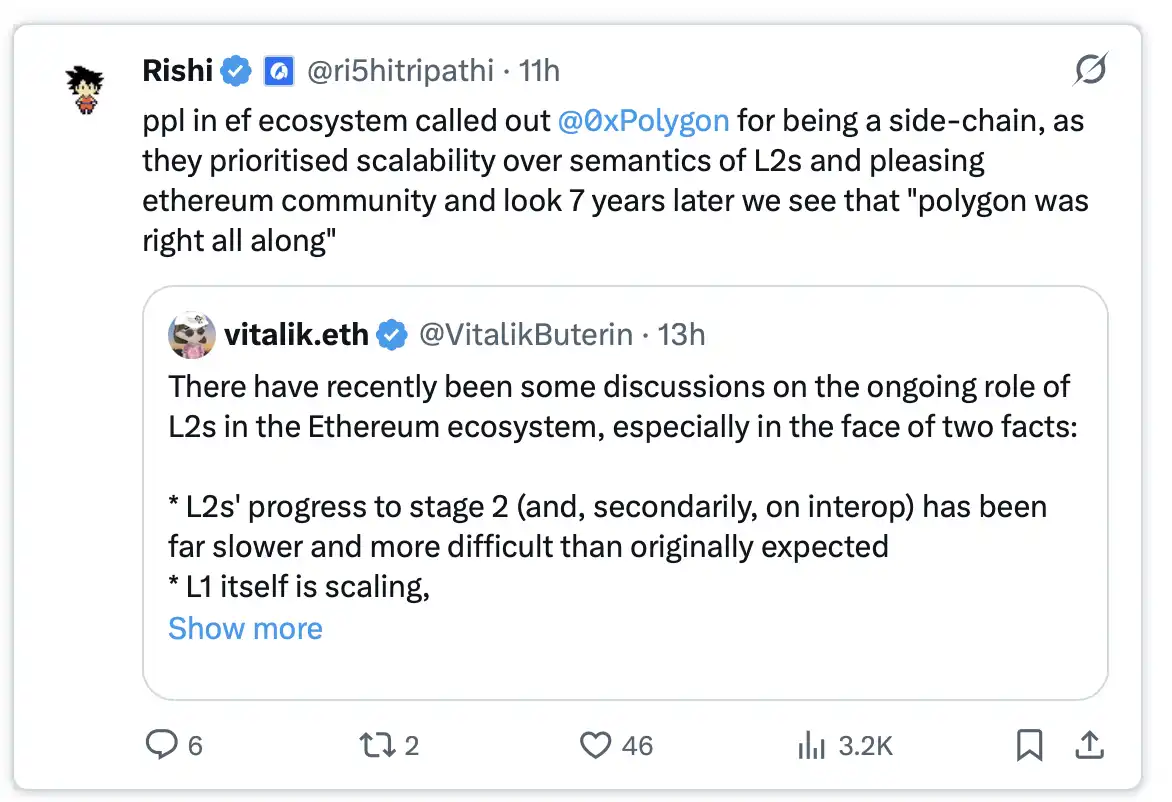
Rishi reviewed the long-standing debate within the Ethereum ecosystem regarding Polygon: in its early days, Polygon was viewed as a "sidechain" and criticized by some members of the Ethereum community for not being a "legitimate" L2 solution. At that time, however, Polygon chose to prioritize solving scalability issues rather than conforming to L2 semantics or community ideologies. Looking back seven years later, Rishi believes that the facts have proven "Polygon was right from the very beginning"—its pragmatic, scalability-first approach has stood the test of time.
Rishi reviewed the long-standing debate within the Ethereum ecosystem regarding Polygon: In its early days, Polygon was criticized by some members of the Ethereum community as an "impure" L2 solution because it was viewed as a "sidechain." However, at that time, Polygon chose to prioritize solving scalability issues rather than conforming to L2 semantics or community ideologies.
Seven years later, Rishi believes the facts have proven that "Polygon has been right from the beginning": the pragmatic approach prioritizing scalability has withstood the test of time.
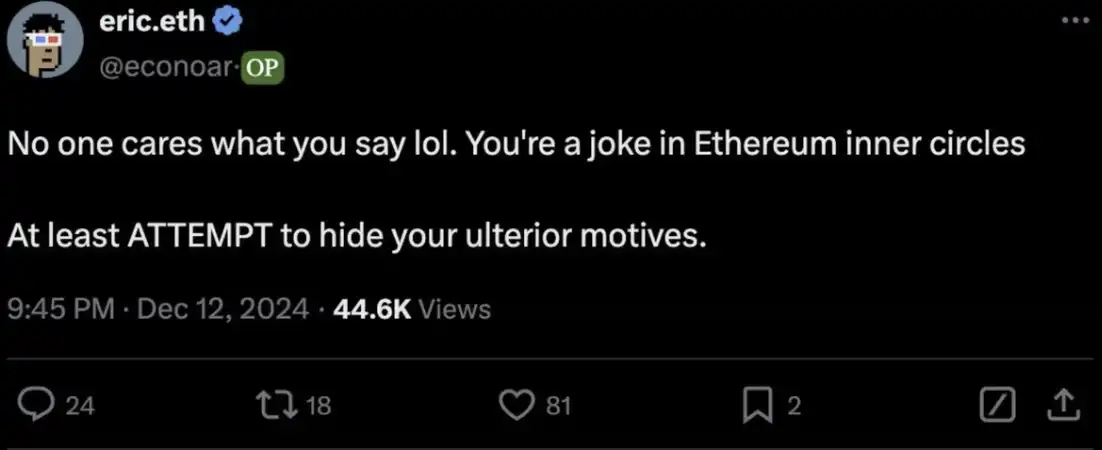
First is the narrative of "ultrasound money": After EIP-1559 and The Merge, ETH's economic model was restructured into a deflationary asset, claiming it would become a better store of value than Bitcoin. However, by 2024, ETH's annual inflation rate turned positive again.
In other words, the vision of "ultrasonic money" only lasted three years? In this way, it could never serve as a store of value. This narrative is dead—and more importantly, it was never valid to begin with. Because ETH was never designed for "store of value"; that is Bitcoin's mission, and you cannot compete with it in this dimension.
Next, Ethereum couldn't decide what its token actually was:
Is it a commodity? No—it's because the supply is dynamically changing, and there is also a staking mechanism;
More like a tech stock? That doesn't hold up either—because Ethereum doesn't generate enough revenue to be valued like a technology company.
Some people even go as far as to say that ETH is not a "currency" at all. So what exactly is happening now? We must take a side.
Ethereum cannot be all things to all people at the same time—it's either that you have a clear, unified global direction, or you will fall behind.
Financial incentives... once again
I still can't understand how a lead engineer like Péter Szilágyi can earn only about $1 million per year. He has been involved with the project since its earliest days and helped grow Ethereum from almost nothing to a $450 billion market cap, yet he has only received a return equivalent to 0.0001% of that market value.
After Bitcoin, the most influential and successful protocol in crypto history居然 offers neither incentives nor equity. It's easy for people to justify this with the principles of "decentralization, open source, and permissionless access": "We're not in it for money; we're in it for progress."
But the problem is, even the most loyal soldiers must be motivated; otherwise, they will either leave or secretly take on other projects. Péter left, Danny Ryan left, and Dankrad Feist went directly to Tempo.
In 2024, Justin Drake and Dankrad accepted advisory roles at EigenLayer and received token allocations, which immediately led to backlash from the community.
These people at the Ethereum Foundation, who earn a "pitiful salary" (compared to FAANG companies and AI research labs), are being collectively vilified simply for wanting to make some money while helping an "independent protocol that isn't Ethereum itself, but hopes to make Ethereum better."
Is this too absurd? Sometimes I really feel that if you're an honest and hardworking person on Ethereum, it seems like you're not even allowed to make money, and you can only work as a lifelong unpaid laborer just to gain "recognition" from the Ethereum community.
The Ethereum Foundation has been selling ETH to fund various operations, projects, and research. However, perhaps researchers' salaries should be prioritized first?
Zero tolerance for adaptability
"Day one. Ethereum will definitely win. It is the most decentralized and the most live blockchain."
We hear this line of reasoning every day, just like we hear Ethereum defending itself daily.
Yes, Ethereum is expensive and slow. But we have Rollup. Just use Rollup. Rollup is Ethereum!
Yes, ETH's price has underperformed everything. However, Ethereum has the largest developer ecosystem and a strong foundation; demand will eventually catch up.
Ethereum is the most decentralized blockchain! Solana is terrible; it lacks client diversity.
Ethereum is 100% online! Solana is terrible, it has gone down multiple times.
Is Ethereum's network activity not as high as Solana's? That's because Solana is full of junk transactions and meme traders gambling, while we are the "moral blockchain"!
Over the years, it's always been the same excuses, the same answers, the same self-comforting. Everything is junk except Ethereum and Rollups; if Ethereum performs poorly on any metric, we say "it's still Day 1," we know what we're doing, and there's no better place in the world than Ethereum.
Everyone has already grown tired of these same excuses being repeated over and over again in the community.
Ethereum is becoming more and more like an old, wealthy grandmother who can barely walk, yet refuses any innovation, and instead keeps giving money to her children and grandchildren, allowing them to live off her.
Reform
Just a few hours before I finished this article, Vitalik tweeted acknowledging that the rollup-centric roadmap has failed and that a new path must be sought, shifting instead to scaling L1.
You know, I'm actually happy when people can realize their own mistakes. It takes courage to admit one's errors publicly. But I'm worried that it might already be a bit too late. Once again, Ethereum has found a long-term direction it must take, but overall progress remains slow.
The Ethereum Foundation has indeed undergone some recent changes: new leadership, increased treasury transparency, restructuring of the R&D team, and so on. At the same time, the foundation has also started to bring in some young new faces in developer relations and market direction, such as Abbas Khan, Binji, Lou3e, and others.
But the change must be fast enough. Ethereum must go all out to prove everyone wrong.
Let's wait and see: after these reforms and changes, whether Ethereum can become an exciting project again, rather than just a place of blind faith and disappointment.
Click to learn about BlockBeats' job openings.
Welcome to join the official Lulin BlockBeats community:
Telegram Subscription Group:https://t.me/theblockbeats
Telegram discussion group:https://t.me/BlockBeats_App
Official Twitter account:https://twitter.com/BlockBeatsAsia