



Author:Joe ZhouForesight News
"One year has passed, and Vitalik seems to have undergone some subtle changes."
This was my first thought as I just finished my second interview with him in Chiang Mai.
The memory rewinds to the end of 2024. Our first conversation took place in a quiet, enclosed room on Nimmanhaemin Road in Chiang Mai. Back then, he was full of excitement about innovation in the Web3 application layer, from Farcaster to Polymarket and then to Solana and Base. We talked for a full 90 minutes.
This time, the time is set to the weekend of early January 2026, and the scene shifts to a completely open space.
That afternoon, Vitalik wandered from the "Four Seas Community" all the way to the "Co-living space at 706 Community." Sitting alone on a swing on the second-floor balcony, he was swaying contentedly, exuding a relaxed ease that seamlessly blended in with any ordinary community member here. I took the opportunity to sit beside him. As the swing gently swayed back and forth, I launched into a series of questions.
Around us were community members busy with their own tasks. There was no strict security here, nor any deliberate formality. After a while, noticing that we were chatting, a few curious members from the 706 community naturally gathered around. We sat on the ground, just like students chatting casually on a university lawn.
In the following conversation, I was surprised to find that his thinking framework had undergone substantial iteration over the past year.
Whether it's Web3 social, prediction markets, or AI, his perspective has become sharper and more specific. He systematically broke down his observations of leading projects such as Polymarket, Farcaster, UMA, Chainlink, MetaDAO, and Base, and shared his latest insights without reservation on Ethereum's role in the AI era, decentralized stablecoins, and RWA (Real World Assets).
Of course, there are also many things that have remained the same.
He is still homeless, never staying in one city for more than two months; he still doesn't have bodyguards, and he happily joins our large group in the cafeteria to queue for buffet meals; he remains passionately devoted to decentralized communities, tirelessly traveling between various locations in Chiang Mai.
When the conversation ended and night fell, the swing came to a stop. As usual, he dashed out onto the street at a sprint before it got completely dark, hailing a private car by himself to leave.
Outside that multi-billion-dollar decentralized kingdom, he has always been defending his freedom as an "ordinary person."
The following is my latest conversation with Vitalik. At the end of the content, you will also find selected questions from 706 on-site community members.
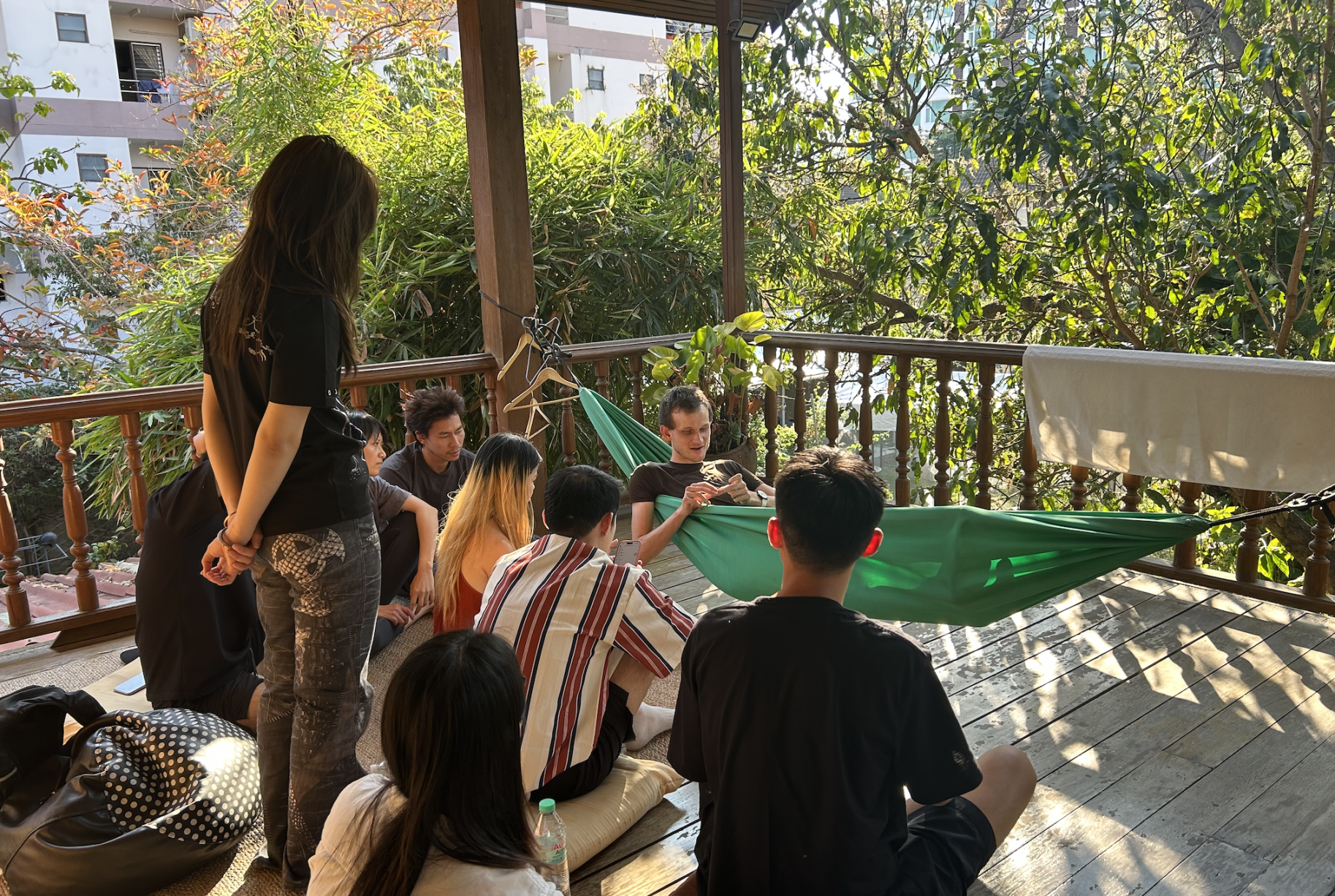
Photo: Vitalik at Chiang Mai 706 Community
Vitalik's Reflections on Chiang Mai: Technological Mastery Achieved, Why Is Application Still at a Crossroads?
Joe Zhou: One year ago, on the eve of Devcon, I invited you for an exclusive interview in Chiang Mai, titled "Vitalik: Forty-Two Days in Chiang Mai." Today, one year later, we meet again here. What new feelings or impressions has returning to Chiang Mai brought to you personally?
VitalikI've seen some communities thriving, such as Sihai Community, where many different changes have taken place. There are lots of activities and people here, and most importantly, it hasn't become boring.
Joe Zhou: Environment and time often reshape our thinking. A year has passed, and I'm curious—how has your thinking framework regarding the core issues of crypto evolved? What are you focusing on now?
VitalikThe biggest change is that I have realized the huge gap between technology and its applications.
Over the past year, Ethereum has made tremendous progress in scalability technology. Our gas limit has increased from 30 million to 60 million, and this year's goal is to reach 300 million. This includes the successful implementation of zkEVM, as well as significant improvements in the user experience of infrastructure such as wallets. It can be said that the development on the technical level has been very successful.
However, in contrast, I see many underlying concerns at the application level. Looking back five or even ten years ago, the community actually had a very diverse and grand vision for the entire ecosystem. Back then, people were full of hope, wanting to build DAOs and various truly decentralized applications that would genuinely change the way society collaborates, such as creating a "decentralized Uber." Yet I feel that afterwards, many people seemed to have forgotten these original intentions.
Crypto has been successful financially but has lost its way in governance, as exemplified by the flaws in the current "token voting" mechanism of DAOs. In recent years, the explosive popularity of memecoins is a typical case in point. The most notable example was in early 2025, when even Donald Trump personally entered the scene by launching a Meme coin. However, I believe that when he greedily issued a second token, MELANIA, his first token, TRUMP, had already effectively died at that point.
Joe Zhou: Last year, we had an in-depth discussion about SocialFi applications like Farcaster. A year has passed. From today's perspective, how do you evaluate their development?
VitalikSocialFi is currently in a somewhat awkward phase. The biggest structural dilemma of SocialFi lies in the fact that if you tightly bind social interactions with finance, financial incentives often backfire and overwhelm social incentives.
When users no longer come for high-quality content but instead for profit, they begin to generate a large amount of spam in order to maximize their earnings. This is a dangerous sign — because financial incentives are undermining the essence of social interaction.
I like the Substack model. If you look at the top ten authors on Substack, they are all thoughtful and content-rich. But if you look at the top ten on some SocialFi platforms in the crypto space, they are often just those who have inflated numbers or engaged in hype. The difference is that Substack does curating and community building. They worked hard to find authors they believed had high-quality content and worked hard to bring them onto their platform, rather than simply providing a tool for issuing tokens. This is something crypto entrepreneurs need to learn.
Joe Zhou: This seems to explain Farcaster's recent transformation—why they are no longer fixated on pure social networking, but instead pivoted to building a wallet?
VitalikYes. They couldn't find a way to scale it up. They are not content with creating a "small and beautiful" product; instead, they are eager to reach tens of millions or even hundreds of millions of users. In the current path analysis, they believe that the wallet (Wallet) sector is more likely to achieve this level of mass adoption than pure social networking.
Joe Zhou: A few years ago, there was a widespread consensus in the industry that the application layer was about to experience a "breakthrough," but this did not happen. Looking back four years ago, were you also optimistic at that time?
VitalikYes, I have thought about it. At that time, my thought was that the application didn't take off, and the core bottleneck was the limitations of the underlying technology—such as insufficient scalability, slow speed, and poor user experience.
However, by 2025, at least on the L2 (Layer 2 network) level, these rigid technical barriers have largely been resolved. Yet, embarrassingly, we still haven't seen a large-scale emergence of compelling applications. The only sector that can be considered as having experienced a breakout in 2025 is prediction markets, but to be honest, they have also revealed significant issues.
Joe Zhou: What specific "issue" are you referring to?
VitalikIf you look at discussions on Twitter, the most heavily promoted bets on Polymarket are often things like "Which team will win next week" or "Will Bitcoin's price rise or fall in an hour." I think, in the long run, these short-term wagers don't really have much social significance. The prediction market, as a tool, is theoretically successful (because it works), but we need more meaningful applications.
I think mechanisms with long-term incentives would be better. For example, I find Robin Hanson's concept of Futarchy (governance through prediction markets) quite interesting. In traditional governance, people usually vote to select individuals (presidents, legislators) or vote to choose methods (e.g., "Should we build this road?"). However, Robin Hanson's governance idea is that people only vote to decide the "goals" (e.g., we want GDP growth, or we want to reduce unemployment), and then use prediction markets to determine the "methods." Traders in the market will reveal the most accurate data through real money in their pursuit of profit. Currently, MetaDAO is making related attempts.
The Strategy Behind Making $70,000 and the Oracle Concerns: Vitalik's "Anti-Craziness" Approach
Joe Zhou: Are you still using Polymarket? I remember that you used it quite frequently last year.
VitalikYes, I made $70,000 on Polymarket last year.
Joe Zhou: How much is the principal?
Vitalik: $440,000.
Joe Zhou: Many people are losing money, how do you make money?
VitalikMy approach is very simple: I look for markets that have entered "craziness mode," and then I bet on the idea that "crazy things won't happen." For example, there's a market betting on whether "Trump will win the Nobel Peace Prize." Or sometimes, in the midst of extreme panic, markets predict that the U.S. dollar will collapse to zero next year. When market sentiment enters this irrational "craziness mode," I bet against it, and this strategy usually makes money.
Joe Zhou: What specific categories do you usually focus on at Polymarket? Crypto? Politics? Entertainment? Economics?
VitalikThere are political factors and technical factors. If you want to make money, you should go to those prediction markets where people are caught up in relatively crazy and irrational behavior, and that's when you can make money.
Joe Zhou: You are the founder of Ethereum, so do you have insider information? During the war in Venezuela, netizens found that it seemed like some people could know insider information in advance. Have you ever encountered similar situations?
VitalikHere, I would like to present a significant case regarding a vulnerability in an oracle. There was a prediction market about the situation on the Ukrainian battlefield, where people were betting on whether "Russian forces would control a certain city." The contract defined the standard for "control" as whether the most important train station in the city was under control. The data source (oracle) relied on the Twitter account and maps from ISW (Institute for the Study of War).
As a result, one event occurred: ISW employees may have made a mistake or intentionally hacked their own company's system, and their map suddenly updated to show that Russian forces controlled the train station. This caused an event that was previously thought to have only a 5% chance (almost impossible) to instantly become 100% likely on prediction markets. Although ISW retracted the update the next day, the money might have already been paid out.
This reveals a major issue: the current Oracle data sources (such as Web2 news websites, Twitter) have very low security standards. They have never considered that a single piece of information they post could determine the ownership of $1 million on the blockchain.
Joe Zhou: That does sound like a very crazy situation. You just pointed out some issues with Oracle. How should we address them?
VitalikCurrently, there are mainly two approaches to solving the oracle problem.
The first approach is the centralized model, which simply means placing trust in a single company, such as Bloomberg, to provide you with accurate information.
The second approach is Token Voting, which represents a decentralized model. Its logic is to let token holders vote to determine "what is the truth." UMA is a representative example of this model. (Note: UMA is a decentralized oracle protocol on Ethereum that relies on token holders to vote on the authenticity of data.)
But recently, people's trust in UMA has been declining. This is because people believe it has a game-theoretical flaw: if large holders (whales) decide to collude to manipulate the voting outcome, ordinary users would find it hard to counteract. In this mechanism, even if you vote for the truth, as long as you are on the opposite side of the majority, the system will declare you the loser, and you will lose money. This forces people to follow the whales' votes rather than the truth.
I think a reliable oracle is very important. Because any DeFi project today requires an oracle.If you want to develop applications related to the real world (such as tokenizing real estate or predicting real-world elections), you will need an oracle. In the DeFi industry, most people currently trust Chainlink. However, Chainlink's mechanism is relatively complex and somewhat centralized.
I have always hoped that in the future we can find a better solution.
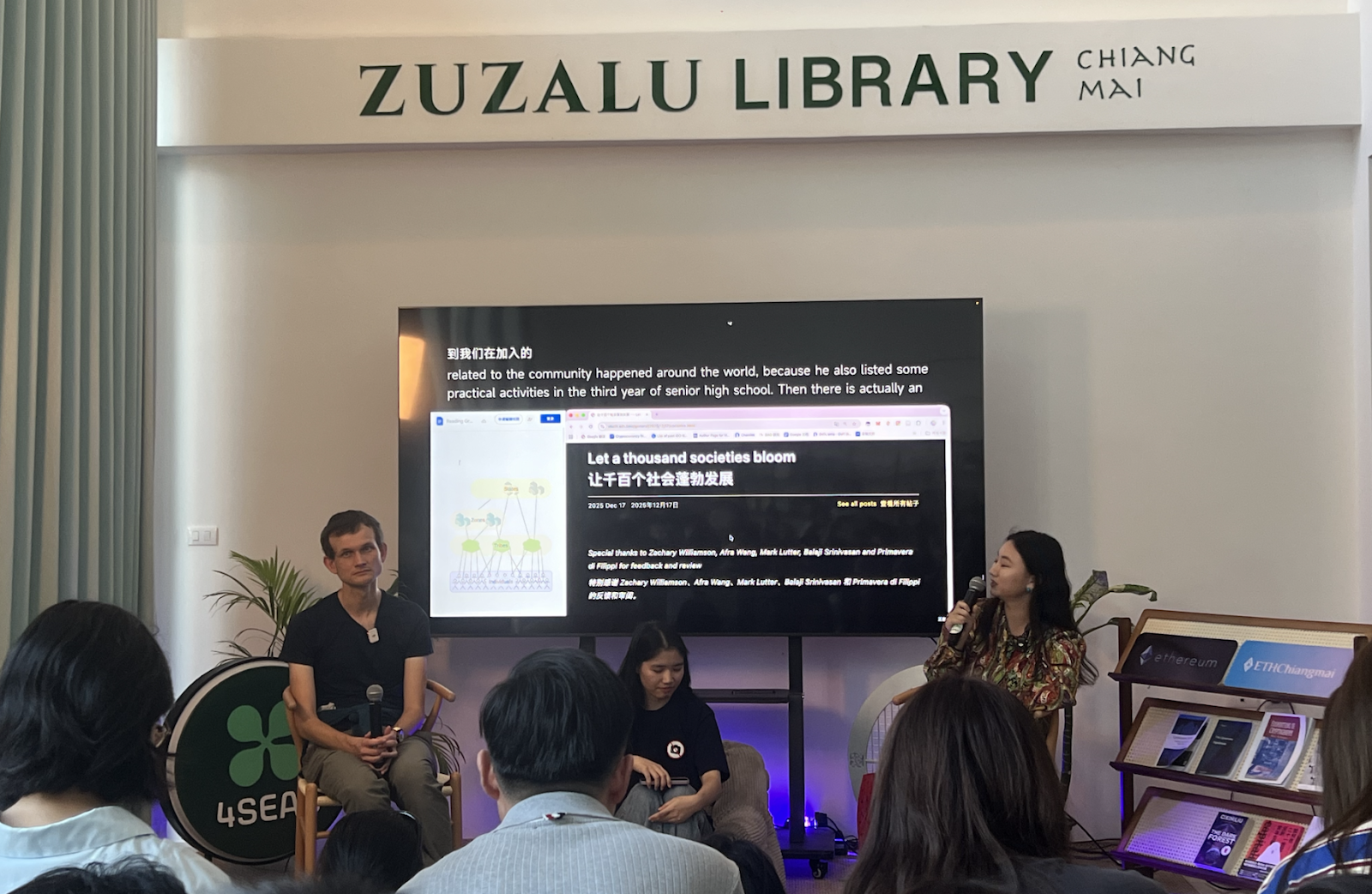
Photo: Vitalik gives a book discussion at the Four Seas Community in Chiang Mai.
The Survival Strategy of Ethereum in the Age of AI
Joe Zhou: I'd like to discuss with you one of the hottest topics today: AI. Over the past year, the market has placed tremendous hopes on the integration of AI and crypto, but the current atmosphere seems to have shifted into a kind of collective confusion. In this new era of AI, what role do you think Ethereum will play?
VitalikAt its core, Ethereum is a decentralized world computer. Its fundamental attribute is "permissionlessness"—whether it's humans, companies, or AI agents, all have equal access rights. This means that AI can hold assets on Ethereum, make transactions, and even participate in DAO governance. From this perspective, Ethereum is already well-prepared.
Joe Zhou: However, the confusion lies in this: where exactly are the concrete integration points? How can we implement these two grand concepts?
VitalikFirst, we need to be alert to a kind of thinking trap: do not combine just for the sake of combining.
For example, even in the AI era, our fundamental TCP/IP protocols (Internet protocols) do not need to be restructured simply because of AI's emergence. The same logic applies to blockchain—as a foundational trust protocol, it may not require dramatic changes either.
However, if we look for the intersection of AI and Crypto at the application layer, I believe there are indeed several directions worth paying attention to.
I: AI's Bank AccountAI cannot open an account at a traditional bank. If an AI Agent needs funds to perform tasks, cryptocurrency is its only option.
II: Market ForecastAI can participate in forecasting as a trader, providing more accurate information.
Three: Content AuthenticityUse blockchain to verify whether the content is created by humans or generated by AI.
Joe Zhou: Now there is a popular term called "Vibe Coding" (meaning writing code easily with AI assistance, without focusing on details). Do you still write code by hand in your daily work?
VitalikSometimes, I still maintain the habit of writing code by hand. My coding work is mainly divided into two categories:
The first category is utility scripts, where I write small programs for myself, mainly to improve my personal work efficiency (Productivity).
The second category is research verification. When I study some complex cryptographic algorithms, I will personally write an implementation (usually in Python) to verify my mathematical ideas through code.
Joe Zhou: Do you use any of the currently popular AI programming tools on the market, such as Claude, Gemini, or Manus? Which one do you personally prefer?
VitalikActually, I'm not tied to any specific tool. I mainly use OpenRouter. It's an aggregation platform through which I can access all the models. For coding tasks, I still use some mainstream models like ChatGPT, DeepSeek, and Gemini.
Vitalik's Conversation with the 706 Community: On Motivation, Original Intent, and Ideals
(The following content is compiled from a joint interview with Vitalik by Joe Zhou and members of the 706 Community)
706 Community: What is your current motivation for doing things?
VitalikMy driving force mainly comes from three levels, or rather, three senses of urgency.
First, it is to avoid the "doom scenario" of crypto. The future I'm most worried about now is this: the entire industry eventually degrading into a 100% speculative trading environment, where only speculation exists and no real applications. If that happens, once people gradually lose interest, the industry will die out in boredom. To avoid this outcome, we must build real value—develop better DAOs, create decentralized applications that truly penetrate various industries, and build a more open DeFi ecosystem.
Second, we need to make Ethereum's technology better. Frankly speaking, Ethereum's current technology is not yet good enough. Although L2 (Layer 2) solutions have addressed scalability issues, most of them are still highly centralized at the moment. We need to push L2 solutions to their full potential and make them more decentralized, so that the user experience of applications can truly catch up with that of Web2.
Third, if we fail in the realm of cryptocurrency, the future technological world is very likely to be completely dominated by centralized AI, which would be a very dangerous future. Cryptocurrency is our defense line against this trend toward digital authoritarianism, helping us maintain diversity and freedom in the technological world.
706 Community: This is a hypothetical question: if you could now discard all of Ethereum's historical constraints and redesign Ethereum from scratch on a blank canvas, what would you do?
Vitalik: Frankly speaking, the technical roadmap won't change much. This is because no matter how many times we restart, Ethereum's core goal has never changed: to be a decentralized application platform.
Looking back before the birth of blockchain, the most successful decentralized network was actually BitTorrent. It was great, but it was missing a key component: a global shared database (Global Shared State). With BitTorrent, you could share files, but you couldn't create a currency, establish ownership of assets, or run a DAO. Without "state," there's no way to record "who owns what."
Therefore, if I were to redesign a platform to fill this gap, it would need to have two core features: the first is scalability. Without high scalability, on-chain costs would be too high, limiting the platform to only high-value DeFi transactions, while mass-market applications would be infeasible. The second is speed. Only with sufficient speed can we deliver a usable user experience.
706 Community: As an ETH holder, I would like to ask a pointed question: What do you think is the biggest, yet most overlooked, risk that ETH currently faces?
Vitalik: To be honest, I'm not too worried about technical risks anymore.
What truly concerns me is actually the application layer. The so-called "failure scenarios" are not about network outages or cyberattacks, but rather this: we indeed develop tens of thousands of applications, yet when we look back, we find that none of them truly hold social significance. If we possess the strongest decentralized technologies but only use them to create a bunch of toys or casinos, that would be the greatest risk.
Question 706: Community — Looking ahead 5 to 10 years, what do you think Ethereum's role will be?
Vitalik: I hope it can serve as a core hub for all decentralized applications, not only serving finance but also permeating various industries.
Its core value lies in "true ownership." Here, if you own something, it truly belongs to you. In the traditional world, however, you are always constrained by big corporations—they have the power to block you, change the rules arbitrarily, or charge excessive fees. We need to change this status quo. This change is not limited to finance; it is also critically important in areas like social interaction and identity verification.
Therefore, the primary prerequisite for Ethereum's success is that our technology (scalability, user experience) must be strong enough to genuinely support these applications and serve as a solid underlying foundation for them.
Question 706: Could the development of AI and quantum computing pose a 51% attack risk to Ethereum?
Vitalik:I don't think so. We need to clarify the concept: the essence of a 51% attack is attacking the consensus and coordination mechanism (Coordination) of a Proof-of-Stake (PoS) system. This requires controlling 51% of the total network funds, not computational power.
Quantum computing mainly threatens cryptographic signatures, not consensus mechanisms. As for AI, I believe it is not a threat but rather something that can be helpful. For example, AI can assist us with formal verification and help identify code vulnerabilities, thereby making Ethereum more secure.
706 Community Members: Are you following Hyperliquid?
VitalikActually, there isn't much attention being paid.
706 Community: You just mentioned that you hope to see more applications emerging. What type of applications would you most like developers to build?
Vitalik:The first is decentralized social (DeSoc). Current social media platforms have significant issues. Although most people dislike Twitter (X), it's awkward that we lack a sufficiently good alternative. Users are locked into platforms and lack the freedom to "move" their data and presence. We need to build a truly user-owned, portable social network.
Second is "smarter" DAOs. DAOs remain a highly valuable concept, but we need to become significantly more intelligent than we are now. It's not enough to simply launch a token and hold a vote. Developers need deeper thinking: what is the specific goal of this organization? What governance structure best aligns with this goal? We need to conduct more experiments and try things that are different from what we've done before.
Third, it would be better if we had more decentralized stablecoins.
706 Community: Decentralized stablecoins, do they refer to those pegged to fiat currencies?
Vitalik: The most interesting part is right here—if we can achieve "moving away from fiat currency," that would be true innovation.
Joe Zhou: If it's not pegged to a legal currency, then what is it pegged to?
Vitalik: Anchoring to real-world values. For example, anchoring to the CPI (inflation indicator), ensuring that the money you hold will always buy as much bread as it does now; or anchoring to energy prices. This is what true "stability" really means.
Joe Zhou: This logic sounds very similar to Facebook's former Libra project (a basket of currencies).
Vitalik: Yes. I think the idea of Libra is good, but the execution went off track. They turned a vision of a decentralized currency into a corporate version controlled privately by Zuckerberg. Because of Facebook's poor privacy record, people naturally feel fear. So we need to create a similar one, but a decentralized version.
Joe Zhou: Recently, have you been conducting any interesting "personal experiments" in your life or use of technology?
Vitalik:(Thinking for a moment) I'm trying to completely disconnect from the official X client. I'm now mainly using decentralized aggregation protocols like Firefly to post and browse content.
706 Community: What is your ideal Web3 social product?
Vitalik: It doesn't necessarily need to have features that aren't available on Twitter, nor does it necessarily need to have new finance-related features. However, it should offer higher quality than Twitter. The most important issue isn't what features are available, but rather who the users on this platform are.
706 Community: Most ordinary users today actually don't care much about "data sovereignty," which might also be the reason why Web3 social media has struggled to gain traction. At this stage, where do you think the way forward lies?
Vitalik:To be honest, I don't know either.
Author's note: Thank you to Qiūqiū and other members of the 706 community for their contributions to this article.