





On February 3, 2026, Vitalik Buterin made a statement on X.
The shock this statement has caused in the Ethereum community is no less than the one he pushed for a "Rollup-centric" roadmap in 2020. In that post, Vitalik admitted: "The original vision of using Layer2 as 'Branded Sharding' to solve Ethereum's scalability is no longer valid."
One sentence almost announced the end of Ethereum's mainstream narrative over the past five years. The Layer2 camp, once highly anticipated and seen as a lifeline for Ethereum, is now facing its biggest legitimacy crisis since its inception. More direct criticisms soon followed. Vitalik wrote mercilessly in a post: "If you create an EVM that can process 10,000 transactions per second, but its connection to L1 is achieved through a multisig bridge, then you are not scaling Ethereum."
Why did the once life-saving straw become a burden to be discarded today? This is not merely a shift in a technological path, but a ruthless game involving power, interests, and ideals. The story has to start five years ago.
How did Layer2 become Ethereum's lifeline?
The answer is simple: it is not a technical choice, but a survival strategy. Time goes back to 2021, when Ethereum was mired in the quagmire of being a "noble chain."
The data doesn't lie: On May 10, 2021, Ethereum's average transaction fee reached a historical peak of $53.16, and during the craziest period of the NFT craze, Gas prices once surged above 500 gwei. What does this mean? A regular ERC-20 token transfer could cost tens of dollars, and a token swap on Uniswap could cost as much as $150 or even more.
The DeFi Summer of 2020 brought unprecedented prosperity to Ethereum, with the total value locked (TVL) surging from $700 million at the beginning of the year to $15 billion by the end of the year, an increase of over 2100%. But the cost of this prosperity was extreme network congestion. By 2021, when the NFT wave swept in, the minting and trading of blue-chip projects like Bored Ape Yacht Club further exacerbated the network congestion, with gas fees for a single NFT transaction often amounting to hundreds of dollars. There was a collector who was outbid in 2021 with an offer of over 1000 ETH for a Bored Ape, but ultimately gave up due to the high gas fees and complex transaction process.
At the same time, a challenger named Solana emerged unexpectedly. Its data is shocking: tens of thousands of transactions per second, with transaction fees as low as $0.00025. The Solana community not only mocks Ethereum's performance, but even directly attacks the bloat and inefficiency of its architecture. The saying "Ethereum is dead" is rampant, and anxiety fills the Ethereum community.
Against this backdrop, in October 2020, Vitalik formally proposed a vision in "Rollup-Centric Ethereum Roadmap": positioning Layer2 as Ethereum's "branded shard." The core of this concept is that Layer2 processes massive amounts of transactions off-chain, then packages the compressed results and sends them back to the mainnet, thereby theoretically achieving infinite scalability while inheriting the security and censorship resistance of the Ethereum mainnet.
At that point in time, the future of the entire Ethereum ecosystem was almost entirely bet on the success of Layer2. From the Dencun upgrade in March 2024, which introduced EIP-4844 (Proto-Danksharding) specifically to provide cheaper data availability for Layer2, to various core development meetings, everything was paving the way for Layer2. After the Dencun upgrade, the data publishing cost of Layer2 dropped by at least 90%, and the transaction fees of Arbitrum plummeted from about $0.37 to $0.012. Ethereum is trying to gradually push L1 into the background, quietly becoming a "settlement layer."
But this bet, why wasn't it fulfilled?
Those "centralized databases" with a $1.2 billion valuation
If Layer2 could really achieve the original vision, they wouldn't be out of favor today. But the question is, what exactly did they do wrong?
Vitalik pointed out the fatal flaw in his article: the decentralization progress is too slow. The vast majority of Layer2 solutions have not yet reached Stage 2—having a fully decentralized fraud or validity proof system, and allowing users to withdraw assets without permission in emergency situations. They are still controlled by centralized sequencers that pack and order transactions. Essentially, they are more like centralized databases dressed in blockchain clothing.
The conflict between commercial reality and technical ideals is clearly exposed here. Take Arbitrum as an example: its development company, Offchain Labs, raised $120 million in Series B funding in 2021, achieving a valuation of up to $1.2 billion, with investors including top-tier institutions such as Lightspeed Venture Partners. However, to this day, this giant with over $15 billion in locked funds and holding about 41% of the Layer2 market share, remains stuck in Stage 1.
The story of Optimism is also intriguing. This project, led by Paradigm and Andreessen Horowitz (a16z), completed a $150 million B-round financing in March 2022, with a total fundraising amount reaching $268.5 million. In April 2024, a16z even privately purchased $90 million worth of OP tokens. However, despite such strong capital support, Optimism has also only reached Stage 1.
The rise of Base reveals another dimension of the issue. As a Layer2 solution launched by Coinbase, Base quickly became a market favorite after its mainnet launch in August 2023. By the end of 2025, Base's TVL had reached $4.63 billion, accounting for 46% of the entire Layer2 market, surpassing Arbitrum to become the Layer2 with the highest DeFi TVL. However, Base is less decentralized, as it is entirely controlled by Coinbase, making it technically closer to a centralized sidechain.
The story of Starknet is more ironic. This Layer2 solution using ZK-Rollup technology, developed by Matter Labs, has raised a total of $458 million, including a $200 million Series C funding round in November 2022 led by Blockchain Capital and Dragonfly. However, the price of its token STRK has dropped 98% from its historical high, with a market cap of about $283 million. According to on-chain data, the daily protocol revenue it generates is not even enough to cover the operating costs of a few servers, and its core nodes remain highly centralized, only reaching Stage 1 by mid-2025.
Some project teams have even privately admitted that they may never fully decentralize. Vitalik cited a case in a post: a certain project claimed that they would never further decentralize because "regulatory requirements of customers require them to have ultimate control." This completely angered Vitalik, who responded bluntly:
"This might be the right thing to do for your clients. But it's obvious that if you do this, you're not 'scaling Ethereum'."
This comment has effectively sentenced almost all projects that claim to be Ethereum L2s but reject decentralization to death. Ethereum wants a doppelgänger that can extend decentralization and security to a broader space, not a group of vassals that wear the clothes of Ethereum but practice centralization.
The deeper issue lies in the irreconcilable conflict between decentralization and commercial interests. A centralized sequencer means the project team can control MEV (Maximum Extractable Value) revenue, respond more flexibly to regulatory requirements, and iterate products more quickly. Full decentralization, on the other hand, means giving up these controls and transferring power to the community and validator network. For projects funded by venture capital and under pressure to grow, this is a difficult choice.
If Layer2 truly achieves full decentralization, will they still fall out of favor? The answer might still be yes. Because Ethereum itself has changed.
When the mainnet is faster and cheaper than the sidechain
Why is Ethereum no longer in such need of Layer2 for scaling?
As early as February 14, 2025, Vitalik released a key signal. He published an article titled "There Are Reasons for a Higher L1 Gas Limit Even in an L2-Heavy Ethereum," clearly stating that "L1 is scaling." At the time, this statement sounded more like a reassurance to mainnet fundamentalists, but looking back now, it was actually the rallying cry marking the Ethereum mainnet's renewed competition with Layer2.
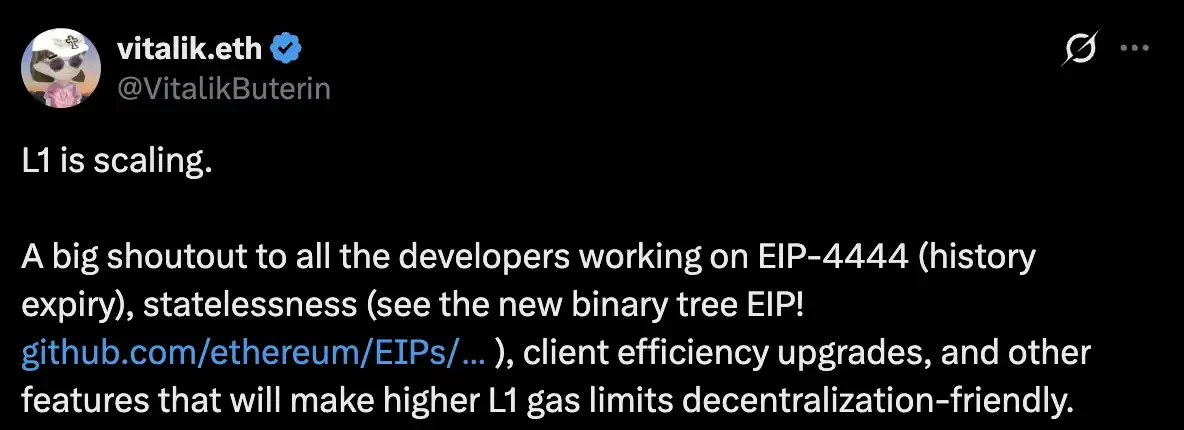
Over the past year, the expansion speed of Ethereum L1 has far exceeded everyone's expectations. Technological breakthroughs have come from multiple dimensions: EIP-4444 has reduced the storage requirements for historical data, stateless client technology has made node operation more lightweight, and most importantly, the continuous increase in Gas Limit. At the beginning of 2025, Ethereum's Gas Limit was 30 million, but by mid-year it had increased to 36 million, a 20% growth. This is the first significant increase in Ethereum's Gas Limit since 2021.
But this is just the beginning. According to the Ethereum core developers' plan, there will be two major hard fork upgrades in 2026. The Glamsterdam upgrade will introduce perfect parallel processing capabilities, and the Gas Limit will surge from 60 million to 200 million, an increase of over three times. The Heze-Bogota fork will add the FOCIL (Fork-Choice Enforced Inclusion Lists) mechanism, further enhancing block-building efficiency and censorship resistance.
The Fusaka upgrade, completed on December 3, 2025, has already shown the power of L1 scaling to the market. After the upgrade, Ethereum's daily transaction volume increased by about 50%, the number of active addresses rose by about 60%, and the 7-day moving average of daily transaction volume reached a historical high of 1.87 million transactions, surpassing records from the DeFi peak in 2021.
The result is astonishing: transaction fees on the Ethereum mainnet have dropped to extremely low levels. In January 2026, the average Ethereum transaction fee fell to $0.44, a decrease of over 99% compared to the $53.16 peak in May 2021. During off-peak hours, the cost of a single transaction often drops below $0.10, sometimes as low as $0.01, with gas prices as low as 0.119 gwei. This number has already approached Solana's level, and the largest cost advantage of Layer2 is being rapidly erased.
Vitalik did a detailed calculation in that February article. He assumed an ETH price of $2500, a gas price of 15 gwei (long-term average), and demand elasticity close to 1 (i.e., doubling the gas limit would halve the price). Under this assumption:
Censorship resistance requirements: Currently, enforcing a transaction censored by L2 through L1 requires about 120,000 gas, costing $4.5. To reduce the cost to less than $1, L1 needs to scale 4.5 times.
Cross L2 asset transfer: currently, withdrawing from one L2 to L1 requires about 250,000 gas, and then depositing into another L2 requires 120,000 gas, with a total cost of $13.87. With an ideal optimized design, only 7,500 gas is needed, costing $0.28. To achieve the target of $0.05, a 5.5 times expansion is required.
Mass Exit Scenario: Taking Sony's Soneium as an example, PlayStation has about 116 million monthly active users. If an efficient exit protocol (7,500 gas per user) is adopted, the current Ethereum can just support emergency exits for 121 million users within a week. However, if multiple applications of this scale are to be supported, L1 needs to scale approximately 9 times.
And these extended targets are gradually being realized in 2026. Technological advancements are changing the game completely. When L1 itself can become fast and cheap, why would users still tolerate the cumbersome cross-chain bridges, complex interaction experiences, and potential security risks of Layer2?
Security issues with cross-chain bridges are not groundless worries. In 2022, cross-chain bridges became a hotspot for hacker attacks. In February, the Wormhole bridge was stolen of $325 million; in March, the Ronin bridge suffered the largest DeFi attack in history, losing $540 million; other bridging protocols such as Meter and Qubit were also successively breached. According to Chainalysis, the total amount of stolen cryptocurrency from cross-chain bridges in 2022 reached $2 billion, accounting for the majority of losses from all DeFi attacks that year.
Fragmented liquidity is another pain point. With the surge in the number of Layer2s, DeFi protocol liquidity is scattered across dozens of different chains, leading to increased transaction slippage, reduced capital efficiency, and deteriorated user experience. A user who wants to move assets between different Layer2s needs to go through a complex bridging process, wait for long confirmation times, and bear additional fees and risks.
This leads to the next, and most brutal, question: What should those Layer2 projects that raised huge funds and issued tokens do now?
Valuation Bubble and Ghost Cities
Where did the money from Layer2 go?
In the past few years, the Layer2 track has been more like a huge financial game rather than a technological revolution. Venture capital firms have waved their checks, pushing the valuations of one L2 project after another to astonishing heights. zkSync has raised a total of $458 million, Offchain Labs behind Arbitrum is valued at $1.2 billion, Optimism has raised $268.5 million, and Starknet has raised $458 million. Behind these figures are top-tier venture capitals such as Paradigm, a16z, Lightspeed, and Blockchain Capital.
Developers are enthusiastic about "nesting" different L2s, building complex DeFi Legos to attract more liquidity and airdrop hunters. However, the real users are gradually worn out by the cumbersome cross-chain operations and high hidden costs.
A harsh reality is that the market is becoming highly concentrated at the top. According to data from crypto research firm 21Shares, the top three L2s—Base, Arbitrum, and Optimism—have already controlled nearly 90% of the trading volume. Base, leveraging Coinbase's traffic advantage and user base, experienced explosive growth in 2025, with its TVL surging from $10 billion at the beginning of the year to $4.63 billion by year-end, and its quarterly trading volume reaching $59 billion, a 37% increase from the previous quarter. Arbitrum remains in second place with a TVL of approximately $19 billion, followed closely by Optimism.
But apart from the head, most L2 projects have quickly dropped to freezing levels in real user numbers after losing the driving force of airdrop expectations, turning into real "ghost cities." Starknet is the most typical example. Although its token price has fallen by 98% from its peak, its price-to-earnings ratio remains in an extremely high bubble range relative to its very low daily active users and transaction fee income. This means there is a huge gap between the market's expectations for its future and its current ability to create real value.
More ironically, when Layer2 fees dropped significantly due to EIP-4844, the data availability fees they paid to L1 also plummeted, which in turn reduced Ethereum L1's fee revenue. In January 2026, analysis pointed out that the Dencun upgrade caused a large number of transactions to shift from L1 to cheaper L2, becoming one of the main reasons for Ethereum network fees dropping to their lowest level since 2017. While Layer2 is reducing its own costs, it is also draining the economic value of L1.
21Shares predicts in its 2026 Layer2 Outlook Report that most Ethereum Layer2 solutions may not survive until 2026, and the market will undergo a brutal consolidation, with only those projects offering high performance, true decentralization, and unique value propositions ultimately succeeding.
This is exactly the true intention behind Vitalik's recent attack. He wants to burst the bubble of infrastructure self-indulgence and pour a basin of cold water on this sickly market. If a Layer2 cannot provide more interesting and valuable functions than L1, then it will ultimately become nothing more than an expensive transitional product in Ethereum's development history.
Ethereum is reclaiming its sovereignty.
Vitalik's latest recommendation has pointed out a new path for Layer2: to abandon scaling as the sole selling point, and instead explore functional added values that L1 cannot or is unwilling to provide in the short term. He specifically listed several directions: privacy protection (achieving on-chain private transactions through zero-knowledge proof technology), efficiency optimization for specific applications (such as games, social networks, AI computing), ultra-fast transaction confirmation (millisecond-level rather than second-level), and the exploration of non-financial use cases.
In other words, the role of Layer2 will shift from being a clone of Ethereum to becoming plugins with various functions. They are no longer the sole savior for scaling, but rather a functional expansion layer within the Ethereum ecosystem. This is a fundamental shift in positioning, and also a return of power—the core value and sovereignty of Ethereum will be re-anchored on L1.
Vitalik also proposed a new framework: viewing Layer2 as a spectrum, rather than a binary classification. Different L2s can have different trade-offs in terms of decentralization level, security guarantees, and functional features. The key is to clearly inform users what kind of guarantees they provide, rather than all claiming to be "scaling Ethereum."
This reckoning has already begun. Those Layer2 projects that have been maintained by expensive valuations but have no real daily active users are now facing their final judgment. Projects that can find their unique value proposition and truly achieve decentralization may survive in the new landscape. Base might continue to rely on Coinbase's traffic advantage and its ability to bring in Web2 users to maintain its lead, but it needs to address criticisms regarding its insufficient level of decentralization. Arbitrum and Optimism need to accelerate the progress of Stage 2 and prove that they are more than just centralized databases. ZK-Rollup projects like zkSync and Starknet need to demonstrate the unique value of their zero-knowledge proof technology while significantly improving user experience and ecosystem vitality.
Layer2 has not disappeared, but the era in which they were the sole hope for Ethereum has come to an end. Five years ago, when cornered by competitors like Solana, Ethereum placed its scalability hopes on Layer2 and rebuilt its entire technical roadmap for this purpose. Five years later, it found that the best scalability solution is to make itself stronger.
This is not betrayal, but growth. And those Layer2 projects that cannot adapt to this evolution will become the cost. When the Gas Limit surges to 200 million by the end of 2026, when Ethereum L1 transaction fees stabilize at a few cents or even lower, and when users discover they no longer need to endure the complexity and risks of cross-chain bridges, the market will vote with its feet. Those projects that once had astronomical valuations but failed to create real value for users will be forgotten by history in this process of winnowing.