





Author: Yitao
Source:Geek Park
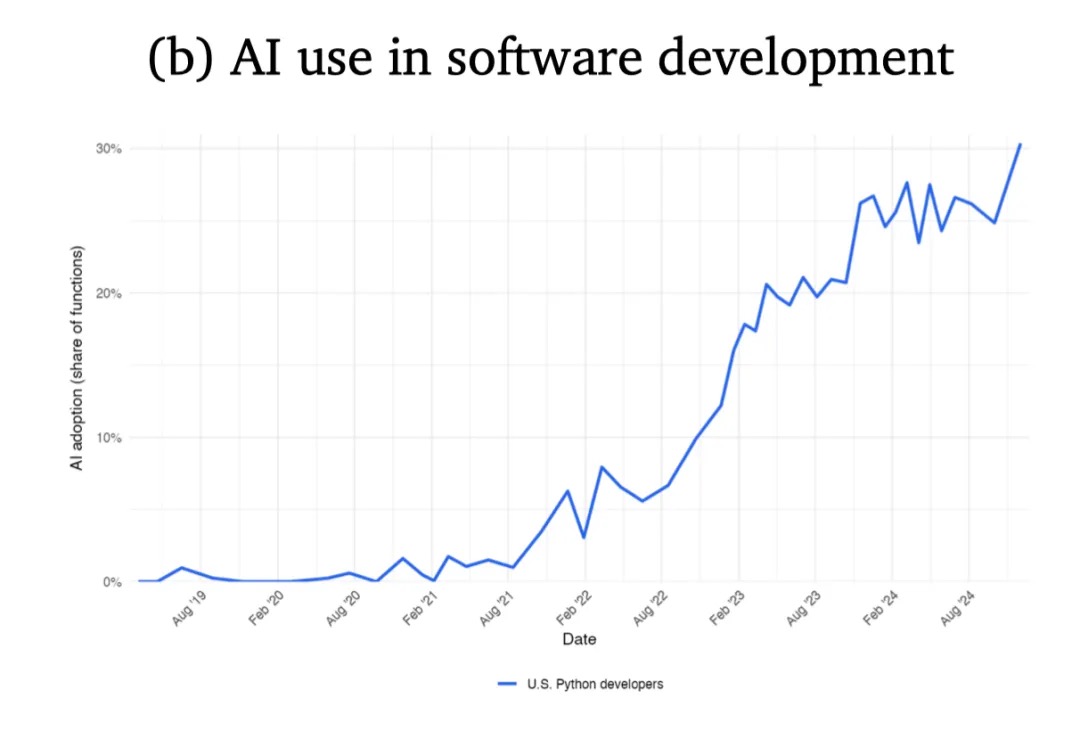
Over the past year, Vibe Coding has almost completely rewritten the way programming is done.
You no longer need to write code line by line manually. Just tell Cursor, Claude, or Copilot: "I want a feature that does X, using technology stack Y, and ideally it should feel like product Z," and let the AI take care of the rest.
Many people who previously couldn't write code now have the ability to "create something" for the first time. From an individual's perspective, this is almost the golden age of software development.
But there is a neglected premise: AI does not create code out of thin air; instead, it is calling upon and assembling existing human knowledge and achievements. When you say, "Help me build a website," AI is actually silently referencing the accumulated logic and structures from countless open-source projects on GitHub.
The core capability of Vibe Coding is built upon the learning and reorganization of these open-source code libraries.
Recently, a research team from Central European University and the Kiel Institute for the World Economy published a paper titled "Vibe Coding Kills Open Source" (https://arxiv.org/pdf/2601.15494v1), revealing the hidden crisis behind the prosperity of Vibe Coding.
The thesis points out a truth:
Vibe Coding may be fundamentally undermining the open-source ecosystem that supports the entire software world.
01 The "Invisible Infrastructure" of the Digital World
To understand what this paper is concerned with, we first need to clarify one thing:What is open source software, and what role does it play in our lives?
Many people may not have a clear understanding of open-source software, but in reality, the foundation of almost every digital product people use daily is built upon open-source software.
When you wake up in the morning and pick up your Android phone, the Linux operating system running underneath it is open-source software;
When you open WeChat to browse chat history, the open-source SQLite database stores every message for you;
When you browse TikTok or Bilibili during your lunch break, the video decoding and playback in the background are handled by FFmpeg, which is also open-source software.
Open source software is like the sewer system of the digital age. You use it every day, but you don't even notice it..
You only suddenly realize its importance when something goes wrong.
The Log4j vulnerability in 2021 is a typical example. Log4j is the most widely used logging framework in the Java ecosystem, used to record events and information during application runtime.
The majority of ordinary users have never even heard of it, but from Apple and Google's cloud servers to government administrative systems around the world, billions of devices globally run it in the background.
At the end of 2021, a vulnerability named "Log4Shell" emerged. This flaw allowed hackers to remotely take control of servers around the world as easily as operating their own computers. The entire internet infrastructure suddenly became "exposed," forcing global security teams to urgently address the issue over the weekend. The widespread impact and difficulty of remediation made it one of the most severe security crises in internet history.
This is the essence of open source—it is not a product of a particular company, but rather a "public good." Because it lacks commercial attributes, the maintainers who write the code often cannot directly charge for the project.
Their rewards are indirect: gaining reputation through projects, which leads to jobs at top companies; earning income by providing consulting services; or relying on community donations.
This model has operated for decades based on "direct interaction." Users read documentation, submit questions, and give likes and recommendations while using the software. This attention flows back to the maintainers, transforming into motivation for ongoing maintenance.
And this is exactly the connection that Vibe Coding is cutting off..
02 How has AI gradually "starved" open source?
Before Vibe Coding, the development model was like this: you would download an open-source package and read its documentation; if you encountered a bug, you would submit an issue on GitHub; and if you found it useful, you would give it a star to show your support.
Maintainers thus gain attention, which is converted into income, forming a closed loop..
After Vibe Coding, you just need to tell the AI what functionality you want. The AI will automatically select and combine open-source code in the background to generate a "working implementation."
The code runs, but you don't know exactly which libraries it uses, nor would you check their documentation or communities.
The paper refers to this change as a "MediationEffect—Originally, the attention and feedback directly conveyed by users to the maintainers are entirely intercepted by the intermediate layer of AI.
What will happen if this mechanism continues?
The paper's authors constructed an economic model simulating an open-source ecosystem. They compared developers to entrepreneurs deciding whether to "enter the market" at different quality levels, first investing costs to develop, and then deciding whether to open-source and share their work based on market feedback. Users, on the other hand, must choose among countless software packages and decide whether to "use them directly" or through an "AI intermediary."
The model run revealed two opposing forces.
The first is increased efficiency. AI makes software easier to use and reduces the cost of developing new tools. This should, in theory, encourage more developers to enter the field and increase supply.
The second is demand shifting. When users turn to AI intermediaries, maintainers lose income from direct interactions, which reduces developers' returns.
However, when viewed from a longer-term perspective, if the second force (demand shift) becomes stronger than the first (efficiency improvement), the entire system will slide into contraction.
The specific manifestation is that,The entry threshold for developers has increased, so only the highest quality projects are worth sharing. Projects of medium quality disappear, and ultimately, the number of packages in the market and their average quality both decline.Although individual users enjoy the convenience of AI in the short term, their long-term benefits actually decrease because the number of high-quality options available diminishes.
In short, the ecosystem has fallen into a vicious cycle. Once the open-source ecosystem, the foundation, becomes weaker, the capabilities of AI will also decline.
This is a point repeatedly emphasized in the paper:Vibe Coding improves productivity in the short term, but in the long run, it may actually reduce the overall quality of the entire system..
This trend is not purely a theoretical assumption, but is actually happening in real life.
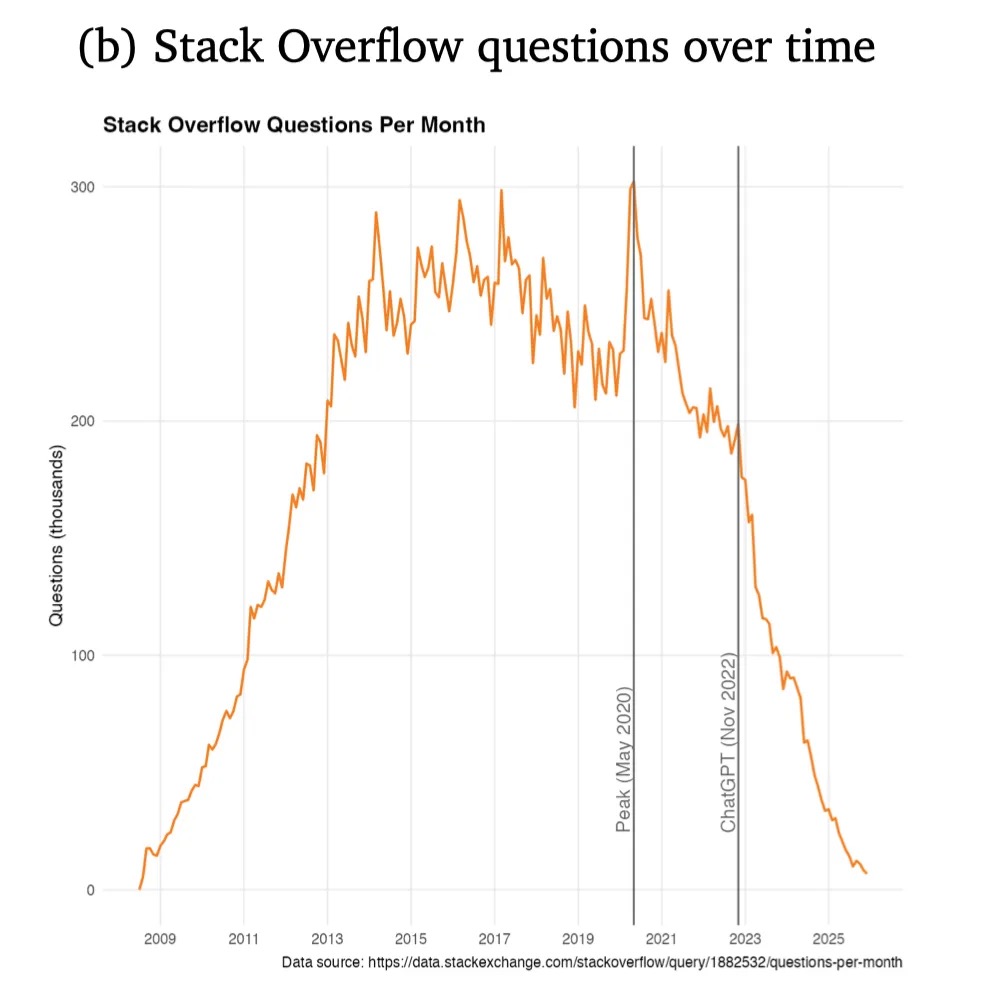
For example, the public Q&A traffic on Stack Overflow has shown a noticeable decline after the popularity of generative AI. Many questions that were previously discussed in public communities have been shifted to private AI conversations.
For example, projects like Tailwind CSS have seen continuous growth in download numbers, but a decline in documentation traffic and commercial revenue.
The project is heavily used, yet it is becoming increasingly difficult to convert this usage into meaningful rewards for the maintainers.
03 When will the Spotify of the coding world emerge?
Although Vibe Coding has such issues, the productivity improvements it brings are real, and no one can return to a world without AI coding.
The more fundamental issue is that,When AI becomes the new intermediary, the old incentive structures are no longer applicable.
Under the current structure, AI platforms derive significant value from the open-source ecosystem, yet they do not bear the corresponding cost of maintaining this ecosystem itself. Users pay for AI services, and AI provides convenience, but the open-source projects and maintainers that are invoked often receive nothing in return.
The hypothesis proposed by the paper's author is:
Reform the method of benefit distribution.
Just like in the music industry, where streaming platforms such as Spotify distribute revenue with musicians based on play counts,An AI platform can fully track which open-source projects it has used and return a portion of its revenue to the maintainers in proportion..
In addition to platform revenue sharing, funding from foundation grants, corporate sponsorships, and government special funds for digital infrastructure also serve as important means to compensate for the loss of maintainers' income.
This requires a shift in the industry's mindset, fromView open-source software not as "free resources," but as "public infrastructure that requires long-term investment and maintenance.".
Open-source software will not disappear; it has become deeply embedded in the digital world and cannot be easily replaced.
But that era of open source, which relied on fragmented attention, accumulated reputation, and idealism, may have reached its limits.
Vibe Coding brings not only a faster development experience but also a stress test on how "public technology can be continuously nurtured."