





Original Title: Did DOJ Prosecutors Violate Trump's Executive Order by Selling the Forfeited Samourai Wallet Bitcoin?
Original Author: Frank Corva, Bitcoin Magazine
Translated by: Chopper, Foresight News
The U.S. Marshals Service (USMS) appears to have successfully liquidated the bitcoin associated with Samourai Wallet developer Keonne Rodriguez and William Lonergan Hill, which was valued at $6.3 million as part of their plea agreement.
This action is suspected of violating Executive Order No. 14233. The order stipulates that Bitcoin obtained by the government through criminal or civil asset forfeiture procedures should be held in the U.S. Strategic Bitcoin Reserve, rather than being liquidated.
If the U.S. District Court for the Southern District of New York, which is responsible for hearing the Samourai case, indeed violated Executive Order 14233, this would not be the first time that the court's staff has defied federal government directives.
Where are these bitcoins going?
Bitcoin Magazine has obtained a previously undisclosed "Asset Liquidation Agreement" document. The document shows that the seized bitcoins belonging to Rodriguez and Hill are either about to be sold or have already been liquidated.
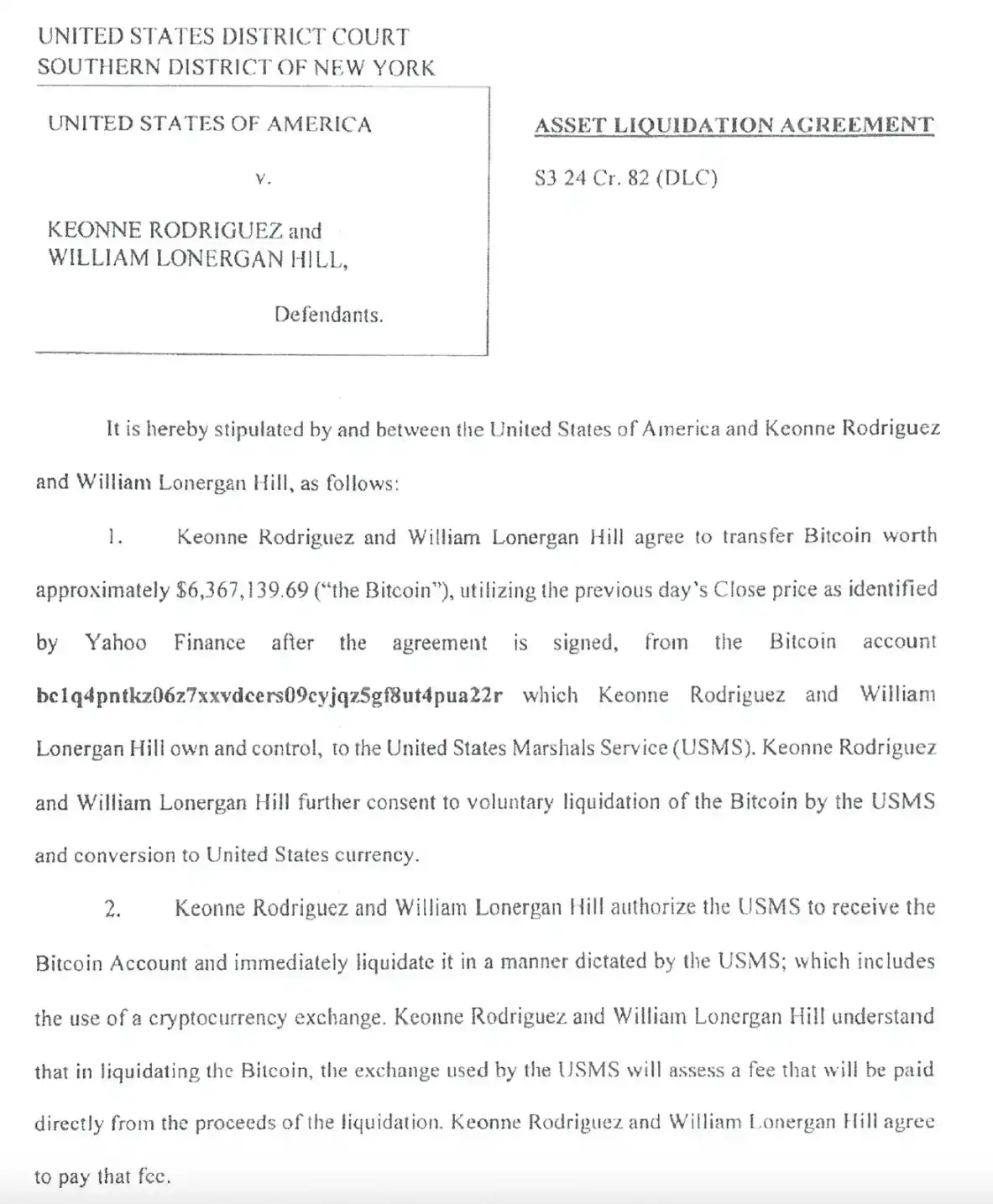
According to the agreement, the two defendants agreed to surrender 57.5 bitcoins to the U.S. Marshals Service, which would be valued at approximately $6.36 million on the agreement's final signing date of November 3, 2025.
On November 3, 2025, this batch of Bitcoin was sent from the address bc1q4pntkz06z7xxvdcers09cyjqz5gf8ut4pua22r. However, it appears that it did not enter the direct custody account of the U.S. Marshals Service, but was instead directly transferred to the Coinbase Prime wallet address 3Lz5ULL7nG7vv6nwc8kNnbjDmSnawKS3n8. It is speculated that the purpose of this transaction was to liquidate the assets.
Currently, the balance of this Coinbase Prime address has been emptied, which suggests that this batch of bitcoins has likely been sold.
Violate Executive Order No. 14233
Once the U.S. Marshals Service confirms the sale of this seized batch of Bitcoin, it would constitute a violation of Executive Order 14233. This executive order explicitly requires that Bitcoin obtained by the government through criminal forfeiture procedures "shall not be sold," and must instead be incorporated into the U.S. Strategic Bitcoin Reserve.
The U.S. Marshals Service's decision to sell Bitcoin is based on its own discretion, rather than a legal requirement. This phenomenon suggests that some personnel within the Department of Justice may still regard Bitcoin as a "forbidden asset," eager to liquidate it quickly, rather than treating it as a strategic asset that government agencies are supposed to hold, as requested by President Trump.
It is worth noting that the investigation and subsequent prosecution of Samourai began during the previous administration, which held a strong hostility toward non-custodial cryptocurrency tools and their developers. Therefore, the Department of Justice's decision to ignore Executive Order 14233 and insist on selling Bitcoin continues the pattern of previous administrations, treating Bitcoin as an asset that should be quickly removed from the government's balance sheet.
Legal details related to confiscation and liquidation
According to a legal insider, the developer of Samourai had their Bitcoin seized under 18 U.S.C. § 982(a)(1). This provision states that any property involved in criminal violations of 18 U.S.C. § 1960, which prohibits operating an unlicensed money transmission business, must be forfeited to the U.S. government.
In conjunction with 18 U.S.C. § 982 and its reference to 21 U.S.C. § 853(c) (a criminal forfeiture statute that provides that "property transferred subsequent to the defendant to other persons may be subject to a special order of forfeiture and then ordered to be delivered to the United States Government"), the batch of Bitcoin seized from Rodriguez and Hill fully meets the definition of "government Bitcoin" under Executive Order No. 14233.
Neither 18 U.S.C. § 982 nor the referenced 21 U.S.C. § 853 mandates the conversion of property subject to criminal forfeiture into cash. Furthermore, the two asset management regulations cited in Section 3 of Executive Order 14233—31 U.S.C. § 9705 and 28 U.S.C. § 524(c)—only regulate the storage accounts and usage of forfeited funds, and do not require the conversion of seized Bitcoin into fiat currency.
The executive order also clearly states that "government Bitcoin" falls under the category of "government digital assets," and stipulates that "agency heads shall not sell or otherwise dispose of any government digital assets," with exceptions only under specific circumstances. The cases of Rodriguez and Hill do not meet any of these exceptions. Moreover, in all exceptional cases, the U.S. Attorney General must be involved in the decision-making process regarding the disposal of seized digital assets.
The Southern District of New York U.S. District Court, which "stands out on its own."
In light of Executive Order No. 14233 and the regulations cited herein, the actions of the U.S. District Court for the Southern District of New York clearly contravene the core requirement of the executive order, which is to transfer criminally forfeited bitcoins to the U.S. Strategic Bitcoin Reserve.
And this is certainly not the first time that such defiant behavior has occurred at the hospital.
This jurisdiction, often jokingly referred to as the "Sovereign Court of New York," has long been known for its independent and autocratic manner of operation. Even though it is part of the federal judicial system, it frequently operates beyond the reach of control.
The court's insistence on proceeding with the lawsuits against Rodriguez, Hill, and Tornado Cash developer Roman Storm is another strong indication of its arbitrary and self-willed approach.
On April 7, 2025, U.S. Deputy Attorney General Todd Blanche issued a memo titled "Ending the Prosecution-Over-Compliance Model," clearly stating that "the Department of Justice will no longer bring charges against developers of virtual currency exchanges, mixing services, and offline wallets based on the actions of end users..."
However, the U.S. District Court for the Southern District of New York has ignored this core principle in the memorandum and continues to push forward with the trial of the Samourai Wallet and Tornado Cash case.
More notably, Hill and Rodriguez's defense team filed a motion under the Brady rule (which requires the prosecution to disclose exculpatory evidence to the defense), ultimately obtaining documents that revealed two senior officials from the U.S. Department of the Treasury's Financial Crimes Enforcement Network (FinCEN) had explicitly stated that, due to Samourai Wallet's non-custodial nature, it did not constitute a money transmission business. Despite this, the prosecution proceeded with the case.
In criminal cases heard in the U.S. federal court system, over 90% of defendants ultimately receive convictions and sentences, with rates of acquittals in some years dropping as low as 0.4%. The prosecution team in the U.S. District Court for the Southern District of New York is especially renowned for its exceptionally high conviction rate, far exceeding the federal average.
Rodriguez was well aware of such data, and he also knew that Judge Denise Cote, who would preside over his case and the Hill case, was known for imposing strict sentences.
The morning before he pleaded guilty to the charge of "conspiring to operate an unlicensed money transmission business," Rodriguez confided all of this to me.
Has the cryptocurrency war really ended?
In the 2024 election, many Bitcoin and cryptocurrency supporters cast their votes for President Trump, and the cryptocurrency industry had also strongly supported his re-election campaign. Now, these supporters and industry professionals are increasingly questioning: Is President Trump truly committed to ending the war against cryptocurrency?
To achieve this goal, the Department of Justice under the Trump administration must strictly adhere to the requirements of Executive Order 14233 while following the guidelines provided by Deputy Attorney General Blanche, which call for ceasing prosecutions against developers of non-custodial cryptocurrency technologies. Regarding the latter, President Trump recently indicated that he is considering pardoning Rodriguez.
Pardoning Rodriguez and ordering the Department of Justice to thoroughly investigate the seizure of Bitcoin from Samourai developers would send a strong signal that the president is serious and committed to his pro-bitcoin and pro-cryptocurrency stance.
Click to learn about BlockBeats' job openings.
Welcome to join the official Lulin BlockBeats community:
Telegram Subscription Group:https://t.me/theblockbeats
Telegram discussion group:https://t.me/BlockBeats_App
Official Twitter account:https://twitter.com/BlockBeatsAsia