







If no one in your group is discussing $SATO, $uPEG, and Slonks, you might need to find a different group.
The mint price of Slonks at launch was under 0.004 ETH, equivalent to less than 70 RMB; six days later, the floor price rose to 0.123 ETH, a 60-fold increase. uPEG priced at $982 reached a market cap of $34.44 million in just two weeks from zero. When SATO's market cap dropped below $3 million, someone directly bought the dip via the on-chain bonding curve, opening a position of 260,000 SATO; the market cap later surged to $40 million, generating an immediate paper profit of $360,000.
These are not ordinary memecoin get-rich narratives. Together, they point to a single赛道: Uniswap V4 Hooks. In just two and a half weeks, these three projects have pulled the entire V4 Hooks赛道 from “a niche toy for DeFi enthusiasts” into the mainstream spotlight.
Related reading: “In a bull market, trading new coins: Will the ‘Hook’ concept become the next big赛道?”
For retail investors who missed out on $SATO, $uPEG, and Slonks early on, how can we catch the next potential wealth-building opportunity? Before diving into this, let’s briefly recap how the V4 Hook narrative gained momentum.
How did the V4 Hook narrative become popular?
Before V3, Uniswap was like a currency exchange counter: you traded ETH for USDC, and the price followed x*y=k, done. After V4, the hook feature was introduced into the swap lifecycle, allowing anyone to insert their own code before, after, or at the moment of adding liquidity.
In fact, Uniswap v4 launched on January 30 last year. However, it wasn’t until recent projects like $SATO, $uPEG, and Slonks appeared that hooks sparked widespread discussion among retail investors.
SATO was the first to launch among these three, going live around mid-April, about a week earlier than uPEG. However, it didn’t have KOL-driven hype or backing from high-profile figures like Adam Hollander. Its growth path leaned more toward the degen community. Keywords like “pure on-chain,” “fair launch,” “no team allocation,” and “contract runs itself” directly attracted V4 enthusiasts and bonding curve veterans.
The real breakthrough of the V4 Hook narrative lies in Unipeg (UPEG), and the name "Unipeg" inherently carries narrative weight and attention due to its strong commemorative significance to Uniswap.
In 2019, Hayden Adams wrote a blog titled Uniswap Birthday Blog—V0, recalling that when naming the Uniswap protocol, he initially wanted to call it "Unipeg," a combination of "Unicorn" and "Pegasus." But Vitalik took one look and said, "Unipeg? That sounds more like Uniswap." So Hayden settled on the name Uniswap.
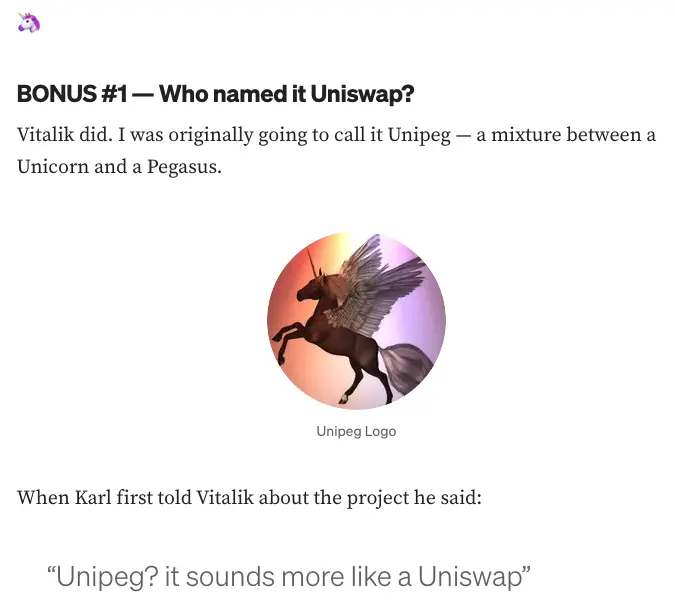
“Uniswap” replaced “Unipeg” as the name of the $70 billion DeFi blue chip.
Eight years later, in April 2026, an anonymous developer (Twitter handle @unipegv4, rumored to be associated with the 0xHadrian blog) revived this abandoned name, giving it new meaning: Uni + JPEG = uPEG. The NFT community has long jokingly referred to images as "JPEGs"; since this asset was born in a Uniswap pool, it became Uniswap’s JPEG.
The story itself is viral-grade material. It brings together Hayden’s personal anecdote, Vitalik’s offhand comment, NFT jargon, and the new V4 mechanism—all wrapped up in one name.
The story of "uPEG" is easy to tell and highly shareable, attracting OpenSea CMO Adam Hollander, who retweeted on April 25 saying: "I'm interested in this concept—buying a little to try it out."
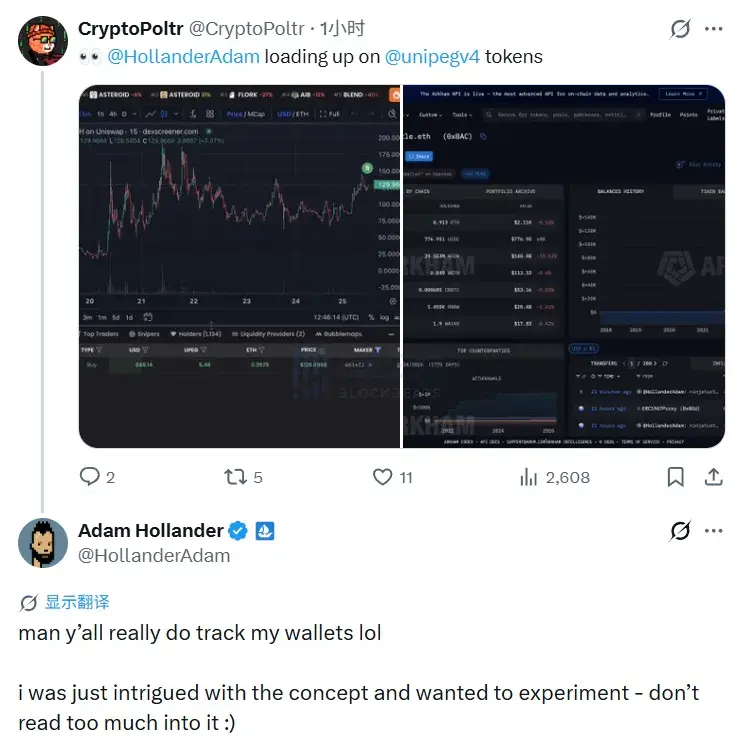
That night, uPEG surged threefold, followed by Uniswap team member niko, Ouroboros co-founder Nafay, and meme coin KOL pow, who all posted their uPEG holdings on X. Within two weeks, uPEG skyrocketed from $0 to a $34.44 million market cap, with a price of $982.
Related reading: “Market Cap Surpasses $23 Million, Setting a New High: What Makes the New Image Dog Unipeg So Special?”
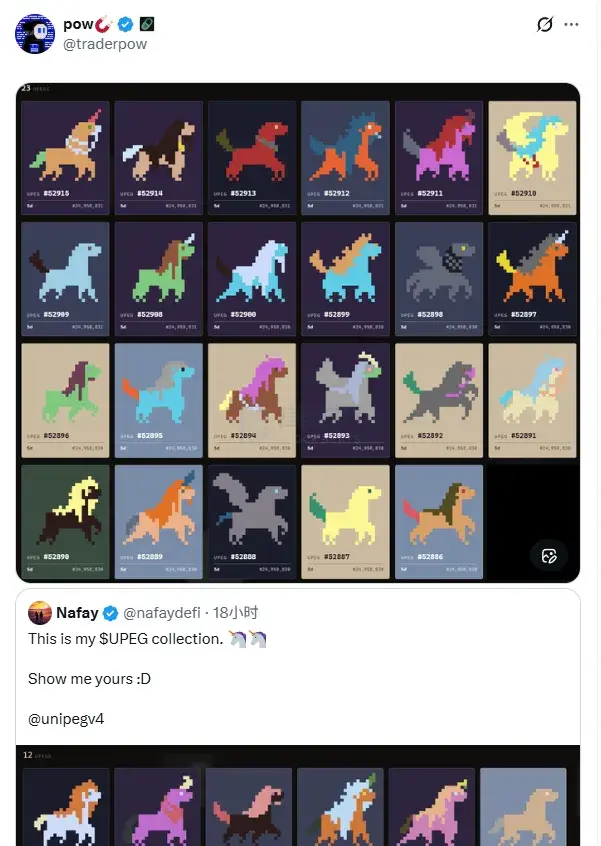
Meme coin KOL power promotes uPEG
After uPEG, "Slonks" launched on May 1.
Developer Hirsch did something that sounds bizarre: he embedded an AI image generation model—just 214KB in size, about the size of a low-resolution phone wallpaper—directly into an Ethereum smart contract. The model’s task is to replicate 10,000 CryptoPunks.
But a 214KB model cannot remember 10,000 faces. With each image consisting of 576 pixels, the model averages about 24 incorrect pixels—roughly a 4% distortion rate. Only 32 out of 10,000 images were perfectly replicated; the rest were all “distorted punks.”
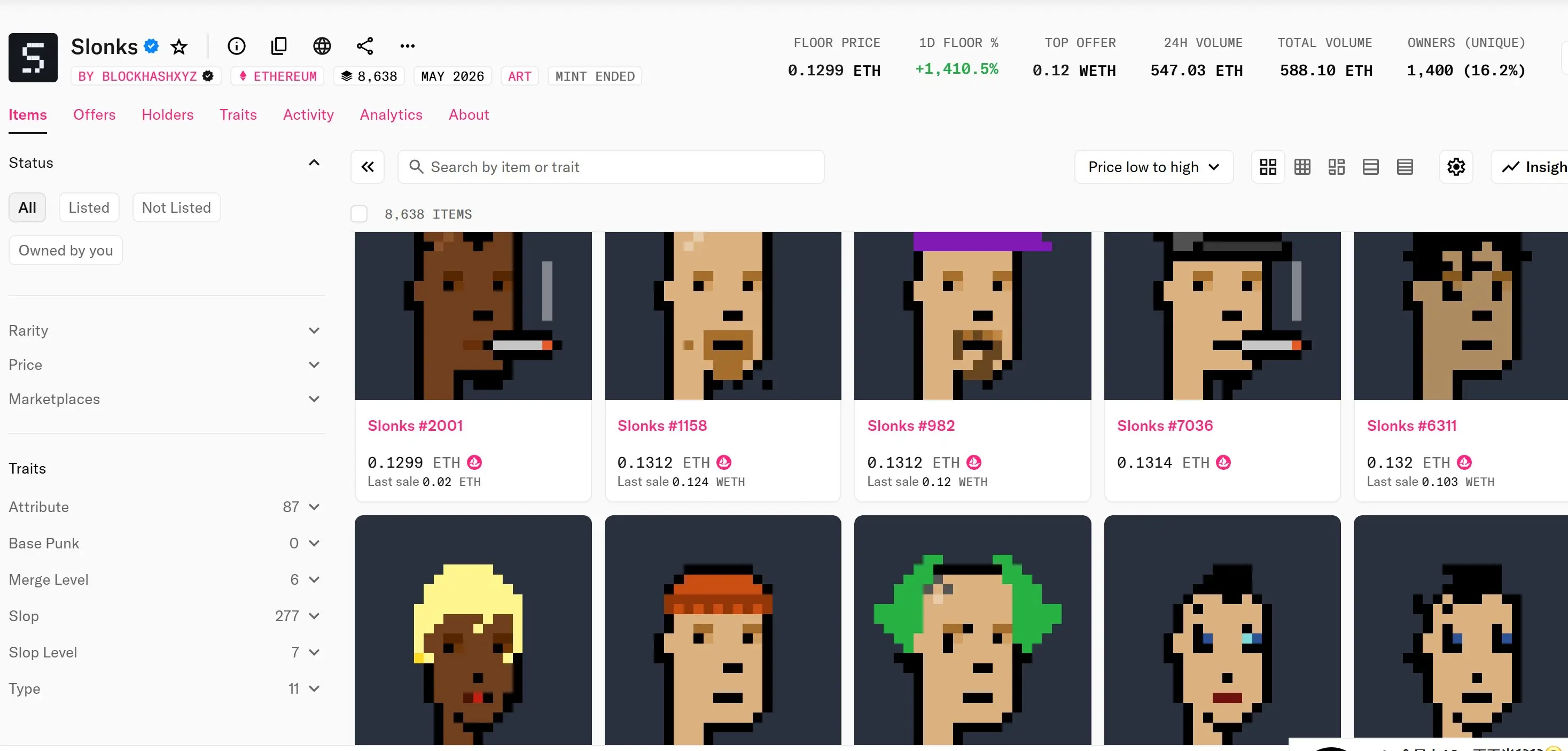
slop legend
Hirsch called these misrendered pixels "slop." Then he posted the project's ethos on Twitter: "The slop is not a bug. It is the medium."
The entire economic model is built on the principle that "the more wrong, the more valuable." Two Slonks of the same rank can be merged—burn one to upgrade the other, and the new Slonk’s slop only increases. Any Slonk can be sent to the void to mint future $SLOP tokens at a 1:1 ratio based on its slop count (not yet officially launched). Every action is executed via a V4 hook and is verifiable on-chain.
Slonks didn’t become popular right after launch; for the first few days, it was nearly overlooked amid the spotlight of uPEG’s $30 million market cap. The floor price stagnated around 0.005 ETH, with little discussion on OpenSea—until a group of veteran NFT insiders on X collectively tweeted, turning the phrase “a mistake is art” into a shareable meme. Simultaneously, further detection of on-chain smart money, followed by promotion from KOLs and media, and being featured on OpenSea’s trending homepage drove traffic distribution, causing Slonks to surge 60x in five days.
In summary:
The significance of SATO lies in its fundamental proof that "V4 hooks can enable new economic models," which serves as the foundation for the later emergence of uPEG and Slonks.
The significance of uPEG lies in translating the DeFi concept of V4 hook to the NFT community. Retail investors suddenly realized that hooks aren't just toys for DeFi enthusiasts—they can create things they themselves want to buy.
Slonks built stronger narrative hooks and an engaging economic model on the attention红利 created by uPEG, further advancing the V4 Hook narrative.
What should you focus on to seize the next opportunity?
Foreign V4 Hook core circle, Lvdong editors mainly recommend the following users:
Hayden Adams (@haydenzadams), founder of Uniswap, speaks for itself.
saucepoint (@saucepoint), the godfather of Uniswap Foundation hooks and author of v4-template, whose templates serve as the starting code for nearly all hook projects.
The Builder Update, released by Uniswap official (@Uniswap) and the Uniswap Foundation (@UniswapFND) every Wednesday or Thursday, is the most important official signal source in the space.
Niko (@niko_eth), a member of the Uniswap Labs team, delivered a crucial leg in the first wave of KOL relay for uPEG.
horsefacts (@horsefacts_eth), one of the earliest builders of the V4 hook and a technical trendsetter.
Adam Hollander (@AdamHollander), CMO of OpenSea and an early ecosystem advocate for Hashmasks and Pudgy Penguins, is a key messenger bridging the DeFi and NFT communities in this wave.
Project accounts: uPEG Official (@unipegv4), Unimon Official (@unimonapp), Slonks Official Account, SATO Official (@Satothedog). Observing who they follow and interact with often reveals the next upcoming hook project not yet mentioned.
In addition, we can also follow some V4 hook and Uniswap-related websites:
HookRank.io is currently the cleanest V4 hook explorer, featuring 1,300+ hooks all listed and sorted by TVL/Volume/Fees, with «New» and «Trending» tags. This is the first place to discover hooks that haven’t yet been mentioned on Twitter but are already showing strong data.
HookAtlas.com is a directory of hook projects with project descriptions, ideal for mapping.
Uniswap Foundation Builder Update — Blog update; the foundation releases this once per week on Wednesday or Thursday, ensuring that core users following the Uniswap ecosystem won’t miss the hottest narratives.
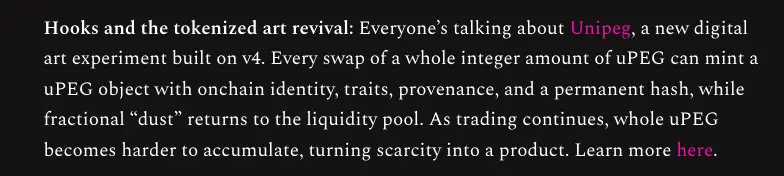 The latest Blog also mentioned community news such as "Hooks" and "Unipeg"
In the Unichain Infinite Hackathon, nearly all winning projects are seed projects, allowing us to identify core projects on Unichain.
Dune Uniswap V4 Tracker, view total hook count, TVL distribution, and chain volume distribution.
DexScreener is a widely used cryptocurrency charting platform for monitoring newly created V4 pairs, serving as an early indicator of projects before they are amplified by KOLs. For example, when uPEG’s holder count surged from 200 to over 4,000 within 24 hours, that steep slope itself was a clear signal.
Slonks appeared on OpenSea’s Trending list on its second day, a feat that typically takes regular NFT projects weeks of marketing to achieve. Meanwhile, on May 8, Slonks recorded a single-day trading volume of 575 ETH, surpassing CryptoPunks’ 129 ETH—any new project outperforming CryptoPunks in daily volume signals a sector-level movement.
The GitHub project awesome-uniswap-hooks lists all hook experiments, making it ideal for discovering early projects with interesting designs that don’t yet have a token.
The next phase of the V4 Hook narrative
Based on an off-the-cuff, unverified guess from our editorial team, if the V4 Hook narrative doesn’t immediately fade, the next wave of narratives will likely follow three trajectories in chronological order: short-term, a SATO bug-fix rally; medium-term, the composability of Hook; long-term, Unichain becoming the central hub of the entire sector.
First, there’s a short-term SATO bug fix pump, and you can see plenty of discussion about it in various group chats today.
The reason SATO has this kind of "fixing patch" called sat1 stems from its hook contract. Any V4 hook that wants to replace Uniswap’s standard pricing must maintain its own ledger of "how much money is in the pool" to calculate its own pricing curve. However, the Uniswap PoolManager also maintains a separate, actual ledger. With two ledgers existing simultaneously, they must be synchronized on every swap. If the synchronization logic is not implemented rigorously, the two values will gradually diverge—a phenomenon known in the hook engineering community as dual-state drift.
Arbitrage opportunities arise from discrepancies. At a certain moment, the hook internally assumes 1 SATO equals X ETH, but the pool’s actual reserves show Y ETH—the difference is claimed by whoever detects it first. The two addresses that profited $360,000 didn’t exploit market sentiment; they exploited an accounting flaw in the contract.
sat1 positions itself as "one curve, single state," using just one ledger with no drift. While the engineering fix is reasonable, the narrative is deliberately manipulative—it tells retail users, "SATO had a bug; I'm the correct version," aiming to seize legitimacy.
This strategy isn't unique to V4. The Bitcoin ecosystem had ORDI, SATS, 1000SATS; the ERC-404 era had Pandora, DN404, ERC-404 V2; the pump.fun era had BankrFun and ClankerFun—each successor claimed to have fixed the issues of the previous one.
The essence of a bugfix pump is not technical repair, but narrative appropriation. It doesn’t need to actually fix anything—it just needs to make the idea that “the original pool had a bug” become consensus on Twitter, and liquidity will naturally shift from the original pool to the new one.
The V4 hook has reduced the cost of this script to an unprecedented low. The hook is open-source—fork it and change three lines of code to deploy it. Every successful hook project comes with a built-in copycat generator. SATO/sat1 is the first pair of templates; others like uPEG2 and Slinks are inevitable.
By mid-term, we can look forward to the composability of hooks.
In V4, a single pool can only have one hook attached. However, some developers are already creating "meta-hooks" that internally call multiple sub-hooks to achieve combined behaviors.
Once this is operational, uPEG’s image generation, Slonks’ NFT-token exchange, and SATO’s bonding curve can all coexist within the same pool. A single swap will trigger image generation, update the pricing curve, and mint an NFT simultaneously.
There are many possible directions to explore: using swaps to trigger music or audio generation (replacing SVG with MIDI, since audio is easier to spread than images); using swaps as an identity or reputation system (updating soul-bound points with each swap); integrating a prediction market hook (treating swaps as bets, running a Polymarket-style model within LPs); implementing a time-based hook (reducing sell taxes the longer an asset is held); or enabling cross-collection fusion mechanics (using hooks to combine Pudgy Penguin and Azuki into new forms—most feasible between CC0 projects).
BlockBeats editors believe that composability is the true ceiling of this space; isolated mechanisms are merely demos.
Looking further into the long term, Unichain could become the next hot chain.
It’s not because of its superior technology, but because of Uniswap Foundation’s funding, traffic, and whitelist preferences. Projects on Unichain have an order of magnitude higher chance of being featured in official Builder Updates than those on Ethereum mainnet.
If you want to catch the earliest signals, BlockBeats editors also recommend setting up a separate monitor for Unichain: check the number of hook deployments on Dune’s Unichain dashboard, monitor TVL and active addresses on L2Beat, and keep an eye on new tool updates via the official builder toolkit.