




Author: BlockWeeks
In traditional tech, Google is Google, and Stripe is Stripe. But in the crypto world, when you talk about Uniswap, you’re actually referring to two entirely different entities: a non-profit “steward” — the foundation — and a for-profit “engine” — Uniswap Labs.
This "dual-head structure" is not only a shield to evade regulation, but also a fundamental divergence in business logic between cryptocurrency companies and traditional tech firms. When the Uniswap Foundation (UF) laid its latest quarterly operational report out in the open, it essentially revealed an extremely peculiar business landscape: an organization holding millions in cash and tokens worth hundreds of millions, producing no product and generating no direct profit, existing solely to serve as the steward of a "public protocol."
This "foundation + development entity" dual-structure represents a large-scale rebellion against the traditional business logic of tech companies, but this rebellion has also brought unprecedented operational challenges.
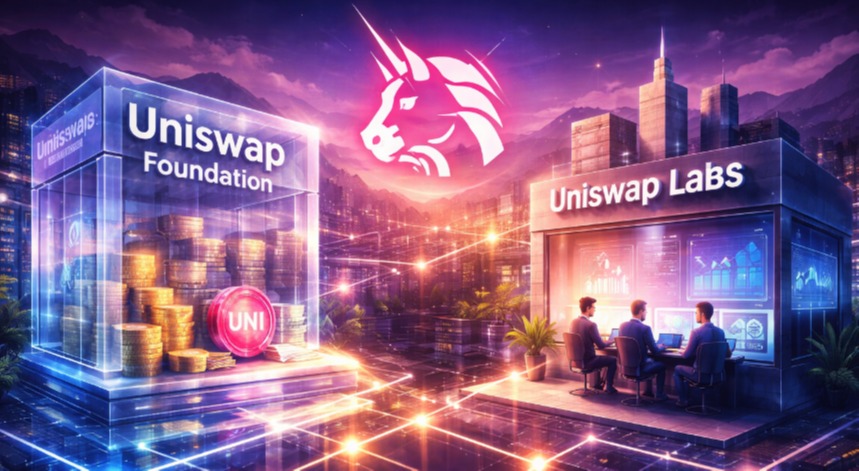
Foundation: A nonprofit caretaker living in a glass house
Taking the Uniswap Foundation's (UF) latest 2025/2026 fiscal year report as an example, we can observe the typical characteristics of this nonprofit entity. On paper, UF holds approximately $49.9 million in cash, 15.1 million UNI tokens, and some ETH. However, its operational mission is not to "sell a product," but to distribute grants and engage in governance. It requests budgets from the DAO through proposals such as "Uniswap Unleashed," then allocates funds to developers and researchers.
The core challenge of this model is that it must be extremely transparent. Unlike traditional companies where executives hold closed-door meetings, every dollar spent by the foundation and the establishment of every legal entity (such as the newly created DUNI entity) is scrutinized under a magnifying glass by global users on Twitter and community forums.
Compared with other ecosystems, this model is clearer:
- Ethereum Foundation (EF): Like Uniswap, the EF does not control Ethereum. In its 2026 roadmap, the EF is focusing significant resources on the "Glamsterdam" upgrade and research into quantum resistance (PQ team). Its core operating principle is "neutrality"—if the EF behaves like a profit-driven company, Ethereum’s decentralization narrative will collapse.
- Solana Foundation: Its focus is on ecosystem expansion. In early 2026, the Solana ecosystem's TVL reached a new all-time high, and the foundation's core mission is to support institutional adoption, such as BlackRock’s BUIDL fund.
Development entity: Silicon Valley elites dancing with chains
Across the street from the foundation are Uniswap Labs, Consensys (Ethereum ecosystem), or Solana Labs. These are real tech companies: they have CEOs, venture capital funding, and pursue profitability.
But their revenue model faces a “misalignment” dilemma. Traditional tech companies profit from their core protocols (e.g., if TCP/IP charged fees), but the Uniswap protocol is freely open-source. Uniswap Labs’ revenue does not come directly from protocol fees, but rather from the front-end apps and wallets it develops. The small fees it charges on its app interface are a typical business practice. This mismatch—“code public, service private”—forces crypto company operators to walk a tightrope, balancing the “decentralized narrative” against the pursuit of commercial profit. Cross the line, and they risk being accused by the community of “centralized evil.”
In terms of talent and incentives, these companies attract top engineers through substantial token incentives. The key difference from traditional companies’ employee stock ownership plans (ESOPs) is that tokens are immediately liquid, making team stability highly vulnerable to market bull and bear cycles. Employee loyalty is closely tied to token prices—when UNI or SOL surge, every engineer becomes a believer in “changing the world”; but when the market enters a deep bear phase, this instantly liquid wealth rapidly diminishes, causing talent to migrate en masse to the next hot trend.
Three fundamental differences between crypto companies and traditional tech companies
The boundary between "public goods" and "private property" is blurred.
In traditional companies, code is IP (intellectual property) and a moat. In the crypto world, code is a "public good." Anyone can write Hook plugins for Uniswap v4. The challenge for operators is: how do you retain users in an environment where everyone can freely fork your code? This forces companies to shift from "selling products" to "selling brands" and "selling liquidity."
This paradox of a “public good” creates deeper operational challenges: why is it so difficult for great protocols to directly sustain their creators? Uniswap Labs (the development entity), as the builder of this engine, cannot directly take a cut from the protocol’s hundreds of billions in trading volume—those funds belong to liquidity providers (LPs). As a result, Labs can only earn modest “service fees” outside the protocol, much like setting up a stall in a public park.
2. Governance friction: When "users" become "board members"
At Meta, Zuckerberg wants to push VR and doesn’t need to ask every Facebook user. But at Uniswap, any major operational change—such as turning on the “fee switch”—must be voted on by UNI holders. This “governance tax” leads to extreme decision-making delays: what a traditional company can decide in a week may take a crypto project six months to negotiate.
From the perspective of the foundation, we can clearly see the high cost of this “governance tax.” Any major grant from the Ethereum Foundation (EF) or the Uniswap Foundation requires a lengthy process of proposal, disclosure, debate, and voting. This is not merely a cumbersome procedure—it is a form of psychological drain and internal friction.
For operators, their "board of directors" is not a handful of suited professionals, but thousands of emotionally volatile token holders. Take Solana as an example: its ecosystem expansion relies heavily on the foundation’s incentive programs, yet the transparency of every large expenditure often becomes a target for community backlash. This "cost of transparency" leads to severe delays in decision-making. In a fast-moving financial market, while traditional financial giants make decisions in seconds, crypto protocols may still spend three months debating a single parameter adjustment on forums. This "mediocrity of democracy" is every crypto operator’s nightmare when striving for maximum efficiency.
3. The Legal Entity's "No Man's Land" and Identity Anxiety
Traditional tech companies pay taxes in their jurisdiction of incorporation and are protected by the law. In contrast, crypto companies—especially Labs—have long been caught in a regulatory cat-and-mouse game. Uniswap Labs has been engaged in prolonged legal battles with the SEC for years. As a result, legal and compliance costs represent a significantly higher proportion of operating expenses for crypto companies compared to typical SaaS firms.
This kind of "legal engineering" expense stands out sharply on the Uniswap Foundation's bills. It’s not just about money—it’s about diverted energy. While traditional tech companies focus on optimizing algorithms, top executives at crypto companies often spend their time consulting lawyers on how to avoid a regulatory subpoena from across the ocean.
The article mentions that the Uniswap Foundation established legal entities such as "DUNI," reflecting one of the most frustrating realities in crypto operations: identity anxiety. Traditional companies, upon registration, have clear legal frameworks governing taxes, labor, and contract law. Yet crypto entities—especially those attempting to be decentralized foundations—must invent complex legal structures to interface with the real world. They must grapple with questions like: How do you pay anonymous developers distributed globally? How do you exercise governance without being classified by the SEC as an unregistered exchange?
From "Utopia" to "Coming of Age": The Business Philosophy of the Dual-Head Structure
According to the Uniswap Foundation report, crypto giants are undergoing a "coming of age":
- From burning cash to precision: The foundation has begun calculating its runway, with UF’s funding plan scheduled through 2027. This “doomsday countdown” approach demands operators possess strong cycle management skills—not just focusing on business, but constantly monitoring treasury balances and token sell pressure.
- Structural compliance: Introducing legal entities such as DUNI is intended to give decentralized protocols a "legal embodiment" in the real world.
- Checks and balances: The foundation handles “abstract” matters (ecosystem, security, governance), while Labs handles “concrete” tasks (products, experience, profitability).
The best business is one where you are no longer needed.
If traditional tech companies are authoritarian kingdoms pursuing efficiency, then cryptocurrency companies are federal governments seeking consensus amid chaos. Though less efficient and noisier, their “irreversibility” and “transparency” are precisely what give them the confidence to support trillions of dollars in global financial assets.
This report from the Uniswap Foundation is essentially a health check for an industry transitioning from its wild, early days into maturity. It reveals that operating a crypto company is not simply about writing code and launching tokens, but about navigating extreme tensions across four dimensions: the ideal of decentralization, the noise of the community, the iron fist of regulation, and the drive for commercial survival. Unlike traditional tech companies, they are more like “digital city-states,” whose core challenge is no longer monopolizing resources, but rather gaining room to survive in a world that is fully transparent and constantly vulnerable to forks—by building consensus.
This model is less efficient and more friction-heavy, but also more resilient. As the report shows, although the Uniswap Foundation generates no revenue, as long as consensus endures, this autonomous financial machine will continue to operate. This may be the crypto industry’s most profound disruption of traditional business logic: the best business is one that ultimately renders itself unnecessary.