




Author: Gu Yu, ChainCatcher
In the crypto industry, the pace of innovation is often a key indicator of a protocol’s vitality. However, Uniswap, which once single-handedly launched the DeFi Summer, appears to be slowing down.
Looking back at Uniswap’s evolution, its iteration pace has always been known for its speed: V1, launched in 2018, introduced the AMM mechanism; V2 in 2020 brought ERC-20/ERC-20 pairs; V3 in 2021 introduced concentrated liquidity; and V4 in 2023 proposed programmable Hooks. On average, every 1.5 years, Uniswap has introduced an innovative mechanism that reshapes the flow of hundreds of billions of dollars.
However, as of April 2026, nearly three years since the announcement of the V4 proposal, the market has still seen no updates on Uniswap’s next version.
Currently, Uniswap’s product developments remain centered on Uniswap V4, which transforms Uniswap from a fixed-function AMM into a highly programmable liquidity platform. The core innovation of this version is Hooks—modular, programmable plugins that enable developers to insert custom logic throughout the lifecycle of a pool, allowing for nearly unlimited functionalities such as dynamic fees, limit orders, TWAMM (Time-Weighted Average Market Maker), MEV protection, loss hedging, custom oracles, and Continuous Liquidation Auctions (CLA).
Previously, many developers needed to fork Uniswap to implement specific features, causing Uniswap’s liquidity to be fragmented across numerous forked DEXs. Now, developers can significantly enhance the customization of Uniswap liquidity pools by simply writing a Hook contract.
Although Uniswap announced the specific design of its V4 version in June 2023,出于安全考虑,该版本经历了九次独立审计和大规模安全竞赛,导致其主网上线时间从原定的2024年第三季度推迟至2025年1月底。
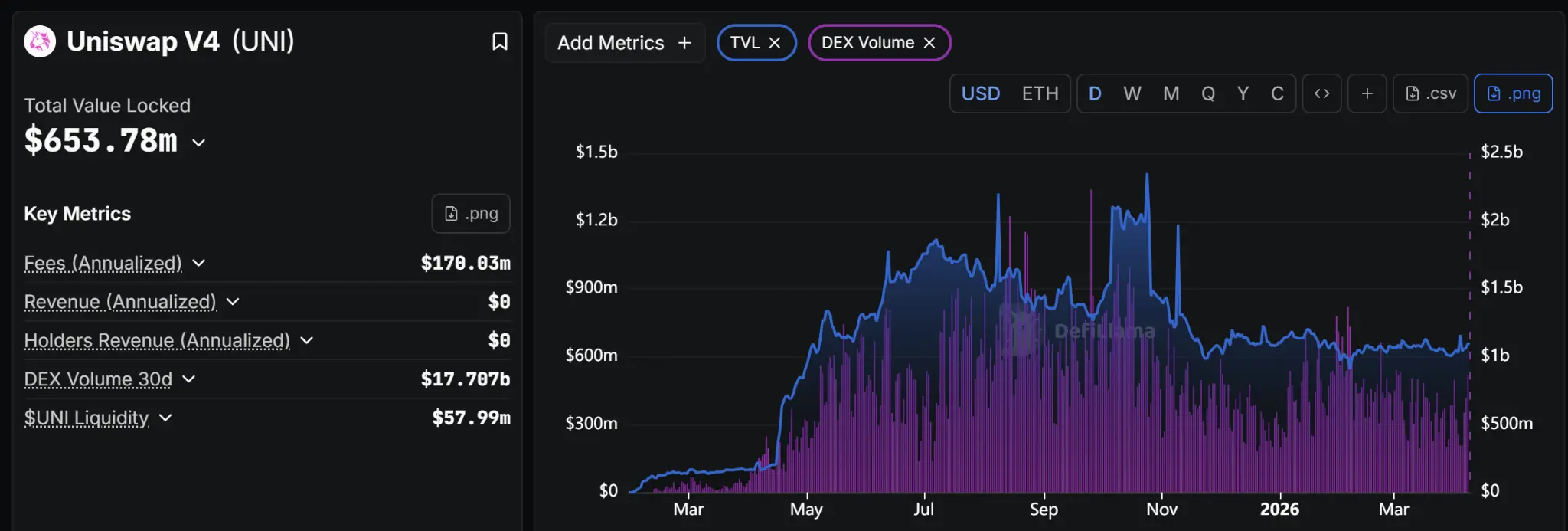
After launch, Uniswap V4's total value locked peaked above $1.2 billion, but has since declined to $650 million—still only 40% of V3's levels and below V2's.
At the same time, Uniswap is also accelerating its expansion in use cases and markets. Over the past six months, Uniswap has simultaneously launched on emerging blockchains such as Linea, Tempo, X Layer, and Monad to secure early market positioning, while also aggressively expanding its API partnerships—recently announcing adoption by Anchorage Digital, Ledger, Privy, and MetaMask.
Of course, Uniswap has not been inactive on the product front in recent years—for example, its application chain and CCA token auction products have generated significant market interest.
In February 2025, Uniswap launched its application chain, Unichain, which went live on mainnet and attracted integration from over 90 DeFi protocols; TVL has since declined from a peak of $900 million to $36 million.
By the end of 2025, Uniswap announced the launch of the Continuous Auction mechanism (CCA), specifically designed for price discovery and liquidity initialization of new assets, and subsequently partnered with Aztec and Rainbow to complete token sales.
However, it must be noted that at this 2025 milestone, application chains and token auctions are very outdated business models in the crypto space, with many projects facing stagnation in their core operations exploring initiatives like “launching chains” and Launchpads. Uniswap has also begun following this trend, but its actual impact remains very limited.
In earlier years, Uniswap also made significant acquisitions of products such as Genie and Crypto: The Game to explore the NFT trading market and on-chain gaming, but subsequent data revealed these two acquisitions were unsuccessful.
Over the past year, the departure of Uniswap’s Head of Growth Sarina Siddhanti, Chief Operating Officer Mary Catherine Lader, Head of Strategy and Operations Zach Wong, Chief Legal Officer Katherine Minarik, and Head of Venture Capital Julia Rosenberg reflects Uniswap’s efforts to control operational costs and address sluggish growth.
Uniswap’s overall decline is also reflected in the price of its governance token, UNI. Over the past year, UNI’s price has dropped by more than 74%, falling below $2 at its lowest point—significantly exceeding the overall decline of major cryptocurrencies and sparking criticism from market analysts who claim the UNI token has “no real value.”
In September 2025, Arca’s Chief Investment Officer Jeff Dorman replied to a tweet from Uniswap founder Hayden Adams about the protocol’s data performance: “We’re not bearish on Uniswap, but we are bearish on UNI. In today’s market and evolving regulatory environment, it’s just a completely meaningless token. Your stance and your venture capitalists’ opinions don’t matter—either shift to a model that distributes revenue or conducts buybacks, or just don’t have a token at all.”
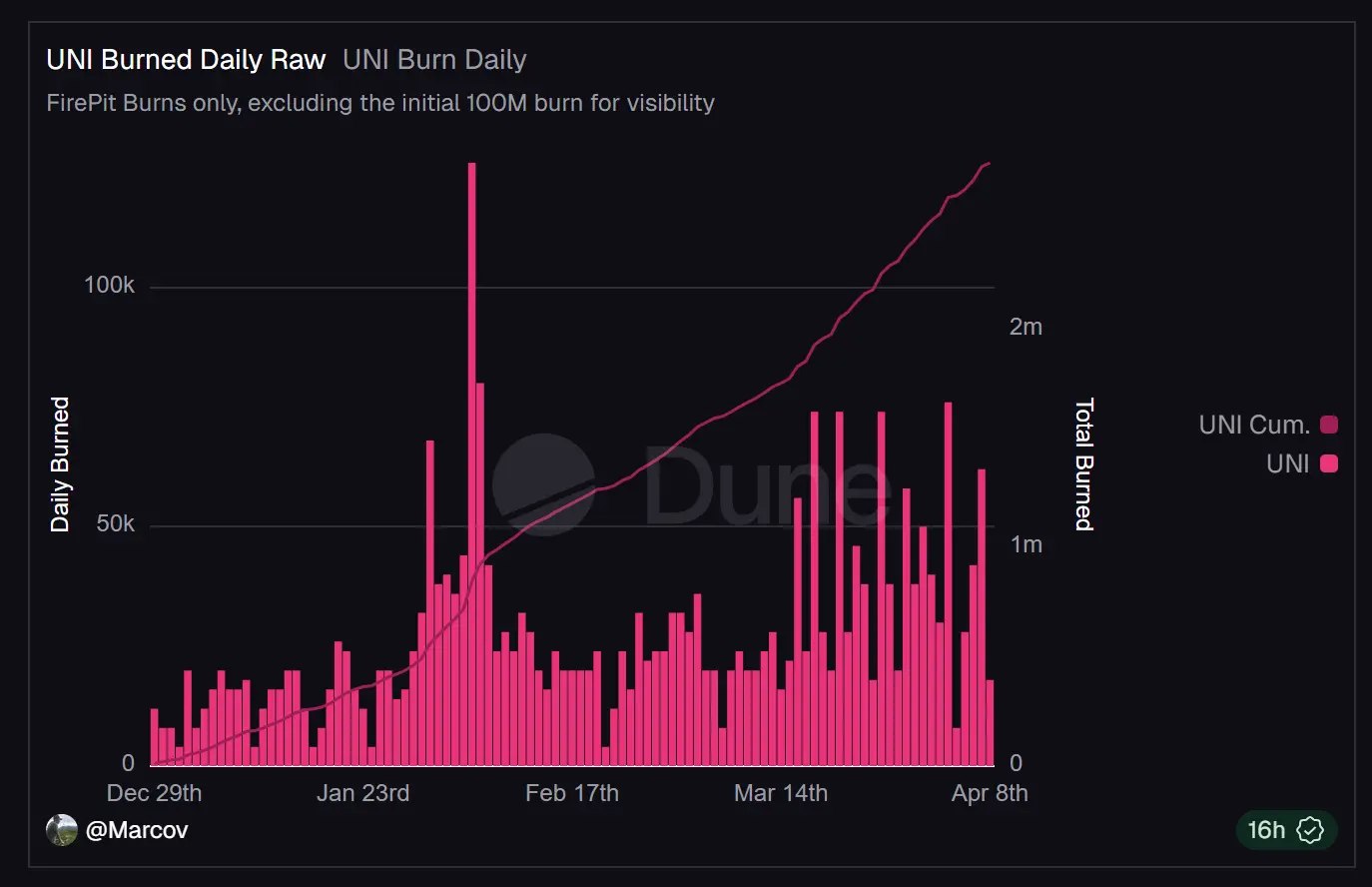
To address market concerns and add further value to UNI, the Uniswap Foundation launched a proposal in November last year to activate the protocol fee switch for Uniswap V2 and V3, using the fees to repurchase and burn UNI tokens, while also burning 100 million UNI from the treasury. Following this, UNI surged nearly 38% in a short time, peaking above $9.
According to DeFiLlama data, Uniswap’s daily fee income has recently ranged between $100,000 and $200,000, with a 30-day total of $3.93 million, resulting in an annualized income of approximately $46 million—still trailing other DeFi protocols such as PancakeSwap, Jupiter, Lido, and Aave.
Uniswap’s predicament reflects and mirrors the broader bleak state of the DeFi industry: a lack of foundational innovation, exhausted narratives, and liquidity continually drained by fragmentation and zero-sum competition.
However, Uniswap remains one of the few top DeFi protocols that have never been hacked, with no instances of protocol-level fund theft, and it is still the decentralized exchange with the highest total value locked, maintaining its industry standing and user trust.
But will there be a Uniswap V5? If so, when will it arrive? Can Uniswap continue to be the engine behind the next DeFi Summer?