





Original Author: Tanay Ved
Original Translation: Saoirse, Foresight News
Key Points
- Uniswap's fee toggle, through a token supply burn mechanism, links UNI tokens to protocol usage. Currently, fees generated by the protocol are used to reduce the UNI supply. This adjustment transforms UNI tokens from merely governance-enabled tokens into assets that can directly accumulate value.
- Early data shows that the protocol's annualized fees amount to approximately $26 million, with a revenue multiple of about 207 times. Around 4 million UNI tokens will be burned annually, a measure that has already incorporated high growth expectations into the $5.4 billion valuation of the UNI token.
- DeFi is gradually shifting toward a "fee-linked" token model. Mechanisms such as token burning, reward distribution for stakers, and "voting escrow (ve)" locking are all designed to more closely align token holders with the protocol's economic system, thereby reshaping the valuation logic of this field.
Introduction
By the end of 2025, the Uniswap governance passed the "UNIfication" proposal, officially launching the long-anticipated "fee toggle" feature for the protocol. This marks one of the most significant token economic transformations in blue-chip DeFi projects since 2020—coming at a time when the market is increasingly focused on "realized yield" and "fee-driven, sustainable value accumulation." Now, this fee toggle creates a more direct link between the UNI token, Uniswap's revenue, and trading activity. Uniswap itself is already one of the largest decentralized exchanges (DEXs) in the cryptocurrency space.
In this article, we will delve into Uniswap's token economic system after the activation of the fee switch, evaluate the dynamics of UNI token burning, the fee mechanism, and their impact on valuation, and explore the significance of this transition for the entire DeFi ecosystem.
Disconnection Between DeFi Tokens and Protocol Value
One of the core challenges facing the DeFi space is the disconnection between "strong protocols" and "weak tokens." Many DeFi protocols have achieved clear product-market fit, high usage, and stable revenue, yet the tokens they issue often serve only governance functions and provide token holders with little to no direct access to the protocol's cash flows. As a result, capital is increasingly flowing into areas such as Bitcoin, foundational layer-1 blockchains (L1s), and Meme coins, while the trading prices of most DeFi tokens become significantly disconnected from the actual value growth of the underlying protocols.
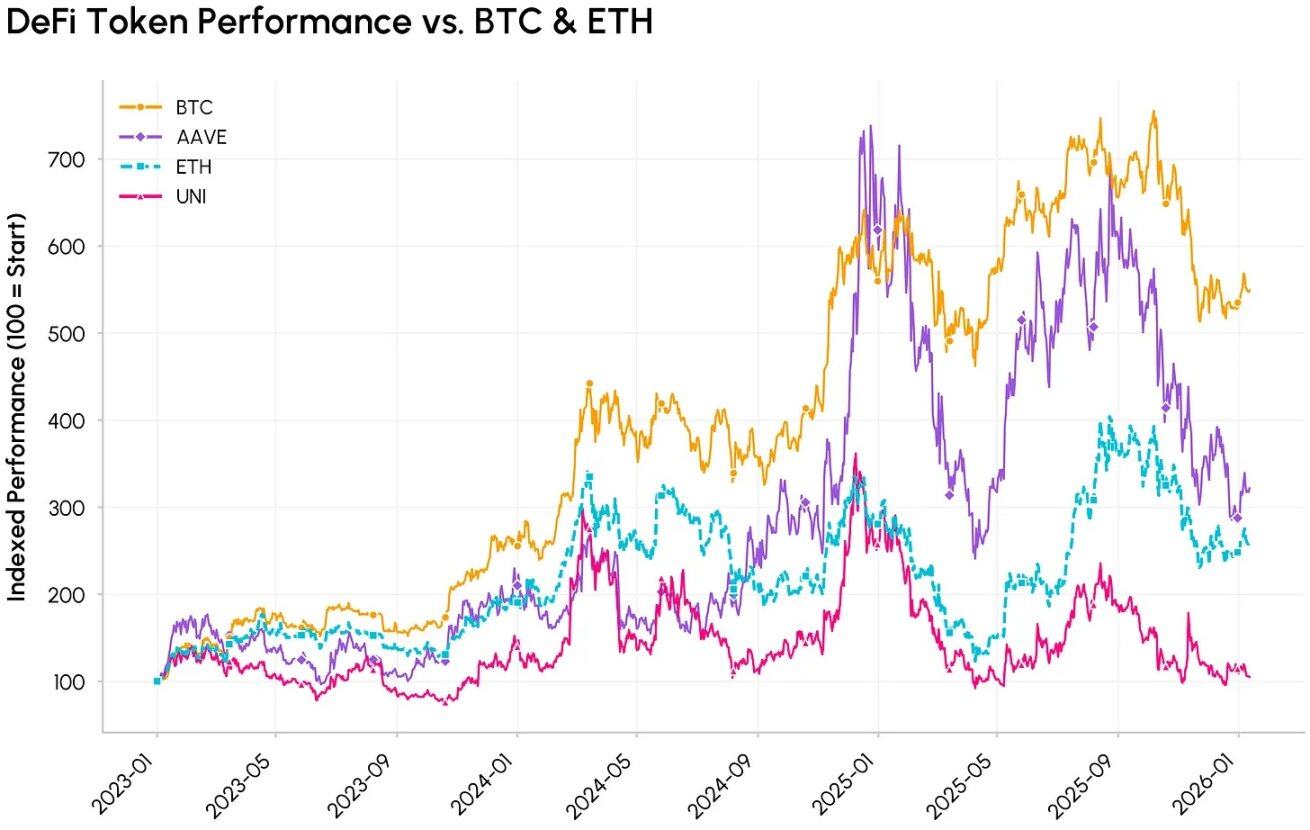
Comparison of the Index Performance of DeFi Tokens (AAVE, UNI) vs. Major Cryptocurrencies (BTC, ETH)
Uniswap launched on the Ethereum network as a decentralized exchange (DEX) in November 2018, designed to enable the order-book-free and intermediary-free exchange of ERC-20 tokens. In 2020, Uniswap issued the UNI token and positioned it as a governance token — a practice consistent with blue-chip DeFi projects such as Aave, Compound, and Curve, which primarily issue tokens for governance voting and user incentives.
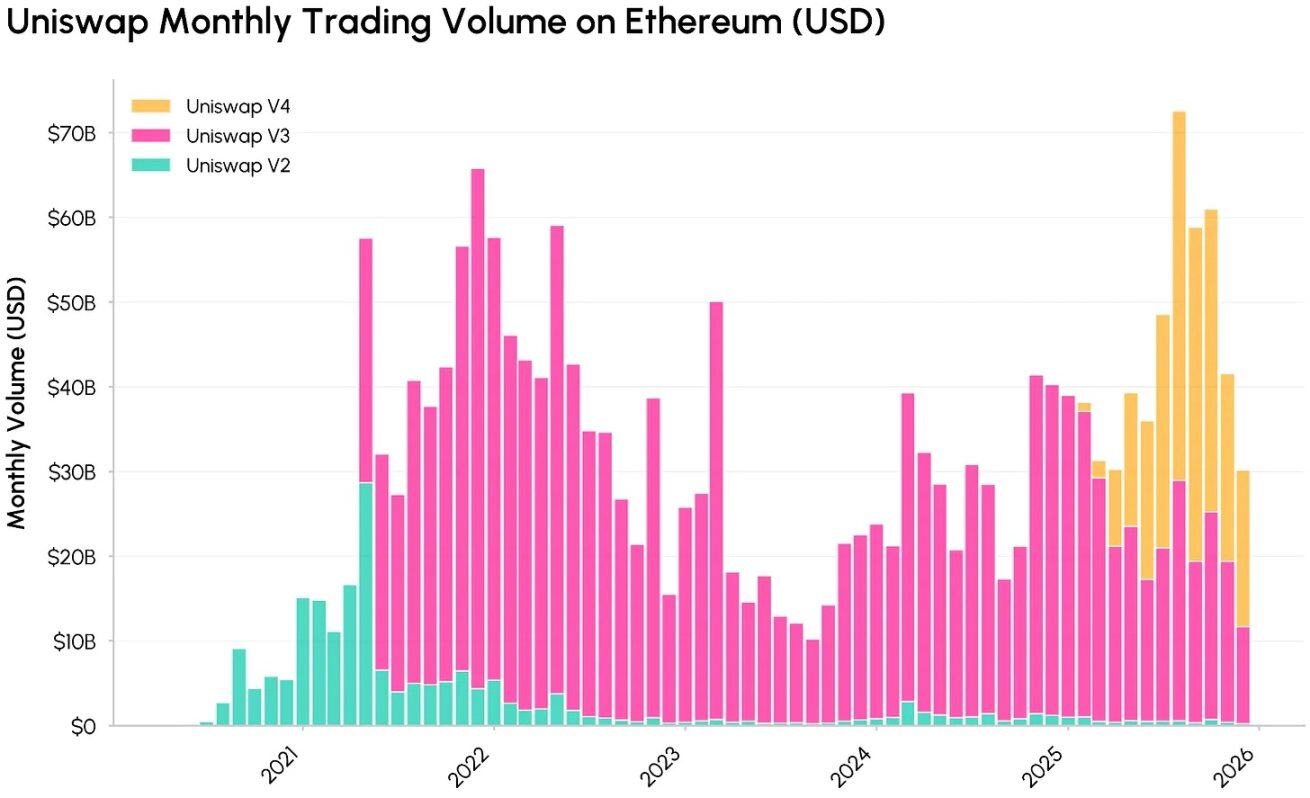
The monthly trading volume (in USD) trend across different versions (V2, V3, V4) of Uniswap on the Ethereum network. Source: Coin Metrics Network Data Pro
As the protocol has evolved, Uniswap has become a core component of on-chain financial infrastructure, processing billions of dollars in trading volume and generating substantial fee revenue for liquidity providers (LPs). However, like most DeFi governance tokens, UNI token holders are unable to directly receive a share of protocol revenue, leading to an increasing disconnect between the scale of the protocol's cash flow and the economic interests of token holders.
In fact, the value generated by Uniswap primarily flows to liquidity providers (LPs), borrowers, lenders, and related development teams, while token holders only receive governance rights and inflationary rewards. This contradiction between "governance-only" tokens and the "demand for value accumulation" laid the foundation for Uniswap's fee switch and the "UNIfication" proposal—this proposal explicitly links the value of the UNI token to protocol usage, aligning token holders more closely with the economic system of the decentralized exchange (DEX).
Uniswap Fee Toggle: Fee and Burn Mechanism
With the passage of the "UNIfication" governance proposal, the Uniswap protocol has introduced the following key adjustments:
- Activation of Protocol Fees and the UNI Burn Mechanism: Launching the "protocol fee switch" will channel protocol-level pool fees from Ethereum mainnet Uniswap V2 and V3 into the UNI token burn mechanism. By establishing a programmatic link between "protocol usage" and "token supply," the UNI economic model transitions from being "governance-only" to "deflationary value accumulation."
- Implement a retroactive treasury token burn: One-time burn of 100 million UNI tokens from the Uniswap treasury to compensate token holders for fees foregone over the years.
- Incorporating Unichain Revenue: Sequencer fees generated by the Unichain network (after deducting Ethereum Layer 1 data costs and Optimism's 15% share) will be fully integrated into the aforementioned "burn-driven" value capture mechanism.
- Adjust the organizational incentive structure: consolidate most of the Uniswap Foundation's functions into Uniswap Labs, and establish a 20 million UNI annual growth budget to enable Uniswap Labs to focus on protocol promotion. At the same time, reduce the fee share in interface, wallet, and API services to zero.
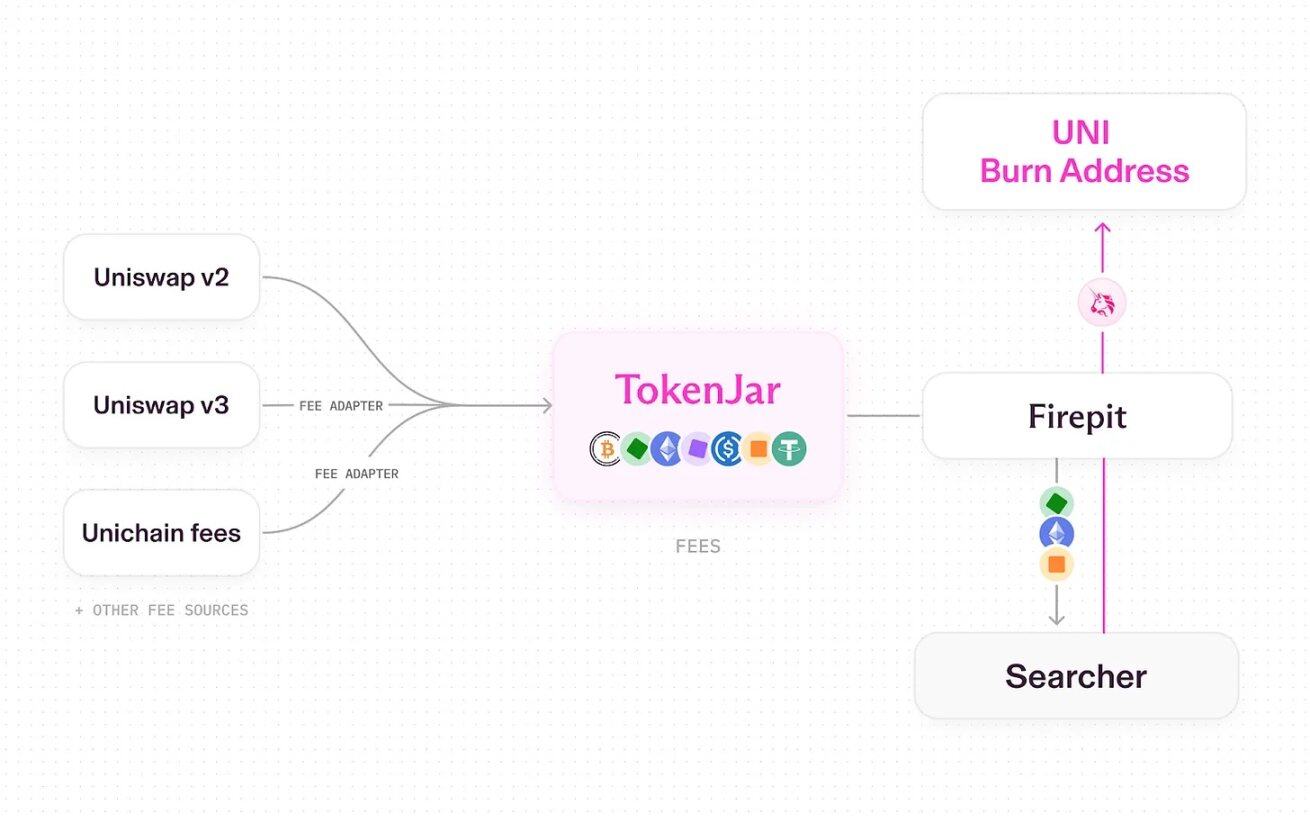
After the Uniswap fee switch is activated, the complete process of protocol fees being converted into UNI tokens for burning, source: Uniswap UNIfication
Currently, Uniswap operates in a "pipeline" model and uses dedicated smart contracts to handle the release and conversion of assets (such as the burning of UNI tokens). The specific process is as follows:
- Transactions on Uniswap V2, V3, and Unichain generate trading fees;
- A portion of the transaction fees belongs to the protocol (the remaining portion is allocated to liquidity providers);
- All protocol-level fees flow into a single vault smart contract on each chain, named "TokenJar";
- Value can only be released from the TokenJar when UNI tokens are burned through the "Firepit" smart contract.
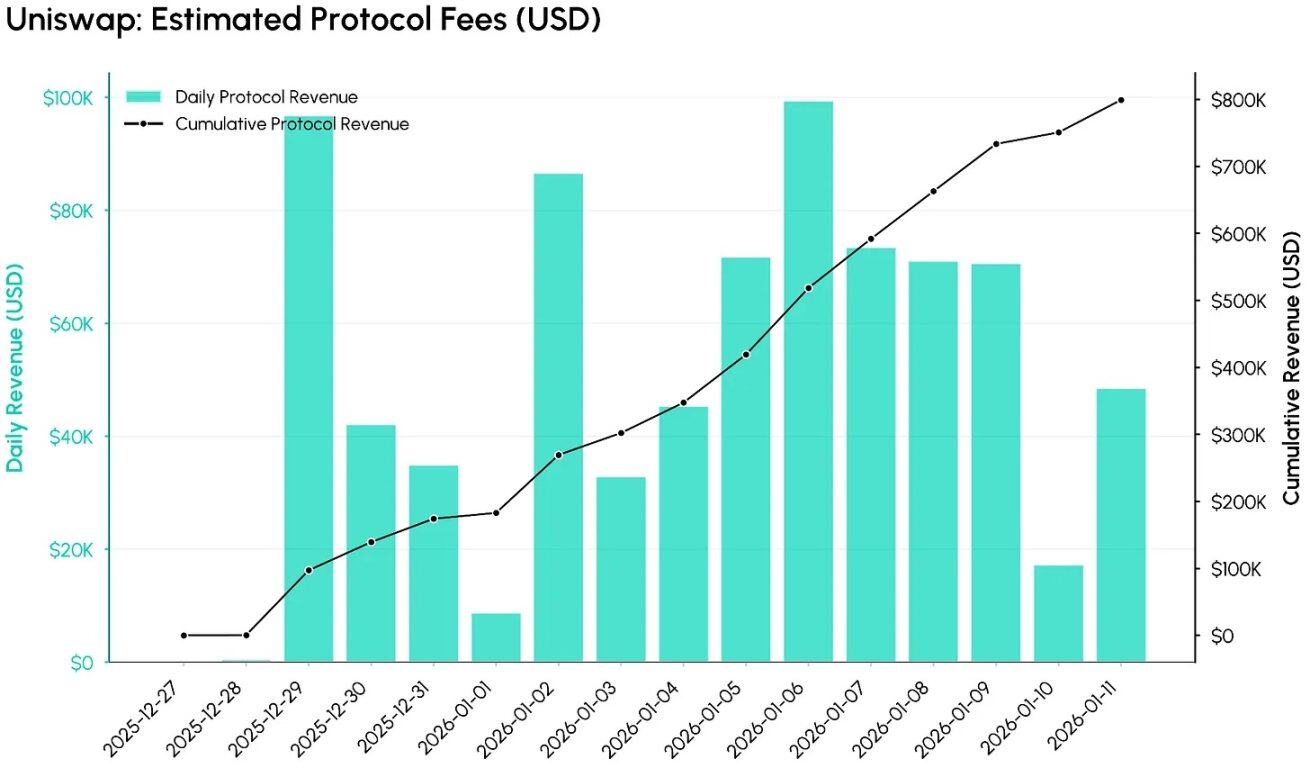
Protocol fee data after the Uniswap fee switch was activated (starting December 27, 2025), source: Coin Metrics ATLAS
According to Coin Metrics ATLAS data, a significant amount of protocol fees has already flowed into the system in the first 12 days after the fee switch was enabled. The following chart tracks the daily estimated protocol fees (in USD) and the cumulative total. It is evident that under the initial configuration, the fee switch quickly monetized Uniswap's trading volume—within just 12 days, the cumulative protocol-level fees reached approximately $800,000.
If current market conditions remain stable, the annualized revenue from this agreement is estimated to be approximately $26 to 27 million (for reference only). However, the actual revenue will depend on market activity levels and the progress of promotion of various liquidity pools and chain-based fee mechanisms.
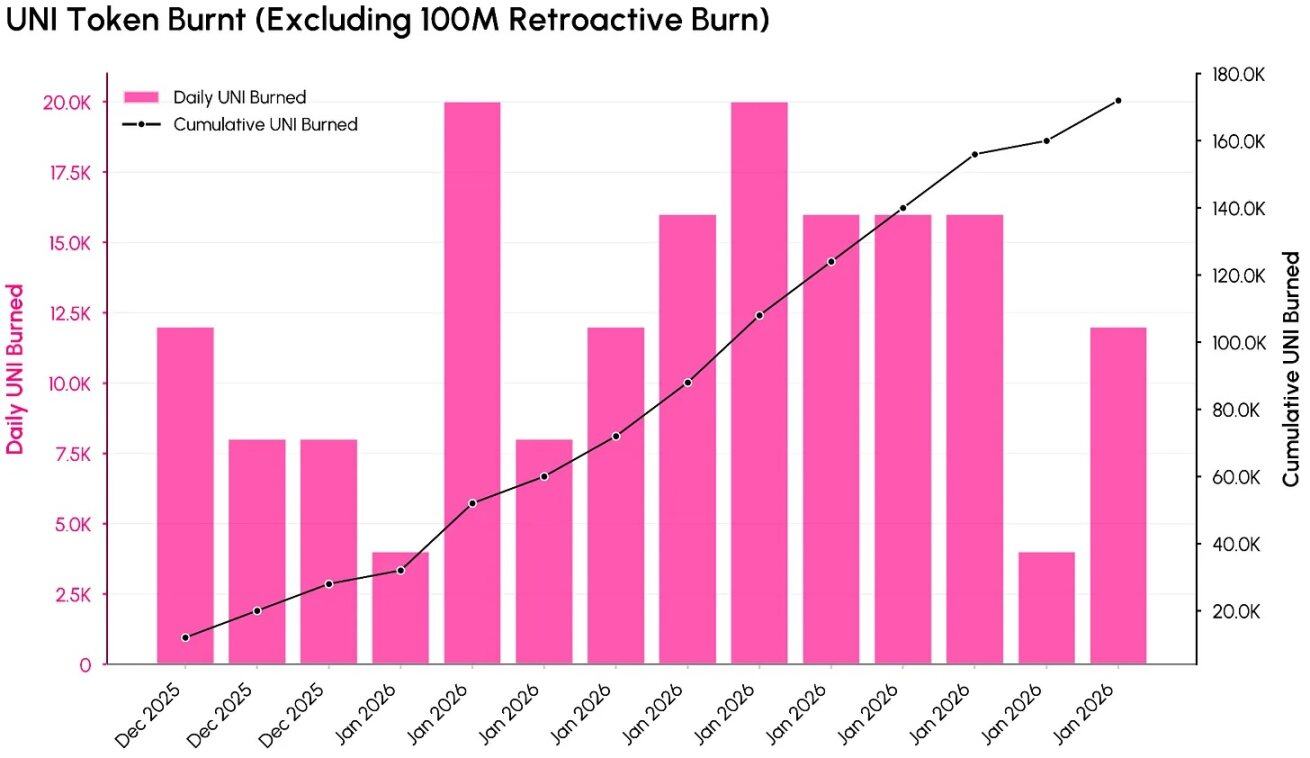
UNI token burn data after the Uniswap fee switch was turned on (excluding the retroactive burn of 100 million tokens), source: Coin Metrics ATLAS
The chart above illustrates how protocol fees are converted into a reduction in the UNI token supply (excluding 100 million tokens burned retroactively). As of the time of data collection, the total number of UNI tokens burned has reached approximately 10.017 million (valued at roughly $557 million), representing 10.1% of the initial total supply of 1 billion UNI tokens.
According to the burn data in the first 12 days after the "UNIfication" proposal took effect, the annualized UNI token burn rate is estimated to be approximately 4 to 5 million tokens. This figure highlights that the protocol's usage is now generating "cyclical and programmatic" UNI burns, rather than merely inflationary token issuance.
Valuation and Impact on the DeFi Sector
After the fee switch was activated, the valuation of the UNI token is no longer limited to its "governance function," but can now also be assessed from a "cash flow perspective." With a current market cap of $5.4 billion, and initial TokenJar data showing approximately $26 million in annualized protocol fees, the revenue multiple is about 207 times—this valuation is more in line with high-growth tech assets than with a mature decentralized exchange (DEX). If we exclude treasury burns, the annualized burn amount for UNI is approximately 4.4 million tokens, accounting for only 0.4% of the current supply. Relative to its valuation, the "burn rate" is at a relatively low level.
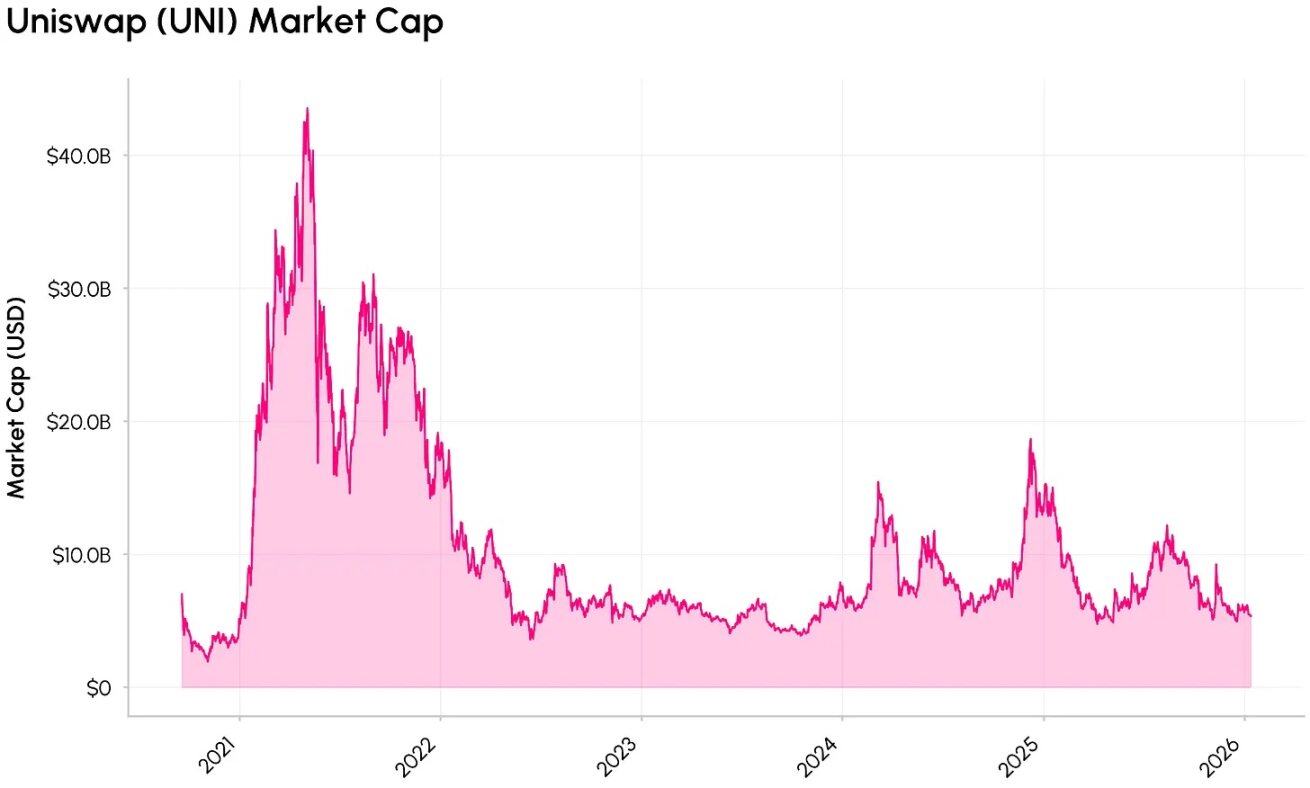
The market value change trend of Uniswap token UNI. Source: Coin Metrics Network Data Pro
This current situation highlights a new trade-off: although more explicit value capture mechanisms enhance UNI's investment appeal, current data suggests that the market has extremely high expectations for its future growth. To reduce this revenue multiple, Uniswap needs to adopt a comprehensive approach involving multiple measures: expanding its fee capture scope (e.g., covering more liquidity pools, introducing V4 "hook" features, conducting fee discount auctions, optimizing Unichain), achieving sustained trading volume growth, and offsetting the annual 20 million UNI inflation budget and other token releases through deflationary mechanisms.
From an industry structure perspective, the "UNIfication" proposal is pushing the DeFi space toward a direction where governance tokens must be clearly tied to the protocol's economic model. Whether it's Uniswap's token burning, Ethena's "direct fee distribution to stakers," Aerodrome and other DEXs' "voting-escrowed locking + fee/bribery sharing," or hybrid mechanisms like Hyperliquid's perpetual contract model, they all essentially represent different forms of "protocol fee sharing," with the core objective being to strengthen the connection between tokens and the protocol's economic activity. As the world's largest decentralized exchange (DEX) adopts a "fee-linked + burn-driven" design, the future market's evaluation criteria for DeFi tokens will no longer be limited to "total value locked (TVL)" or "narrative popularity," but will instead focus more on the "efficiency of converting protocol usage into lasting value for token holders."
Conclusion
The activation of the Uniswap fee switch marks a pivotal turning point: the UNI token has transitioned from being a "pure governance asset" to an "asset clearly tied to protocol fees and usage." This shift makes the fundamentals of UNI more analyzable and investable, but it also subjects its valuation to more rigorous scrutiny—current valuations already reflect strong expectations about its future fee-capturing ability and growth potential.
In the future, two key variables will influence the long-term trajectory of UNI: first, the extent to which Uniswap can increase protocol-level fees without harming the economic interests of liquidity providers (LPs) or trading volume; and second, the evolving regulatory stance toward "fee-linked tokens" and "buyback-and-burn tokens." These two factors will jointly shape the long-term risk-return profile of the UNI token, and also provide important insights for other DeFi protocols on how to share value with token holders.