



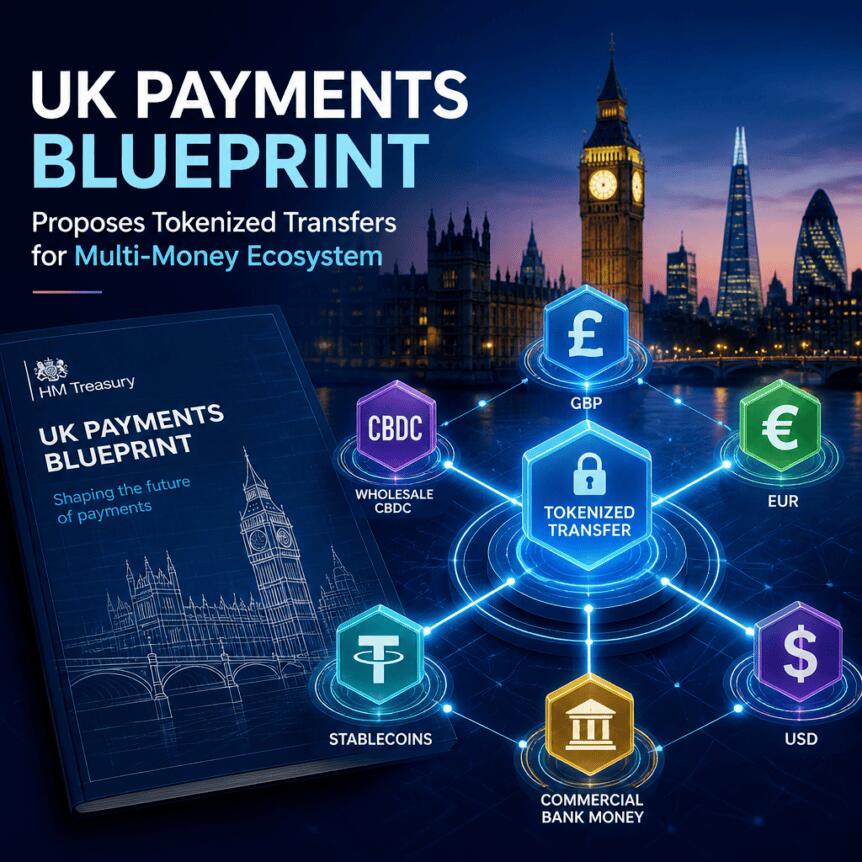
UK regulators are pressing for tokenization and “new forms of digital money” to become part of the country’s core retail payments infrastructure, setting the tone for how future payments may be designed and regulated. In an update to the government’s retail payments roadmap, HM Treasury—acting for the Payments Vision Delivery Committee—said these capabilities could help the UK build what it calls a “diverse multi-money ecosystem.”
The push links retail payments modernization to broader regulatory momentum in crypto and tokenized finance. The UK’s Financial Conduct Authority (FCA) has already outlined a new authorization route for crypto businesses, while the Bank of England (BoE) has been exploring changes to settlement infrastructure to support tokenization in wholesale markets.
Key takeaways
- HM Treasury’s latest Payments Vision update explicitly names tokenization-backed programmable payments as potential “product-level arrangements” for retail payments innovation.
- The roadmap calls for infrastructure that lets emerging “digital money” forms interact with traditional payment systems, aiming for a multi-money ecosystem.
- Earlier this year, the UK government signaled it would revisit payments rules to create a unified regulatory approach for traditional and tokenized payment activity, including stablecoin-related use cases.
- Separate BoE and FCA workstreams are focused on tokenized finance readiness—BoE via settlement operating hours and the FCA via its crypto regulatory framework and consultation on tokenization.
Tokenization positioned as retail payments infrastructure, not a side project
In an update released Thursday, HM Treasury said the future retail payments ecosystem should incorporate tokenization and other “new forms of digital money” as foundational elements. The government’s goal is not simply to allow isolated experiments, but to build a payments environment where different “money types” can work together.
The update points to “programmable payments,” including those that rely on tokenization, as possible “product-level arrangements” that can support innovation. The emphasis matters for market participants because product arrangements often determine how systems interface with existing networks, how responsibilities are allocated, and what user-facing payment experiences may look like.
That stance also reflects a broader direction laid out in the government’s National Payments Vision document. HM Treasury described a need for infrastructure capable of enabling emerging digital money forms to interoperate with established payment rails—essentially treating tokenized models as interoperable building blocks for mainstream retail activity.
How the roadmap aligns with the UK’s crypto authorization timeline
The retail payments message lands as the FCA progresses its landmark crypto regulatory framework. Earlier this week, the FCA published the framework and set out a licensing authorization window for crypto businesses.
According to FCA reporting via Cointelegraph coverage, the licensing period would run from September through Feb. 28, 2027, before the regime goes live on Oct. 25, 2027. Under the framework, cryptocurrency firms—including trading platforms, custodians, stablecoin issuers, staking companies, and other intermediaries—will need FCA authorization to operate in the UK.
For investors and operators, the sequencing is significant: the government’s payments roadmap is moving toward tokenization-enabled retail experiences, while the FCA’s authorization timetable shapes how compliant businesses can enter, scale, and serve customers under the new regime. Even if tokenized retail payment products are still developing, firms typically plan their roadmap around regulatory certainty.
From rule changes to tokenized settlement: momentum across the stack
The Treasury update follows earlier indications that the UK intends to revisit payments rules to accommodate new technology, including stablecoins and tokenization. In April, the UK government said it would revisit its payments rulebook to support adoption of new payment technologies. As described in an April 21 announcement by HM Treasury and Economic Secretary to the Treasury Lucy Rigby, the planned reforms would include a consultation on changes to payment services and electronic money rules, aiming to create a single framework covering traditional and tokenized payments, including stablecoin-based and tokenized deposit scenarios.
That work connects to parallel infrastructure planning at the central bank level. The BoE proposed extending operating hours for its core settlement infrastructure toward near-24/7 availability. The proposal was framed as part of a broader effort, with the FCA, to prepare UK wholesale markets for tokenized finance.
As reported in connection with the BoE’s initiative, the central bank said expanded operating hours could support cross-border payments and new settlement and payment models as tokenization develops. The BoE sought public feedback on the proposal until July 3, with an intention to publish a feedback statement during the summer.
This creates a notable contrast in where tokenization readiness is being pursued: the Treasury update is about retail system design and interoperability, while the BoE is looking at the mechanics of when settlement can occur. For the market, both layers must mature together—tokenized retail services may rely on settlement capabilities that work on the same operational timescales.
Regulators also point to tokenization benefits in finance and asset management
The tokenization push is not limited to payments. In the days before the BoE’s operating-hours proposal, the FCA signaled that tokenization and distributed ledger technologies could improve efficiency in fund management and support innovation in the UK asset management sector. That earlier FCA positioning—captured in Cointelegraph coverage—helps explain why the UK is treating tokenization as a cross-sector regulatory theme rather than only a payments experiment.
Taken together, the UK’s approach suggests an ecosystem strategy: payments modernization, crypto authorization, and tokenized settlement infrastructure are all being advanced through distinct but related workstreams. Even where retail and wholesale use cases differ, shared regulatory definitions and consistent infrastructure expectations can reduce friction for firms building across multiple market segments.
What to watch next
With HM Treasury pushing tokenization into the retail payments roadmap and the FCA’s authorization framework scheduled to take effect after its licensing window, the next critical developments are how the government’s promised rule consultations translate into enforceable requirements and how infrastructure changes—such as settlement operating-hours proposals—feed into real tokenized payment and settlement pilots.
This article was originally published as UK Payments Blueprint Proposes Tokenized Transfers for Multi‑Money Ecosystem on Crypto Breaking News – your trusted source for crypto news, Bitcoin news, and blockchain updates.