





Article by Bu Shuqing
Source: Wall Street Journal
As geopolitical tensions in the Middle East continue to escalate, every rise in international oil prices is testing the global market’s breaking point. UBS, in its latest research report, has set a clear threshold: $150 per barrel.
According to Zhui Feng Trading Desk, UBS analysts recently released a global macro research report stating that if international oil prices break above $150 per barrel and remain elevated, the U.S. and global markets will face significant systemic risks, substantially increasing the likelihood of a recession and sharp market adjustments.
The line emphasizes that the danger of this tipping point lies in its potential to trigger a full negative cycle: "high oil prices → inflation rebound → monetary policy tightening → worsening financial conditions → demand collapse → market panic."
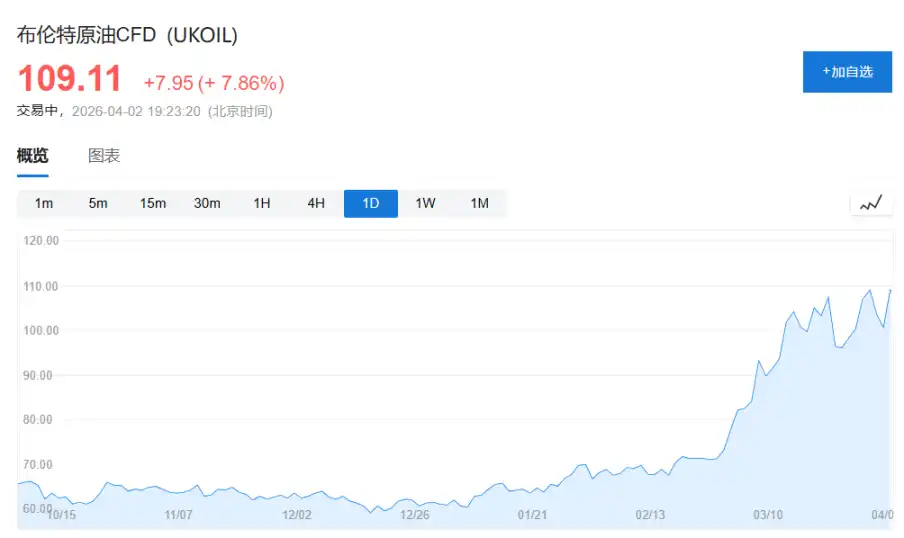
As of press time, international benchmark Brent crude oil surged nearly 8%, once again testing the $110 per barrel level. UBS warned that current market pricing for oil price risks remains overly linear, severely underestimating the cliff-edge risk near $150 per barrel. Amid the shadow of high oil prices, market margins of safety have largely vanished; safeguarding against risk and avoiding highly sensitive assets is more critical than pursuing returns.
Impact depends on initial vulnerability.
UBS research report challenges the long-standing market assumption that a $10 increase in oil prices always imposes a fixed economic drag, highlighting that the impact of energy shocks heavily depends on the initial economic conditions.
The global economy is currently in an environment of high interest rates, weak recovery, and tight credit conditions, where the initial probability of recession was already elevated, significantly amplifying the transmission effects of oil price shocks.
UBS has developed a three-dimensional analytical framework, using the U.S. composite recession probability, oil price increases, and the magnitude of economic cyclical downturns as the three dimensions; the results clearly reveal the nonlinear nature of risk:
- When the recession probability is 20% and oil prices are at $100 per barrel, the economic cyclical downturn is only 0.28 standard deviations, indicating a mild shock;
- If the recession probability rises to 40% and oil prices remain at $100 per barrel, the downside movement expands to 0.81 standard deviations, nearly triple the baseline;
- When the recession probability reaches 40% and oil prices surge above $150 per barrel, the downside movement spikes to 1.4 standard deviations, with impact intensity reaching nearly five times the baseline.
This means that the more fragile the economy, the more devastating the impact of high oil prices. Under current conditions, an increase in oil prices from $100 to $150 does not simply result in a 50% rise in pressure, but rather a multiplicative accumulation of risk.
$150: The Critical Divide in Two Scenarios
UBS provided critical thresholds under two key scenarios, based on a prior 30% probability of U.S. recession before the Middle East conflict, with the gap between them highlighting the central role of financial market reactions.
Under an ideal steady-state scenario, with financial markets stable and no additional risks emerging, the U.S. economy could theoretically withstand oil prices rising to approximately $200 per barrel before entering a substantive recession. However, under realistic risk scenarios, if stock markets experience a sharp correction and risk appetite deteriorates rapidly due to high oil prices, the recession threshold would immediately drop to $150 per barrel.
UBS notes that once $150 per barrel is reached, the world will face three systemic pressures:
- On a macro level, inflation surged again, forcing central banks to halt rate-cutting cycles and even restart rate hikes, pushing the economy rapidly toward stagflation;
- At the market level, equity profit expectations have been revised downward, valuations have contracted, credit spreads for high-yield bonds have widened, and liquidity tightening has triggered cross-asset selling;
- At the institutional level, corporate costs have surged and profits have been squeezed, household purchasing power has declined, and both consumption and investment have cooled simultaneously, creating a synchronized downturn in the economy and markets.
The report also cites historical comparisons, noting that larger oil price shocks before 2000 had a lesser impact due to stronger initial economic resilience compared to the shock during the 1990 Gulf War. Today, with global high interest rates still in place and the financial system more sensitive to rising costs, a $150 per barrel shock would be even more severe.
Nonlinear Risk: Blind Spots in Market Pricing
UBS research report specifically warns that the market is systematically underpricing oil price risks, particularly overlooking the threshold effect near $150 per barrel.
According to UBS Research, oil prices in the $100 to $130 per barrel range typically result in localized industry shocks, pressuring sectors such as aviation, logistics, and chemicals, but the overall market remains manageable; once oil prices stabilize above $150 per barrel, risks will expand from localized to systemic, escalating from industry-level impacts to systemic financial risks.
This nonlinear risk manifests at three levels:
- First, risk transmission accelerates, as high oil prices rapidly erode the buffers of corporate profits, household consumption, and government finances.
- Second, policy space has narrowed as rising inflation has trapped central banks in a dilemma between combating inflation and supporting growth, preventing them from timely market support;
- Third, a collapse in confidence accelerates, with a sharp stock market correction and rising credit risks reinforcing each other, creating a negative feedback loop of "decline → deleveraging → further decline."