





Organized & Compiled by Shenchao TechFlow
Guest: Scott Bessent, U.S. Secretary of the Treasury
Host: Wilfred Frost
Podcast source: The Master Investor Podcast with Wilfred Frost
Scott Bessent: Inside Trump’s Treasury; War Costs; and Why the Bond Market Rules
Broadcast date: March 13, 2026
Key Points Summary
Scott Bessent, the U.S. Secretary of the Treasury and one of the most successful global macro investors of his generation, visited the Treasury’s Cash Room for a rare and wide-ranging conversation with Wilfred Frost, covering markets, geopolitics, and public service.
From his current perspective, Scott deconstructs why 85% of consensus is merely meaningless noise, revealing that true excess returns—and the deeper motivations behind policies—are hidden within the “15% of world imagination.”
He not only revisited the "cognitive gaps" behind classic trades like shorting the yen, but also revealed for the first time his survival philosophy as a "lifesaver in the bond market" amid the geopolitical conflicts and energy uncertainty of 2026. If you want to see through the macro truth overlooked by most—and understand why he warned never to let yourself slide off the edge of your snowboard—this summary of his insights is the cognitive threshold you must cross.
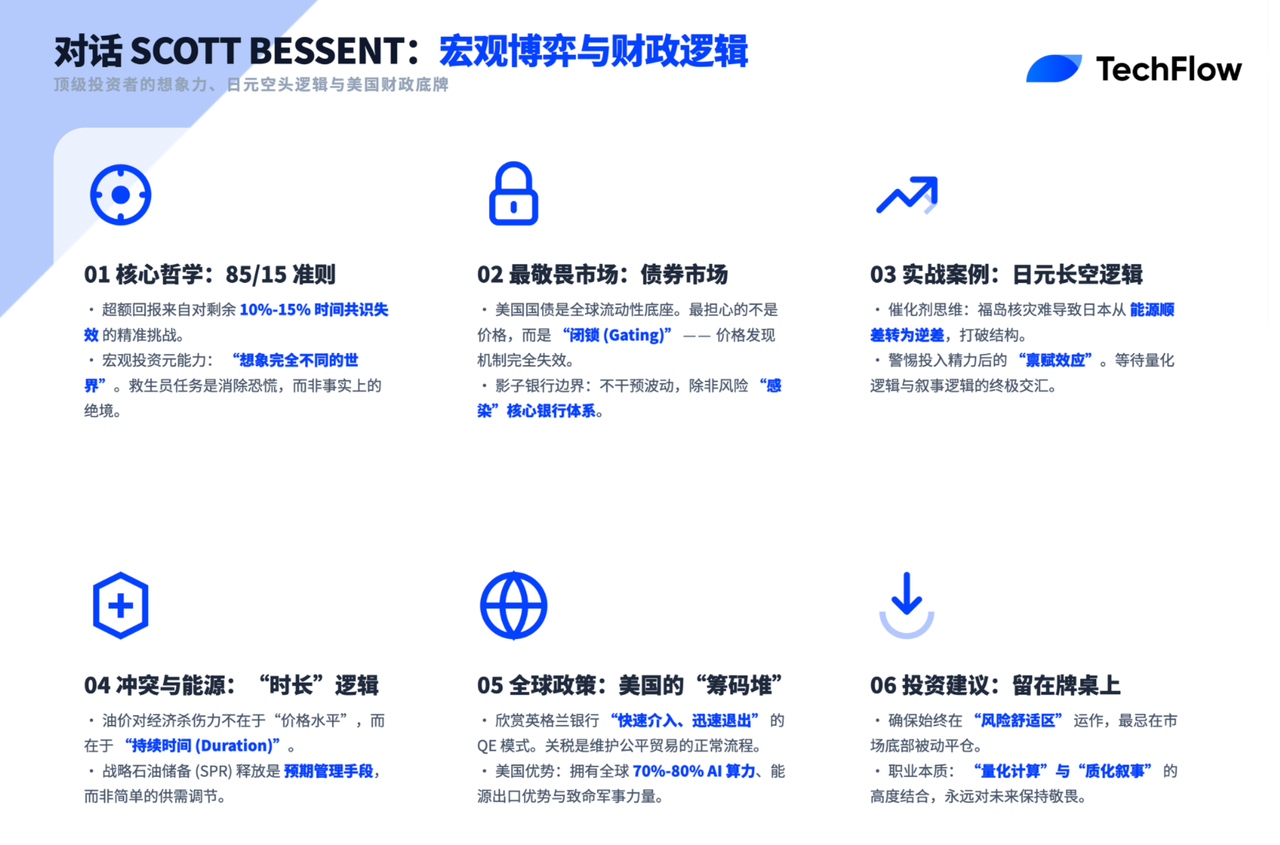
Summary of Key Insights
On "Consensus" and "Massive Returns"
In most cases, the market’s consensus is correct, and momentum makes sense about 85% to 90% of the time. But what truly matters is when things begin to shift—or when you can envision a different outcome—because that’s when challenging the consensus yields enormous rewards.
On imagination and investment logic
My father collected a large number of science fiction novels... which taught me how to imagine an entirely different world. In finance, this ability is crucial—you need to be able to envision a different state of the world and believe it could happen.
What truly matters is whether you can envision a different state of the world, predict when, why, and how it might occur, and determine whether the market has underestimated this possibility—then act accordingly.
On "Shorting the Yen" and Abenomics
I don't know (whether these policies will impact the Japanese economy), but this will be a market opportunity unlike any other in a lifetime.
Our team has always excelled at setting an idea aside after thorough research, waiting for the right moment to act.
Regarding the "bond market" and "real risk"
Ultimately, the most important thing is the bond market. The U.S. Treasury market is the deepest, most liquid, and most stable market in the world, and in this building, we are its guardians.
Throughout my 35-year career, the truly alarming moments have been when markets completely shut down—when the price discovery mechanism is disrupted or the market faces the threat of a “circuit breaker.”
In-depth analysis of "oil prices"
I don’t think the key lies in the level of oil prices, but in how long they last. If you look back at history, even in 2008, oil prices soared to a record $147—but the issue was how long that high price persisted.
The metaphor of the "lifeguard"
As a lifeguard, you’ll find that drowning people sometimes try to pull you under with them—and this also happens in investing and politics. But your ultimate goal is always to save them and bring them back to safety. In fact, many drowning people simply need to realize they can stand up to be saved. Often, people in crisis are primarily overwhelmed by panic.
Core Advice for Investors
Understand the risks you can afford to take, and ensure you always operate within your comfort zone. Don’t let yourself “slide off the edge of your snowboard”—that is, avoid being forced to sell at market lows or buy at market highs.
You never know what might happen.
Regarding "shadow banking"
My role is not to directly regulate the shadow banking system, but to ensure that its interactions with the regulated banking system and insurance sector do not trigger systemic risk. Currently, while we have observed some volatility, there is no indication of systemic issues within the shadow banking system. However, we will continue to monitor closely to prevent any potential risks from spreading to the regulated financial system.
Scott Bessent’s underlying mindset: the lifeguard metaphor, science fiction, and world imagination
Wilfred Frost: Welcome to the Master Investor Podcast. Today’s guest is U.S. Secretary of the Treasury, Scott Bessent—a towering figure in global finance and one of the greatest investors of our time. In the 1990s and 2000s, he spent 20 years at Soros Fund Management, eventually rising to Chief Investment Officer (CIO). In 2015, he founded his own hedge fund, Key Square, before transitioning into public service as the current Secretary of the Treasury.
Before diving into the topic, I’d like to quote a passage from your 2025 October interview with the Financial Times. You said: “Unlike most of my predecessors, I maintain a healthy skepticism toward elite institutions and elite viewpoints, which I believe they do not. But I have a healthy reverence for the market.” This statement left a strong impression on me. Has this become a guiding principle for you since shifting from investing to politics?
Scott Bessent:
Yes, I believe this is indeed one of my core investment principles: in most cases, the market consensus is correct, and market momentum makes sense about 85% to 90% of the time. But what truly matters is when things begin to shift—or when you can envision a different outcome—that’s when challenging the consensus offers the greatest rewards.
Some of my greatest career successes have come from standing against the prevailing elite consensus. For example, Japan was long seen as permanently trapped in deflation and low growth, with its “lost decades” set to continue indefinitely—but when I met Shinzo Abe, I believed he could be the catalyst for change.
So, I’ve been looking for where consensus might go wrong. We need to ask ourselves: Are there issues with the existing framework? Have we overlooked something?
Wilfred Frost: Given your healthy respect for the markets, which market do you consider the most important? Ultimately, is it the bond market that you respect the most?
Scott Bessent:
Yes, ultimately, the most important thing is the bond market. The U.S. Treasury market is the deepest, most liquid, and most stable market in the world, and in this building, we are its guardians.
We are committed to maintaining market transparency while ensuring sufficient resilience in operations and settlements. Whether after last year’s Liberation Day or amid current tensions in Iran, the smooth functioning and settlement of the market have remained our top priority.
Wilfred Frost: Have there been moments in the bond market that made you feel concerned or uneasy, such as in April last year or January this year?
Scott Bessent:
I mentioned earlier that there may have been operational challenges during those times, but I monitor the bond market every day. Markets always experience volatility, but what we focus on is the continuity and functioning of the market. In my 35-year career, the truly alarming moments have been when the market completely shuts down—when the price discovery mechanism is disrupted or when the market faces the threat of "gating." Our priority is ensuring that the market continues to operate smoothly, with both buyers and sellers able to transact effectively.
Wilfred Frost: You once considered becoming a lifeguard, a computer scientist, or even a journalist. You later entered finance, initially working as a bank analyst at Brown Brothers, but ultimately chose global macro investing as your career path. Did you ever consider making lifeguarding a long-term career?
Scott Bessent:
No, but it’s not a long-term career. Whether due to physical limitations or prolonged sun exposure, a lifeguard’s career is typically short. As a lifeguard, you’ll find that people drowning sometimes try to pull you under with them—something that also happens in investing and politics. But ultimately, your goal is always to save them and bring them back to safety. In fact, many people who are drowning simply need to realize they can stand up to be saved. Often, people in crisis are primarily overwhelmed by panic.
Wilfred Frost: So, as a macro investor, you not only need to predict what might happen in the world, but also determine whether the market has mispriced those outcomes. Do you believe that the key to successful investing lies in identifying such mispricings?
Scott Bessent:
I’m often asked: “What prepared you for your career?” My answer usually traces back to childhood. My father collected a vast number of science fiction novels—possibly the largest collection in South Carolina, though that’s not saying much. He frequently read them to me when I was young. I’ve always said that before I could locate Chicago on a map, I could point to Alpha Centauri.
This taught me how to imagine a completely different world. In finance, this ability is crucial—you must be able to envision an alternative state of the world and believe it could happen. As the legendary macro investor Bruce Kovner said, “I have the ability to imagine a different state of the world and believe it could happen.”
So what truly matters is whether you can envision a different state of the world, predict when, why, and how it might occur, and also determine whether the market has underestimated this possibility—then act accordingly.
Building the long-term shorting rationale for the Japanese yen and the minister of finance's role transition
Wilfred Frost: During the 2010s into the early 2020s, the yen was very strong, with the exchange rate一度 below 80. You held this trade for a decade, ultimately witnessing the yen depreciate all the way to around 150! Could you share with us what you saw back in 2011 or 2012—whenever exactly you initiated this trade—that others didn’t see?
Scott Bessent:
This comes back to timing. In psychology, there’s a significant cognitive bias called the endowment effect. When you’ve invested a lot of time and effort into something, you feel a strong urge to act on it immediately. I believe one of our consistent strengths, both personally and as a team, is the ability to step back from an idea after thorough research and let it sit until the right moment arises—foreign exchange trading in yen is a perfect example of this.
I first visited Japan in 1990, around the time the Nikkei Index reached its peak. I stayed for about three months at the famous Okura Hotel in Tokyo, where the room rate was $500 per night; by 2011, the same room cost only $350. This clearly illustrates Japan’s prolonged economic stagnation and decline.
I witnessed Japan’s economic rise, experienced its decline, and continued to follow its development even during its prolonged stagnation. 2011 was a pivotal turning point. On March 11 of that year, Japan endured the Fukushima nuclear disaster—a devastating tragedy involving an earthquake, tsunami, and the threat of nuclear meltdown. At the time, the Japanese government decided to shut down all nuclear reactors, which revealed to me a potential catalyst.
Before that, shorting the yen had always been very difficult because Japan had a large current account surplus, amounting to 3% of GDP. However, after Japan shut down its nuclear reactors, it was forced to import large quantities of fossil fuels, causing the current account to shift from surplus to deficit.
Even so, the yen's exchange rate at the time remained between 78 and 83, showing no significant movement. Then, one day, my Japanese friend, Mr. Funabashi—a seasoned Japanese journalist, thinker, and policy expert—called me and said, “There’s a man named Shinzo Abe who previously served as prime minister and may return to office. His campaign platform is ‘reviving Japan’s economic vitality and national strength,’ and he plans to implement an economic agenda centered on reflation.”
This information clicked for me because I knew the Bank of Japan was about to face three board vacancies, meaning the new prime minister would have the opportunity to reshape the central bank’s leadership—including appointing a new governor. Since the Bank of Japan had long been dominated by deflationists or low-inflation advocates, such a reshuffle could lead to a major policy shift. From that moment on, all the pieces began to fall into place.
Wilfred Frost: I remember you mentioned on your Capital Allocators Podcast interview in November 2024 that your boss, George Soros, asked you: “Will Abenomics and these policies work for the Japanese economy?”
And your response left a deep impression on me—you said, “I don’t know, but this will be a market opportunity unlike any other in my lifetime.” It turned out your judgment was correct, and you made a lot of money on that trade. But now, as an investor turned policymaker, you need to assess whether “policies can actually be implemented,” not just whether “market pricing is wrong.” Is this a significant shift for you?
Scott Bessent:
Regarding Japan and Abenomics, the "three arrows" policy has indeed achieved significant success. Initially, it produced immediate effects in the market. Over time, while Japan’s policy implementation remained as cautious and gradual as ever—perhaps slower than Westerners would have preferred—they made outstanding efforts to reshape the economy and investment environment.
For example, they increased shareholder equity, improved return on capital, and encouraged women’s participation in the labor market through “Womenomics.” Japan’s labor market has long had little mobility, but they are actively driving change—and overall, Japan has made significant progress in reshaping its economy.
Wilfred Frost: As a policymaker rather than an investor, do you need to ignore market pricing and focus instead on whether policies can actually be implemented?
Scott Bessent:
I still gather information from the market, as it sometimes truly reflects important signals. However, my current role is more focused on considering from a policy perspective—what can be done, what should be done, and what will be done—and predicting the real-world impact of these policies on the economy and markets.
For over three decades, my work involved gathering as much information as possible about policymakers’ intentions—sometimes even trying to eavesdrop on their meetings. Now, I sit at the policy-making table and must judge the feasibility, implementation, and potential market reactions of policies.
Whenever I speak publicly about policy—whether it was after Liberation Day last year or regarding the current conflict in Iran—I strive to think from the perspective of market participants. I ask myself: If I were still an investor, what kind of guidance would I want from policymakers? How can I provide a clear framework to the market, the American public, and other global policymakers without disclosing any material non-public information?
Wilfred Frost: Was it difficult for you to transition from being an extremely successful and wealthy investor who ran your own business to becoming a policymaker who now reports to the president?
Scott Bessent:
I am no stranger to collaborating with others, and our cabinet team is exceptional, demonstrating a high level of professionalism, especially under such high-pressure conditions. Our war room holds a series of daily morning meetings, and while the team has already performed outstandingly, their performance has reached an even higher level under current circumstances.
In a way, I feel I’ve been preparing for this role for a long time. In the past, when I attended G7 and G20 meetings as an investor, I met many central bank governors and finance ministers. Back then, their job was to “reassure” investors like me; now, I work alongside them as a peer and colleague, discussing policy together.
Global Energy and Geopolitical博弈: Scott Bessent on the Iran Conflict and U.S. Economic Strategy
Wilfred Frost: The price of WTI crude oil is currently around $94.95. At the beginning of this year, it was under $60, and earlier this week it spiked as high as $114 to $115. At what level does oil prices start to become unsustainable for the U.S. economy?
Scott Bessent:
I believe the key isn't the "level" of oil prices, but their "duration." If you look back at history, even in 2008, oil prices soared to a record $147—but the issue was how long that high price lasted.
President Trump's energy policy has provided the United States with significant resilience. Currently, U.S. liquid fuel production, including crude oil and natural gas, has reached historic highs. Additionally, natural gas prices remain relatively stable, directly impacting energy costs and household utility bills.
The president’s top priority is to degrade Iran’s military capabilities, including its missile program, manufacturing capacity, air force, and navy—particularly its ability to project military power beyond its borders. At the same time, the president is determined to “decapitate the snake’s head” and completely eliminate Iran’s capacity as the world’s leading sponsor of terrorism.
Wilfred Frost: The U.S. government and the International Energy Agency (IEA) recently announced the release of strategic petroleum reserves—the largest such release in history. However, in the short term, this appears to have had little impact on rising oil prices. What are your thoughts on this?
Scott Bessent:
We need to look at this issue from a longer-term perspective—the market always anticipates future expectations. Last Sunday evening, oil prices surged by $30, but later that day, after the Financial Times reported that the IEA was considering releasing 300 to 400 million barrels from its strategic reserves, we witnessed the largest single-day price reversal in history.
On Monday, we held a G7 finance ministers meeting focused on energy issues. Following that, energy ministers met on Tuesday, and on Wednesday, during the leaders' summit, the president confirmed the decision to release 400 million barrels from the strategic reserve—an unprecedented scale.
Wilfred Frost: Nonetheless, oil prices are still about $50 higher than at the beginning of the year. If this continues, would you consider deploying naval forces to escort tankers through the Strait of Hormuz?
Scott Bessent:
This possibility has always been part of our planning, and we have developed relevant scenario analyses, including options for the U.S. Navy or an international coalition to escort tankers through the Strait of Hormuz. In fact, some tankers are already passing through, including those flying Iranian and Chinese flags, and we are aware that Iran has not laid mines in the strait.
Wilfred Frost: So, will the number of ships passing through the Strait of Hormuz improve from now on?
Scott Bessent:
Once military conditions permit, the U.S. Navy—potentially under the framework of an international coalition—will escort vessels safely through the Strait of Hormuz. We have been conducting scenario planning for months, even weeks, to ensure the success of this operation.
Wilfred Frost: I have a few more questions about this war. Can you disclose the current daily operating cost? Is it $1 billion or $10 billion per day?
Scott Bessent:
I don't directly track the daily cost of the war, because in the United States, the Treasury and the Office of Management and Budget (OMB) are separate entities. That's also why we refer to the Treasury Secretary rather than the Finance Minister. However, according to today's published data, the current cumulative cost is approximately $11 billion.
Wilfred Frost: In the long term, how long do you expect this war to last? Can U.S. finances withstand such pressure?
Scott Bessent:
$11 billion is indeed a substantial amount, but we have already allocated sufficient fiscal buffers to cover it. We are not concerned about funding issues. In fact, last year, demand for U.S. Treasuries abroad continued to grow, and the U.S. Treasury market performed strongly, being the only bond market among G7 nations to see a decline in its 10-year yield.
Wilfred Frost: Final question: The U.S. government recently granted Indian refiners a 30-day waiver allowing them to purchase Russian oil. Does this mean Russia is benefiting from this conflict? What are your thoughts?
Scott Bessent:
This is indeed unfortunate, but we must consider the availability of supply. We granted a 30-day exemption because these Russian tankers were already at sea, providing Indian refineries with a rapid source of energy. From another perspective, these oil shipments could ultimately end up in China. Therefore, we intend for this benefit to be limited to a “very brief period.”
The New Normal of Oil Prices and Gold Revaluation: The Fed Must Seek a “Lean” Solution in a Liquidity Trap
Wilfred Frost: Let’s discuss the Federal Reserve and the short- and long-term directions of domestic policy. Starting with the short term, do you think current oil price volatility will affect the pace at which the Fed eases policy?
Scott Bessent:
This requires balancing multiple factors; I believe the Federal Reserve may be concerned that rising energy prices could elevate inflation expectations; but on the other hand, they also need to assess whether the oil price increase represents a temporary “momentum” or leads to a prolonged decline in “kinetic” economic growth. If it’s merely a short-term shock, the economy may rebound quickly.
One more point to note: if oil prices were below $60 at the beginning of the year and this conflict ultimately ends in a manner favorable to the United States, we could enter a new normal of lower oil prices in the medium term.
Wilfred Frost: If the Federal Reserve is forced to raise interest rates in the future, and your current debt management relies heavily on short-term bond issuance, would you consider shifting toward issuing more long-term bonds?
Scott Bessent:
We will work closely with the Federal Reserve to coordinate debt management strategies. As for whether the Federal Reserve will restart quantitative easing (QE), that possibility currently appears extremely distant and not even worth discussing.
Wilfred Frost: You’re an Anglophile who has lived in the UK for a long time. Do you appreciate the Bank of England’s operating model more than that of the Federal Reserve?
Scott Bessent:
The Federal Reserve and the Bank of England are very different institutions; the Federal Reserve is a larger, more decentralized organization with multiple regional reserves and board members, only some of whom have voting rights. In contrast, the Bank of England has a more centralized structure, divided into the Monetary Policy Committee and the Executive Committee, with only the Governor serving on both committees.
Wilfred Frost: The Bank of England’s model has several features, such as an inflation target within a 1% band and the requirement for the Chancellor’s approval for unconventional measures like QE. Do you think these features are worth considering for the Federal Reserve?
Scott Bessent:
I believe setting an inflation target is a worthwhile approach, but I don’t think the Federal Reserve needs to fully adopt the Bank of England’s model. Regarding QE, I do believe the Bank of England’s actions better align with the nature of unconventional measures. The Bank of England briefly intervened in the market at the start of the COVID-19 pandemic to stabilize the functioning of UK government bonds and then quickly exited. In contrast, the Federal Reserve continued purchasing assets for the following four years, which may have been one of the reasons behind the “Great Inflation” of 2022 and 2023.
Wilfred Frost: The United States holds substantial gold reserves, yet their book value is still calculated at the outdated rate of $42 per ounce, while the current market price exceeds $5,000 per ounce. Could revaluing the gold and sterilizing it create an opportunity to reduce the Federal Reserve’s balance sheet without triggering a liquidity crisis?
Scott Bessent:
I believe these are two completely separate issues. If the Federal Reserve intends to adjust its balance sheet, it needs to signal its intentions well in advance and develop a detailed plan. We also need to reexamine how bank regulations since the Global Financial Crisis (GFC) have impacted the balance sheet, particularly in relation to interbank markets and reserve requirements.
Currently, the Federal Reserve operates under a high-reserve regime, but it may transition in the future to a leaner model in which banks provide reserves to each other. This shift will require time and careful planning.
Wilfred Frost: You had the opportunity to become Chair of the Federal Reserve, but ultimately chose to continue serving as Secretary of the Treasury. Why did you believe the role of Secretary of the Treasury was a better fit for you?
Scott Bessent:
I enjoy interacting with my cabinet colleagues, and the role of Minister of Finance allows me to directly participate in the formulation and implementation of national policies.
As Secretary of the Treasury, my responsibilities include preserving the dollar’s global dominance, managing the nation’s debt, and operating the United States’ sanctions system. These tasks are not only economic in nature but also critical to national security. I believe that, in this unique historical moment, these duties are more important than ever.
Wilfred Frost: Private credit has recently attracted significant attention. If problems arise in this sector, should the investors who have profited in the market bear the consequences themselves, rather than having the government step in?
Scott Bessent:
This is precisely why we call it the "shadow banking system." It does not belong to the traditional regulated banking system.
My role is not to directly regulate the shadow banking system, but to ensure that its interactions with the regulated banking system and insurance sector do not trigger systemic risk. Currently, while we have observed some volatility, there is no indication of systemic issues within the shadow banking system. However, we will continue to monitor closely to prevent any potential risks from spreading to the regulated financial system.
Geopolitical cooperation under tariff pressures and new consensus amid the "Iran threat"
Wilfred Frost: You’ve lived in the UK for many years and have a deep understanding of the “special relationship.” Recently, President Trump expressed dissatisfaction with the UK, stating that the British Prime Minister is not Winston Churchill. How do you view this comment?
Scott Bessent:
President Trump expressed concern about certain delays, particularly regarding the use of the Diego Garcia Air Base, as the U.S. B-2 bombers require extended flight times and in-flight refueling, thereby inadvertently increasing risk. As Commander-in-Chief of the U.S. Armed Forces, the President prioritizes the protection of military personnel’s lives and is therefore highly sensitive to any actions that could heighten risk.
Wilfred Frost: Do you believe that the UK is putting Americans' lives at risk?
Scott Bessent:
We have a very deep historical relationship with the UK, and I believe we can overcome these differences and get back on track. However, to be honest, the Prime Minister was slow to respond in terms of allocating resources to this region, but I believe our long-term relationship with the UK will withstand these short-term fluctuations, and ultimately we will return to the right path.
Wilfred Frost: From a broader perspective, over the past year and a half—especially with the recent announcement of new tariff investigations targeting multiple countries, including allies such as EU member states, Switzerland, Singapore, South Korea, and Norway—could this affect allies’ support for the United States, particularly at this critical juncture while war is ongoing?
Scott Bessent:
If restoring normal tariff levels would cause certain countries to take opposing positions, then they were never our true allies to begin with. We are currently enforcing a global tariff rate of 10%, and countries that have signed trade agreements with us all wish to maintain the status quo.
It should be clarified that these tariff investigations are part of standard business procedures. Although the Supreme Court ruled that the President cannot use the International Emergency Economic Powers Act (IEPA) to impose tariffs, we can restructure the tariff system under Section 301 or Section 122 of the Trade Act. These measures are intended to ensure a fair trading environment, not to target allies.
Wilfred Frost: Are you concerned that the U.S. policy style—such as acting before allies fully agree—might be interpreted as "American isolation" rather than "America First"?
Scott Bessent:
I don't think so. During the recent G7 leaders' call, all leaders expressed support for the United States' actions in the Middle East and congratulated us on successfully weakening the threat from Iran.
In addition, regarding the Strait of Hormuz, several countries have expressed willingness to provide mine-clearing vessels and participate in establishing an international coalition to ensure maritime security. No country wishes for the Iranian regime to continue in its current form. Particularly, Arab nations in the Gulf region have been alarmed by Iran’s attacks, which have made them realize that further enhancement of Iran’s military capabilities would make the situation even more dangerous.
Wilfred Frost: You’ve said that investing requires “earning the right to take risk.” From that perspective, do you think today’s United States has a smaller stack of chips on the global stage than before?
Scott Bessent:
On the contrary, I believe the United States today is stronger than ever before. We have achieved energy dominance, transforming from an energy importer to an exporter; we continue to lead the world in technology, particularly in artificial intelligence, where the U.S. currently controls 70% to 80% of global computing power; and our military strength has reached unprecedented levels, becoming more powerful and lethal than at any time in history.
Economically, the U.S. is growing much faster than Europe. For example, the EU celebrates a 0.3% GDP growth, while we expect the U.S. to achieve 3% growth once the current conflict ends—nearly ten times that of Europe.
Wilfred Frost: But U.S. debt levels are rising and oil reserves are declining—could this become a concern?
Scott Bessent:
The share of debt relative to GDP has indeed risen globally, a legacy of the global financial crisis and the COVID-19 pandemic. However, in relative terms, the United States continues to outperform other countries in debt management and economic growth.
Within your risk comfort zone, wait for the convergence of quantification and narrative.
Wilfred Frost: Finally, could you offer our audience your top piece of investment advice and career advice?
Scott Bessent:
Regarding career advice, I want to remind everyone that you can never predict what the future holds. When I graduated from Yale in 1980, I intended to become a journalist or a computer scientist, but I eventually discovered that investing captivated me because it combined the quantitative, computational aspects with the qualitative, narrative elements.
Regarding investing, my advice is: clearly understand the level of risk you can afford, and ensure you always operate within your comfort zone. Don’t let yourself “slide off the edge of your snowboard”—that is, avoid being forced to sell at market lows or buy at market highs.
Wilfred Frost: Do you think the United States' actions in the Middle East have already "gone off the board"?
Scott Bessent:
Absolutely not. Our operations are progressing faster than planned, and Iran’s military capabilities are being degraded. It remains uncertain whether Iran’s Supreme Leader has become incapacitated or is facing internal threats.
Wilfred Frost: Do you think a regime change in Iran could occur in the coming days?
Scott Bessent:
Our goal is clear: to weaken Iran’s military capabilities, prevent it from developing nuclear weapons, and limit its ability to project power abroad. But once action begins, developments often exceed expectations and take on their own momentum.