





Written by: Oluwapelumi Adejumo
Translated by: Saoirse, Foresight News
The legislative push, supported by the President, aimed at establishing more comprehensive regulatory rules for the U.S. cryptocurrency market, is nearing the political deadline at the congressional level. Meanwhile, the banking industry is pressuring lawmakers and regulators to ban stablecoin companies from offering interest-like returns similar to bank deposits.
This battle has become one of the most central unresolved issues on Washington's crypto agenda. The crux of the debate lies in whether stablecoins pegged to the U.S. dollar should focus on payment and settlement functions or add wealth management attributes that compete with bank accounts and money market funds.
The Senate's market structure bill, known as the "CLARITY Act," has stalled due to negotiations breaking down over the so-called "stablecoin yields."
Industry insiders and lobbyists suggest that late April to early May will be the realistic window for advancing the bill before the election year agenda tightens.
Congressional Research Service sharpens the legal debate
The Congressional Research Service (CRS) defines this issue more narrowly than the public discourse.
In a March 6 report, the CRS pointed out that the "GENIUS Act" prohibits stablecoin issuers from directly paying yields to users, but it does not fully clarify the legality of the so-called "tri-party model"—where intermediaries like exchanges come between issuers and end-users.
The CRS noted that the act does not explicitly define "holders," leaving room for debate over whether intermediaries can still pass economic benefits to customers. This ambiguity is the core reason the banking industry wants Congress to clarify it in a broader market structure bill.
The banking industry argues that even limited yield incentives could turn stablecoins into strong competitors to bank deposits, hitting regional and community banks the hardest.
However, crypto firms counter that incentives tied to payments, wallet usage, or network activity can help digital dollars compete with traditional payment channels and potentially boost their position in mainstream finance.
This divergence also reflects the differing perceptions of the two sides regarding the future development of stablecoins.
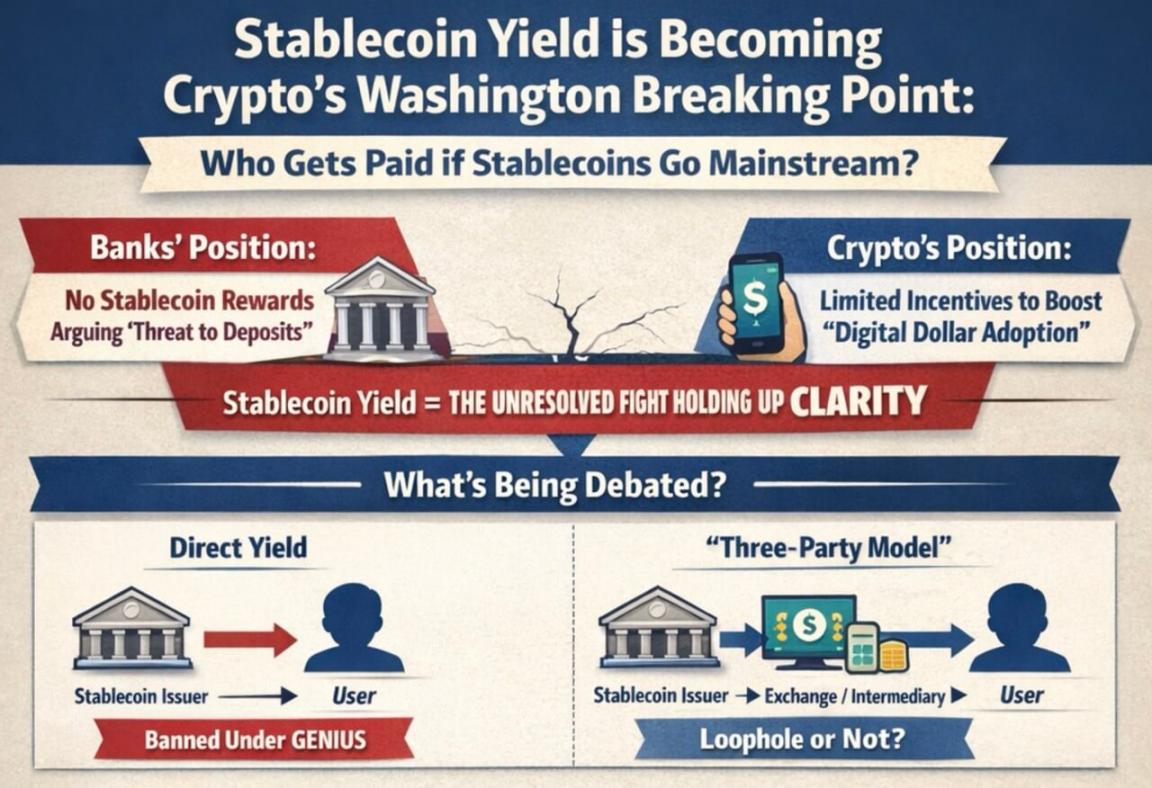
An infographic highlights the significant disagreement between banks and crypto firms over who should benefit from stablecoin yields as the usage scale of digital dollars continues to expand.
If lawmakers primarily view stablecoins as a payment tool, there will be stronger justification for imposing stricter limits on related rewards. Conversely, if lawmakers see them as part of a major transformation in how value circulates on digital platforms, there will be more support for limited incentives.
Banking associations have urged lawmakers to close what they call "regulatory loopholes" before such reward mechanisms become more widespread. Banks argue that allowing idle balances to earn rewards would lead depositors to withdraw funds from banks, thereby weakening the core funding source for loans to households and businesses.
Standard Chartered estimated in January that by the end of 2028, stablecoins could drain about $500 billion in deposits from the U.S. banking system, with small and medium-sized banks bearing the brunt.
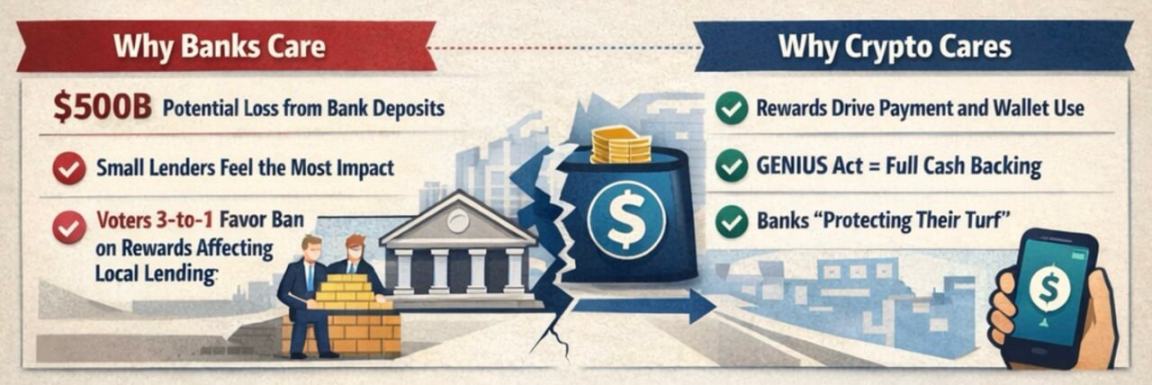
An infographic contrasts why banks and the cryptocurrency industry care about the stablecoin bill, illustrating deposit losses, impacts on lenders, cash-back rewards, and banking protectionism.
The banking sector is also trying to convince lawmakers that public opinion supports their stance. The American Bankers Association recently released a poll:
- When asked about "the possibility that allowing stablecoin yields could reduce banks' lending capacity, affecting communities and economic growth," respondents supported Congress banning stablecoin yields by a 3:1 ratio.
- By a 6:1 ratio, respondents believed stablecoin-related legislation should be cautious to avoid disrupting the existing financial system, especially community banks.
But the crypto industry argues that the banking sector is simply trying to protect its funding model by restricting competition from digital dollars.
Industry figures, including Coinbase CEO Brian Armstrong, argue that under the "GENIUS Act," the reserve requirements for stablecoin issuers are stricter than those for banks—issued stablecoins must be fully backed by cash or cash equivalents.
Transaction volume amplifies Washington's stakes in the debate
The market size has made this yield debate impossible to dismiss as a niche issue.
Boston Consulting Group estimated that last year, the total transaction volume of stablecoins was about $62 trillion, with only about $4.2 trillion representing real economic activity after excluding bot trading, intra-exchange transactions, and other activities.
The massive gap between headline trading volume and actual economic usage also explains why the "yield" debate has become so pivotal.
If stablecoins remain primarily a tool for trading and market structure clearing, lawmakers may find it easier to restrict them as payment tools. But if yield mechanisms turn stablecoins into widely used cash-storage tools in user apps, the pressure on banks will rise rapidly.
Earlier this year, the White House attempted to broker a compromise: allowing limited yields in specific scenarios like peer-to-peer payments but banning returns on idle funds. Crypto firms accepted this framework, but the banking industry rejected it, causing Senate negotiations to collapse entirely.
Even if Congress does not act, regulators may tighten yield models.
The Office of the Comptroller of the Currency (OCC) proposed in a rule implementing the "GENIUS Act" that if stablecoin issuers provide funds to affiliates or third parties who then pay yields to stablecoin holders, it would be considered a disguised form of prohibited yield distribution.
This means that if Congress fails to legislate, the executive branch may set boundaries through regulatory rules.
Congress is running out of time
The current battle has split into two fronts:
- Congress is debating whether to resolve the issue with statutory law;
- regulators are defining the limits of corporate behavior under the existing legal framework.
For the Senate bill, time itself is the greatest pressure.
Galaxy Digital research head Alex Thorn wrote on social media:
If the "CLARITY Act" fails to pass committee review by the end of April, the likelihood of approval in 2026 will be extremely low. The bill must be presented for a full Senate vote by early May. Legislative time is running out, and with each passing day, the probability of passage declines slightly.
He also noted that even if the revenue disputes are resolved, optimism about the bill's breakthrough remains premature:
Currently, public opinion suggests that disputes over stablecoin revenue have stalled the "CLARITY Act." However, even if compromises are reached on revenue issues, the bill is still likely to face other obstacles.
These obstacles may include decentralized finance regulation, regulatory authority limits, or even ethical issues.
Before the midterm elections in November, cryptocurrency regulation is highly likely to become a larger political battleground. This adds urgency to the current deadlock—any delay in the bill will face a more crowded political agenda and a tougher legislative environment.
Prediction markets also reflect shifting sentiment. In early January, Polymarket estimated the bill's likelihood of passing at about 80%; after recent setbacks (including Armstrong stating that the current version is unworkable), the probability has dropped to nearly 50%.
Kalshi data shows that the probability of the bill passing by May is only 7%, while the likelihood of passage by the end of the year is 65%.
Failure of the bill would hand more decision-making power to regulators and the market.
The impact of failure goes far beyond the revenue dispute. The core objective of the "CLARITY Act" is to define whether crypto tokens are securities, commodities, or other categories, providing a clear legal framework for market regulation.
If the bill stalls, the entire industry will increasingly rely on regulatory guidance, interim rules, and future political shifts.
This is one of the reasons the market is closely watching the fate of the bill. Earlier this year, Bitwise Chief Investment Officer Matt Hougan stated that the "CLARITY Act" would codify the current pro-crypto regulatory environment into law; otherwise, future administrations might reverse existing policies.
He wrote that if the bill fails, the crypto industry will enter a period of "proving itself," requiring three years to demonstrate its indispensability to the general public and traditional finance.
Under this logic, the industry's future growth will rely less on the expectation of "legislative implementation" and more on whether products like stablecoins and asset tokenization can achieve true mass adoption.
This presents the market with two distinctly different paths:
- Bill passes → Investors price in growth from stablecoins and tokenization in advance;
- Bill fails → Future growth depends more on actual adoption while facing uncertainty from potential policy shifts in Washington.
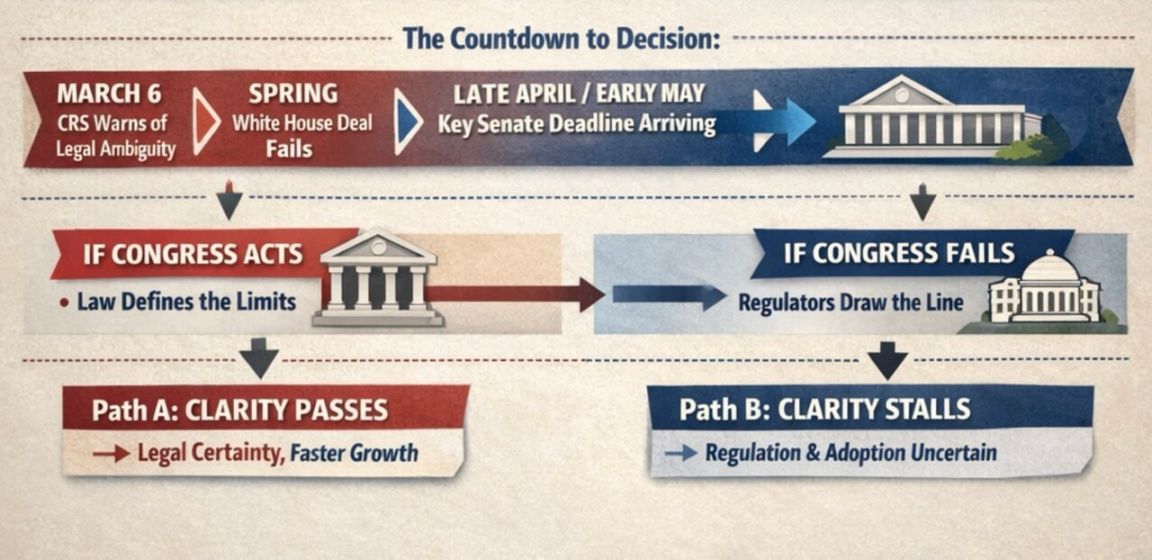
A flowchart illustrates the countdown for Senate stablecoin decisions, with deadlines in early March, late April, or early May leading to two outcomes: Congressional action would bring regulatory clarity and faster growth; failure to act would introduce uncertainty.
At this stage, the next step lies in Washington's hands. If Senators can revive this market structure bill this spring, they will still be able to directly define the extent to which stablecoins can transfer value to users and how much of the crypto regulatory framework can be codified. If not, regulators are clearly ready to set at least part of the rules themselves.
Regardless of the outcome, this debate has long since moved beyond "whether stablecoins belong in the financial system" to "how stablecoins should operate within the system" and "who stands to benefit from their development."