








Key Insights
- In the recent stablecoin news, U.S. Senate lawmakers are preparing to advance the CLARITY Act through committee action in mid-May.
- SEC Chair Paul Atkins urged lawmakers to finalize crypto legislation as regulators prepare “Project Crypto.”
- Negotiators agreed to prohibit passive stablecoin yield while allowing staking and activity-based rewards.
U.S. lawmakers are moving closer to advancing the CLARITY Act after months of negotiations around stablecoins, tokenization, and digital asset oversight.
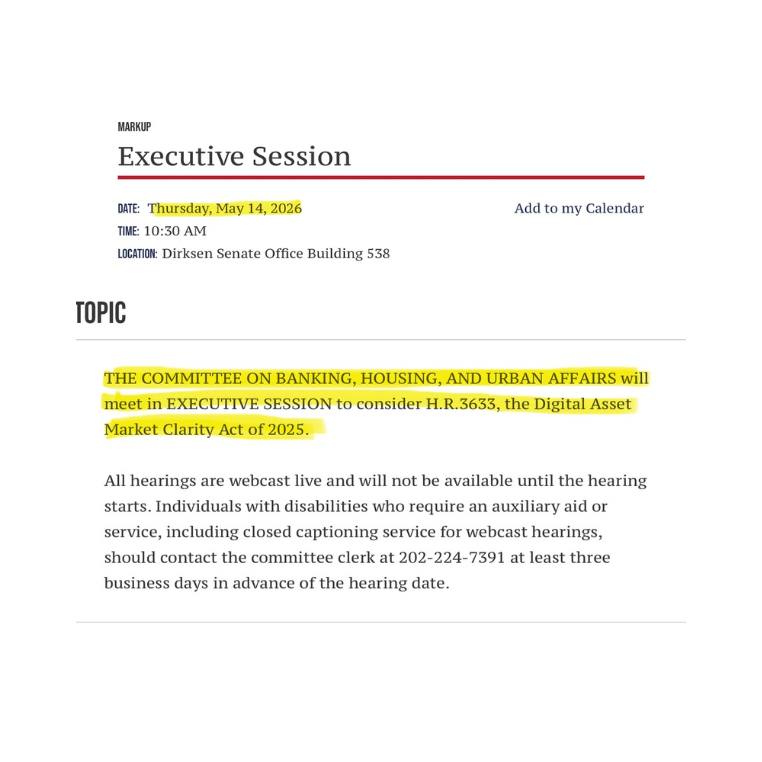
Momentum around the legislation increased after the Senate Banking Committee prepared for a markup session expected between May 11 and May 14. The proposal would establish clearer jurisdiction between the Securities and Exchange Commission (SEC) and the Commodity Futures Trading Commission (CFTC) while creating rules for stablecoins and crypto markets.
Crypto Regulations Move Toward Senate Committee Vote
According to the latest stablecoin news from the Senate Banking Committee, lawmakers are preparing to hold a markup session for the CLARITY Act between May 11 and May 14. The committee is expected to vote on the proposal on May 14.
The session could become one of the most important moments for U.S. crypto regulations this year. The legislation aims to define how the SEC and CFTC oversee digital assets while reducing the industry’s long-running regulation-by-enforcement dispute.
Senator Cynthia Lummis publicly backed the proposal ahead of the committee process. In a post on X, she said, “The United States WILL lead the way on digital asset innovation!”
The proposal also carries broader implications for tokenization and on-chain financial infrastructure. Supporters believe the bill could accelerate blockchain adoption across traditional financial markets if it passes both chambers of Congress.
However, some policy analysts remain cautious. Several previous crypto bills stalled despite early momentum, while disagreements over stablecoin regulation delayed negotiations for months.
SEC Chair Pushes Congress to Finalize Crypto Rules
Pressure to finalize the legislation has also increased from regulators and crypto executives.
Coinbase CEO Brian Armstrong recently argued that crypto adoption could expand beyond stablecoins into broader financial services. The CLARITY Act currently includes provisions covering decentralized finance, tokenization, and self-custody protections.
SEC Chair Paul Atkins also publicly supported the legislation during remarks at AIExpoDC. Atkins urged lawmakers to move quickly while regulators prepare operational frameworks under a broader initiative called “Project Crypto.”

One unresolved issue remains the division of authority between the SEC and CFTC. The legislation attempts to clarify which digital assets qualify as securities and which fall under commodities oversight.
That distinction has become increasingly important as tokenized assets expand beyond cryptocurrencies into equities, bonds, and real-world assets.
Stablecoin News: Passive Stablecoin Yield Banned and More…
For stablecoin news, the debaters agreed to scrap the stablecoin yield after banks fought to protect their deposit base.
However, stablecoin yield was not banned outright; it left room for activity-based rewards, such as staking. A significant number of participants saw this as the right call, as it looked more practical than what the crypto community was pushing.
Prediction markets like Polymarket and Kalshi had a 70% chance of passing, as per analysts. However, the decision rested solely on the Senate Banking Committee. For instance, Rep. Ritchie Torres proposed a ban on insider trading in political events.
In a tweet, Torres said, “Prediction markets cannot be a backdoor for campaign insiders to profit off nonpublic polling, strategy, and fundraising data. I will be introducing legislation to ban insider trading on political event contracts and require platforms to detect suspicious campaign-affiliated activity.”
Altogether, this latest report hinted at an end to a multi-month saga that brought in lawmakers and industry leaders in the banking and crypto sectors.
The post Stablecoin News: Senate Prepares to Vote for CLARITY Act Around Mid-May After Deal Done appeared first on The Market Periodical.