





Crypto investor Roger Metz’s attempt to block Internal Revenue Service (IRS) summons for his financial records has hit a wall.
The taxman had sought an audit of Metz’s 2022 federal tax return, but the situation quickly escalated.
Although the user initially found the omission by Coinbase and filed an amended tax return for an additional $14,700 for the 2022 period, the agency sought Metz’s entire activity on the platform since its launch.
The watchdog requested additional data, including account information, physical addresses, communications with Coinbase, and detailed platform activity logs.
In response, Metz filed a petition in the Northern District of California last year, seeking to bar the IRS summons. Through his lawyers, he argued that the IRS request was ‘overbroad and irrelevant’ because it was asking for years of personal data that was unrelated to the 2022 tax audit.
For him, the IRS’s overture to access his private communications and account logs was a privacy breach. He added that the taxman acted in ‘bad faith’ because it didn’t communicate with him even after filing the amended 2022 federal tax return.
Court’s grounds for dismissal
However, the court didn’t rule on his privacy arguments or concerns but on procedural guidelines.
On the 18th of March, the US District Judge Araceli Martínez-Olguín ruled against Roger Metz, stating that he failed to notify relevant government entities of the petition in advance.
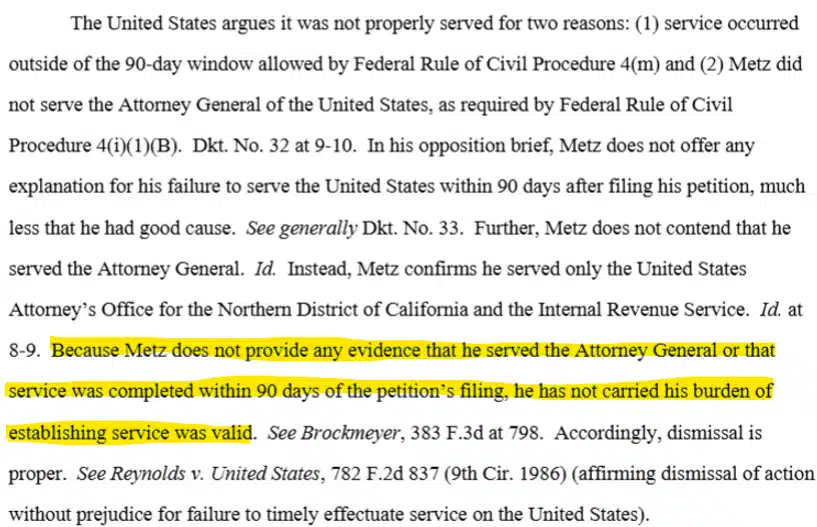
Under U.S. procedural guidelines, defendants must be notified of lawsuits to ensure they have time to respond.
In the Metz’s case, apart from the IRS, the local district’s US Attorney, and the AG in Washington ought to have been notified within 90-days of filing the petition.
That leaves a little room to speculate whether the court would have treated the IRS summons as a breach of privacy.
Even so, the IRS’s current crypto tax reporting regime remains very strict.
Currently, the IRS mandates crypto exchanges to report users’ gross crypto sales and cost basis (buying price) for each asset bought in Form 1099-DA. A mismatch between this (1099-DA) and the user’s reported figures will likely trigger further scrutiny from the tax watchdog.
For the 2025-2026 tax period, however, the IRS has relaxed the rules a bit, allowing crypto holders to identify and self-report their asset sales for tax purposes.
Final Summary
- A U.S. judge dismissed Roger Metz’s petition to block the IRS summons for his historical financial data on procedural grounds.
- IRS crypto tax reporting regime remains strict, but it has relaxed some of the rules for the 2026 period.