





In recent times, international news has been dominated by the situation in Iran and Trump's inconsistent stance on the course of the war.
Yet one event, which dominated front-page headlines in 2025, is now rarely mentioned by mainstream media—on February 14, a partial shutdown of the Department of Homeland Security (DHS) officially began after Democrats and Republicans became deadlocked over the DHS appropriations bill.
As of today, the shutdown has not yet ended.
During this nearly two-month shutdown, over 100,000 DHS employees went unpaid, and nearly 11% of Transportation Security Administration (TSA) staff were absent. In New Orleans, passengers waiting for security screening lined up from inside the terminal, winding around seven laps in the parking lot before reaching the entrance.
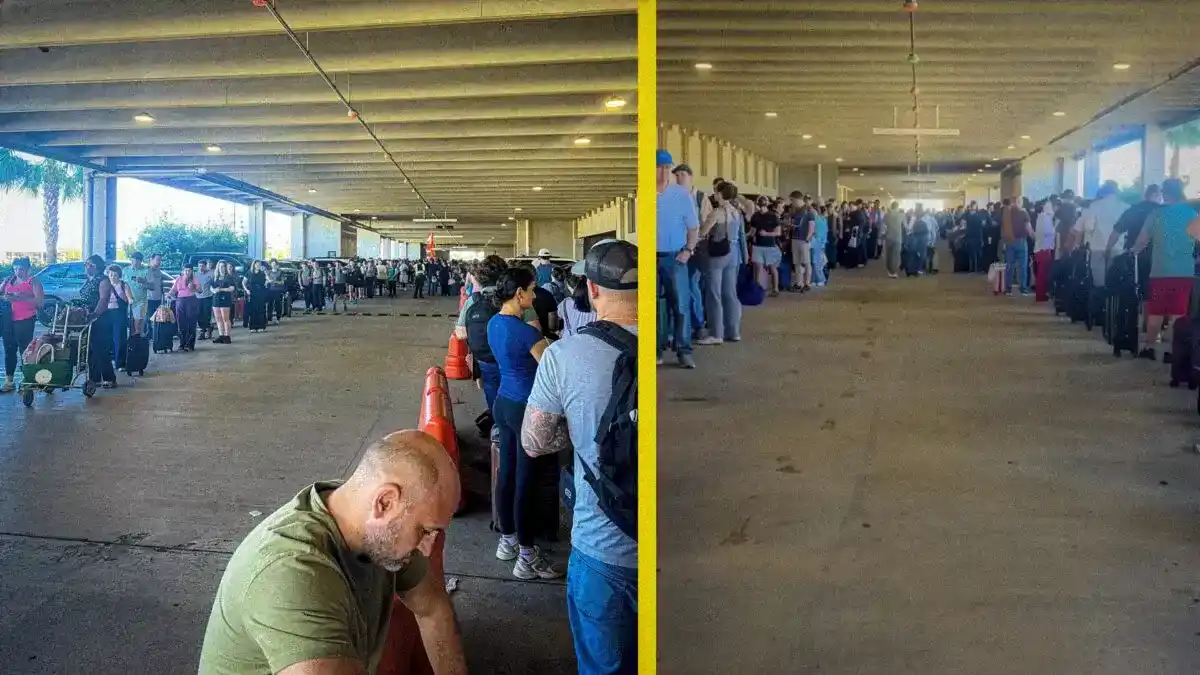
For the United States, which has almost no high-speed rail network and heavily relies on air travel, disruptions to the civil aviation system are catastrophic. Even Musk has publicly stated that he is willing to pay the salaries of affected TSA employees out of his own pocket.
Also starting in March, the prediction market Polymarket launched a weekly updated prediction event for "Number of U.S. Flight Delays This Week"—traders can bet on how many flights will be delayed each week; correct predictions earn profits, while incorrect ones result in total loss.
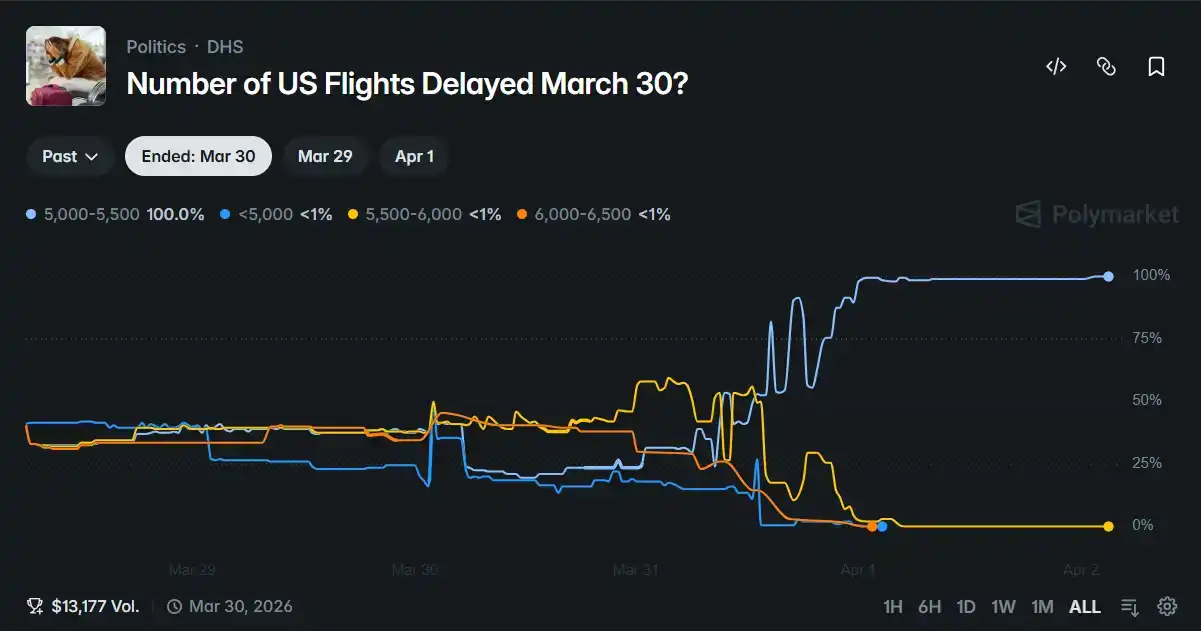
In addition to this purely entertainment-based event, Polymarket has launched several topics with considerable analytical value. Through the probabilities reflected in these topics, we can attempt to interpret the current reality of the U.S. government shutdown and domestic politics.
The partisan shutdown standoff
This shutdown has surpassed Trump’s previous record of 35 days. Amid widespread flight delays and a security system on the verge of collapse, when the shutdown will end is the most pressing concern for those affected across the United States.
There is already a related event on Polymarket: "DHS Shutdown Will End on ___." As of publication, the probability of the shutdown ending between April 5 and 8 is 44%, and the probability that it will not end in April is 14%.
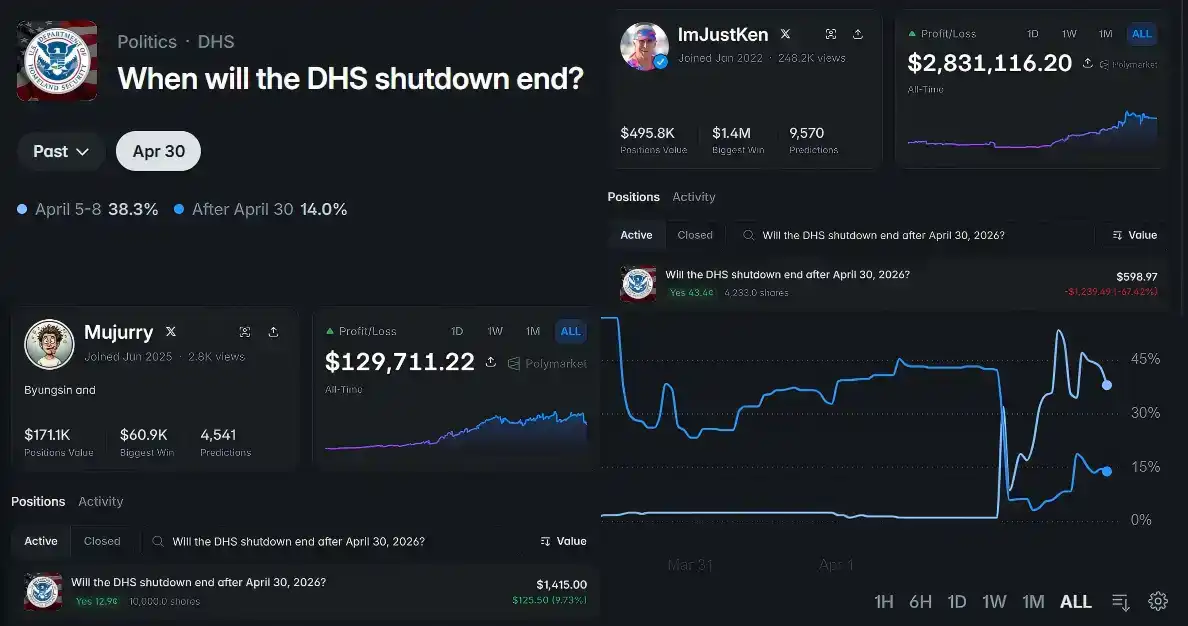
Significant "smart money" has positioned itself at these two time points—experienced traders with a high track record of accurate predictions and strong profitability in the political sector. This trading profile reflects a clear logic: if the shutdown does not end within the window of April 5 to 8, the likelihood of reaching an agreement this month will drop significantly.
From April 5 to 8, following the congressional recess, both parties will resume work and revisit the appropriations bill. If an agreement can be reached within the first few days after resuming, and the bill is passed by both the House and Senate before being signed into law, the shutdown will end.
However, if this window is missed again, both the House and Senate will subsequently become occupied with other legislative priorities. Without strong political pressure, the incentive for both parties to return to the negotiating table will significantly diminish.
Musk's "Buy" and ICE's "Cover"
Due to severe delays at major airports caused by ongoing staff departures from the TSA, Musk posted on March 21 that he was willing to pay TSA employees' salaries, sparking a Polymarket market titled "Will Musk pay TSA employees' salaries?"
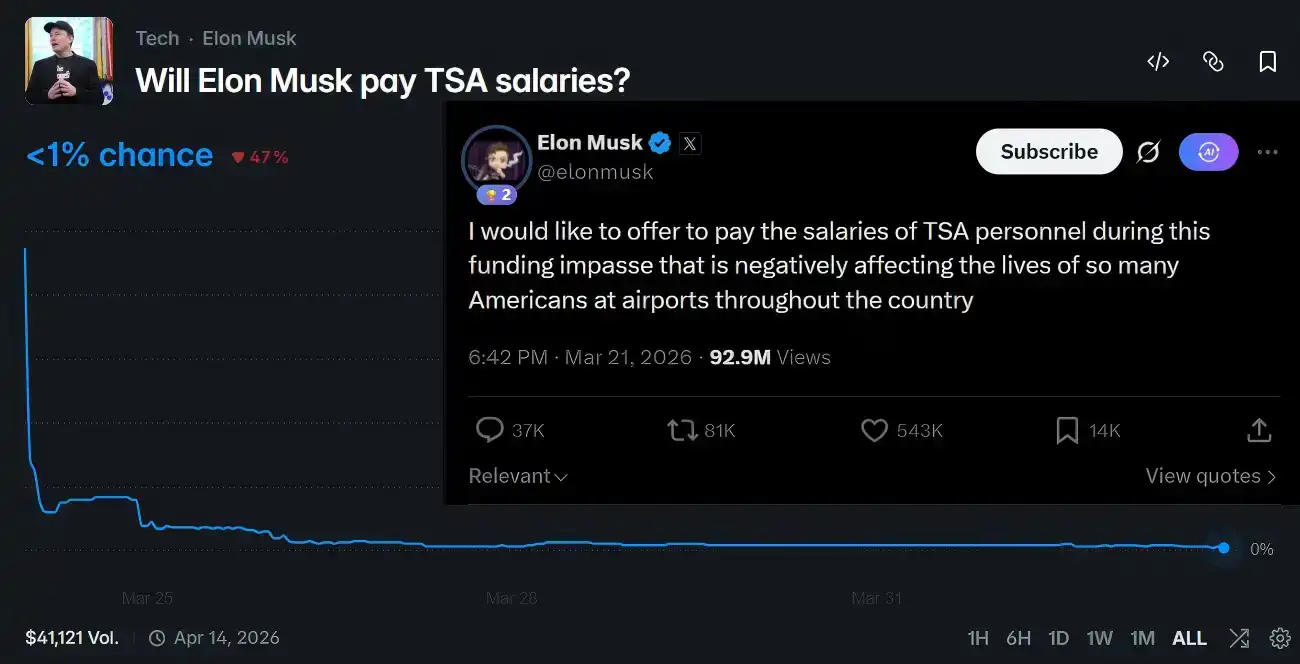
However, shortly after Musk's post, the White House declined the proposal citing legal compliance and conflicts of interest: under U.S. federal law, government employees are prohibited from accepting external compensation related to their official duties; moreover, given Musk's deep involvement in federal government contracts, directly paying his salary presents significant conflicts of interest.
Although the refusal had legal grounds, people still need to make a living. To minimize the impact of the aviation system shutdown on the midterm elections, Trump ordered ICE agents to be deployed to airports in March to replace TSA employees who had walked off the job due to unpaid wages.
But the scene that unfolded after these ICE agents arrived at the airport made the entire shutdown seem even more absurd.
Since Trump took office, ICE has significantly streamlined its recruitment and training processes to meet its goal of "arresting 3,000 people daily and deporting a million annually"—planning to hire 10,000 additional law enforcement officers and reducing the in-person training period from 16 weeks to 8 weeks.

In short, the professional competence of these ICE agents is already in question.
TSA security screening requires systematic training in core skills such as X-ray machine operation and explosive detection, which ICE agents do not possess.
Thus, a historic scene unfolded: TSA employees, working without pay, had to demonstrate security screening procedures to ICE agents and teach them how to maintain order. However, most ICE agents did not actually conduct security screenings; instead, they patrolled the terminals, using their law enforcement authority to question and deport individuals suspected of being undocumented immigrants.

The data confirms the outcome of this farce: after ICE agents arrived at the airport, flight delays showed no significant improvement. By the end of March, the U.S. air traffic system still experienced thousands of daily flight delays, with TSA absenteeism at Atlanta Airport nearing 40% and over 350 flights delayed in a single day. These figures demonstrate that the ICE agents, who were supposed to serve as a buffer against the shutdown, failed to fulfill any of the expected roles.
The nuclear option to break the deadlock
Another trading event related to this government shutdown is: "Will Republicans use the 'nuclear option' to break the filibuster before December 31, 2026?" The current probability is 31%.
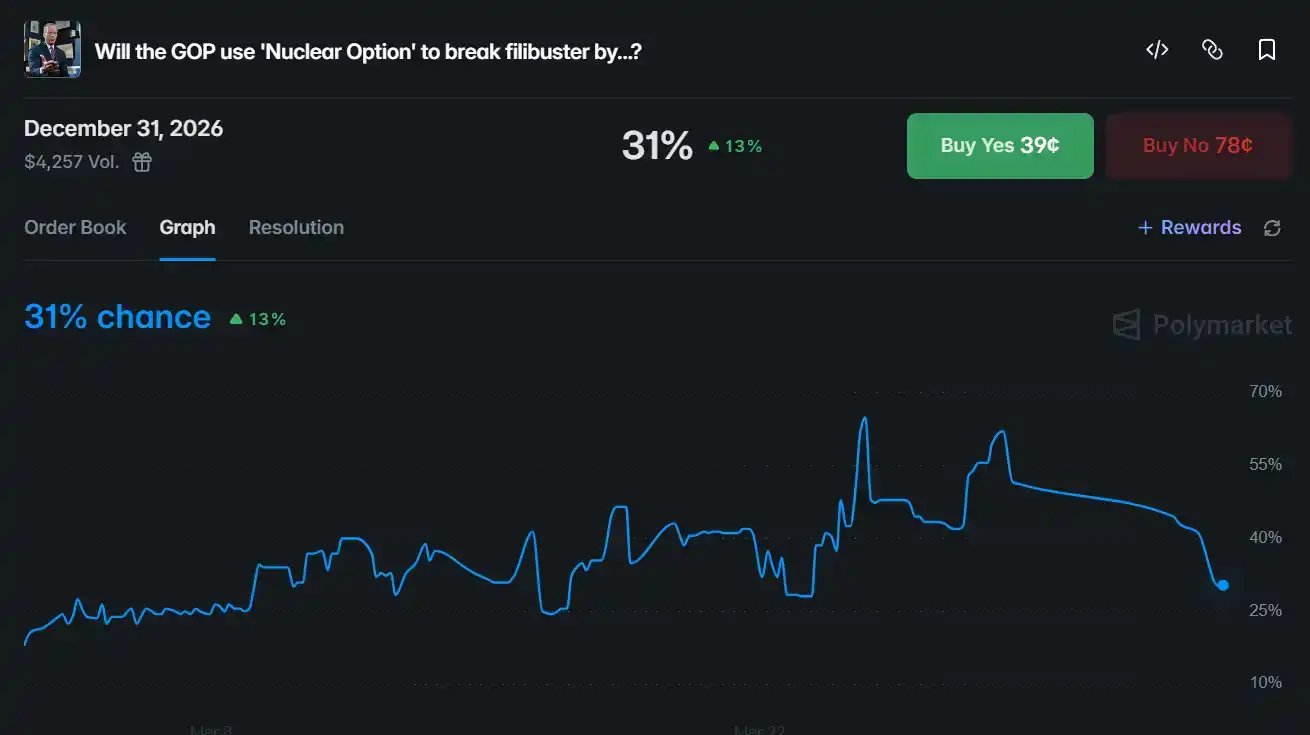
At first glance, the term "nuclear option" sounds intimidating; however, in U.S. politics, it does not refer literally to nuclear weapons, but rather to one of the Republican Party’s few yet highly disruptive parliamentary tactics.
In the U.S. legislative system, the House of Representatives is responsible for introducing and drafting appropriation bills, while the Senate is responsible for reviewing and voting on them. Typically, ending debate and proceeding to a vote in the Senate requires 60 votes—meaning the minority party needs only 41 votes to indefinitely delay debate and block any bill.
The "nuclear option" provides a way to bypass this threshold: a senator can file a procedural appeal to overturn the presiding officer's ruling by a simple majority (51 votes), thereby forcibly lowering the vote threshold required to end debate from 60 to a simple majority.
The Republican Party currently holds 53 seats in the Senate; once the nuclear option is invoked, the Democrats’ ability to filibuster will be virtually nonexistent.
But the reason the "nuclear option" is called "nuclear" is that it comes at a high cost to the user itself: undermining Senate rules is seen by voters as an abuse of power; more importantly, should the Republican Party lose its majority in the future, the same rule could be used by the Democratic Party as a countermeasure.
The pit you dig today may one day be the one you have to fill yourself. This 31% probability is the market’s true pricing of this dilemma.
Even as this government shutdown impasse remains unresolved, Trump must also contend with the escalating situation in Iran.
On one side, high-stakes diplomatic and military maneuvering; on the other, long airport lines, unpaid wages, and partisan gridlock—this U.S. administration faces far more complex challenges than headlines suggest. Domestic and foreign crises never wait for each other to be resolved first.
Amid this volatility, predicting the rich array of political and current events on the market will continue to serve as an objective mirror, helping us capture the true trajectory of these narratives.