





Key Insights
- The Digital Asset Market Clarity Act split oversight between the SEC and the CFTC, clarifying U.S. crypto market roles.
- Stablecoins face strict limits, barred from generating yields except programmatic activity‑based rewards.
- Industry reactions are mixed, praising innovation clarity but warning that compliance burdens may favor large players.
The Digital Asset Market Clarity Act moved closer to passage on Jan. 15 after the Senate Banking Committee released a bipartisan draft. The 278-page bill proposed a federal framework for cryptocurrency, stablecoins, and decentralized finance, aiming to clarify oversight between U.S. regulators and reduce market uncertainty.
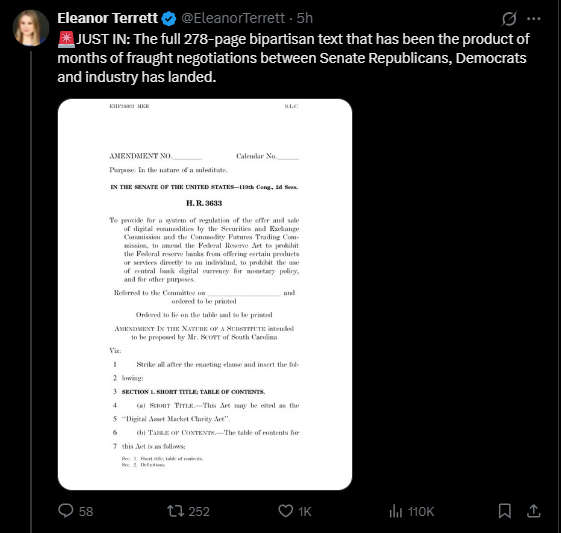
The Act aims to strike a balance between innovation and consumer protection. It addresses risks such as illicit finance and market instability. The bill is scheduled for markup on January 15. Lawmakers hope it will strengthen U.S. leadership in the financial technology sector.
Digital Asset Market Clarity Act splits SEC and CFTC oversight
The Act divides oversight between the Securities and Exchange Commission (SEC) and the Commodity Futures Trading Commission (CFTC). The SEC will regulate “ancillary assets.” These are tokens whose value depends on the work of originators or affiliates.
They will be treated like securities, with disclosure and resale restrictions. The CFTC will regulate “digital commodities.” These are decentralized tokens that derive their value from adoption and usage. The CFTC will oversee spot markets and trading platforms.
The bill defines “digital assets” broadly. It includes fungible and non‑fungible items on distributed ledgers. “DeFi protocols” are defined as automated systems without central control. “Stablecoins” are defined mainly for payment use, including offshore versions tied to the U.S.
Non‑fungible tokens (NFTs) receive a safe harbor. They are not treated as securities if they represent unique ownership rights, such as art or collectibles. Mass‑produced or fractionalized NFTs are excluded.
How the Digital Asset Market Clarity Act regulates stablecoins
The Act is organized into nine titles. Title I requires disclosures for ancillary asset originators. These include economic details, risks, and financials. Requirements scale with fundraising size. Exemptions apply if decentralization is certified.
Title II strengthens anti‑money laundering rules under the Bank Secrecy Act. It applies to brokers, exchanges, and kiosks. It also creates pilots for information sharing and studies illicit activities such as mixers.
Title III sets rules for DeFi. It requires risk management programs and cybersecurity measures. It allows transaction holds of up to 180 days for suspicious activity.
Title IV covers banking innovations. Institutions may engage in custody, lending, and staking without prior approval. They may use joint portfolio margining across asset classes. Stablecoins cannot generate interest or yield, except for programmatic activity‑based rewards.
Title V creates a joint SEC‑CFTC “Micro‑Innovation Sandbox.” It allows testing of new technologies with limited exemptions. The sandbox is capped at $20 million and two years.
Title VI protects developers and users. Software creators are shielded from liability for non‑controlling code. Self‑custody rights are affirmed under the “Keep Your Coins Act.” Title VII provides bankruptcy safeguards. Digital assets are treated as customer property.
Title VIII requires educational disclosures on risks and insolvency, and Title IX establishes a Joint Advisory Committee. It mandates rulemaking within one year.
Exemptions and Reactions
A key provision exempts certain tokens from ancillary asset rules. Tokens that underpin exchange-traded products (ETPs) listed on national securities exchanges by January 1, 2026, are eligible.
This could streamline treatment for Bitcoin, Ethereum, XRP, Solana, Litecoin, Hedera, Dogecoin, and Chainlink, if their spot ETFs launch by the deadline. These assets would be treated as commodities without retroactive changes.
Ethics clauses disqualify originators with felony convictions related to fraud or insider trading. The bill preempts conflicting state laws for federally exempt assets but allows state enforcement on fraud. Internationally, it promotes cooperation on standards and requires reports on foreign compliance.
Industry reactions are mixed. Senator Cynthia Lummis urged Democrats to advance the bill, citing innovation and consumer protection as key benefits. Analysts praised clarity for staking rewards and developer safe harbors.
Critics warned of compliance burdens and AML overreach. Some argued the framework arrives “14 years late” and may favor large players.
If passed, the Act will take effect 360 days after enactment. Supporters believe it will reduce uncertainty, boost competitiveness, and protect against scams and insolvency.
Amendments may address issues such as double taxation on staking or broader stablecoin yields. With midterm elections approaching, the bill’s future depends on bipartisan commitment in Congress.
The post Digital Asset Market Clarity Act sets new U.S. crypto rule appeared first on The Market Periodical.