


Representatives Scott Fitzgerald, Ben Cline, and Zoe Lofgren introduced the bill to Congress on February 26, seeking to protect software developers who write blockchain applications that don’t handle custody of funds from legal actions and criminal prosecution under Section 1960, Title 8.
Promoting Innovation in Blockchain Development Act Introduced In Congress With Bipartisan Support
The U.S. Congress is working to maintain the nation’s leadership in the blockchain software sector, making advances in guaranteeing the safety of blockchain software developers.
Representatives Scott Fitzgerald, Ben Cline, and Zoe Lofgren introduced a new bill to shield these workers from criminal prosecution for only writing software. Referred to as the “Promoting Innovation in Blockchain Development Act,” the draft focuses on protecting software developers from being wrongly classified as money transmitting businesses.
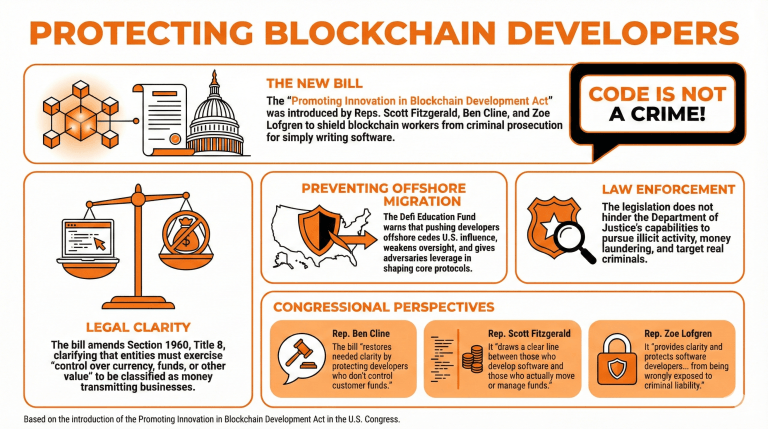
According to the amendments proposed by the bill, Section 1960, Title 8 would now declare that to be classified as money transmitting businesses, entities must exercise “control over currency, funds, or other value that substitutes for currency.”
Cryptocurrency organizations see the bill as a catalyst to secure American software innovation in the industry, dispelling concerns regarding earlier investigations and prosecutions by the former administration targeting software developers who did not handle fund custody.
The Defi Education Fund argues that “pushing developers offshore who create that infrastructure cedes U.S. influence over design and standards, weakens oversight, and hampers illicit‑finance detection. If innovation migrates overseas, adversaries gain leverage in shaping core protocols.”
It also highlights that this bill does not hinder the Department of Justice’s capabilities to pursue illicit activity and money laundering crimes, which can be tackled differently.
Rep. Cline stated that the bill “restores needed clarity by protecting developers who don’t control customer funds, while ensuring law enforcement can continue to target real criminals,” while Rep. Fitzgerald argues that it “draws a clear line between those who develop and deploy blockchain software and those who actually move or manage funds.” Rep. Lofgren highlights that it “provides clarity and protects software developers who don’t control customer funds from being wrongly exposed to criminal liability.”
FAQ
What recent legislation has been introduced in Congress regarding blockchain developers?
The “Promoting Innovation in Blockchain Development Act” aims to protect blockchain software developers from criminal prosecution for merely writing software.What does the bill clarify about the classification of money transmitting businesses?
The bill amends Section 1960 to specify that entities must control currency or funds to be classified as money transmitting businesses, protecting developers who do not manage customer funds.How does this bill affect U.S. influence in blockchain innovation?
Cryptocurrency organizations view the bill as essential for securing U.S. software innovation, preventing developers from relocating abroad and maintaining oversight in the industry.What assurances does the bill provide regarding law enforcement capabilities?
It allows the Department of Justice to continue pursuing illicit activities and money laundering while clearly delineating the roles of developers versus those managing funds, according to congressional representatives.