



Organized by: Jerry, ChainCatcher
Last week's performance of crypto spot ETFs
Net inflow of $787 million into U.S. Bitcoin spot ETFs
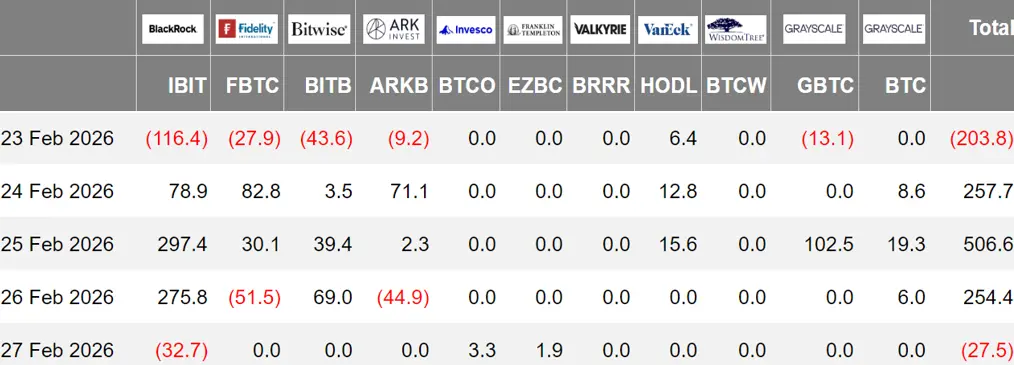
Last week, U.S. spot Bitcoin ETFs saw three days of net inflows, totaling $787 million, bringing total assets under management to $83.4 billion.
Last week, nine ETFs experienced net inflows, primarily driven by IBIT, GBTC, and BITB, with inflows of $503 million, $89.4 million, and $68.3 million, respectively.
Data source: Farside Investors
Spot Ethereum ETFs in the United States saw net inflows of $80.2 million.
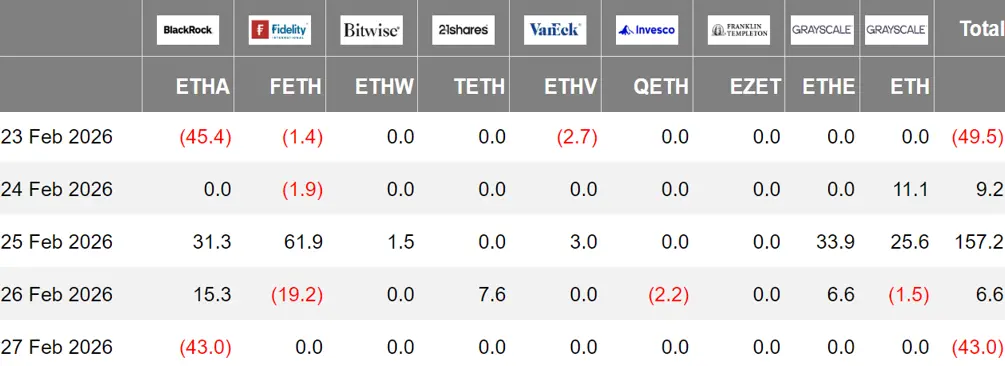
Last week, U.S. Ethereum spot ETFs recorded three days of net inflows, totaling $80.2 million,with total assets under management reaching $10.96 billion.
Last week, the primary inflows came from Grayscale's ETHE, with net inflows of $40.5 million. All six spot Ethereum ETFs were in net inflow.
Data source: Farside Investors
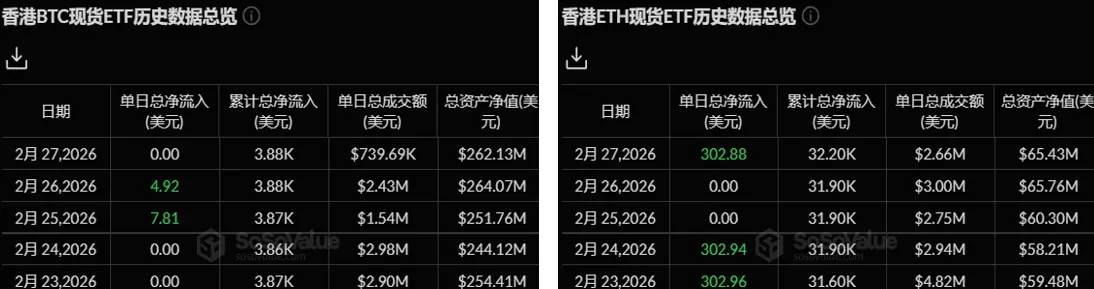
Hong Kong Bitcoin Spot ETF recorded a net inflow of 12.73 BTC
Last week, Hong Kong's spot Bitcoin ETFs saw a net inflow of 12.73 Bitcoin, with a total net asset value of $262 million. Among them, the holdings of Harvest Bitcoin decreased to 219.69 Bitcoin, while China Asset Management's increased to 2,510 Bitcoin.
Hong Kong Ethereum spot ETF had a net inflow of 908.78 ETH, with a net asset value of $65.43 million.
Data source: SoSoValue
Performance of Crypto Spot ETF Options
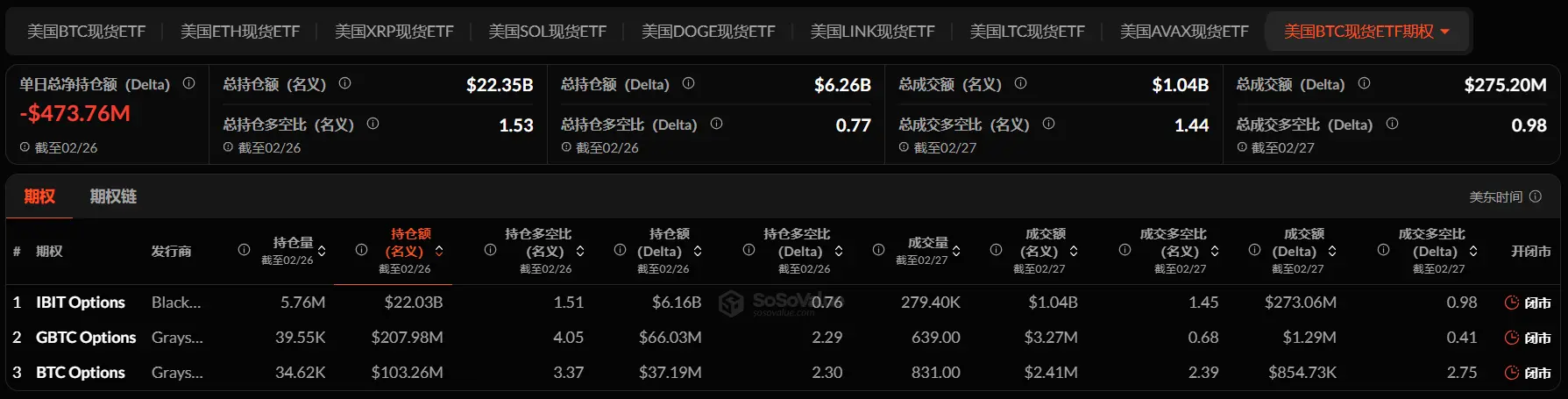
As of February 27, the total notional volume of U.S. Bitcoin spot ETF options was $1.04 billion, with a total notional long-to-short ratio of 1.44.
As of February 26, the notional open interest of U.S. Bitcoin spot ETF options reached $22.35 billion, with a net long-to-short ratio of 1.53.
Short-term trading activity for Bitcoin spot ETF options has declined, with overall sentiment turning bearish.
Additionally, the implied volatility is 50.36%.
Data source: SoSoValue
Last week's highlights on crypto ETFs
Bitcoin ETF and treasury company buys 60,000 USD in protective put options
According to market reports, major Bitcoin ETF holders and treasury firms recently concentrated on buying BTC put options with strike prices of $60,000 or lower and maturities of 6 months and 1 year on Deribit, as portfolio insurance against a price drop below $60,000.
Deribit reported that open interest for BTC put options with a strike price of $60,000 has risen to approximately $1.5 billion, the highest across all strike prices and expiries on the platform, indicating a significant increase in medium- to long-term downside hedging demand. While Bitcoin spot price is currently trading around $67,000, the 30-day implied volatility for put options remains about 7% higher than that for call options, suggesting market participants still favor downside protection.
According to Bloomberg ETF analyst James Seyffart, overall 13F filers reduced their positions in spot Ethereum ETFs, as hedge funds sold off en masse due to the collapse of basis trade returns; traditional and long-term capital, however, increased their positions, with the Harvard endowment becoming the largest new buyer this quarter.
Nasdaq applies to list the VanEck JitoSOL ETF
According to Cointelegraph, Nasdaq has submitted a rule change proposal to list the VanEck JitoSOL ETF, which will hold JitoSOL, a liquid staking token based on Solana, directly.
Brian Smith, Chairman of the Jito Foundation, stated that if approved, staking rewards will not be distributed separately but will instead be reflected in the fund’s net asset value. Since JitoSOL automatically compounds rewards, each token held by the trust will represent the underlying deposited SOL and its accumulated staking rewards on the Solana network.
Top university endowments, including Harvard, are beginning to allocate to Bitcoin ETFs.
According to CoinDesk, facing lower expected returns on traditional assets, several university endowments are adjusting their investment strategies by allocating to cryptocurrency ETFs. Harvard University and Brown University have disclosed holdings in Bitcoin and Ethereum ETFs in their latest 13F filings.
Kim Lew, CEO of Colombia Investment Management, said that expected returns and alpha from traditional asset classes are being compressed, forcing institutions to reach further along the risk curve and explore new strategies. Carlos Rangel of the W.K. Kellogg Foundation noted that the traditional foundation model will be difficult to sustain without achieving an 8% return rate.
21Shares spot SUI ETF has begun trading on Nasdaq
According to the official announcement from the Sui Foundation, 21Shares' spot SUI ETF (Nasdaq ticker: TSUI) has begun trading on Nasdaq, providing U.S. investors with regulated, highly liquid direct exposure to SUI through their existing brokerage accounts.
This ETF has recently been approved by the U.S. Securities and Exchange Commission.
U.S. SEC filings show that BlackRock’s iShares has filed an amended S-1 to launch the “iShares Staked Ethereum Trust ETF” (ticker: ETHB) and list it on Nasdaq.
This trust is a statutory trust under the laws of the State of Delaware, primarily holding ETH, and participates in Ethereum staking through third-party validators such as Coinbase, allocating approximately 70%–95% of its assets to earn staking rewards, without compromising its status as a grantor trust for U.S. tax purposes.
The product employs a 40,000-unit basket creation and redemption mechanism, supporting cash or physical ETH redemptions, with direct creation and redemption available only to authorized participants. The base fee rate is 0.25% annually, reduced to 0.12% for the first $2.5 billion in assets during the first 12 months after listing. The trust expects to continuously issue shares under controlled risk conditions.
Opinions and analysis on crypto ETFs
Nate Geraci, President of The ETF Store, said that a 50% drawdown is not unusual for long-term Bitcoin investors and may not be the last one. He noted that despite significant market declines,现货比特币 ETF investors have not shown signs of noticeable panic, with fund flow data indicating that these investors remain steadfast.
Geraci believes that, based on recent fund flows, some ETF investors prefer to accumulate positions during pullbacks.
Bloomberg senior ETF analyst Eric Balchunas posted on X that Bitcoin ETFs attracted approximately $500 million in inflows yesterday, the largest single-day increase in recent times, with a cumulative $750 million流入 over the past two days—amid widespread market pessimism. He described this inflow as “like hitting a home run in the bottom of the ninth,” providing a much-needed boost to the market.
Year to date, Bitcoin ETFs have still seen net outflows of less than $2 billion, though it remains unclear whether this signals the beginning of a genuine rebound or merely a temporary "dead cat bounce."
The discussion surrounding the mechanism of Bitcoin ETFs, sparked by speculation about Jane Street's market manipulation, continues to grow. Jeff Park, a consultant at Bitwise, wrote that the question of whether Bitcoin's price is being suppressed by Jane Street is not about a single institution, but rather determined by structural characteristics within the Bitcoin ETF framework.
Each authorized participant (AP), including Jane Street Capital, JPMorgan, Goldman Sachs, and others, has the authority to create and redeem ETF shares, allowing them to flexibly manage their positions—including hedging with futures or derivatives—without needing to purchase spot Bitcoin, which may impact price discovery mechanisms.
This gray area stems from regulatory exemptions and the SEC’s approval of physical settlement. Although there is no evidence that any AP has explicitly suppressed Bitcoin prices, the existing structure may alter the natural price formation mechanism, warranting attention from regulators and investors.
Bloomberg ETF analyst Eric Balchunas responded that this mechanism is indeed difficult to understand, and he is curious about who or what force is behind the "patterned sell-offs" that appear daily and then suddenly vanish. Samson Mow, CEO of Bitcoin technology company Jan3, said that becoming an AP is not the only factor suppressing prices; the key lies in how "extensive" their undisclosed trading and hedging activities are. This is a channel that brings capital costs close to zero.
According to the Bitfinex Alpha report, the Bitcoin market remains in a downtrend on higher timeframes due to weak inflows into Bitcoin spot ETFs and continued selling by large holders.
The report notes that although Bitcoin has rebounded 20% from its February 5 low, a bottom has not yet been confirmed. Year-to-date, U.S. spot Bitcoin ETFs have recorded a net outflow of $2.6 billion, with institutional investors' "ETF weakness" intensifying selling pressure. On-chain data shows that approximately 64% of current exchange inflows come from large holders (whales), the highest level since October 2015.
Additionally, influenced by U.S. tariff policies and macroeconomic uncertainty, options traders have once again paid a premium for downside risk, reflecting a cautious market sentiment. Currently, the $53,000 realised price is viewed as a key support level for the medium-term market.
Bloomberg analyst James Seyffart posted on X that institutional investors filing 13F reports with the U.S. Securities and Exchange Commission in the fourth quarter of 2025 collectively reduced their Bitcoin ETF positions, with investment advisory firms and hedge funds being the two largest categories of holders and serving as the primary sellers in the market.
Overall, institutional investors filing 13F reports collectively sold ETF shares equivalent to approximately 25,000 bitcoins in the fourth quarter of 2025.
According to Bloomberg, the hedge funds that fueled the surge in U.S. Bitcoin exchange-traded funds (ETFs) are rapidly withdrawing.
According to data compiled by CF Benchmarks, a wholly owned subsidiary of the crypto exchange Kraken, the total allocation of Bitcoin ETFs by the largest hedge funds declined by 28%. Gabe Selby, Research Director at CF Benchmarks, wrote in a research report on February 19: “The dominant theme over the past two quarters has been hedge fund de-risking. The peak and subsequent pullback in October appears to have triggered systemic unwinding.” Brevan Howard significantly adjusted its position in BlackRock’s iShares Bitcoin Trust, becoming the largest seller of this spot ETF in the fourth quarter. Its holdings dropped by approximately 86% to 5.5 million shares, reducing the value of its spot position from around $2.4 billion to $275 million. As Bitcoin prices fell alongside broader macro risks—and in some phases even more sharply—the earlier rationale promoted to institutional investors—that Bitcoin could hedge against inflation, currency depreciation, or stock market stress—was undermined.