





Author:Changan, Amelia I am the Biteye content team.
The United States has once again raised the tariff big stick, but this time the target is not the trade deficit, but territory. Trump officially declared war on Europe's traditional allies: wielding the ownership of Greenland as a pretext, he brandished the sword of tariffs.
For investors, understanding this conflict is not only about gaining clarity on the geopolitical situation, but also about protecting their assets amid significant liquidity fluctuations.
This article will thoroughly analyze how this tariff event will affect each of your investment decisions.
Background and Development: From Military Drills to Tariff Threats
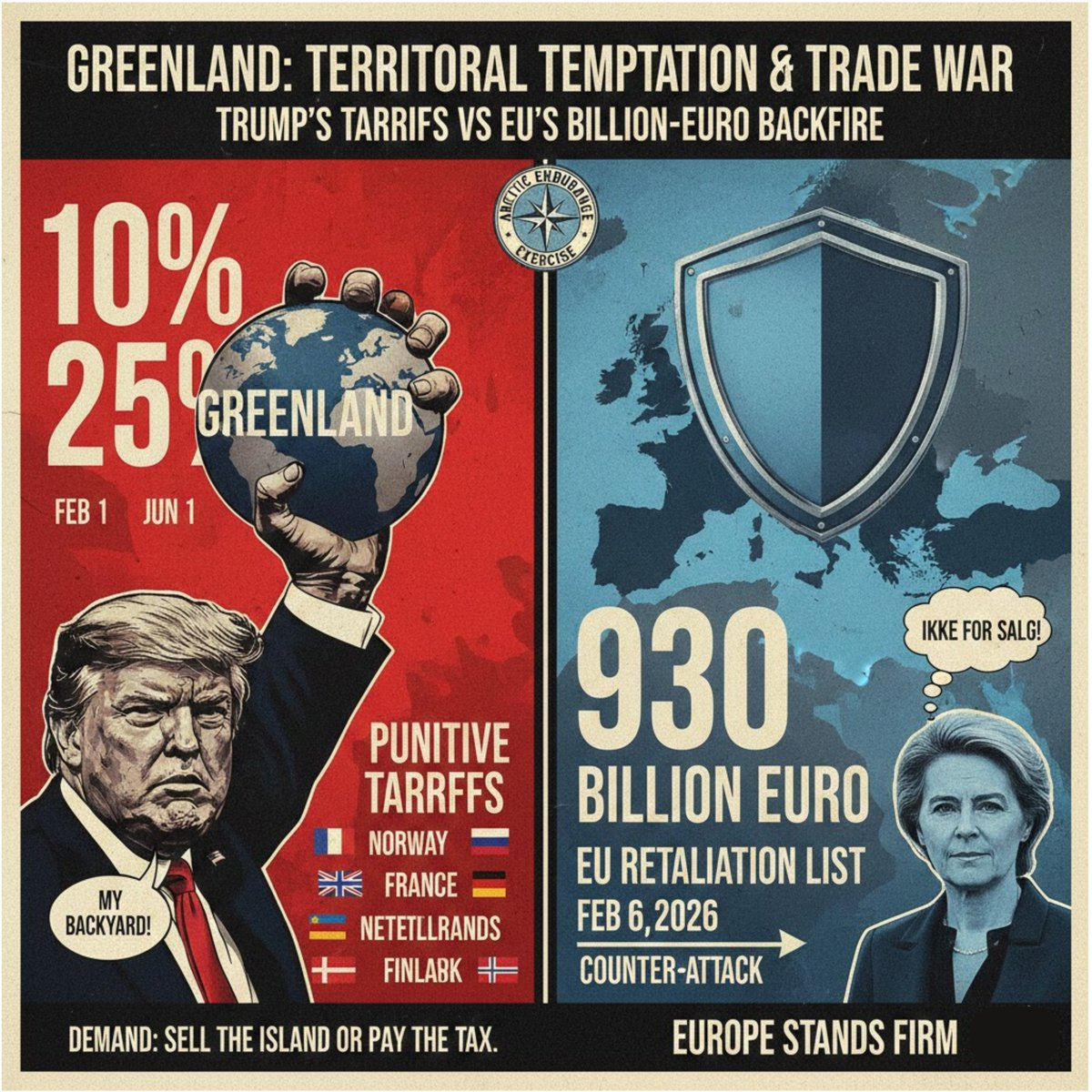
The immediate target of the additional tariffs is Denmark, Norway, Sweden, France, Germany, the United Kingdom, the Netherlands, and Finland.
The immediate trigger was the recent deployment of military forces from these eight countries to Greenland for the Arctic Endurance Exercise. In Trump's view, Greenland should be considered America's backyard, and this military presence without his approval was perceived as provocative. As a result, he quickly resorted to his most familiar tool—tariffs.
Trump's demand is simple and straightforward: either sell the island or pay taxes.
Starting from February 1st: 10% punitive tariff.
As of June 1: Increased to 25%.
Tariffs will be lifted only if an agreement to purchase Greenland is reached.
Currently, Europe has taken a firm stance, with Denmark reiterating that Greenland will not be sold. According to the latest news from Brussels, ambassadors of the EU's 27 member states have convened an emergency meeting to discuss reciprocal countermeasures.
The European Union holds a list drawn up last year with a total value of up to 93 billion euros. This list was originally suspended due to a trade agreement last year, but the suspension period expired on February 6, 2026. This means that if Trump takes action on February 1, the EU could retaliate directly just a few days later.
Currently, both sides are frantically coding.
- Trump is betting that European unity is fragile, and tariffs of 10% to 25% would be sufficient to cause internal economic strain in Europe, ultimately forcing it to compromise.
- Europe is betting that American companies cannot afford the cost of losing the European market, which will in turn pressure the U.S. Congress and voters to exert pressure on Trump.
Tariff Transmission and Market Repricing
Affected by this news, global markets experienced significant volatility today: the Hong Kong stock market fell by 1.05% during the day, while Asian markets such as the Nikkei index generally declined. Risk-aversion sentiment intensified, with spot gold rising as much as 2% during the day, reaching a historic high alongside silver prices. Meanwhile, the price of Bitcoin plunged by as much as $4,000 within two hours, with a daily decline of approximately 3.6%.
Since the main difference of this Greenland tariff dispute from previous tariff issues lies in territorial sovereignty rather than trade matters, the European Union may not easily give in.
What are the differences between this Greenland-Guam tariff war and previous tariff wars? Its impact is mainly reflected in three aspects:
1. International Trade and Commodities Level:Trump's punitive tariffs imposed on eight European countries directly cut off the low-cost circulation channels for high-value industrial goods.
Due to the United States' high reliance on countries like Denmark and Germany for precision instruments, pharmaceuticals, and high-end automobiles, tariff costs will quickly be transmitted through the supply chain to the end markets, triggering sharp imported inflationary pressures.
Under this macroeconomic uncertainty, global trade volumes have suffered, pushing up the safe-haven premium for physical assets. Driven by this, the prices of gold and silver have hit record highs.
2. Liquidity and Interest Rates: Trump's linkage of tariffs to territorial sovereignty disrupted the existing international capital balance. Under the pressure of tariffs, global trade credit contracted, significantly increasing the cost of obtaining U.S. dollars in offshore markets. At the same time, risk-aversion sentiment drove a large-scale repatriation of capital to the United States, with a concentrated purchase of U.S. Treasury securities. This mismatch in capital flows led to a noticeable regional imbalance in global dollar liquidity.
Currently, the U.S. Treasury market is experiencing increased volatility. The 10-year Treasury yield is caught in a fierce battle between safe-haven buying pressure and long-term inflation expectations.
In the short term, inflows of risk-averse capital into the bond market can suppress yields. However, as the market begins to digest inflation risks triggered by tariffs and concerns over the U.S. large-scale fiscal expansion leading to a heavier debt burden, long-end U.S. Treasury yields face the risk of a second rise. This uncertainty in the interest rate environment is gradually undermining the support for assets with high valuations.
3. Cryptocurrency Market:Cryptocurrencies failed to demonstrate their safe-haven properties during this crisis, instead facing significant pressure due to their strong and high correlation with macroeconomic liquidity.
As offshore U.S. dollar liquidity tightened, institutional investors prioritized selling highly volatile crypto assets to address margin shortfalls in traditional markets. After Bitcoin broke below a key support level, it triggered large-scale liquidations, causing the total market capitalization of the crypto market to sharply contract in a short period. This once again exposed its vulnerability during extreme geopolitical turbulence.
In summary, tariff barriers lead to trade contraction → imported inflation raises interest rate expectations → global dollar liquidity tightens → institutions sell across asset classes to cover margin requirements, ultimately causing a crash in the cryptocurrency market.
Summary of KOL Opinions
1. Phyrex @Phyrex_Ni(XHunt Rank: 765)
Viewpoint: If Trump were to actually implement the Greenland tariffs starting on February 1st, it is likely that market expectations would anticipate a renewed rise in inflation, which could lead the Federal Reserve to maintain higher interest rates for a longer period. This scenario might cause investors to reduce their risk appetite and possibly sell off assets in search of safer investments.
2. qinbafrank @qinbafrank(XHunt Rank: 1533)
Viewpoint: The biggest difference between the Greenland tariff dispute and previous tariff issues is that the core issue is territorial sovereignty rather than a trade issue. Trump's ultimate goal is to achieve long-term, complete U.S. control over Greenland's defense and mineral resources through a long-term agreement. The Greenland tariffs have increased uncertainty, and what the market fears most is uncertainty.
https://x.com/qinbafrank/status/2013041531926794415
3. The Kobeissi Letter @KobeissiLetter(XHunt Rank: 1054)
Viewpoint: This time, Trump's plan to acquire Greenland indeed represents a higher level of demand than previous requests, and market turbulence may last longer. However, they believe that the most skilled traders will take advantage of asset price fluctuations caused by trade wars. Volatility creates opportunities.
4. Deep Tide @TechFlowPost(XHunt Rank: 652)
Viewpoint: Since 2019, Trump has been fixated on acquiring Greenland. This time, he weaponized tariffs against NATO allies for the first time, prompting the EU to consider activating its anti-coercion tools to retaliate against U.S. goods. This marks a deterioration in transatlantic relations. At its core, Bitcoin remains a "U.S. asset" dependent on the dollar system, losing its appeal amid U.S.-EU tensions, while "stateless" assets like gold have become the true safe-haven choice. This shift signals a transformation in the international order toward economic nationalism and calls for a "de-Americanization" revolution in cryptocurrencies.
https://x.com/TechFlowPost/status/2013071438375497963
5. Veteran in the cryptocurrency world @Bqlsj2023(XHunt Rank: 1519)
Perspective: This post thoroughly analyzes the reasons behind Trump's persistent interest in acquiring Greenland, including its strategic location, control over the Arctic shipping routes, potential as a missile defense base, and its rich reserves of rare earth elements and energy resources. It also reviews multiple past U.S. attempts to purchase the territory. Based on the experience of the U.S.-China tariff war, the post predicts that the EU tariff negotiations could last 4 to 6 months, leading to the current cryptocurrency market crash being a temporary "black swan" event. Investors are advised to remain cautious, wait for a period of easing, and consider buying the dip for a rebound. The post also emphasizes that the market will continue to be volatile around the tariff war.
6. The Long-Term Investor @TheLongInvest(XHunt Rank: 40695)
Viewpoint: Trump uses threats of tariffs as a negotiation tactic to exert maximum pressure (this time aiming to force the EU to sell Greenland), and his true objective is to force a deal, not to impose long-term tariffs. The market will repeat the fixed cycle of "panic decline—negotiation easing—rebound to new highs," and investors should take advantage of these artificially created short-term fluctuations, looking for buying opportunities amid panic.
Biteye Perspective: TACO Action Guide
A term is circulating in the market: TACO "(Trump Always Chickens Out)" — This meme originated from observations of his past negotiation style: although he often started with extreme threats of tariffs, when faced with significant stock market turmoil or intense pressure from domestic interest groups, he usually chose an appropriate moment to reach a deal and declare a victory.
Under this logic, what signals should we pay attention to?
1) Pay attention to risk-averse funds:Before the tariff shoe finally drops, gold and silver remain core assets for hedging against geopolitical risks.
2) Maintain liquidity vigilance:When offshore US dollars experience a dollar panic, it is crucial not to recklessly add leverage during the liquidity liquidation period.
3) Identify wrongly liquidated assets:Historical experience shows that when the market falls into irrational panic, companies with fundamentally strong businesses that have been wrongly hit due to macro-level sentiment often become the first group to rebound after the volatility.