





In 2017, Trump took with him a $253.5 billion order list. What will Trump take in 2026?
Author and source: 0x9999in1, ME News

TL;DR
- Trump visits China for the second time on May 13; list of 17 top U.S. CEOs accompanying him is leaked.
- The lineup spans four major sectors: technology, finance, aviation, and agriculture—featuring Apple, Tesla, Boeing, Goldman Sachs, Blackstone, and Cargill.
- The market has anticipated the leaders' statement—15 out of 17 companies saw their stock prices rise in advance.
- Compared to the 29 CEOs and $253.5 billion in deals during the first visit to China in 2017, this delegation is noticeably smaller.
- The core focus has shifted from "maximizing economic and trade cooperation" to "strategic competition" and "geopolitical issues".
- Throughout history, U.S. presidential visits to China have almost always left landmark milestones; this time is different—political significance has, for the first time, outweighed commercial importance.
A list has emerged, and the market moved first.
17 CEOs.
15 stocks are rising.
This is not a prediction; it is the market's initial reaction.
Even before Trump landed in Beijing, Wall Street had already priced in "relations easing" on the charts. Apple, Tesla, Boeing, Qualcomm, Micron, BlackRock, Goldman Sachs, Visa, Mastercard—any one of these names is a cornerstone of its respective industry.
17 individuals, behind whom lies a total market capitalization of over $10 trillion.
What does this mean? It's equivalent to the GDP of three Indias.
So when this list leaks, the funds won’t ask, “Why did they go?”—they’ll only ask, “Why haven’t I gotten on board yet?”
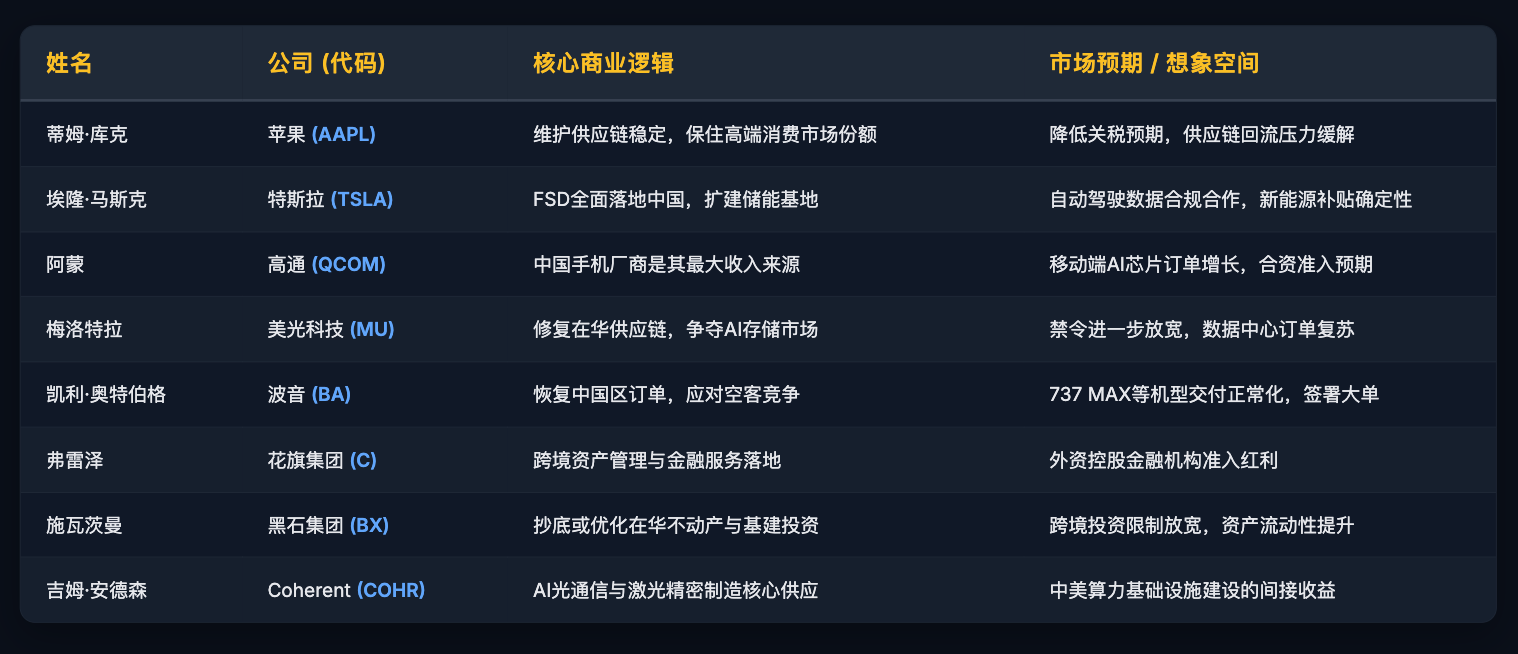
Tech hardware group: the most sensitive group
The tech CEOs who went on this trip were almost all those most dependent on China.
Apple's Tim Cook. No need to explain. A significant portion of the iPhone's global production capacity remains in China. Since taking over in 2011, every ripple in U.S.-China relations has caused AAPL to tremble.
Elon Musk of Tesla. The Shanghai Gigafactory is Tesla's largest production base globally and one of its most profitable. Musk also brings up the question of FSD—whether autonomous driving can truly function in China largely depends on this conversation.
Cristiano Amon of Qualcomm. Chinese smartphone manufacturers—Xiaomi, OPPO, vivo, and Honor—are Qualcomm’s largest customer base. No question about it. Once consumer electronics recover alongside improved relations, Qualcomm is the kind of investment where the logic is obvious without needing to think twice.
Sanjay Mehrotra of Micron. What is the most scarce resource in the AI era? Beyond computing power, it’s storage. Micron previously experienced regulatory fluctuations in the Chinese market; the CEO’s presence itself is a signal.
Cisco's Chuck Robbins. In enterprise networks, data centers, and cloud infrastructure, Cisco is a trusted standard. As AI adoption accelerates, it plays the classic "selling shovels" role.
Jim Anderson of Coherent, a core company in optical communications and laser equipment, is essential to the foundational infrastructure of AI data centers.
Jacob Thaysen of Illumina, the global leader in gene sequencing. The Chinese market previously experienced significant volatility due to regulatory reasons; the CEO’s personal attendance this time carries deep significance.
This group of seven companies is each deeply integrated into China’s industrial chain.
They’re not here to show off.
Financial capital camp: Money has the keenest nose.
Six financial CEOs. It's rare to have this many come at once in history.
Larry Fink of BlackRock, the world's largest asset manager with over $11 trillion in assets under management. Fink's stance on Chinese assets has fluctuated over the past few years; his personal visit this time is a significant gesture.
David Solomon of Goldman Sachs. As a top global investment bank, China's investment banking business is one of the key drivers of Goldman Sachs' overseas growth.
Stephen Schwarzman of Blackstone, a global private equity giant with deep investments in real estate, infrastructure, and private equity. Schwarzman’s relationship with China has always been unique—he established the "Schwarzman Scholars" program at Tsinghua University, which itself serves as a long-term cultural bridge.
Jane Fraser of Citigroup. As one of the most internationally diversified large U.S. banks, China and Asia-Pacific operations are a significant part of its footprint.
Ryan McInerney of Visa and Michael Miebach of Mastercard. The two giants appeared together. International payment giants have long coveted the Chinese market, and both companies are striving for deeper market access.
Money has the keenest sense of smell.
Financial capital never pays for sentiment. Their collective appearance only indicates one thing—they’ve identified an opportunity to rebalance Chinese assets.
Industry giants: Those anchor stones
Kelly Ortberg of Boeing.
In 2017, during Trump's first visit to China, Boeing signed a letter of intent for 300 aircraft, with a total value of approximately $37 billion.
Ortberg’s personal visit this time speaks volumes about the market’s intentions.
If the order is restored, Boeing's long-term narrative must be retold.
Larry Culp of GE Aviation. There is a frequently overlooked connection: as Boeing’s orders recover, GE Aviation’s engine business typically benefits in tandem. The two companies are upstream and downstream in the supply chain.
Brian Sikes of Cargill, a global agricultural and commodities giant. U.S. agricultural exports to China have long been a "stabilizing factor" in U.S.-China trade relations. Soybeans, corn, and meat—each can influence the direction of U.S.-China trade data.
Dina Powell McCormick of Meta. Strictly speaking, she is not Meta’s CEO but a representative at the board level. However, her background is intriguing—a former partner at Goldman Sachs and former Deputy National Security Advisor in the Trump administration—this combination of “business and politics” carries far greater political clout than that of a typical CEO.
A conclusion
17 individuals, covering several of the most important industrial chains in the United States:
Technology hardware, financial capital, aerospace, agricultural commodities, payment networks, biopharmaceuticals.
If you expand this list into an industry map, you’ll find that it essentially covers the most sensitive and core areas of U.S.-China trade relations.
The list is not arbitrarily determined.
Everyone is a card.
Two visits to China, same person, two different decks
From 2017 to 2026, eight years.
Has Trump changed?
On the surface, it’s still the same Trump—tariffs get raised at a moment’s notice, and tweets get posted without hesitation.
But this visit's delegation revealed something deeper.
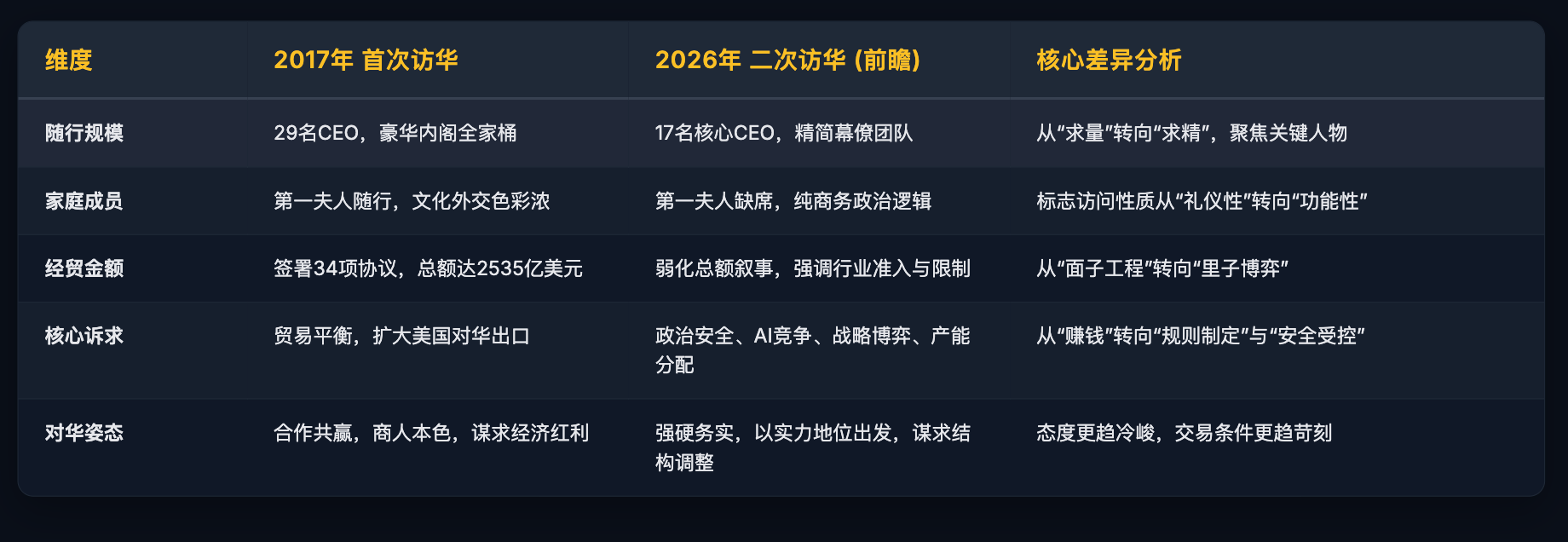
2017: The time when orders piled up
November 2017.
That was one of the highlights of Trump's first term.
Accompanying the business elite were none other than First Lady Melania, along with the Secretary of State, the National Security Advisor, and the White House Chief of Staff—all present in full force. The level of prestige was unmatched.
Business delegation—29 top CEOs.
Performance statement?
34 cooperative projects with a total value of $253.5 billion.
Boeing's $37 billion aircraft order, Qualcomm's chip collaboration in China, ExxonMobil's LNG contract, General Electric's aerospace engine order...
$253.5 billion, in 2017, represented the historical ceiling for single-visit deal sizes between China and the United States.
That time, Trump wanted just one thing—money.
He aims to turn the economic achievements of "Made in America" into a tangible list he can present to voters.
He did it.
2026: Smaller, Harder
By 2026.
It's Trump again, but the lineup has been reduced.
There is no first lady.
The number of cabinet members has been significantly reduced.
The number of business representatives was reduced from 29 to 17.
Core advisors and a few key officials. Streamlined.
Why?
Because this issue is not about "how much money we can make together."
The topic of this discussion is "Where are our strategic boundaries?"
The Taiwan Strait, the South China Sea, chip export controls, the AI race, supply chain restructuring, Southeast Asian geopolitics, the Middle East situation—each issue on the table is tougher than in 2017.
The reduction in the business delegation corresponds to the amplification of political issues.
This is not a coincidence; it's a choice.
Why switch cards if it's the same person?
In 2017, Trump faced a Sino-U.S. relationship that was still in the testing phase.
In 2026, Trump faces a U.S.-China relationship that has already undergone trade wars, technology wars, an AI race, and supply chain restructuring.
Eight years have passed, and the waters have grown deeper.
In deep waters, you can't use a fishing rod from 2017.
Looking back at history: What did U.S. presidents take with them when visiting China?
The U.S. president's visit to China is never just a formality.
Each time, it almost left a historic moment.
Nixon, 1972—Thawing the Ice
Zhou Enlai's hand extended at the airport.
Mao Zedong's meeting with Nixon at Zhongnanhai.
That was a moment that changed the balance of the Cold War.
The Shanghai Communiqué was subsequently issued, marking the beginning of a new chapter in Sino-U.S. relations.
Without this visit, there would have been no subsequent Sino-U.S. economic and trade interactions, nor the external environmental foundation for China’s reform and opening-up.
Clinton, 1998—Paving the way for the WTO
The Clintons stayed in China for nine days.
Nine days.
It was the longest stay by a U.S. president during a visit to China.
His speech at Peking University continues to be widely cited.
This visit provided crucial diplomatic groundwork for China's accession to the WTO in 2001.
In the two decades since joining the WTO, China's GDP grew from just over $1 trillion in 1998 to $17.7 trillion in 2023.
This is the long-tail effect of a visit.
Bush Jr., 2002/2005/2008 — Continuation of the cooperation period
The 2005 visit established the concept of the "Responsible Stakeholder."
At the 2008 Beijing Olympics opening ceremony, Bush Jr. attended in person. That moment—the sitting U.S. president watching the opening ceremony at the Bird's Nest—was itself a symbol of an era.
Obama, 2009/2014 — APEC and Climate
2014 APEC Beijing Meeting.
China and the United States jointly issued a statement on climate change.
That was a crucial precursor to the later Paris Agreement.
"Ying Tai Night Talks" also became a signature image in Sino-U.S. diplomacy.
Trump, 2017 — A狂欢 of Money
As mentioned above.
$253.5 billion.
34 projects.
This trip has been referred to by the industry as a "state visit plus."
Compared to
Each president has left a keyword marking this relationship.
Nixon was the "icebreaker".
Clinton is "in the world."
Bush Jr. is "Olympics".
Obama is "climate".
Trump (2017) is "order".
So, what will Trump (2026) be?
This is a question that still doesn't have an answer.
In conclusion
So what kind of visit is this exactly?
Watching the list means observing where capital is betting.
Watching the issue means observing the strategic博弈.
Watching the number of people reveals the changes of the times.
Among the 17 CEOs, 15 stocks have already risen.
The market is always the most honest.
It doesn’t care what you say, your political stance, or past grievances—it only looks at one thing: where the money flows.
And this time, it chose to move first.
But stay清醒—stock prices can rise again, or fall back.
What truly determines the historical significance of this visit is not the K-line chart, not the list, not the moment the Boeing 747 landed.
What was agreed upon at the table.
Under the desktop, what new boundaries have been drawn?
In 2017, Trump took with him a list of orders worth $253.5 billion.
What will Trump take with him in 2026?
Maybe another order.
Perhaps a new red line.
Perhaps, it’s nothing at all—just a photo where we clearly see each other.
The next 24 hours will tell.
Source of information
- The White House Archives, "Joint Statement on President Donald J. Trump's State Visit to China," November 9, 2017.
- U.S.-China Business Council, "U.S. Presidential Visits to China: Historical Record."
- Boeing Co. Investor Relations, "China Commercial Order Announcement," November 2017.
- The World Bank, "GDP (current US$) – China," World Development Indicators, 1998–2023.
- U.S. Department of State, Office of the Historian, "Nixon's Trip to China, 1972" & "Shanghai Communiqué."
- The White House Office of the Press Secretary, "U.S.-China Joint Announcement on Climate Change," November 12, 2014 (APEC Beijing).
- BlackRock Inc., 2024 Annual Report (AUM disclosures).
- U.S. Census Bureau / USTR, "Trade in Goods with China," historical statistics.
- Reuters & Bloomberg, public reports from May 2026 on the list of accompanying businesses during Trump's second visit to China and market reactions.