


The framework describes six key areas to address, including establishing safeguards for children, shielding communities from datacenter-driven higher power costs, and ensuring America benefits from the transition to AI. AI and crypto Czar David Sacks stated that they will work with Congress to turn this principle into legislation.
Trump Administration Reveals AI Principles For Upcoming Regulation
The American government is defining the guidelines that Congress must follow to establish artificial intelligence (AI) regulation.
On March 20, the Trump Administration unveiled the U.S. National AI Policy Framework, which seeks to address several concerns that the American people have about the adoption of these technologies and their future effects.
David Sacks, AI and crypto czar of the Trump Administration, explained that this framework will “help parents safeguard their children from online harm, shield communities from higher electric bills, protect our First Amendment rights from AI censorship, and ensure that all Americans benefit from this transformative technology.”
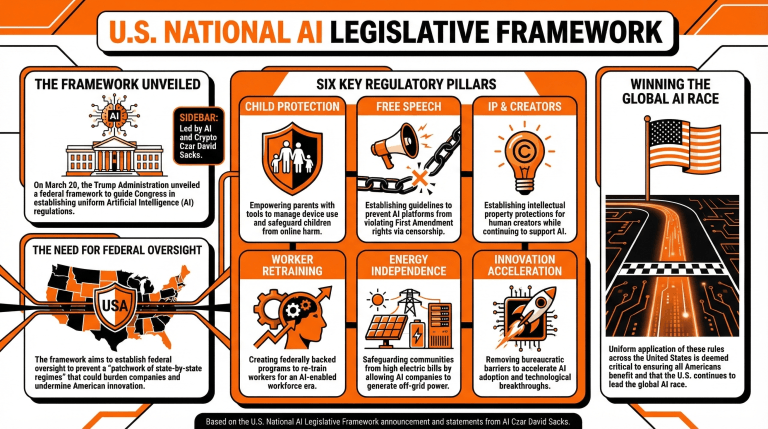
The document describes six key areas that regulation must consider, including protecting children and empowering parents with tools to manage device use, safeguarding American communities by allowing AI companies to generate their own power off-grid, and establishing intellectual property protections for creators while supporting AI.
It also aims to establish guidelines to prevent AI platforms from violating First Amendment rights, remove barriers to accelerate AI innovation and adoption, and establish programs to re-train workers for an AI-enabled workforce era.
The administration ordered the creation of a federal ruleset playbook for AI back in December, when Trump signed an executive order to allow AI companies to innovate without being burdened by what he called a patchwork of state-by-state regimes.
In effect, this document aims to establish federal oversight over AI activities, stating that it can succeed only “if it is applied uniformly across the United States,” declaring that allowing states to have differing AI rules would “undermine American innovation and our ability to lead in the global AI race.”
Sacks stressed that the executive is looking forward to turning these principles into legislation with the help of Congress.
FAQ
What is the new U.S. National AI Legislative Framework? The Trump Administration unveiled federal guidelines designed to help Congress regulate artificial intelligence uniformly across the country.
What key areas does the AI framework address? The proposal focuses on protecting children, safeguarding First Amendment rights, establishing intellectual property rules, and retraining workers.
Why is the administration pushing for federal AI oversight? A uniform federal ruleset aims to prevent a patchwork of state regulations that could hinder American innovation in the global AI race.
What are the next steps for this AI initiative? AI and crypto czar David Sacks stated the executive branch will work with Congress to translate these foundational principles into federal legislation.