





When the rising tide recedes, the market faces its true test. In a prolonged downturn, short-term narratives gradually lose their effectiveness, and more and more projects reveal their weaknesses in enduring cycles. The real test quietly arrives: when there is no new capital, a lack of emotional premium, and narratives gradually fail, what enables a project or ecosystem to survive the cycle?
The answer is: continuous, genuine, and value-building that is independent of market sentiment. Even during phases of overall market weakness, we can still see such ecosystems in action. Take Tron as an example; its ecosystem has not stalled due to market fluctuations: from the SUN Chinese brand "Sun Wukong" making a major debut, to JST initiating its second buyback and burn, to the full launch of the AINFT AI service platform, these moves collectively outline an ecosystem that is still actively building and advancing on multiple fronts.
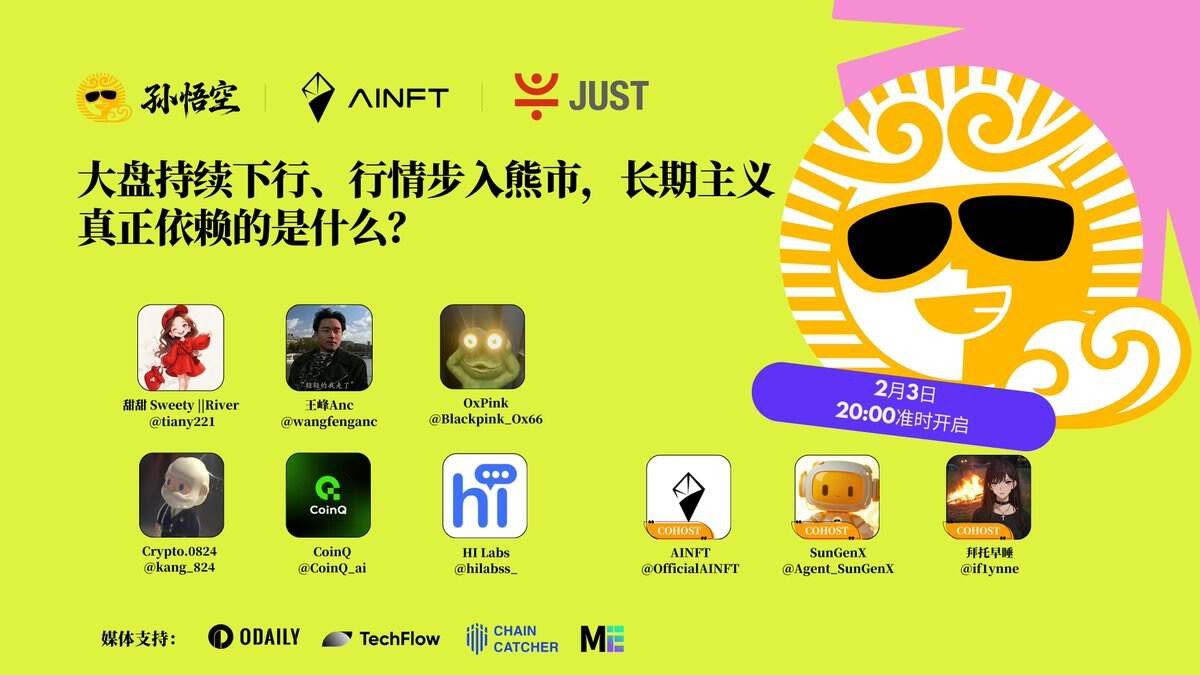
TRON's multi-chain practice has revealed two key aspects of long-termism in the current landscape: the infrastructure of AI and the structural resilience of DeFi. This issue's SunFlush roundtable discussion revolves around these two dimensions, delving into what conditions an ecosystem should have to weather bull and bear markets, as well as TRON's practices in AI infrastructure and the DeFi sector. The following is a summary of the highlights from this Space roundtable discussion.
Three Key Conditions for Surviving Market Cycles: Healthy Operations, Cost Advantages, and Endogenous Cycles
Against the backdrop of an overall sluggish market and tightened liquidity, a series of once-hot phenomena are beginning to recede. This has prompted industry participants to cool down and examine a core question: When the noise fades, which ecological designs can truly withstand the cold, rather than merely relying on seasonal prosperity?
Around this core issue, Crypto.0824 clearly pointed out in the discussion: long-termism is essentially the result of a system design. He summarized the truly bear and bull market-resistant ecosystems as requiring two conditions that must be met simultaneously:First, the infrastructure must remain healthy and functional even under low activity levels.Its economic model should not rely on high trading volume to sustain, this is the underlying logic of being countercyclical.Second, the cost structure must be transparent and extremely low, which constitutes a key competitive advantage in a bear market where users are highly sensitive to fees..
OxPink further points out, based on the ecological "stress resistance" and "internal circulation" capabilities, thatInfrastructure with true penetration power lies in its core ability to maintain the internal functional circulation of the system even in the absence of external emotions and traffic.He emphasized that during market downturns, what is tested is not grand narratives, but whether the ecosystem truly addresses users' real needs.
Miya took the TRON blockchain ecosystem as an example to specifically explain this mechanism.With highly competitive low transaction fees, the TRON ecosystem continues to attract and accumulate substantial stablecoin traffic. This traffic not only forms the foundation of network usage but also naturally transforms into DeFi activities, thereby further reinforcing trust and creating brand effects, thusBuild a self-reinforcing closed loop that continuously converts "actual usage" into "network value."The operation of this endogenous engine does not rely on short-term price fluctuations in the token market, but is rooted in sustainable, real on-chain behaviors and user demand.
In summary, the insights of the three guests build upon each other, collectively painting a complete picture of traversing the cycle of ecosystems: it begins with systematic design (healthy operation, low cost, high autonomy), is refined through inherent pressure resistance and cyclical capabilities, and is ultimately validated by a practical closed loop that transforms real-world usage into lasting value. When these elements work together, the ecosystem can build enduring resilience that transcends short-term prosperity amid market fluctuations.
Counter-Cyclical Development and Value Discovery: A Long-Term Perspective in the Bear Market from the TRON Ecosystem
Based on the above theoretical framework of crossing cycles, the TRON ecosystem provides a key practical example. When the overall market is in a slump, the TRON ecosystem continues to advance infrastructure construction in areas such as AI and DeFi. These actions themselves provide the most direct observation window for how "long-termism should be implemented," and they also shift the discussion from theoretical deduction to concrete practice.
- Why has AI become the main theme of the bear market? The countercyclical insights of AINFT on Tron
When the market enters a downturn cycle, the AI sector becomes a focus against the trend. The discussion among guests pointed out that this is not merely a sector rotation, but rather the market's active screening for true value after liquidity recedes. A bear market becomes a touchstone, filtering out short-term hot topics that rely on narratives, allowing fundamental innovations with long-term value to emerge.
The TRON ecosystem's decision to officially launch the AINFT AI service platform at this moment is an active response to this trend. It is not only a technical layout in the AI field, but also a practical response to a fundamental question: What kind of innovation is brave enough and capable of continuing construction even during market downturns.
Andy, the head of HI Labs, said: The return of AI to the main track is not a new round of trend switching, but an inevitable result of market screening. When the market cools down, all models that rely on sentiment and subsidies can no longer be sustained. As a tool that can improve efficiency and reduce costs, the practical value of AI becomes evident. It does not need market conditions to prove itself; its ability to transcend cycles will be naturally validated in a cooling market.
It is precisely under this logic that the launch of the AINFT AI service platform is of symbolic significance. This platform is not a single model, but an open service network that integrates multiple mainstream large language models, aiming to provide developers and users with stable and accessible on-chain AI capabilities.By lowering the barriers to use and costs, it enables AI tools to truly integrate into everyday on-chain interactions, content generation, and data analysis scenarios, becoming "usable infrastructure" in the crypto world. This practice itself is the best interpretation of long-termism that "tool value is superior to narrative hype."
- How Does DeFi Survive Cycles? An In-Depth Analysis of the TRON Ecosystem's Structural Resilience
The emphasis on "instrumental value" and "intrinsic demand" not only defines the role of AI during a bear market, but also constitutes the underlying philosophy of the DeFi ecosystem. The DeFi system of TRON, with its continuous operation and real user accumulation, has become a vivid example of "anti-cyclical" characteristics. The guests discussed this example, gradually deconstructing the key resilience logic within it.
Crypto.0824 pointed out that the key to TRON's DeFi system being able to transcend cycles lies in "low friction and real-world scenario-driven" factors. He observed that many bull market DeFi projects essentially rely on high APY designs to attract liquidity, a model similar to a capital game, which becomes unsustainable once market sentiment wanes or incentives decrease. In sharp contrast,TRON DeFi ecosystem has always been built around real and high-frequency on-chain needs such as stablecoin exchange, staking, and lending. It does not rely on "incentive binding" of users, but instead retains users by becoming the most practical and economical natural choice.
Wang Feng Anc and OxPink further supplemented this key dimension of user experience. They believe that the reason why TRON DeFi can go through cycles is because it provides a "ready-to-use upon opening, leave after use, but keep coming back" experience without burden. It does not deliberately package complex financial models, but instead focuses on serving a large number of real on-chain activities, thus building the most solid user base.
Tiantian used specific data to support the effectiveness of this structure:Even during periods of market fatigue, the TRON protocol continues to maintain stable profitability, with the protocol's total revenue exceeding $216 million in just January of this year. Its leading DeFi protocol, JustLend DAO, has also consistently maintained a stable TVL of around $6 billion.The lending and borrowing rates have always been within a healthy range.
At the same time, the TRON ecosystem has not only been content with financial resilience, but also returned the fruits of its development to the community through governance mechanisms.As of now, governance token JST has completed two rounds of buyback and burn, with a cumulative burn amount exceeding 1 billion tokens, accounting for 10.96% of the total supply.In addition,SUN.io has also established a mechanism to repurchase and burn tokens from protocol revenue. So far, the cumulative burn amount has exceeded 650 million SUN tokens.These ongoing value returns and deflationary practices not only strengthen the token's economic model, but also clearly demonstrate the ecosystem's commitment to sharing long-term value with the community.
From the sustained revenue-generating capability of the protocol to the proactive value management of multiple tokens within the ecosystem, these facts collectively indicate that ecosystem structures, represented by TRON, which are rooted in real demand and possess a closed-loop value feedback mechanism, not only demonstrate resilience against volatility during bear markets, but also accumulate a solid value foundation at the fundamental level, reserving ample elasticity for market recovery. It is evident, therefore, that the key to navigating through cycles lies in constructing structures, as practiced by the TRON ecosystem, that are rooted in real demand and possess a closed-loop of value. This is not only the way to survive during a bear market, but also the fundamental logic for continuously creating value.