





The Best Traders on Polymarket
Original author: Kiyotaka
SpecialistXBT, BlockBeats
Editor’s Note: In the crypto market, profits are the report card. Drawing on on-chain data from top wallets on Polymarket, this article explores whether the biggest winners in prediction markets rely on information asymmetry, models, conviction, or pure trading discipline. The conclusion: there is no universal strategy for consistent large-scale profits. The top three well-known accounts employ three nearly unrelated approaches to generating returns.
After studying the wallets that have earned millions of dollars on the world’s largest prediction markets, it becomes clear that there is no single unified strategy—instead, there are at least three, and they have almost nothing in common.
If you frequently scroll through Twitter in the prediction markets space, you’ll soon notice the same anonymous IDs appearing on various “top winner” leaderboard posts. Theo4 made a fortune in the 2024 election markets. swisstony quietly generated consistent profits on NBA markets. MonsieurDimanche almost always shows up in the comment sections of various markets. Over time, you might start wondering: Are these people the same type of trader? Are they doing the same thing? Is there a recognizable profile of someone who’s “good at Polymarket”?
The intuitive answer is: yes. Just as you might imagine that "skilled poker players" share a certain profile: patience, mathematical ability...
But after examining the on-chain data of all Top 20 wallets on the platform, the real answer is: there is no unified profile. At least three distinct categories exist, and possibly more. Beyond appearing on the leaderboard, they share almost nothing in common. This answer is more intriguing than expected, making it worthwhile to carefully unpack what the data actually reveals.
The data below is from Polymarket, as of May 5. The top 10 wallets in political markets alone generated $94 million in profits; the top 10 in sports markets added another $60 million; and the third-largest category, Crypto, contributed $25 million. This figure is still less than the combined total of the top three wallets in political markets.
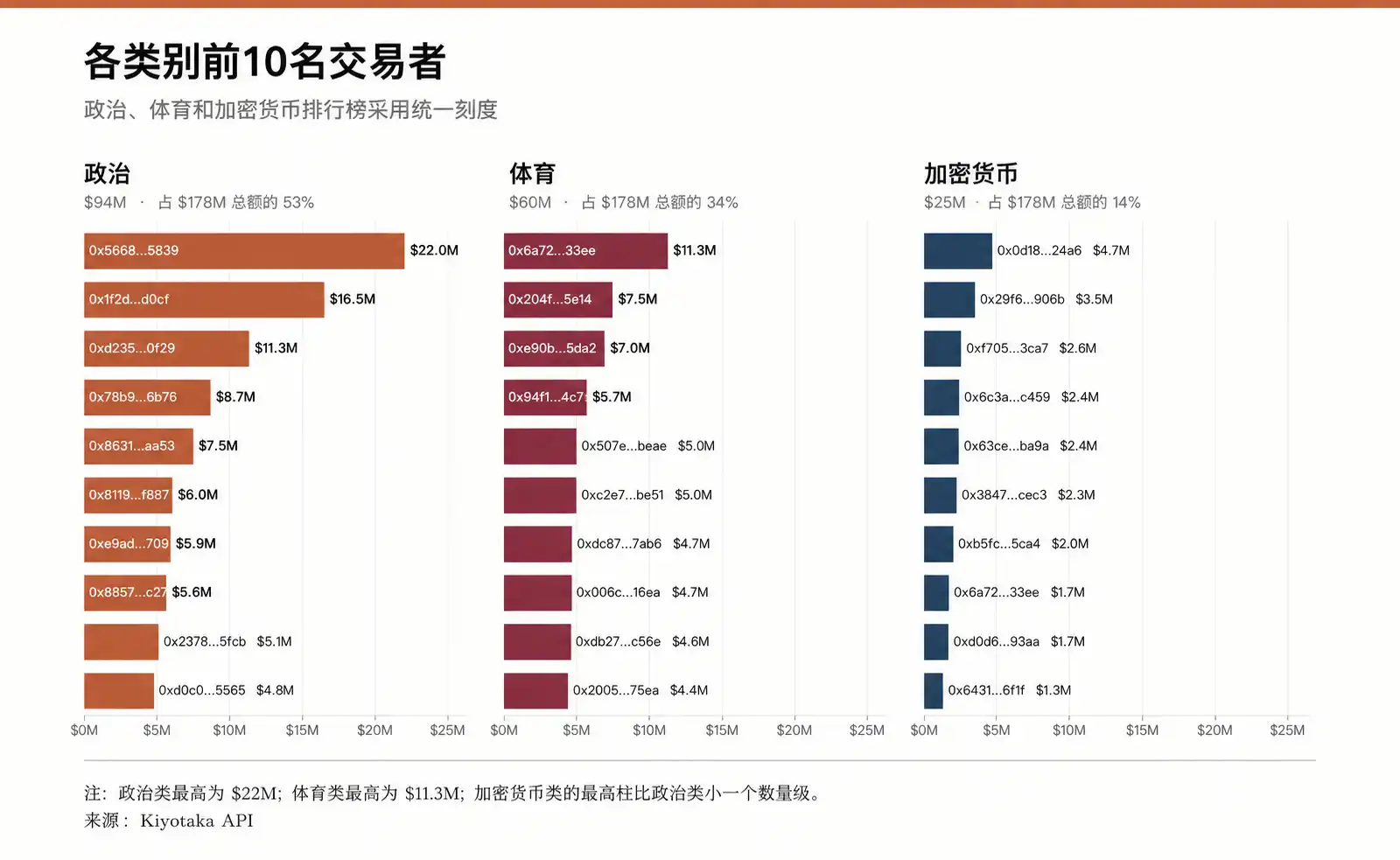
Political markets are another order of magnitude.
Compare top wallets across categories on the same dollar scale. In the political category, both individual wallet peak gains and total profits among the top 10 wallets are clearly leading.
The top political wallet has earned $22 million. The top sports wallet has earned $11.3 million. The top crypto wallet has earned $4.7 million. Unfortunately, this amount doesn’t even make the top 10 in the political category.
This gap is not an illusion caused by a power-law distribution. The 10th-ranked wallet in politics has earned approximately $5 million, surpassing the top wallet in every other category except sports. Politics is not merely "a steeper version of the same distribution"—it operates on an entirely different level.
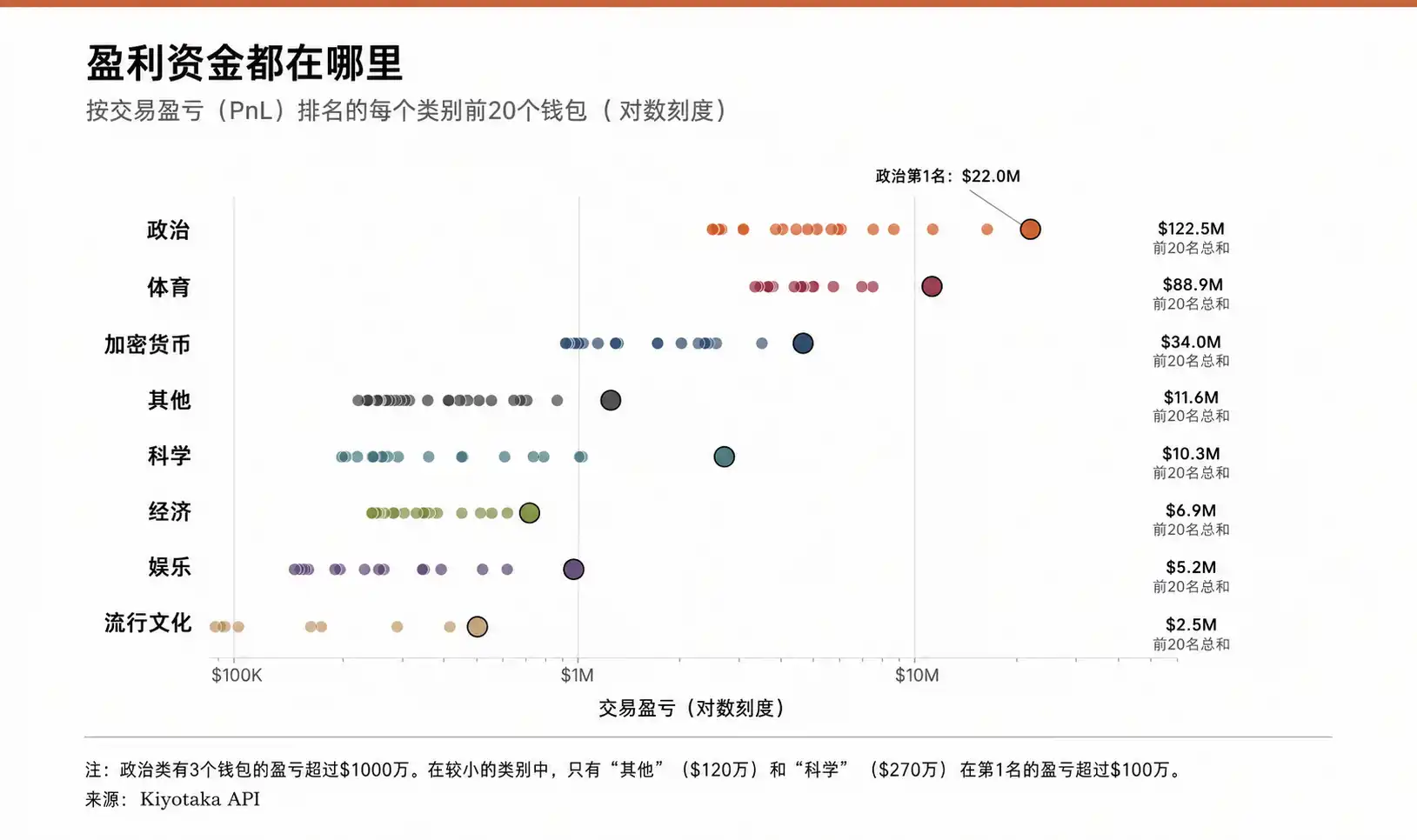
When plotting the top 20 wallets in each category by total profit on a logarithmic scale, only the top wallets in Science and "Other" exceed $1 million, excluding the top three categories: Politics, Sports, and Crypto.
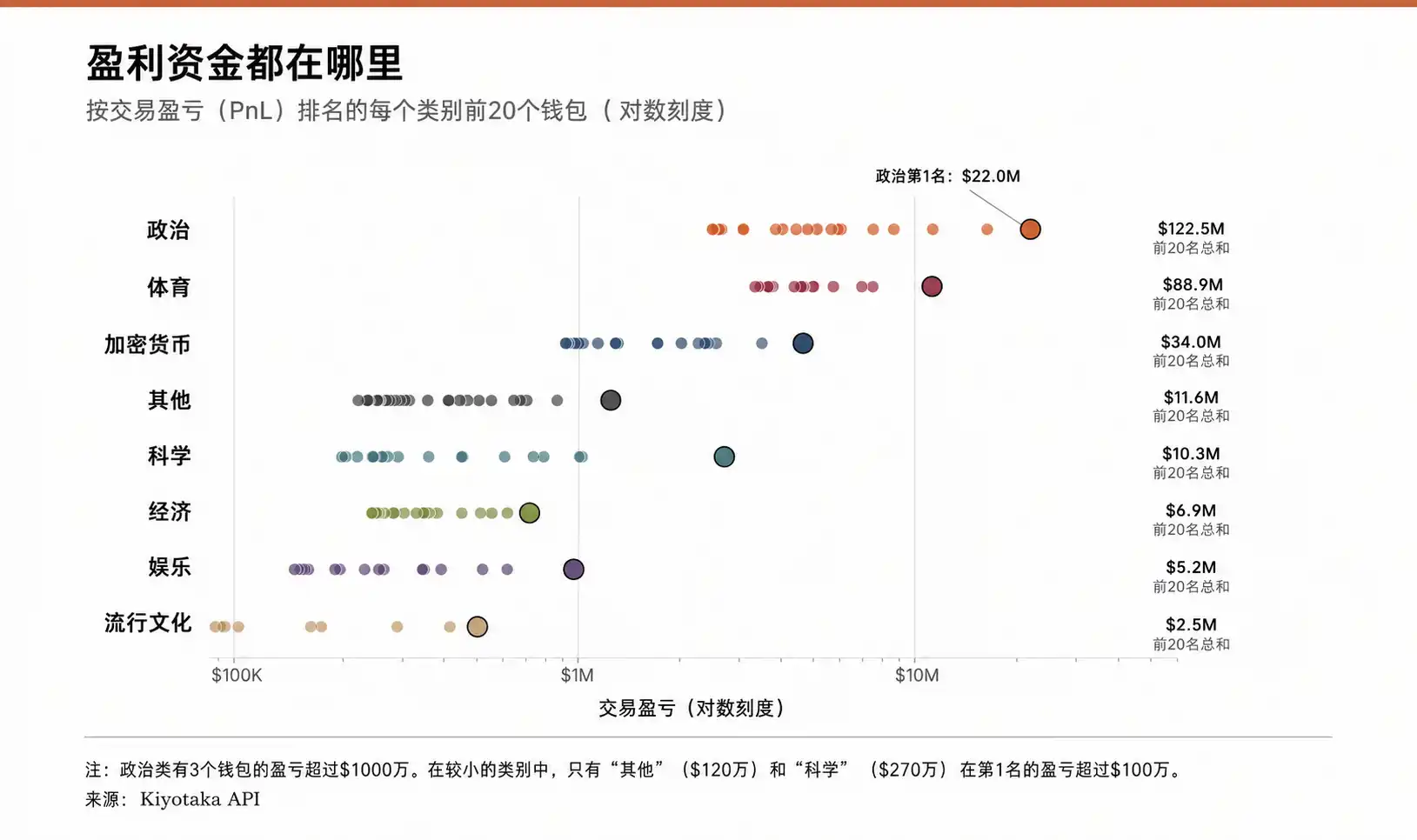
The most straightforward explanation is that political markets have fewer events, larger bet sizes, and longer settlement periods. A correct prediction in a presidential election or a controversial policy outcome can yield seven- or even eight-figure returns. Sports markets typically settle within hours, have narrower spreads, and offer smaller per-bet profits. The market structure determines which strategy prevails.
High-conviction concentrated bets vs. high-frequency multi-market trading
When viewing the position size alongside realized profit, the leaderboard clearly splits into two distinct groups. They share a single vertical axis, but beyond that, they have almost nothing in common.
The comparison chart of holding quantities and trading profits and losses for the Top 10 wallets in politics, sports, and Crypto shows: whale wallets in politics are concentrated at the low holding quantity end; whale wallets in sports dominate the high-frequency trading end.
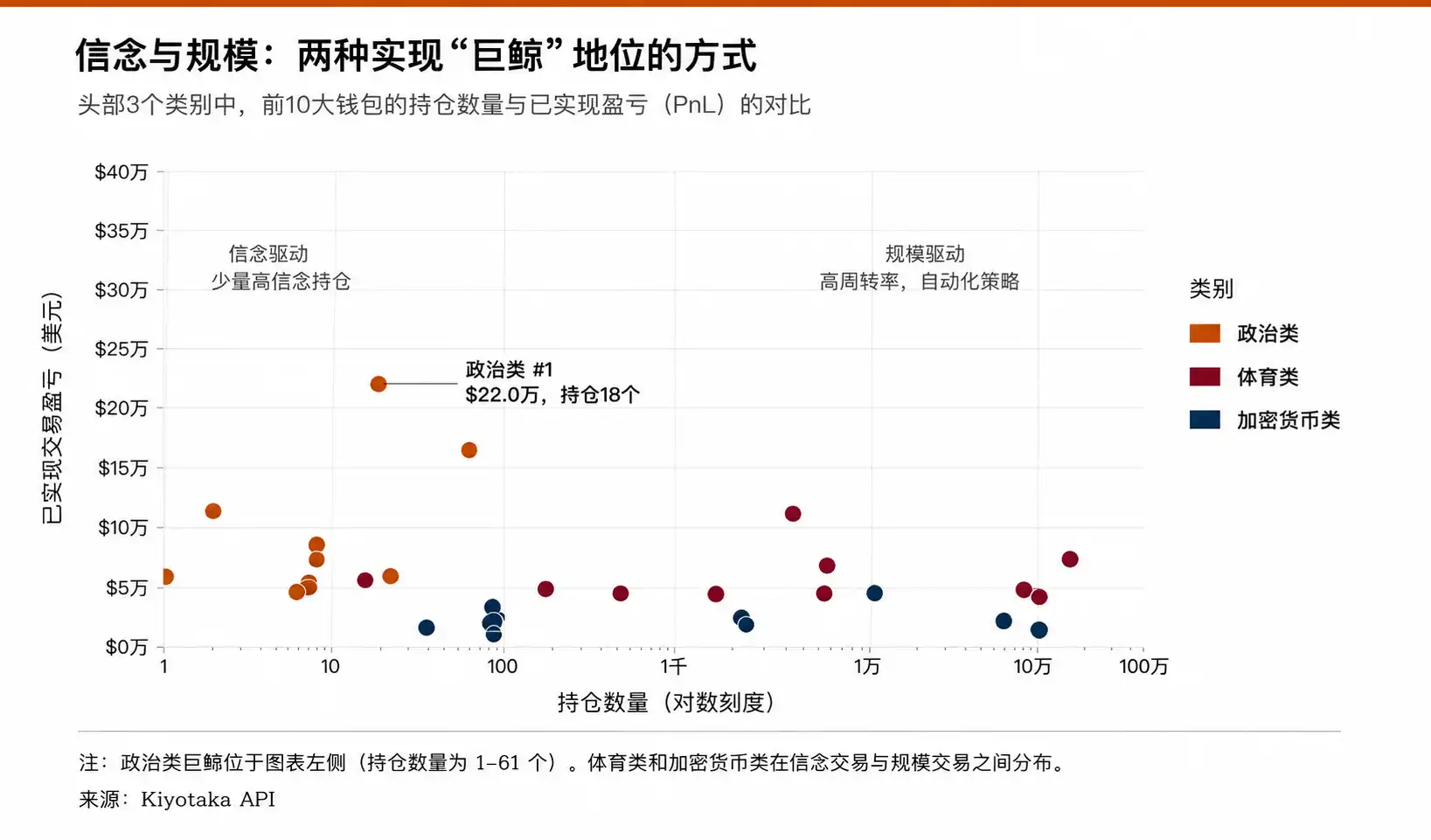
On the left side of the chart, political whale positions are nearly saturated, ranging from about 1 to 100 holdings. The top wallet, 0x5668…5839, earned $22 million with just 18 holdings. Another wallet, 0xd235…0f29, made $11.3 million with only 2 holdings.
To the right of the chart, between 1,000 and 150,000 positions, lies the domain of sports bettors. The second-largest sports wallet, 0x204f…5e14, earned $7.5 million across 151,888 positions—this more closely resembles the footprint of an automated system than that of a "view-based investor."
One wallet made $22 million from 18 positions. Another wallet made $7.5 million from 151,888 positions. They’re on the same leaderboard, but they’re not in the same business.
These are two entirely different approaches. The first requires strong conviction in judgment and a willingness to take large positions on rare, high-risk events. The second demands engineering discipline: a model with thin profit margins per trade, deployed across enough markets for the law of large numbers to take effect. Crypto sits between both, encompassing elements of each style, just on a smaller absolute scale.
Market choice: Coexistence of centralized and decentralized options
Introducing 8 named wallets—accounts identifiable by name from Polymarket’s public data—provides a clearer view of strategy distribution.
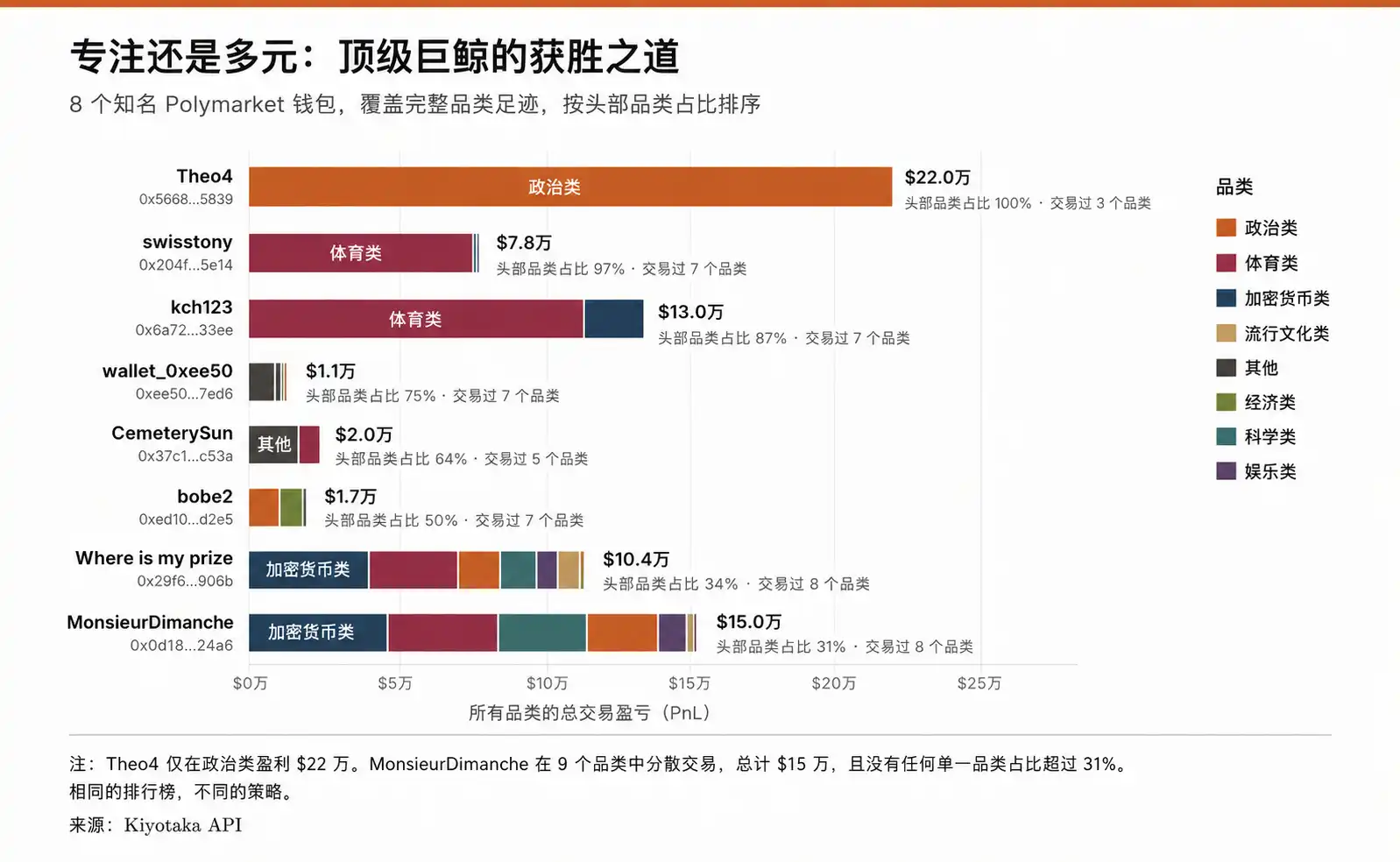
Sort these 8 wallets by the percentage of maximum category profit relative to total profit; Theo4 is entirely concentrated in the political category, while MonsieurDimanche spans 9 categories.
Theo4's $22 million in profits came 100% from political markets. Swisstony's $7.8 million in profits were 97% from sports. Kch123, the top performer in sports, also derived 87% of their profits from sports. These are expert traders who rarely cross over into other categories.
On the other end, MonsieurDimanche distributed his $15 million in profits across nine categories, with no single category contributing more than 31%. He didn’t focus on any one category yet still ranked at the top.
Traditional thinking holds that specialization leads to deeper advantages and thus higher returns. This holds true at the top, but only barely. Theo4 has the most concentrated category of returns among named wallets and ranks first in total profit. MonsieurDimanche is the most diversified yet ranks second.
Position Size vs. Profit per Trade
The most useful chart in the entire dataset is the one that divides each wallet's profit by its position size, measuring the average dollars earned per bet.
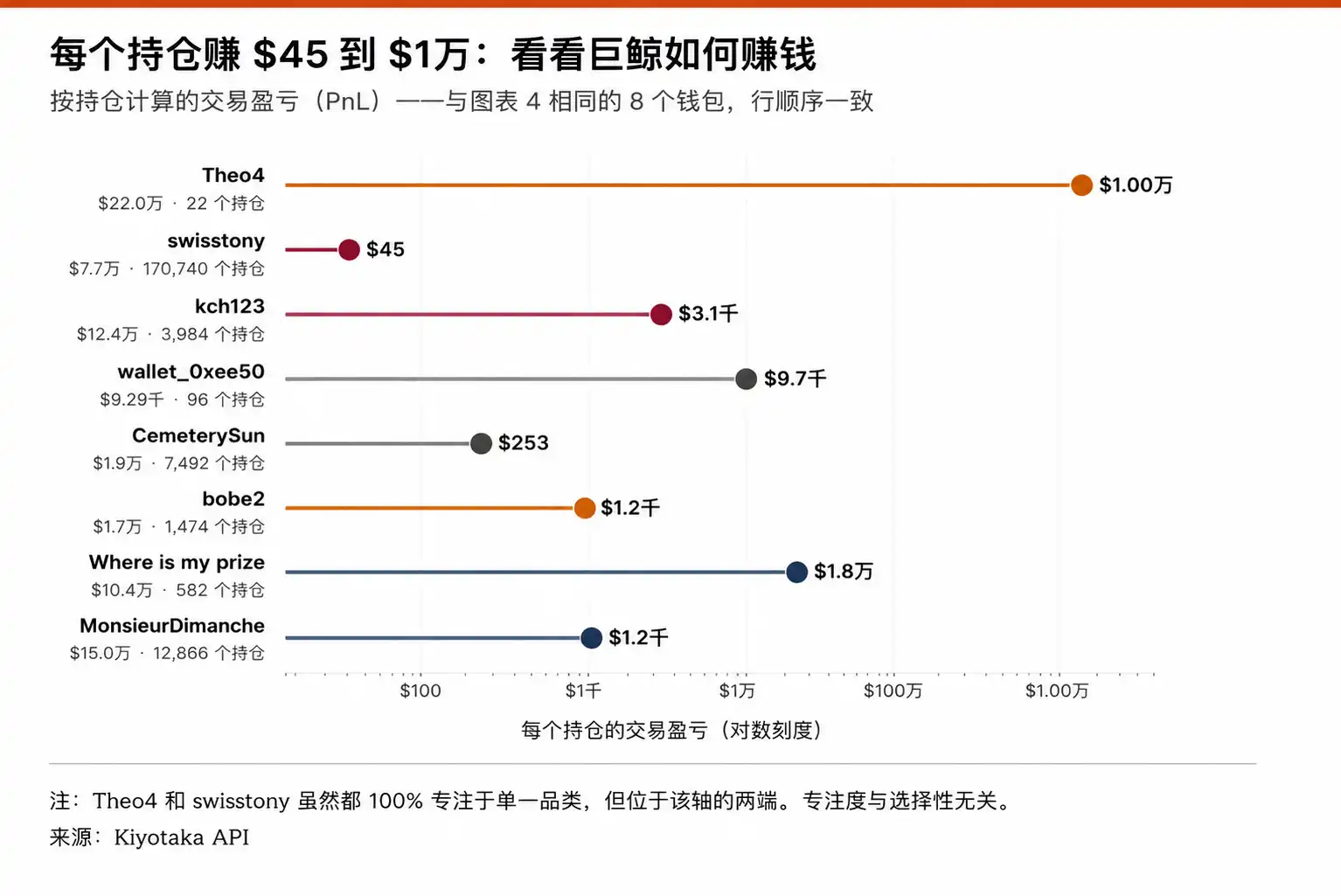
On the log plot of trade profit versus position size, Theo4 and swisstony are both nearly 100% concentrated in a single category, but they differ by approximately 22,000 times in selectivity.
Theo4 earns an average of $1 million per position. Swisstony earns an average of $45 per position. Both are essentially single-category traders and are nearly indistinguishable on the axis of "concentration." However, they differ by approximately 22,000 times on the axis of "selectivity."
This is the most important analytical insight: position size and profit per trade are two independent variables. Confusing them obscures what the leaderboard truly reveals. Which market categories a wallet covers shows where traders are placing their bets; how much profit is generated per unit of position shows how traders are making money. The two are not related.
Three strategies behind eight-digit returns
The data shows three strategies, not one.
The first type is political experts. In political markets characterized by slow settlement, wide odds, and significant impact, they achieve substantial returns by holding a few high-conviction, high-value positions. They trade infrequently, maintain large positions, and conduct in-depth research. Theo4 is a typical example. The main barrier to this approach is psychological: most traders cannot scale their positions to a size sufficient for the strategy to generate meaningful returns. It is also not a traditionally scalable path.
The second type is systematic traders in the sports market. By using automated models to price sports markets, even a slight edge over consensus pricing can generate cumulative profits across thousands or even hundreds of thousands of contracts. Individual profits are thin, but the strategy is sustainable over the long term. Swisstony is a typical example. The barrier to entry for this approach lies in engineering capability and operational discipline, not merely market insight.
The third type is the cross-category generalist—someone who forms well-calibrated judgments across many topics and extracts profits from markets overlooked by specialist traders. MonsieurDimanche is a classic example. The barrier to this approach is breadth of knowledge, and achieving such breadth is harder than building a single-category model.
These skills are not interchangeable. A political expert does not become a systematic trader in sports markets simply by trading more frequently, because his advantage lies elsewhere. A systematic trader in sports markets does not become a political expert by increasing position size, because his per-trade profit margins are too thin to sustain highly concentrated positions. Prediction markets reward three distinct abilities. Excelling in one does not nearly indicate proficiency in another.
In a sense, this is reassuring. There is no single answer to “How to make money on Polymarket?” At least three answers exist. Which one is hardest for someone depends on their personality, engineering skills, and how many high-quality opinions they can form about various topics. And these differences are not erased by leaderboards.
The leaderboard seems to truly penalize the middle ground: traders who have enough breadth to dilute their expertise and enough trading volume to dilute their conviction—essentially the position where most people likely find themselves. The top wallets have all chosen one path to specialize in and have had the discipline to stay on that path.
Click to learn about the open positions at BlockBeats
Welcome to the official BlockBeats community:
Telegram subscription group: https://t.me/theblockbeats
Telegram group: https://t.me/BlockBeats_App
Official Twitter account: https://twitter.com/BlockBeatsAsia