



Organized & compiled: TechFlow
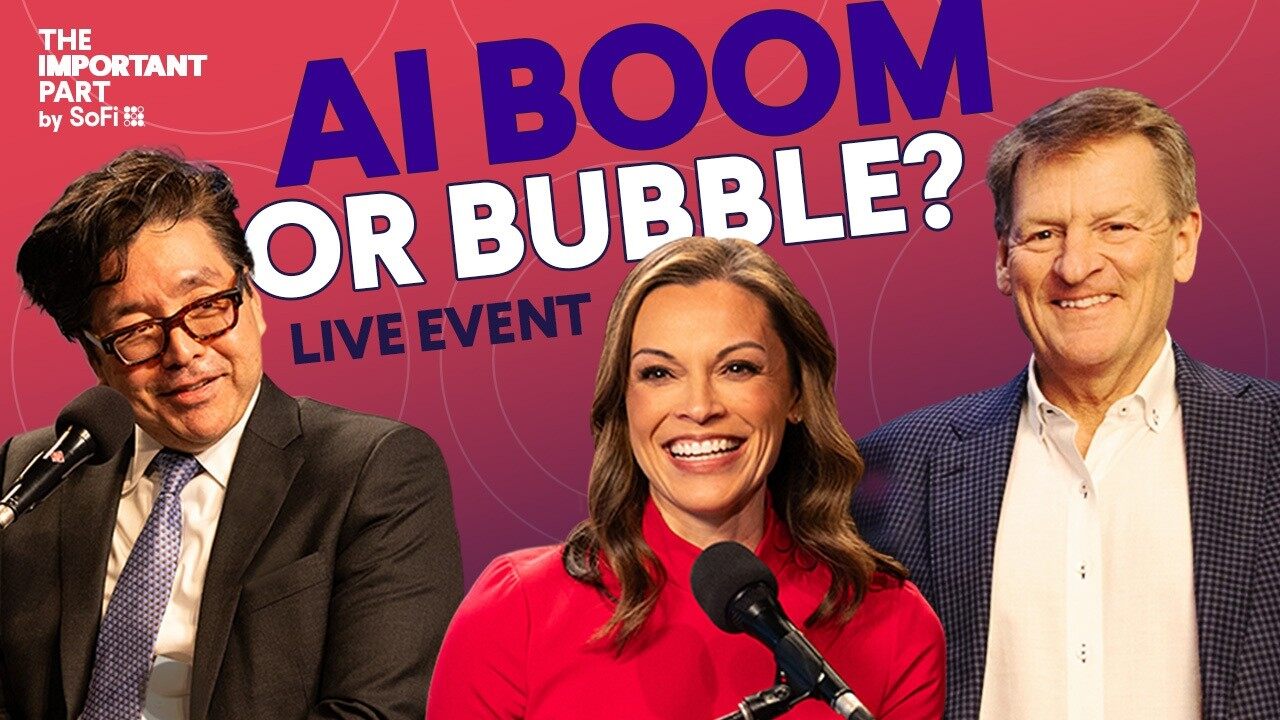
Guests: Tom Lee, Co-founder and Head of Research at Fundstrat; Michael Lewis, author of Moneyball, The Big Short, The Blind Side, and The Undoing Project
Host: Liz Thomas, Head of Investment Strategy at SoFi
Podcast source: SoFi
AI Boom or Bubble? Michael Lewis, Tom Lee on the Risks and Rewards | The Important Part LIVE
Broadcast date: February 19, 2026
Key points summary
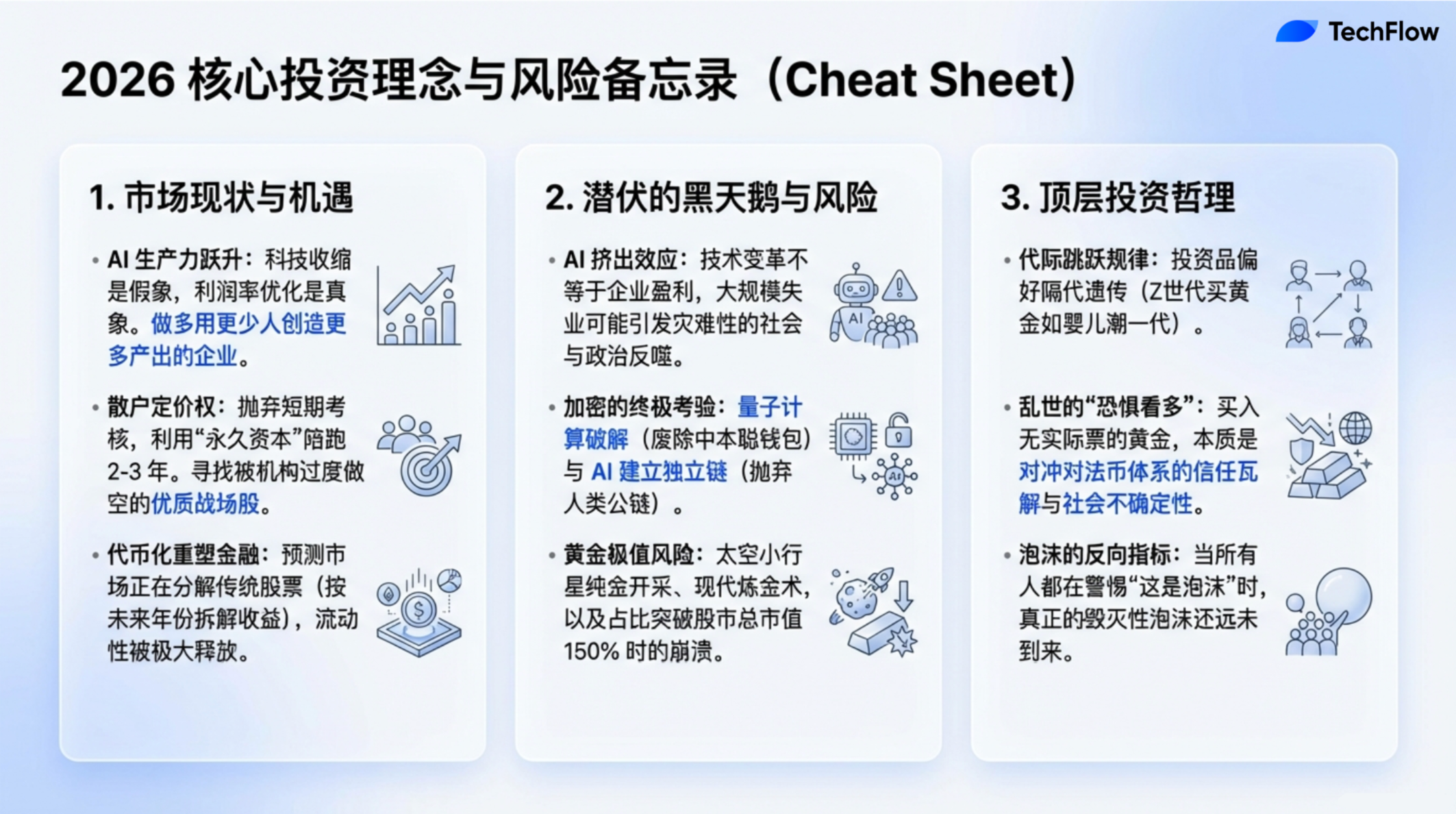
In a special live recording of "The Important Part," Liz Thomas, Head of Investment Strategy at SoFi, raised a question many investors are asking: Will the market’s rapid rise slow down—or will it continue? To address these questions, she invited two leading financial thinkers: Tom Lee, Co-Founder and Head of Research at Fundstrat, and Michael Lewis, author of the New York Times bestsellers Moneyball, The Big Short, The Blind Side, and Going Infinite. Together, the three explored the central question facing investors in 2026.
In this engaging conversation, they delve into several hot topics in today’s market: Why have retail investors outperformed hedge funds in recent years? Has gold reached its peak? Does Bitcoin’s 40% plunge signal the arrival of a “crypto winter”? Tom Lee explains that despite recent declines in AI-driven software stocks, this may actually reflect improved corporate productivity. Michael Lewis shares his contrarian bet on gold and explains why he “buys fear” as part of his investment strategy.
In addition, they explored other major issues in today’s financial markets, including: whether the Federal Reserve’s independence would be threatened after Kevin Warsh was nominated as Chair of the Federal Reserve; whether the rapid advancement of AI technology could lead to large-scale job losses; and whether the federal government might take over struggling AI companies.
Finally, they also turned their attention to the cryptocurrency sector, analyzing potential “black swan” events and valuable lessons about technological disruption drawn from the history of the frozen food industry.
Highlights of insightful perspectives
- The real bubble forms when everyone believes "this is definitely not a bubble."
- The unemployment rate among college graduates is even higher than that of their non-college-educated peers... but viewed from another perspective, this could actually be a sign of increased economic productivity. Productivity is typically measured by producing more output with fewer human resources.
- AI may indeed be as revolutionary as many say, but that does not mean it will inevitably generate widespread profits in the stock market; there is no inherent causal relationship between technological innovation and market returns.
- Retail investors are able to pick the right stocks because their incentives are completely different from those of institutional investors... they invest their own money, so they are more willing to hold a stock for two to three years.
- When I hold gold, I’m actually investing in “fear.” I buy gold because it hedges against current uncertainty—I’m buying insurance against future unease and anxiety.
- Looking back, gold has only increased more than 9% in a single day on three occasions, and all three marked the peak of gold prices—if history is any guide, gold may have already peaked.
- There’s a famous saying in finance from the late Art Cashion: “Bull markets don’t die of old age—they’re killed by the Fed.”
- Although the methods of operation have changed, human nature has not. The instinct to “want to earn more and faster than others” remains the core driving force behind this industry.
- Over the next decade, whoever controls AI and its associated ecosystem may become a global superpower. If the funding pipeline for AI truly begins to dry up, I believe even the Department of Defense is already simulating how to respond to such a scenario.
- Since 1974, approximately 40,000 companies have gone public or spun off. Of these, 90% saw their stock prices decline by more than 50%, and of those companies with declines over 50%, 90% eventually dropped to zero. In other words, most stocks ultimately become worthless.
Is AI a crisis or an opportunity? The dual nature of productivity transformation
Liz Young:
In recent years, global markets have experienced sustained rapid growth, and although there has been some volatility in the past few weeks, the overall trend remains strong. This phenomenon has been largely driven by advancements in artificial intelligence (AI), which has fueled technological innovation, spawned new products, and attracted significant capital inflows. However, many investors are beginning to feel uneasy, concerned that the market may be overheating and developing too rapidly. This sense of unease is spreading globally and has become a key focus of our discussion today.
To better understand this phenomenon, we invited Tom Lee, co-founder and head of research at Fundstrat. He has long been optimistic about the market and is considered a representative of the bull camp. Tom, why are you still optimistic in this current environment?
Tom Lee:
There’s a famous saying in finance from the late Art Cashion, who once said: “Bull markets don’t die of old age—they’re killed by the Fed.” In other words, strong performance in the stock market doesn’t mean it can’t continue performing well. In fact, I believe we’re witnessing two key catalysts: first, the returns from AI are beginning to materialize, reshaping winners and losers; second, a shift in Fed policy could provide a new tailwind for markets. Therefore, there are still many compelling reasons for investors to continue buying stocks this year.
Liz Young:
Let’s talk about the recent market shifts—tech stocks have dropped sharply, and the cryptocurrency market has also seen a noticeable correction. Does this market volatility cause you concern? Does it shake your optimistic view of the market?
Tom Lee:
I believe many people are paying attention to this phenomenon: over the past two years, the development of AI has acted like an unstoppable force, drawing significant investor interest and capital inflows. However, as you mentioned, this year has indeed brought some different developments. We are seeing declines in many stocks and industries; for example, the software sector is currently facing reduced demand and service repricing. Meanwhile, numerous research reports indicate that Agentic AI and other AI technologies are gradually replacing traditional software solutions.
In addition, according to some reports, the number of jobs in the technology industry has decreased over the past three years since the launch of ChatGPT. More surprisingly, the unemployment rate among recent university graduates is now even higher than that of their peers without a college degree. These figures may seem like “bad news” and are precisely what many headlines are focusing on today. However, viewed from another perspective, this could actually be a sign of increased economic productivity, which is typically measured by producing more output with fewer human resources.
From this perspective, the application of AI is demonstrating its potential to enhance productivity. For software companies serving enterprises, a reduction in corporate spending on software represents a process of margin optimization. In other words, the efficiency gains brought by AI are gradually translating into tangible profits. Although these changes may cause short-term disruptions, in the long term, they serve as strong evidence of AI’s ability to unlock productivity advantages.
Signs of market overheating and risks of a crash
Liz Young: Michael, in your past works, you’ve documented multiple instances of markets transitioning from prolonged rallies to sudden crashes. Each time, there were warning signs prior to the crash, such as excessive speculation or risky behavior. Among the market cases you’ve studied, what common patterns of excessive risk-taking did you observe? Do you believe these signs are present in today’s market as well?
Michael Lewis:
That’s a very interesting question. To be honest, I’ve never been able to accurately predict the timing of any market crash—my role has always been more like cleaning up the mess after the storm is nearly over. Looking back on my career, my first book, Liar’s Poker, chronicled the financial markets of the 1980s; later, I wrote about the dot-com bubble and the 2008 financial crisis. But to be frank, I never knew exactly when these events would occur. More importantly, I don’t believe anyone can truly predict the precise timing of such crashes. There are always multiple interpretations possible in the market, and my personal investment strategy is to put my money into index funds.
However, I have noticed that after every market crash, there are always individuals who saw the problems coming beforehand—but interestingly, these same people often fail to accurately predict the next crisis. For example, Michael Burry made the right call during the subprime mortgage crisis, but that doesn’t mean all his future predictions will be correct. He recently mentioned on Twitter that he had taken short positions on Nvidia and Palantir, sparking significant market attention. I interviewed him, and his reasoning was based on the capital expenditure cycle—the period during which companies invest in equipment, technology, and other assets—suggesting that the current valuations of these two companies had reached bubble-like levels. However, he also admitted he cannot precisely predict when a crash will occur. As a result, he adopted a more conservative strategy: purchasing two-year put options. Put options are relatively inexpensive, so even if his judgment is wrong, the potential loss is limited. This approach demonstrates that even someone as insightful as Burry cannot fully anticipate short-term market movements.
Regarding the common traits of excessive risk-taking you mentioned, I believe the most prominent is FOMO. Take my recent book, Going Infinite, which tells the story of Sam Bankman-Fried and FTX—FTX’s collapse is a textbook example of FOMO. Over 180 venture capital firms poured money into SBF without conducting proper due diligence. They invested huge sums without even understanding what his business actually did; this “act first, understand later” mindset is a hallmark of excessive risk-taking.
Another common feature is distorted incentives. When I was writing The Big Short, I interviewed traders who made poor decisions during the subprime mortgage crisis. They told me they participated in high-risk investments because “everyone else was doing it,” and if they didn’t follow the crowd, they’d be seen as lagging behind. Additionally, they were tempted by large bonuses, which were not clawed back even if the investments ultimately failed. This misaligned incentive structure led people to pursue short-term gains despite being fully aware of the risks.
If I may venture a bold prediction, I believe there are indeed some signs of a bubble in today’s market. While AI is undoubtedly a transformative technology, that doesn’t mean everyone will profit from it. In fact, technological advancements can sometimes even compress corporate profit margins. AI may truly be as revolutionary as many claim, but that doesn’t guarantee it will deliver broad market gains—there is no inherent causal link between technological disruption and market returns.
Why retail investors can outperform institutional investors
Liz Young: Tom, I know you have your own unique insights on this topic. I’d like you to talk about internet slang terms like FOMO and HODL, which actually reflect the dynamics between retail and institutional investors.
During this economic cycle since the COVID pandemic, we’ve observed that retail investors have repeatedly accurately predicted market directions, while institutional investors have sometimes appeared overly conservative. How do you think retail investors achieve this? Why might their judgments be more accurate? Additionally, in today’s market environment, who do you think has the greater advantage—retail or institutional investors?
Tom Lee:
At Fundstrat, our clients are primarily divided into two categories. One group consists of our institutional research clients, including approximately 400 hedge funds; the other includes family offices, investment advisors, and high-net-worth individual investors served through FS Insight. Each month, we survey these clients to identify their top five most and least favored stocks. Since 2019, we have been conducting this analysis, and the results have been fascinating: retail investors’ choices are often correct, with the top five most favored stocks by retail investors performing exceptionally well. We are even considering turning this data into an investment product.
I believe retail investors can pick the right stocks primarily because their incentives differ entirely from those of institutional investors; their investment decisions are not directly tied to their daily or weekly gains or losses affecting their livelihood. They invest their own capital—known as “permanent capital” (long-term available investment funds)—and are therefore more willing to hold a stock for two to three years.
When I first entered the industry, institutional investors typically held positions for about a year, which was already considered “long-term investing.” Now, most institutions have shortened their holding periods to 30 days or even less. Data shows that the average holding time for each stock is only around 40 seconds, and some hedge funds consider holding for just one or five seconds as “long-term.” This high-frequency trading model compels institutional investors to focus on stocks with extremely high liquidity and the ability to generate quick returns, while retail investors are more inclined to seek out investment opportunities with long-term growth potential.
Liz Young: But don’t you think this will trigger even more FOMO? If retail investors are right, won’t institutions be forced to chase prices in order to catch up, potentially overheating the market further?
Tom Lee:
Yes, this situation does occur. In the market, there are often popular stocks that are heavily pursued by retail investors while being significantly shorted by institutions. For example, Palantir is a classic battleground stock—similar to Netflix in the mid-2000s, when its stock price ranged from $2 to $4 before rising to $20. At that time, Netflix was heavily shorted by many institutional investors, yet retail investors continued to buy aggressively. Another well-known example is GameStop. Stocks like Palantir and Tesla have also been classic battleground stocks, with retail investors believing in their long-term potential while institutions treat them as tools for short-term arbitrage. When these stocks reach a critical price point, their valuations are often reassessed, leading to rapid price surges. For instance, in 2017, Tesla experienced a similar surge after being added to the Russell 1000 Index.
Michael Lewis: Can I ask a question? You mentioned an interesting idea: you plan to turn retail investors' investment choices into an investment product?
Tom Lee:
We have collected 60 months of relevant data, tracking the stocks most favored and least favored by retail investors, with special attention to “battleground stocks” — those heavily favored by retail investors but shorted by institutions. We are planning to launch an ETF that automatically buys the stocks retail investors view as having the greatest potential each month. Think of it as a “professionally validated WallStreetBets.” Unlike the casual discussions on Reddit, our data comes from paying users who are our actual customers, reflecting real investment ideas. More importantly, our data has undergone rigorous filtering and verification to ensure its authenticity and reliability — it is not generated by bots or fake accounts, but by real investors.
The trust crisis behind the surge in the gold market
Liz Young: In your view, how do institutional and retail investors differ in their investment preferences for gold? Additionally, what do you think about the future performance of precious metals like gold and silver? Although I don’t want to call them meme stocks, they have indeed become part of the speculative asset landscape.
I always believed that gold trading was primarily dominated by institutional investors and central banks, but surprisingly, gold has performed exceptionally well over the past few years, even outperforming the S&P 500 for several consecutive years. A few years ago, I was actively recommending gold investments, but many people thought I was like a "grandma clutching gold bars." Later, however, gold prices surged dramatically, drawing a flood of retail investors.
I remember once, while filming a show at the New York Stock Exchange, I happened to catch the bell-ringing ceremony for GLD (the gold ETF). Giant fake gold bars were displayed outside the exchange, and golden flags hung all around. At that moment, I thought to myself: “Retail investors are really starting to flood in.”
Tom Lee:
Gold's performance has indeed been outstanding. If we look back at market cycles over the past 25 years, we find that gold's returns have even surpassed those of the S&P 500. This may be linked to shifts in demographics. At Fundstrat, we’ve studied many phenomena tied to demographic trends and found that consumer preferences often skip a generation. The sales of recreational vehicles (RVs) serve as a strong example—RV sales peak roughly every 50 years. During the COVID-19 pandemic, RV sales reached an all-time high.
The logic behind this “generation skip effect” is that children often aren’t interested in what their parents like, but become fascinated by what their grandparents enjoy. For example, if your father rode a motorcycle, you might think it wasn’t cool—but if your grandfather rode one, you might find it incredibly cool, especially when seeing old photos. The popularity of Harley-Davidson motorcycles follows a similar pattern. Gold was a key investment for the Baby Boomer generation, while Generation X favored hedge funds. Today, Millennials and Gen Z are rediscovering gold, which is essentially a generational handoff. The current market value of gold is approximately $35 trillion, while the total market capitalization of the S&P 500 (excluding the Big Seven tech companies) is around $40 trillion. The size of the gold market is now nearly on par with that of the stock market.
Michael Lewis: Are the $35 trillion you mentioned referring to the total market value of all existing gold?
Tom Lee:
Yes, all the gold on the ground. There are approximately 7 billion ounces of gold, and at a predicted price of $5,000 per ounce, the total market capitalization is around $35 trillion.
There are some key points to note about gold. As someone interested in research, I’ve always enjoyed studying gold and understand its unique properties. Gold is an asset with the Lindy effect. The Lindy effect refers to the idea that the longer something has existed, the more people believe its value will continue into the future.
Gold has been used as a store of value for hundreds of years, and this long-standing recognition has ensured its continued widespread acceptance. Gold is regarded as a medium of exchange due to its scarcity. However, in my view, gold still faces some potential “black swan” risks.
First, above-ground gold reserves are limited, but millions of times more gold remains buried underground. If the price of gold becomes sufficiently high, it could attract many people into the gold mining industry. For example, if the price reaches a certain level, some individuals might switch careers to mine gold, as the value of extracting gold could then surpass that of any other industry.
Second, the origin of gold is actually “extraterrestrial.” Imagine if SpaceX begins exploring Mars and discovers an asteroid filled with gold in space—when Elon Musk is able to mine these resources, he could potentially own all the gold and become an entirely new “central bank.” This asteroid might contain tens of billions of ounces of gold, which would have a massive impact on the global gold market.
Finally, there is the risk of alchemy. If someone discovered a method to transform lead into gold by altering atomic structure, they might not reveal the technology, but instead quietly begin producing gold. At that point, the global market could be suddenly flooded with a massive supply of gold, causing its value to plummet dramatically.
So, gold is indeed an excellent investment option, but it also has its limitations. For example, when the price of gold reaches $9,000, its market capitalization could exceed the total market capitalization of the entire stock market.
Liz Young: So, is there a price point for gold beyond which it no longer holds investment value?
Tom Lee:
To this end, we conducted an in-depth analysis, reviewing data comparing gold market capitalization to stock market capitalization over the past 100 years. Our research found that gold’s market cap can reach up to 150% of total stock market cap, but this is nearly its upper limit. For instance, on January 30, gold prices dropped by 9% in a single day, illustrating how volatile its price movements can be. Historically, gold has only experienced three single-day increases exceeding 9%, and each of these instances marked a peak in gold prices. If history is any guide, gold may have already reached its peak.
Liz Young: Michael, you mentioned earlier that you primarily invest in ETFs and some passive index funds, like Vanguard’s index funds. But you occasionally try other investments, right?
Michael Lewis:
Yes, sometimes I lose my mind. Speaking of gold, let me tell you a story. When I was a child, I used to play poker every week with a group of older friends, and one of them, Bobby Klein, was always better than the rest—he was born to play poker. He was one of my closest friends. During the financial crisis, he ran his own fund on Wall Street and shorted the subprime mortgage market. He was actually one of the people featured in The Big Short—he made a fortune by shorting the subprime market and later founded his own asset management firm.
Four years ago, when I visited him, he showed me his collection of ancient Roman coins and explained how the emperors of the Roman Empire gradually reduced the silver content in coins to secretly erode their real value. He used these historical stories to illustrate why one should buy gold. Although his argument was compelling, I wasn’t fully convinced at the time—I always thought buying gold sounded like a crazy idea.
Yet his words kept lingering in my mind, and about three years ago, I finally decided to buy some gold—I bought quite a bit, and its price has been rising ever since. A month ago, I called Bobby Klein to tell him I followed his advice and bought gold, making a lot of money. Bobby understands the gold market far better than I do; his investments are primarily focused on gold mining stocks, which is a more cost-effective way to invest in gold. He also acknowledges that gold carries some “black swan” risks, but he believes these risks are significantly lower than those of assets like Bitcoin.
What interested me most was that when Bitcoin first emerged, everyone said it was a competitor to gold, even calling it digital gold. But later, I noticed that Bitcoin’s price movements began to align with the stock market, rather than remaining independent like gold. This made me feel that Bitcoin is no longer digital gold, but may have become another asset class.
Gold is a remarkable asset, but its value is fundamentally based on human consensus. We consider gold valuable only because we collectively believe it to be so. When I hold gold, I am essentially investing in “fear”—I buy gold because it serves as a hedge against current uncertainties, such as global political unrest, economic crises, or even potential financial collapse. In other words, I am buying insurance against future unease and anxiety.
The current political and economic climate remains highly unstable, and I believe this fear and anxiety won’t disappear anytime soon, so even if gold prices dropped by 60%, I still consider it a successful trade. But I must remind everyone that this doesn’t mean it’s a recommended investment strategy. I bought gold on a whim, and luckily, it turned out profitable. Generally speaking, this isn’t a rational approach to investing.
The AI wave brings social impact and technological transformation
Liz Young: Tom, you previously mentioned that the current development of AI reminds you of the telecommunications industry at the end of the 1990s and early 2000s, and you also said we may still be in the early stages of AI. If that’s true, what do you think is different compared to that time?
For example, current capital expenditures (CapEx) are much larger in scale and represent a higher share of GDP than in the 1990s. More importantly, these investments have already begun, whereas in the 1990s this phase may not have been clearly underway yet. Do you think we’re spending too much on capital expenditures?
Tom Lee:
I agree with Michael that AI will eventually become a bubble. But interestingly, when people start saying something is a bubble, it usually isn’t one yet—the real bubble forms when everyone believes “this is definitely not a bubble.” I was a technology analyst in the 1990s and witnessed the overexpansion of the telecommunications industry firsthand. Companies like Global Crossing and Quest were aggressively laying down fiber-optic networks. I was working at Solomon Brothers at the time, and Jack Rubman was one of the key figures raising capital.
At that time, all companies and analysts were adjusting their models to justify those wildly inflated valuations. The cost of capital dropped nearly to zero, while exit valuation multiples soared to 20 or even 30 times. When the bubble eventually burst, every related industry collapsed together—whether wireless communications or other parts of the ecosystem, no one was spared.
However, after the bubble bursts, the best investment opportunities often emerge from the wreckage. For example, after that crash, telecommunications tower companies became the biggest winners, delivering returns ten times higher than the S&P 500. Another unexpected winner was pizza companies, such as Domino's Pizza. This shows that sometimes the pizza bankers ordered late at night turned out to be the better investment. The telecommunications tower companies built metal structures to support wireless equipment and ultimately became the top investment choice.
Michael:
You're right—when everyone says "this isn't a bubble," that's when it's truly a bubble. But now that everyone is debating whether AI is a bubble, it makes me think it isn't one yet, because we're approaching it with caution.
Liz Young: Many people say, “This time is different,” but I’ve always believed that economic cycles and business cycles have never really been fundamentally different. Although the factors driving them may change, the end results are largely the same. Do you think there’s ever been a truly unique case, or has your experience reinforced your belief that history always repeats itself?
Michael:
Maybe, but I feel that each fluctuation seems to be becoming more extreme. People are focusing too much on financial consequences and ignoring the larger societal ones. For example, the impact of AI could extend far beyond financial markets. I’ve spoken with some tech experts, some of whom believe AI could lead to human extinction. If that’s true, what does the performance of the stock market even matter? If we’re no longer here, what good is a well-performing portfolio?
Of course, I remain skeptical of these extreme predictions. But it’s undeniable that the advancement of AI will bring massive societal disruption, such as widespread job losses. More interestingly, executives at companies like Google and OpenAI will say one moment, “We must be extremely careful—AI could destroy humanity,” and the next, “In 18 months, AI will outperform humans.” This sounds truly contradictory.
For now, let’s set aside whether AI will destroy humanity. Suppose that in 18 months, AI can do everything humans can do—and do it better. What would this country look like? Many people are already angry about the current state of the economy; if AI develops this rapidly, that anger will surge to unprecedented levels, making stock market fluctuations seem almost trivial by comparison.
I don’t really believe AI will replace everyone’s job in 18 months. At least for me, I don’t currently feel threatened. I tried having AI write a book about Sam Bankman-Fried or something similar, but it could only scrape existing information from the web—it fundamentally can’t understand human thought, won’t conduct interviews, and can’t reconstruct the details and emotions of a story; what it produces just doesn’t work.
Can I tell you a little story? When I was writing *Going Infinite* (a book about Sam Bankman-Fried), I knew he had crossed paths with Sam Altman, so I decided to visit Sam Altman to hear his thoughts on Sam Bankman-Fried. We had dinner at his home—he’s a fascinating person, and it was a pleasure talking with him. But I noticed he had a subtle strategy: he told me many people wanted to write his biography, but he didn’t want everyone to do it. He wanted to choose the right person, so others wouldn’t keep bothering him.
I asked him, “Since your AI is so smart, why not let it write your biography on its own? You could feed it all your chat logs and materials, and let it write itself.” He replied, “It’s not smart enough yet—the book it writes would be terrible.” I asked, “So when will it be able to write a good book?” He said, maybe in a few years.
So we reached an agreement: when AI is smart enough to write a good book, I’ll challenge it. At that time, I’ll write a book, and the AI will write one too, and we’ll see which one is better. But to be honest, I don’t yet feel that AI can replace everyone’s job.
Liz Young: Every time a new technology emerges, people say it will destroy all jobs, but in reality, technological progress often creates more employment opportunities. Do you think this time will be the same?
Tom Lee:
Historically, two distinct technological advancements have had completely different impacts on employment. The first example is freeze-drying technology in the 1930s. At the time, 30% of the U.S. workforce was employed in agriculture, but the advent of freeze-drying technology revolutionized the food industry. It reduced food spoilage rates and lowered food expenditures from 20% of household income to 5%, while the share of agricultural employment dropped from 30% to 5%. Although 95% of farmers lost their jobs, this also freed up time and resources that fueled economic prosperity.
But another example is the opposite: after China took over manufacturing, many U.S. states suffered severe economic damage. Large numbers of workers lost their jobs, and policymakers failed to find new opportunities for them.
The Evolution of Wall Street and the Rise of the Quantitative Era
Liz Young: Michael, since the beginning of your career, what changes or constants on Wall Street have surprised you? Your daughter is now working on Wall Street too, right? Has she read Liar’s Poker?
Michael:
No. She wouldn’t even read any of the books I wrote. Once, her boss—a very senior partner—slammed the book down on her desk and said to her, “If you want to truly understand the essence of this industry, you have to read this book.” She told me about it when she got home. I asked her, “So, did you read it?” She replied, “No, I used it as a coaster.”
But seriously, after observing her work, I’ve noticed that Wall Street has become extremely “quantitative” and “programmatic.” In my day, traders would yell on the trading floor, relying on guts and relationships. Now, everyone sits in front of computers, watching algorithms run. Although the methods have changed, human nature hasn’t. The instinct to “want to make more and faster than others” remains the core driving force behind this industry. Whether through shouting or running AI algorithms, the essence of greed remains unchanged.
It’s incredible to think that people used to pay me so much money to be a financial advisor—that was the wildest time on Wall Street. What surprises me is that the stories I experienced back then still hold relevance today. The market has changed dramatically—not only is no one doing the work I used to do, but the bond market has changed too, and much of it has been automated. Now, trading is driven more by bots than by human interaction; the trading floor is no longer filled with the same noise and energy, and those personal connections are gone.
So why is my story still interesting to people today? One reason I can think of is that this world is still dominated by young people. Just as when I first entered this industry, or when you first entered it, young people ruled this space. Students fresh out of Princeton, Harvard, or Yale could earn salaries of hundreds of thousands of dollars—what seemed like astronomical sums at the time—after just a few years of work, completely transforming the relationship between elite universities and the financial system.
In my father’s generation, only those with average grades went to work on Wall Street—it was for people who were good with people, not for the smartest minds, who chose other paths. Back then, the financial industry didn’t make much money.
But everything changed later; the rapid expansion of the financial system and its high profits attracted a large number of elite students, and suddenly half of the graduates from these prestigious schools wanted to pursue careers in finance. This phenomenon persists to this day, although the current focus has shifted to high-frequency trading firms and private equity.
Another thing that struck me was the impact this phenomenon has on people’s lives. Because the financial industry’s reward system heavily favors young people, many begin planning their careers while still in college. For example, today’s university students start preparing for careers on Wall Street as early as their freshman year—a trend that was just beginning when I graduated, and has since become even more extreme.
Liz Young: Hasn't this ended, or has it just shifted? Tom, you mentioned that the unemployment rate for recent college graduates is now even higher than for those without a college degree. Does this suggest that today’s elites are increasingly turning to the tech industry rather than Wall Street?
Tom Lee:
My children have all graduated from college in recent years. When my daughter first entered college, she wanted to study art history, but later she met some people and realized that these smart individuals were all aiming to work on Wall Street, so she joined a business fraternity and began immersing herself in that circle.
I think Wall Street still attracts a certain type of person—usually those who are highly competitive and eager to work alongside the best. Perhaps that’s precisely why this culture has endured. The competition today is fiercer than ever. For example, today’s high school students need to participate in business activities just to get into Wharton, whereas in my day, simply showing an interest in business was enough.
Michael:
Competition among smart people still exists, but their options have also expanded. For example, at Jane Street, 25-year-olds can earn millions of dollars a year. Today, the situation is even more extreme. I remember when I first graduated, I knew nothing about finance, yet someone was willing to pay me a huge sum to work for them—it shocked me. No wonder everyone is lining up to get into this industry, because even if you know nothing, they’re still willing to pay you. However, many smart people today are choosing to go to Silicon Valley. In reality, most of the funding in Silicon Valley comes from finance, such as venture capital.
The changes and constants you mentioned make me think of the rise of quantitative analysts. When I first entered the industry, quantitative analysts were a rare role; they gradually became a core force at firms like Solomon Brothers, but they hadn’t yet fully taken control. Now, quantitative analysts dominate everything.
I originally thought the financial sector’s share of the economy would gradually shrink, but the opposite has happened—the financial sector has actually grown larger. Consider the technological changes brought by the internet, which should have eliminated intermediaries, such as the decline of travel agencies, yet strangely, this trend toward disintermediation does not seem to have had the same impact on Wall Street.
Tom Lee:
Technically, the financial industry is a mirror of the real economy, where each unit of the real economy requires a corresponding financial unit, and digitalization is blurring this boundary. Over the past 20 years, 50% of GDP growth has come from the digital economy, meaning the lines between money, services, and digital assets are disappearing.
In the future, the definition of money may become more blurred, as the boundaries between rewards, value creation, and units of currency grow less distinct. This also means that the financial sector’s share of the economy may continue to grow, and the role of quantitative analysts will become increasingly important, as they stabilize markets by providing liquidity—such as exchanging different assets like dollars, bonds, or digital assets. This trend could enable Wall Street to earn more profits, even causing companies like JPMorgan Chase to gradually transform into something akin to tech stocks, as they have moved beyond merely lending to becoming market service providers.
The Federal Reserve and the AI Era: The Interplay of Policy Shifts and National Competition
Liz Young: The Federal Reserve remains the main headline, and we’ve just recently heard about the new Fed chair nominee, Kevin Warsh. I’d like to ask Tom—assuming he is confirmed and takes office, do you think this would change the Fed’s intervention policy? I’m not asking about independence, but rather, given that he is seen as opposed to quantitative easing (QE), could this lead to a shift in the Fed’s intervention approach?
Tom Lee:
You raised a great question. While I’m not an expert on the Federal Reserve, I’ve looked into some information about Kevin Warsh. He has publicly stated in the past that he believes the Fed’s ability to help the economy is limited. Many people think the Fed can save the economy, but in reality, its tools are largely limited to adjusting interest rates or influencing market rates through communication.
If the White House truly wants to limit the Fed’s role, Warsh is indeed a suitable choice. This could increase the influence of the Treasury and fiscal policy in the economy, such as regulating interest rates, narrowing the gap between mortgage rates and policy rates, or even direct intervention. However, the stock market does not seem to welcome his nomination, with a lackluster response.
Liz Young: Perhaps the bigger question is, if the Fed’s role in the market diminishes—say, if Kevin Warsh truly reduces intervention—are we now better equipped to handle a crisis similar to the 2008 financial crisis?
Michael:
You mentioned not discussing independence, but that’s actually the core issue. Trump clearly does not want the Federal Reserve to be independent. He only let go under market pressure—if the market hadn’t collapsed when he tried to intervene, he would have already taken control of the Federal Reserve.
Going back to 2008, it was hard to deny the role of the Federal Reserve’s interventions in stabilizing the financial system and the economy. Those decisions were extreme, but the policymakers at the time had studied the Great Depression of 1929 and learned from the Fed’s mistakes back then. I believe the Fed’s interventions were necessary.
If a similar crisis were to occur during Trump's presidency, I find it hard to believe he would tell the Federal Reserve, "Do nothing, don't intervene in the market"—that simply wouldn't happen.
Liz Young: If we assume a similar crisis is triggered by AI—such as a key AI company collapsing or an entire funding chain breaking down—would the Federal Reserve step in to rescue AI companies?
Michael:
Trump has never minded using government resources to make things look better; I find it hard to believe the Fed would suddenly become a completely non-interventionist institution—that’s not Trump’s style.
Tom Lee:
I agree. In the face of the possibility of an economic collapse, the Federal Reserve will certainly use every tool at its disposal to stabilize the situation. I believe even a more laissez-faire Federal Reserve would agree with this.
If AI companies start going bankrupt, I believe they will be nationalized. This is no longer just a matter of ordinary market competition, but a matter of national competition between the United States and China. Over the next decade, whoever controls AI and its related ecosystem could become the world’s superpower. If the funding for AI truly begins to dry up, I believe even the Department of Defense is already simulating how to respond—such as how to acquire NVIDIA or how to extract enough talent from Taiwan to rebuild TSMC’s production capacity within the United States. I think the stakes have reached such a level that they will likely choose to nationalize these assets.
Michael:
The current situation is truly a bit of cognitive dissonance. On one hand, the Trump administration has been loudly promoting the idea that government is useless, advocating for downsizing and dismantling the so-called "deep state." On the other hand, they are using government intervention in the market to pick winners and losers in ways that even recent Democratic leaders would not dare attempt.
Cryptocurrency winter and the threat of quantum computing
Liz Young: Next, let’s talk about cryptocurrencies. Previously, many believed that Bitcoin’s price movements were highly correlated with the Nasdaq index, so Bitcoin followed the trends of tech stocks. But later, this correlation was broken, and even Bitcoin’s relationship with gold became less tight. What exactly is happening now? Is this a crypto winter? And how long will this winter last?
Tom Lee:
I’ve been writing about cryptocurrency for about 10 years. Bitcoin’s current price is down about 40% to nearly 50% from its all-time high, marking the seventh time Bitcoin has dropped roughly 50% from a recent peak. Three of those declines were full-blown crypto winters that led to bear markets with losses of around 90% from the highs, so if you’ve been in crypto for long, you’ve gotten used to the pain of these price crashes.
However, this bear market is different from previous ones. The narrative around cryptocurrency is shifting, as it increasingly becomes an institutional asset. Additionally, there is now the threat of quantum computing, which indeed poses a real risk to Bitcoin. If quantum supremacy becomes commercialized—especially if China has already acquired the relevant technology—approximately one-quarter of Bitcoin wallets could be compromised, as Satoshi’s wallet has not yet been upgraded.
However, I believe this is more of a “storm” in the cryptocurrency market than a winter. Part of the decline began on October 10, when Trump proposed new tariffs on China, triggering a series of deleveraging reactions across the cryptocurrency industry—this deleveraging was even larger in scale than the impact of the FTX collapse in November 2022.
I don’t think we’re in a crypto winter right now, because if you look at Ethereum’s daily transaction activity, it’s actually experiencing exponential growth due to tokenization. Additionally, Wall Street is beginning to make moves in the crypto space. In a way, crypto’s struggles may be more due to gold performing so well that it’s absorbing demand for risk assets in the market.
Michael: I have a question—I’d like to know what a “black swan event” in cryptocurrency would be.
Tom Lee:
I see a few possibilities. The first is that quantum computing breaks cryptographic algorithms. If quantum computing can crack cryptographic algorithms, Bitcoin would no longer be secure. That means your Bitcoin might never be safe again. Unless Bitcoin can upgrade old wallets, they may have to fork Bitcoin onto a quantum-resistant chain, rendering old wallets like Satoshi’s obsolete. This would undermine Bitcoin’s core ethos, as it would mean people must abandon Satoshi’s coins. And Satoshi’s identity itself remains a mystery.
Another risk is AI. The current narrative is that AI will need to engage in microtransactions, as when robots enter the real world, they will need to verify transactions and collect funds, and blockchain can track these transactions and provide them with digital wallets. Tax revenue generated from these transactions could even allow governments to no longer rely on workers paying taxes, thereby establishing some form of economic safety net.
But the problem is that if AI becomes smart enough, it might run blockchains on its own. In that case, public blockchains might become unnecessary, as AI could develop its own currency systems to verify transactions and even create its own monetary language.
Liz Young: What is the likelihood of these black swan events occurring?
Tom Lee:
The key issue is whether the government can regulate these structures and collect taxes from them. If the government can regulate effectively, it may help prevent such “black swan” events. In the past, one major criticism of cryptocurrency was that it could be used to evade taxes. I believe this is also a key focus for policymakers.
However, the cryptocurrency space we see today is actually undergoing a traditional form of competition. Wall Street incumbents are attempting to hijack the narrative around cryptocurrency, using measures like the Clarity Act to tilt everything in their favor and suppress new entrants—a pattern that has played out with every new technology. This is detrimental to public blockchains, as Wall Street seeks to control the narrative.
Michael:
I’m curious—what would it look like when AIs start getting angry about having to pay taxes? Would they demand voting rights? Could we even see an “AI Tea Party” movement?
Liz Young: When it comes to Sam Bankman-Fried, what do you think he’s up to now? Although most people probably don’t want to hear his name.
Michael:
He indeed built a highly powerful cryptocurrency exchange that attracted high-frequency trading firms like Jane Street and Jump Trading, creating an industrial-grade crypto exchange so robust that even his investors never questioned its operational capabilities. Precisely because this exchange was so successful, it’s hard to imagine him risking it all.
Because he was himself a high-frequency trader who came from Jane Street and later entered the cryptocurrency market, he found the exchange systems at the time to be extremely poor, so he created a better one. When FTX collapsed, I thought the brand would be acquired and relaunched. After all, FTX had become one of the most well-known exchange brands globally, even if it gained fame through negative news.
In addition, I believe he is genuinely committed to the Effective Altruism movement. He and others in this movement have been discussing how to earn money efficiently and donate it accordingly. While this may sound unusual, it is indeed an interesting phenomenon. Even Jane Street has begun to worry about hiring too many “effective altruists,” as these individuals have lower financial aspirations and do not seek material rewards like owning three villas in Hampton, making it difficult for the company to motivate them through traditional incentives.
I don’t think we’ve heard the last of Sam Bankman-Fried. Wherever he is, he makes things more interesting—even prison has become more entertaining because of him. He spent a day in the same cell as P. Diddy, the former president of Honduras, and other celebrities, like something out of a sitcom. Rumor has it that prison guards asked him for advice on cryptocurrency investments, while other inmates wanted him to help raise funds.
I also visited him in the prison in Brooklyn, by the way, that was my first time in Brooklyn. He wasn’t a particularly friendly person, and I didn’t understand why so many people were so fascinated by him. He wrote a daily journal, and the prison had an email system where you could subscribe to his entries. I read his journal, which documented his daily life in prison.
How speculative behavior in prediction markets is reshaping finance and society
Liz Young: Some believe that the rise of sports betting, prediction markets, and new asset classes like cryptocurrencies has provided alternative outlets for speculation that might otherwise have occurred in the stock market. Does this mean the risk of a stock market bubble has decreased? Tom, what do you think?
Tom Lee:
I think this does make sense. First, prediction markets are actually very useful because they are the closest thing to a crystal ball. At Fundstrat, we use aggregated data from sources like Polymarket to track election outcomes. In 2024, we even relied more on Polymarket data than on prediction experts like Nate Silver. Polymarket accurately predicted the election results in all 50 U.S. states, so from a data perspective, prediction markets are indeed valuable.
However, for users, prediction markets are more of a form of gambling, and I believe this does carry some social consequences. But whether it’s prediction markets or cryptocurrencies, they are helping us redefine what stocks are, which represents a tremendous innovation for the financial industry.
For example, in the future, if you want to buy shares of Tesla, you currently need to spend $400 for one share. However, theoretically, Tesla’s stock could be split into different revenue streams, such as tokenizing revenues from a specific future year. If someone only wants to buy the revenue stream from 2036, they can purchase it separately. This not only allows management to understand how the market prices their revenues, but also gives investors a lottery-like option: if the company outperforms expectations, these tokenized revenue streams could yield higher returns than buying the entire stock.
Of course, with the emergence of such innovations, speculative activity also increases, bringing both winners and losers—but this is the nature of capitalism. Since 1974, approximately 40,000 companies have entered the stock market through IPOs or spin-offs. Of these, 90% saw their stock prices decline by more than 50%, and among those companies with declines exceeding 50%, 90% eventually became worthless. In other words, most stocks ultimately end up having no value.
Michael:
The previous question was whether these made the stock market more rational. That is clearly not true. Although it sounds like a good thing, in my view, the stock market has not become more rational due to the legalization of sports betting.
We previously did a podcast series on sports betting, and researching its history was truly fascinating. The entire country’s attitude toward this topic has undergone a dramatic shift. Once considered “the work of the devil” by sports leagues, it is now their primary growth engine.
However, sports betting is corrupting sports by introducing harmful incentives. We predicted where the problems would arise, and we were right. For example, in college basketball, student athletes earn no income, yet massive bets are placed on the games—where a single player’s performance can alter the outcome, leading to a cascade of scandals. Unless prop betting on college sports is banned, this will continue to happen. I expect the government will eventually step in, but looking back on this period, we’ll see it was ultimately harmful to society.
This perspective may not be popular, especially among young men, as the allure of sports betting is very strong. My son just graduated from high school, and many of his friends are attending college in California. Although California is one of the few states where sports betting remains illegal, these minors are opening sports betting accounts through various means—a behavior that inevitably leads some into real-life problems.
Since we did that podcast, I’ve found it ironic to see companies like FanDuel and DraftKings, which once dominated the market, now struggling. Prediction markets are gradually replacing their business, and the platforms operating these markets are classified as commodity exchanges, thus exempt from state regulation. I don’t think this is a good thing.
Prediction markets themselves are a fascinating innovation. I like that people can use them to bet on politics, but I think the problem with sports betting is that its scale has become too large and gotten out of control. It can ruin sports and destroy the lives of many young men.