





Key Points
This report was written by Tiger Research. Different asset classes are accelerating convergence: stocks, cryptocurrencies, and prediction markets were once separate. Today, the trend toward a single platform integrating all assets is gaining momentum. Robinhood has demonstrated this model with data; Polymarket and Kalshi are moving in the same direction.
In prediction markets, collateral utilization will become a core competitive advantage: in prediction markets, collateral is locked until the outcome is determined. Polymarket’s introduction of perpetual futures is likely aimed at turning idle assets into yield.
Traditional finance is also moving in the same direction: new generations of users have grown up accustomed to engaging with multiple asset classes simultaneously. As generations shift, demand for integrated platforms will only continue to grow, and major financial institutions will gradually adopt crypto spot trading and prediction markets as regulatory environments open up.
On April 21, 2026, the two leading prediction market platforms, @Polymarket and @Kalshi, announced the launch of perpetual futures trading on the same day. The underlying assets are expected to include cryptocurrencies such as Bitcoin, commodities such as gold, and stocks such as NVIDIA. Both platforms stated that trading will go live upon receiving regulatory approval.

Why now?
This can be understood through the "Robinhood model." The trend of integrating previously separate asset classes into a single platform has already begun, and the announcements from Polymarket and Kalshi are merely a continuation of this trend.
Robinhood began as a stock trading app, added cryptocurrency trading in 2018, and introduced prediction markets in 2025, pioneering a model that consolidates fractionalized trading markets onto a single platform.
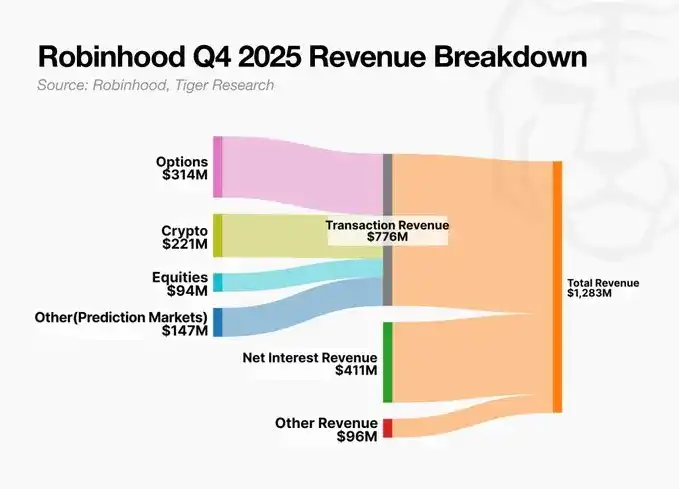
This model has been validated by data. After expanding its crypto business, crypto trading revenue became Robinhood's largest single source of revenue in Q4 2024. Crypto revenue declined 38% year-over-year in Q4 2025, but total revenue remained stable, with options, stocks, and prediction markets filling the gap. The structural resilience achieved through diversification is already in place.
Polymarket and Kalshi are coming from opposite directions toward the same destination. Originating from prediction markets, they are now adding futures trading. Different starting points, but the same endpoint. As the Robinhood model has been validated, traditional finance is likely examining the same path.
Simple analogy
The era of carrying separate devices for a camera, MP3 player, and navigation has ended, as smartphones have integrated all these functions into one device. A similar transformation is now taking place in finance.
Brokerage accounts, crypto exchanges, and prediction markets are converging into a single platform. Robinhood started as a stock app and has since added crypto and prediction markets; Polymarket began as a prediction market and is now introducing crypto perpetual contracts. Different starting points, but the same direction.
Generalization of the Robinhood model
As generations change, this trend will accelerate further. Newer users have grown up simultaneously exposed to stocks, cryptocurrencies, and prediction markets. Just as smartphone users don’t accept separate devices for cameras, MP3 players, and maps, this generation finds the idea of using separate apps for each asset class inherently unfamiliar. The demand for an integrated platform that handles all assets within a familiar interface will grow naturally with each passing generation.
This is a generalization of the Robinhood model.
Polymarket and Kalshi have a particular advantage in this model. Since collateral in prediction markets is locked until the outcome is determined, how to utilize these idle assets will become a key point of competitive differentiation.
On December 3, 2025, a developer proposed the concept of PolyAave: depositing Polymarket outcome tokens into Aave liquidity pools to earn interest. This was an early attempt to convert prediction market collateral into DeFi yield. Polymarket’s launch of perpetual futures is likely an extension of this logic. The strategy of not letting locked capital sit idle is sound.
Polymarket and Kalshi are leading the way, but traditional finance is facing the same pressures. As the regulatory environment gradually opens up, major financial institutions will directly support crypto spot trading and gradually incorporate new asset classes, including prediction markets.