



This report is prepared by Tiger Research **Market Outlook for Bitcoin in Q1 2026: Target Price of $185,500** As we look ahead to the first quarter of 2026, the Bitcoin market is expected to enter a new phase of growth, driven by a combination of macroeconomic stability, increased institutional adoption, and the ongoing maturation of the cryptocurrency ecosystem. Here's a detailed outlook on Bitcoin's potential trajectory during this period. --- ### **1. Macroeconomic Environment** By early 2026, global central banks are projected to have stabilized interest rates, with the U.S. Federal Reserve likely maintaining a neutral stance. This environment is favorable for risk-on assets, including Bitcoin, as investors seek returns in a low-yield world. Additionally, inflation is expected to remain under control, reducing the pressure on investors to seek alternative stores of value. --- ### **2. Institutional Adoption and Regulatory Clarity**
Key Points
- Macroeconomic stability with slowing momentum: The Federal Reserve's interest rate cut cycle is proceeding in line with the growth trajectory of the M2 money supply. Nevertheless, a $4.57 billion outflow from ETFs has impacted short-term trends. The advancement of the CLARITY Act could become a key factor in attracting major banks to enter the market.
- On-chain indicators turning neutral: Buy demand near $84,000 has formed a solid bottom support, while $98,000, representing the cost line for short-term holders, currently acts as the main resistance level. Key indicators such as MVRV-Z show that the market is currently at fair value.
- Target price of $185,500, maintaining a bullish outlook: Based on a base valuation of $145,000 and a macro factor adjustment of +25%, we set our price target at $185,500. This implies approximately 100% upside potential from the current price.
Macroeconomic easing continues, but growth momentum weakens.
Bitcoin is currently trading around $96,000. Since our release on October 23, 2025Previous reportSince then, prices have fallen by 12%. Despite the recent pullback, the macroeconomic fundamentals supporting Bitcoin remain solid.
The Fed's path maintains a dovish stance.
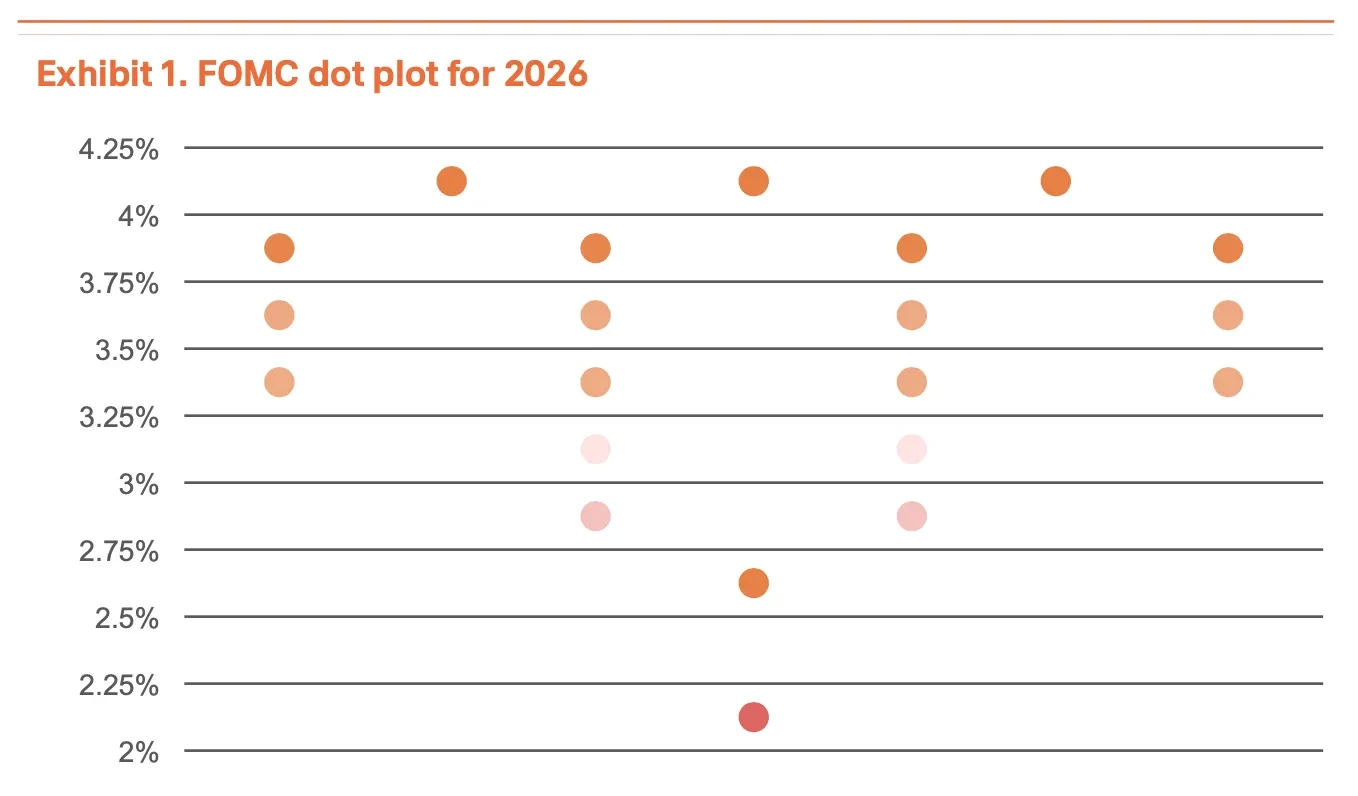
Source:Tiger Research
The Federal Reserve cut interest rates three consecutive times between September and December 2025, for a cumulative reduction of 75 basis points, bringing the current rate to a range of 3.50%–3.75%. The December dot plot projected that the interest rate would fall to 3.4% by the end of 2026. Although a single rate cut of 50 basis points or more is unlikely this year, as Powell's term ends in May, the Trump administration may appoint a more dovish successor, ensuring the continuation of a monetary easing trend.
Institutional Outflows and Continuous Corporate Buying
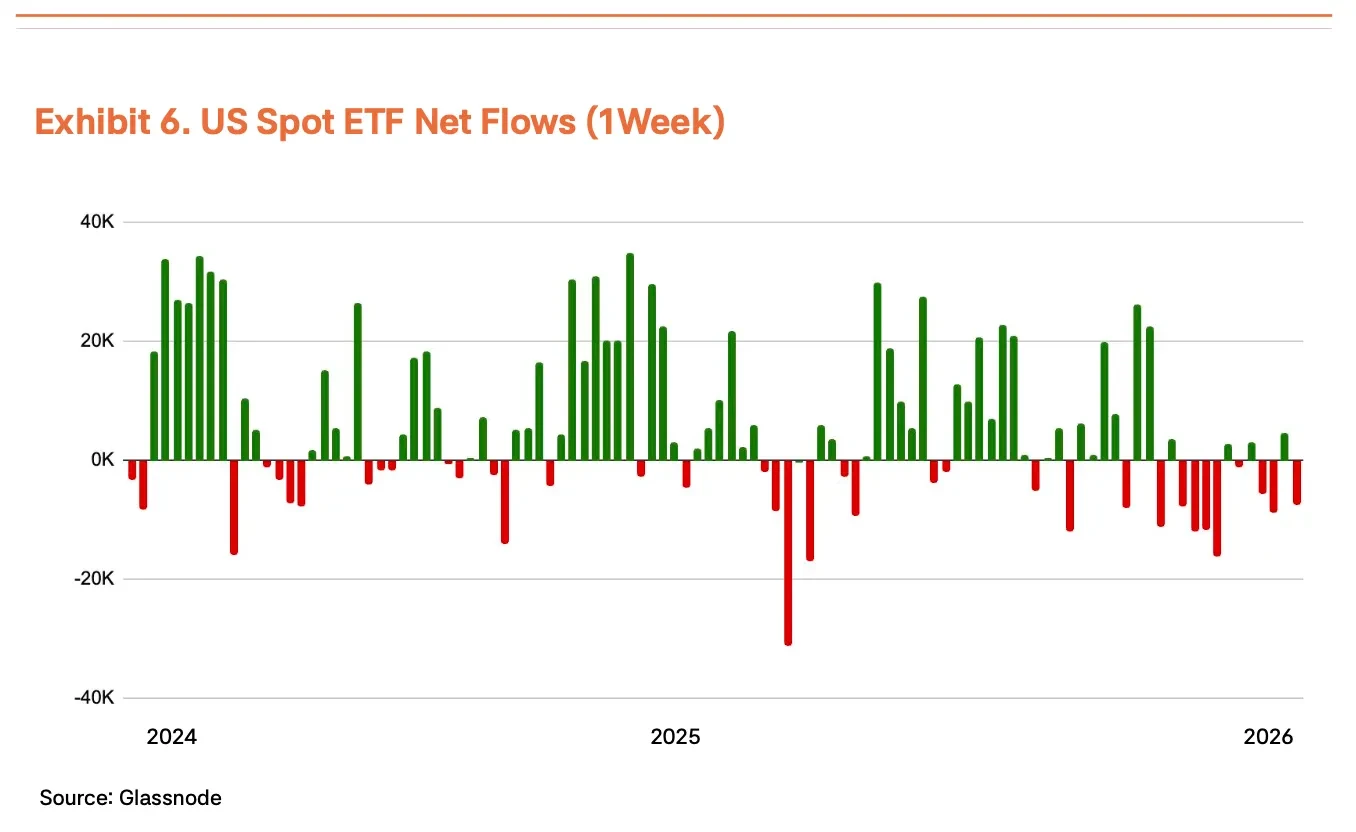
Although the macroeconomic environment remains favorable, institutional demand has recently been weak. Spot ETFs recorded a net outflow of $4.57 billion during November and December, the largest outflow since the product's launch. The annual net inflow amounted to $21.4 billion, a 39% decline from the $35.2 billion in the previous year. Although asset reallocation in January has brought in some inflows, the sustainability of this rebound remains to be seen. Meanwhile, companies such as MicroStrategy (holding 673,783 BTC, or about 3.2% of the total supply), Metaplanet, and Mara continue to accumulate Bitcoin.
The CLARITY Act Becomes a Policy Catalyst
Against the backdrop of stagnant institutional demand, regulatory developments are becoming a potential driving force. The House of Representatives passed the CLARITY Act, which clarifies the jurisdictional boundaries between the U.S. Securities and Exchange Commission (SEC) and the Commodity Futures Trading Commission (CFTC), and allows banks to offer custody and staking services for digital assets. In addition, the bill grants the CFTC regulatory authority over digital commodity spot markets, providing a clear legal framework for exchanges and brokers. The Senate Banking Committee is scheduled to review the bill on January 15. If passed, it could encourage traditional financial institutions that have been waiting on the sidelines to formally enter the market.
Abundant liquidity, Bitcoin lags in performance
Liquidity is another key variable besides regulation. Global M2 money supply reached a historical high in the fourth quarter of 2024 and continues to grow. Historically, Bitcoin has tended to lead liquidity cycles, typically rising before M2 reaches its peak and entering consolidation phases around the peak. Current signs suggest further liquidity expansion, implying that Bitcoin still has upward potential. If stock market valuations appear excessively high, capital is likely to shift into Bitcoin.
Macro factor downgraded to +25%, outlook remains solid
Overall, the macro direction of interest rate cuts and liquidity expansion remains unchanged. However, taking into account the slowing inflow from institutions, the uncertainty surrounding the leadership change at the Federal Reserve, and the rising geopolitical risks, we have adjusted the macro adjustment factor downward from +35% to +25%. Despite this reduction, the weighting still remains in a positive range. We believe that regulatory progress and the continued expansion of M2 will provide core support for a rise in the medium to long term.
$84,000 Support Level and $98,000 Resistance Level
On-chain metrics provide supplementary signals for macro analysis. During the adjustment in November 2025, capital looking to buy the dip focused around the $84,000 level, forming a clear support zone. Currently, Bitcoin has broken above this range. The $98,000 level corresponds to the average cost of short-term holders, forming a psychological and technical resistance in the near term.
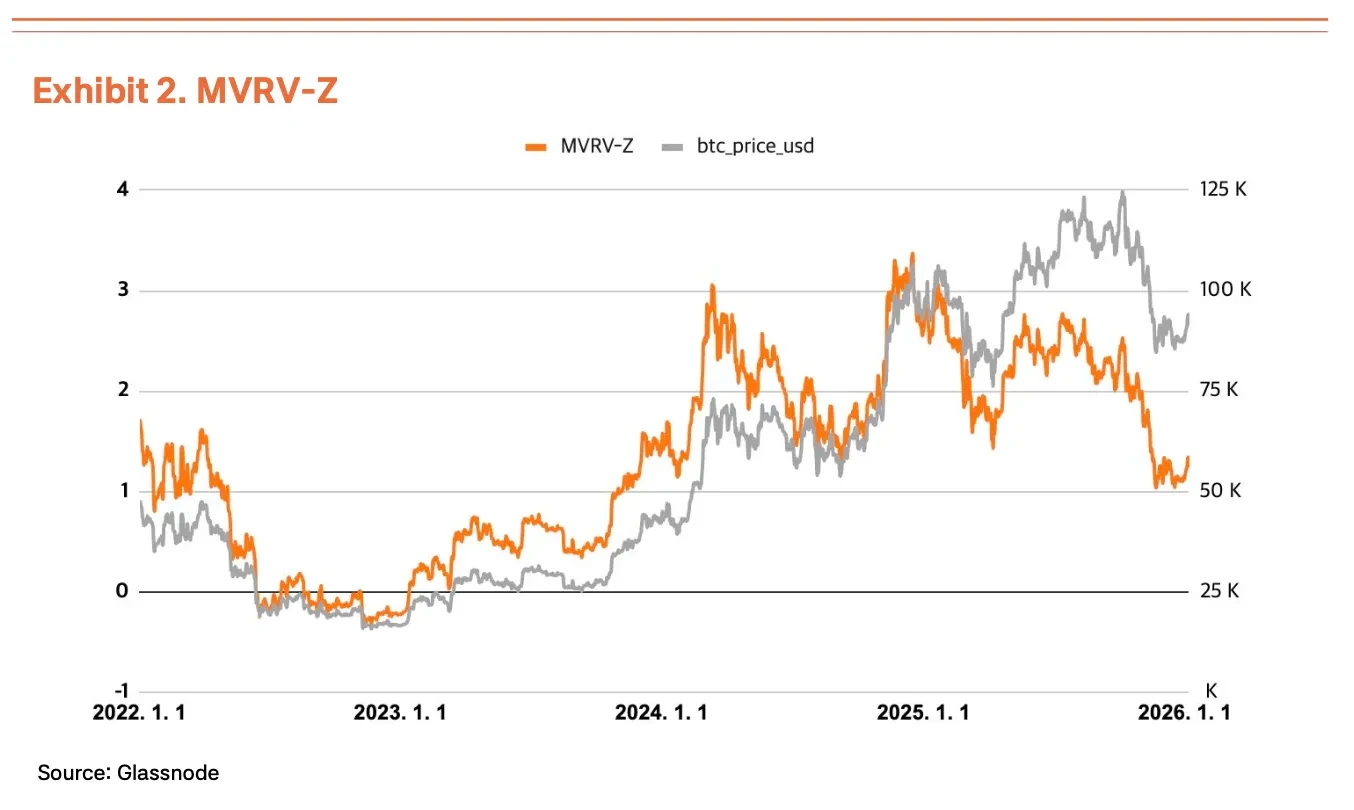
On-chain data indicates that market sentiment is shifting from short-term panic to neutrality. Key indicators such as MVRV-Z (1.25), NUPL (0.39), and aSOPR (1.00) have all moved out of the undervalued zone and entered the balanced range. This suggests that while the likelihood of panic-driven explosive price surges has decreased, the market structure remains healthy. Combined with the macroeconomic and regulatory context, the statistical basis for a long-term upward price trend remains strong.
It is worth noting that the current market structure is significantly different from previous cycles. The increased share of institutional and long-term capital has reduced the likelihood of panic-driven stampedes typically led by retail investors. The recent pullback is more indicative of a gradual rebalancing. While short-term volatility is inevitable, the overall upward trend remains intact.
Target price adjusted to 185,500 USD, bullish outlook remains firm
Applying the TVM valuation framework, we arrive at a neutral benchmark valuation of $145,000 for the first quarter of 2026 (slightly belowPrevious Reportwith a $1.54 million USD). Combining a 0% fundamental adjustment and a +25% macro adjustment, we set the revised target price as $185,500.
We have adjusted the fundamental adjustment factor from -2% to 0%. Although network activity has not changed significantly, the market's renewed focus on the BTCFi ecosystem has effectively offset some of the bearish signals. At the same time, due to the previously mentioned slowdown in institutional inflows and geopolitical factors, we have reduced the macro adjustment factor from +35% to +25%.
This downward adjustment in the target price should not be viewed as a bearish signal. Even after the adjustment, the model still indicates approximately 100% potential for upward movement in the market. The lower base price mainly reflects recent volatility, while Bitcoin's intrinsic value will continue to rise in the medium to long term. We believe the recent pullback is a healthy rebalancing process, and our bullish outlook for the medium to long term remains unchanged.