





This report was written by Tiger Research in February 2026, following the Iranian airstrike, during which gold prices rose and Bitcoin prices plummeted. Can we still trust Bitcoin as “digital gold”? We will explore the conditions Bitcoin must meet to become “the next gold.”
Key Points
- Each geopolitical crisis sees gold prices rise and Bitcoin prices fall. After six tests, the claim of “digital gold” has never been supported by data.
- Countries are hoarding gold but excluding bitcoin from their reserves. For investors, bitcoin is asymmetric: it declines with stocks but does not rise with them. Three structural asymmetries prevent bitcoin from achieving safe-haven status: derivatives oversupply (market structure), dominance of leveraged traders (participant composition), and lack of repeated behavioral patterns (behavioral accumulation).
- Bitcoin is not a safe-haven asset, but it is a “useful asset in crises” and can indeed play a role when borders are closed and banks fail.
- If these three asymmetries narrow, Bitcoin may no longer be a replica of gold but instead become an entirely new "next-generation gold." Generational change and the widespread adoption of algorithms are key factors that could accelerate this process.
Is Bitcoin really "digital gold"?
On February 28, 2026, the United States and Israel launched airstrikes against Iran. Immediately after the operation was announced, gold prices rose sharply. In contrast, Bitcoin's price plummeted to $63,000 on the same day, then recovered within 24 hours.
The same thing produced completely opposite reactions.
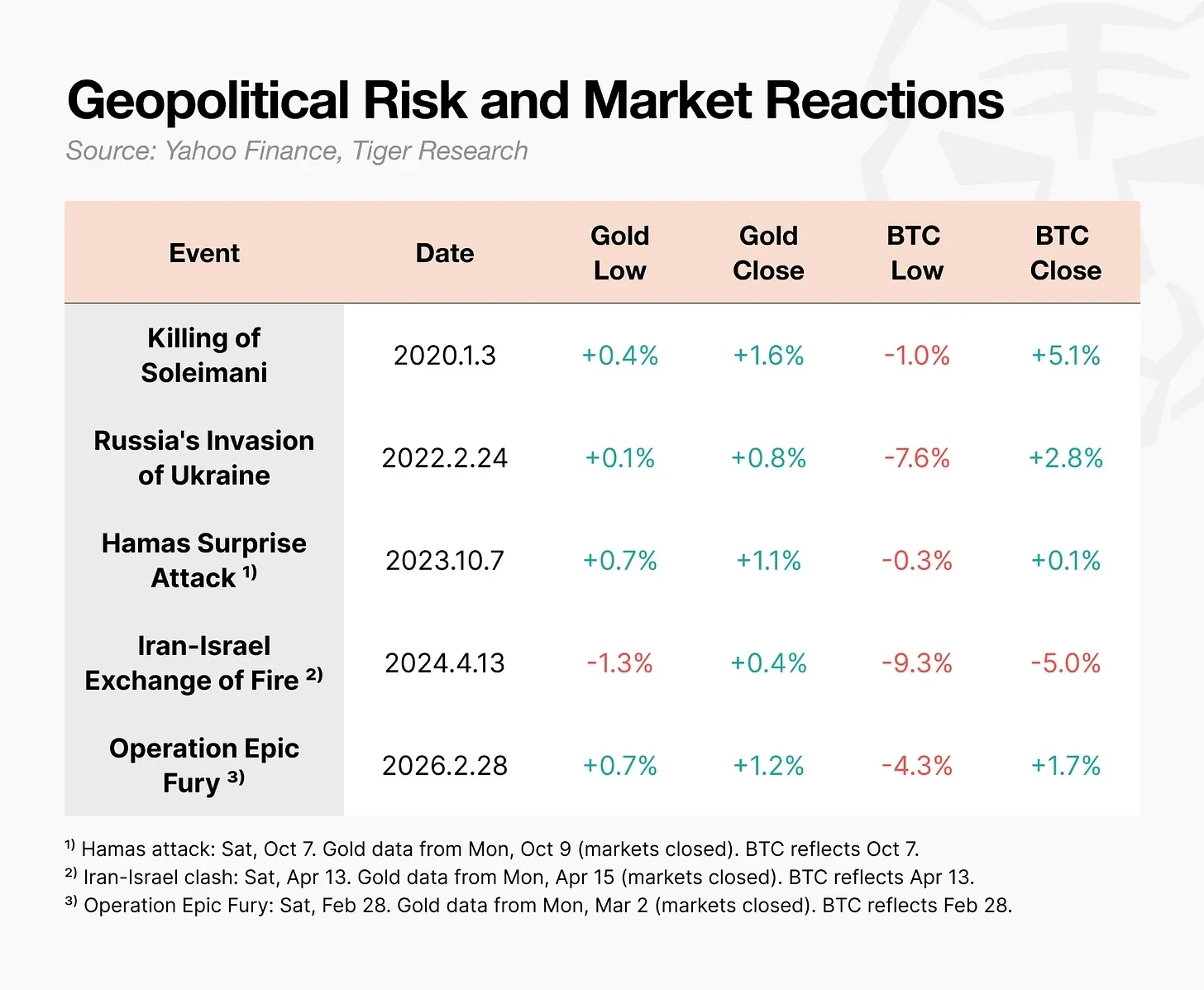
During geopolitical shocks such as war, Bitcoin's price movement differs from that of gold.
After an initial decline, Bitcoin often rebounds quickly, but chain reactions triggered by forced liquidations of leveraged traders can amplify the drop. During the Iran-Israel conflict, Bitcoin’s intraday decline reached as much as 9.3%, and during the Ukraine war, it fell by 7.6%. In stark contrast, gold prices rose during the same periods.
Bitcoin is often the first asset to drop when a crisis erupts—can we still call it "digital gold"?
2. Bitcoin is not "digital gold" for nations or investors.
Bitcoin was not originally designed to be "digital gold." The title of the whitepaper released by Satoshi Nakamoto in 2008 was "Bitcoin: A Peer-to-Peer Electronic Cash System." Its purpose was to serve as a payment mechanism, not a store of value.
The concept of "digital gold" as we know it today gained popularity during the zero-interest-rate and quantitative easing period in 2020. As concerns about currency depreciation peaked, Bitcoin attracted attention as a store of value. However, in practice, neither governments nor investors have treated Bitcoin as "digital gold."
2.1. Sovereign Nations: Hoarding Gold Without Considering Bitcoin
Data from the World Gold Council shows that central banks around the world have never stopped buying gold year after year. However, no major central bank has included bitcoin in its full reserve assets.
Some may argue that the United States formally established a Strategic Bitcoin Reserve via executive order in March 2025, with the text of the order even stating that “Bitcoin is often referred to as ‘digital gold.’” However, the specifics are not as described. The reserve is limited solely to assets seized through criminal and civil forfeiture proceedings. The government is not purchasing new Bitcoin; it is merely holding Bitcoin that has already been confiscated, rather than selling it.
Notably, as the appeal of U.S. Treasury bonds declines, Europe and China are actively purchasing gold, but Bitcoin has not yet been added to their list of alternative options.
2.2 Investors: Fall Together, Rise Separately
The second half of 2025 is crucial. The Nasdaq index has reached a new all-time high, while Bitcoin has plunged more than 30% from its October peak of $125,000. These two assets are beginning to diverge.
But the real issue isn't the decoupling itself—it's the direction. Bitcoin also falls when the stock market declines, but it doesn't rise when the stock market rises. For investors, this is the worst possible combination. Holding an asset that exposes you to downside risk while denying you upside potential makes no sense. Bitcoin is far from a safe haven, and even as a risk asset, its appeal has been called into question.
3. Why Bitcoin Has Not Become "Digital Gold"
Safe-haven assets are not merely those that increase in price. From an academic perspective, they are assets whose correlation with other assets drops to zero or even becomes negative during periods of severe economic downturn. The key question is whether their behavior during crises is predictable. By this standard, the difference between gold and bitcoin is clear.
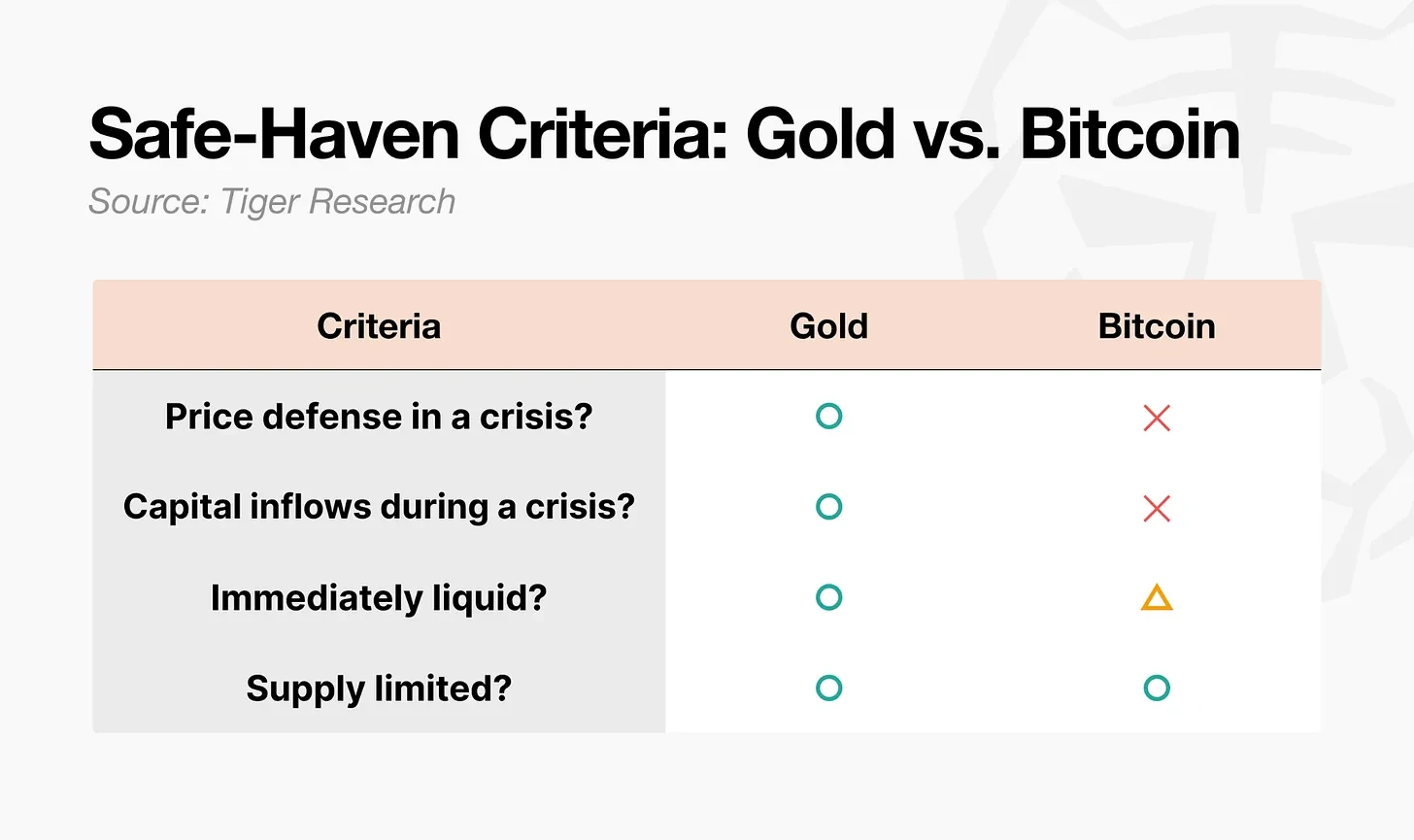
Gold satisfies all four criteria. Bitcoin clearly satisfies only one: fixed supply. Liquidity is conditional. The other two criteria are not met. Three structural asymmetries explain this gap.
- Asymmetric market structure: Physical demand for gold supports its price floor, and its futures leverage is relatively low. Bitcoin’s derivatives trading volume is approximately 6.5 times its spot trading volume, and since its market operates 24/7, it often becomes one of the first assets sold off during crises.
- Asymmetric participants: During the gold crisis, buyers were patient capital such as central banks, pension funds, and sovereign wealth funds. In contrast, the main participants in the Bitcoin market are leveraged traders and hedge funds—capital that is among the first to exit during a crisis.
- Behavioral accumulation of asymmetry: The pattern of buying gold when a crisis strikes has repeated for decades, eventually becoming a fixed habit. Bitcoin needs time to earn the same level of trust.
4. Unsafe, but proven useful
In terms of security, it's hard to call Bitcoin "digital gold." But its role during crises is undeniable.
After the outbreak of the Russia-Ukraine war in 2022, the National Bank of Ukraine immediately restricted electronic transfers and ATM withdrawals. Bank branches closed, leaving citizens unable to access their own deposits. Some refugees crossed the border carrying USB drives containing Bitcoin seed phrases. Reports indicate that upon arriving in Poland, they converted their Bitcoin into local currency via Bitcoin ATMs or P2P transactions to cover living expenses.
UNHCR went a step further by distributing the stablecoin USDC to displaced persons and launching a program allowing them to exchange it for local currency at Western Union outlets. During the 2026 "Epic Fury" operation, funds流出 from Nobitex, Iran's largest cryptocurrency exchange, surged by 700% immediately after airstrikes.
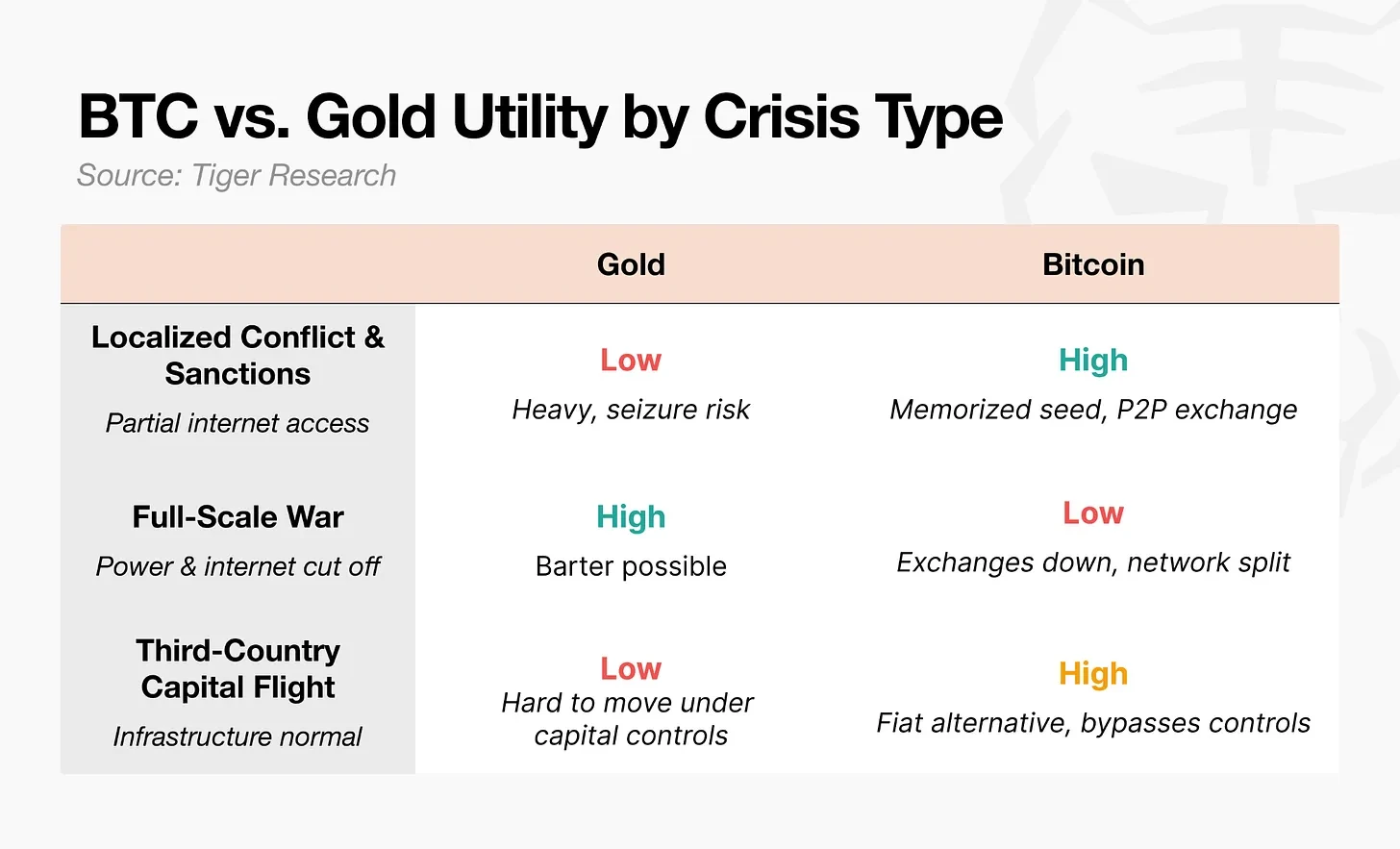
These cases show that people are turning to Bitcoin not because it is a safe-haven asset, but because it functions when the financial system fails.
In finance, a "safe-haven asset" refers to an asset whose price remains stable during times of crisis. This differs from the concept of assets that are usable during crises. Bitcoin clearly provides functional value for transfer and transactions during wartime, but it cannot guarantee the stability of its own price. What truly defines a safe-haven asset is not utility, but predictable price behavior. Bitcoin possesses the former but cannot ensure the latter.
5. Bitcoin’s “Next-Generation Gold” Scenario
In every crisis, Bitcoin's behavior has been distinctly different from gold. Neither nations nor investors have regarded it as "digital gold." However, in regions where borders are closed and banks are shut down, Bitcoin's practicality cannot be ignored. Given this potential, if these three asymmetries narrow, the path to becoming the "gold of the next generation" will open.
5.1 Market Structure Shift
Derivatives trading volume has reached 6.5 times that of spot trading, triggering cascading sell-offs during every crisis. Recently, futures open interest has declined, and price discovery mechanisms show signs of shifting toward spot and ETFs. But the real test will be whether leverage rebuilds during the next bull market.
5.2. Participant Transfer
After spot ETFs were approved in 2024, institutional capital flooded in, making Bitcoin a mainstream financial asset. But this created a paradox: the more institutional investors include Bitcoin in their portfolios, the more likely it is to be sold alongside stocks during periods of risk aversion. Bitcoin’s accessibility has increased, yet its independent price volatility has disappeared. This is the financialization paradox.
Gold ETFs have also become mainstream, yet during crises, gold moves in the opposite direction of stocks, as “crisis buying” is a pattern formed over more than half a century. To break this paradox, the composition of participants must shift from leveraged traders to patient capital.
There is an easily overlooked variable: generational transition. When Generation Z begins to inherit and manage real wealth, gold may still be their parents’ safe haven. This generation’s first investment account is not a securities account, but a cryptocurrency exchange. For the first generation to encounter assets through Bitcoin, they may instinctively turn to Bitcoin rather than gold during a crisis. This shift in participants may not begin with institutional decisions, but with changes in generational behavior.
5.3 Behavioral Accumulation Shift
It took about 50 years for the "crisis buy" pattern in gold to form after the Nixon Shock. Does Bitcoin need the same amount of time? Not necessarily. This U.S.-Iran conflict is the sixth test, and the result is again the same: a intraday plunge followed by a rebound. As this pattern repeats, more people are coming to believe, "It will drop, but it always rebounds."
The more important variable is the algorithm. Today, a large portion of Bitcoin trading volume comes from AI agents and algorithmic trading. If the "buy Bitcoin during crises" strategy is embedded into these algorithms, this pattern can form without the accumulation of human behavior. In this case, trust is built into the code before it is established among people.
Bitcoin is not yet "digital gold." But if market structure, participant composition, and behavioral patterns evolve on the foundation of its proven utility, it could become the "next-generation gold." It is not a replica of gold, but the birth of an entirely new category.