




In the power structure of Web3, Tether has long played the role of a silent, immensely wealthy shadow dollar printing press.
On the evening of April 14, Tether announced the official launch of Tether Wallet, branding it as "The People's Wallet." The introduction of this product represents, at its core, the stablecoin giant's move to extend its interface directly to end users.
Moving from asset issuer to user access point. Previously, Tether was only responsible for “printing money”; now it aims to define how people transfer and hold assets. By directly controlling C-end traffic, Tether is transforming into a closed-loop ecosystem with traffic sovereignty.
This is also a defense of its shadow dollar status. In emerging markets, USDT has already become the de facto fiat substitute. But as Circle continues to strengthen its compliance narrative and squeeze the market, Tether must lock billions of users abandoned by traditional finance into its official gateway by lowering the barriers to physical usage.
What is the true core of the Tether Wallet?
In the product logic of Web3, user experience has always been a false premise. When you ask a user on a street in Latin America trying to send $10 to manually write down 12 meaningless English words and warn them, “Lose them and you’re bankrupt,” financial inclusion is already dead at the starting line.
The key highlight of the Tether Wallet lies in its attempt to dismantle the three major barriers of self-custody wallets—addresses, transaction fees, and seed phrases—through white-box transparency, focusing squarely on simplicity and convenience, and streamlining the experience to its bare essentials.
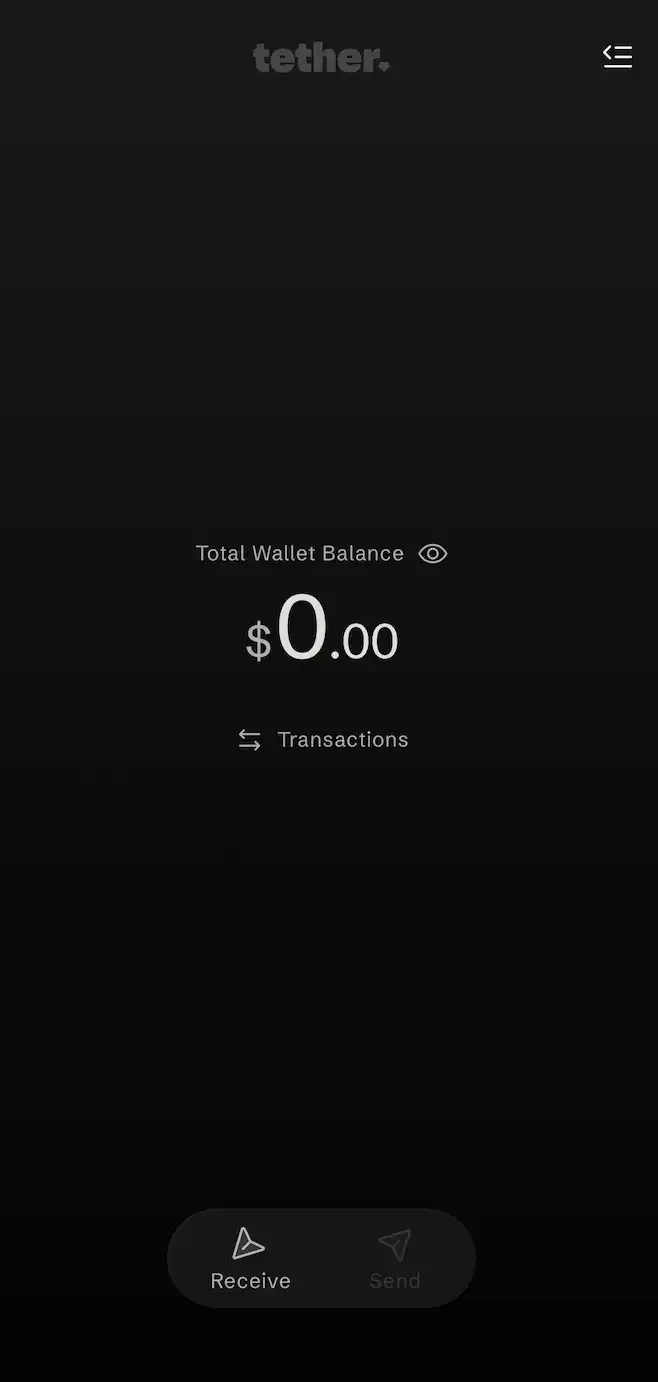
First, identity the on-chain address.
For a long time, long hexadecimal string addresses have been the biggest barrier to mass adoption. Tether Wallet introduces a payment username system (such as [email protected]), meaning that in cross-border transfer scenarios, USDT completely sheds its obscure crypto-asset image and becomes as simple as sending an email or a message.
After testing, Tether Wallet requires email registration and login. The current payment username must consist only of lowercase letters and numbers, with a length between 4 and 15 characters.
Second, Gas is truly abstracted, with transaction fees directly deducted from the transferred asset.
The Tether Wallet does not charge fees and supports using transferred assets to cover network fees.
The technology itself isn't innovative, but its native integration by Tether makes all the difference: it completes the payment experience at the protocol level. This native, issuer-integrated "gas abstraction" means the payment experience is fully闭环 at the underlying protocol level—users only need to worry about how much to send, not the transaction fees.
Third, self-custody design and cloud backup solutions
The Tether Wallet uses a self-custodial design, where all transactions are signed and confirmed on the user’s own device before being sent to the blockchain. The Tether Wallet also offers an encrypted cloud backup (Cloud Backup) solution: wallet data is encrypted and stored on Tether’s servers, while the key is stored on the user’s own iCloud or Google Drive. Neither party can unlock the wallet alone; the two components are only combined when the user logs in to their device. To restore the wallet on a new device, simply log in with your email.
Of course, users can still choose to back up manually.
Currently, Tether wallets support the following assets and networks:
· USDT: Ethereum, Polygon, Plasma, Arbitrum
· XAUT: Same as above
· USAT: Ethereum
· Bitcoin: On-chain + Lightning Network
Notably, 45% of the circulating USDT supply is currently on Tron, but the Tether Wallet does not currently support Tron.
When stablecoins become high-frequency payment assets
When the barrier to payment is lowered to just an email and a username, USDT is no longer merely a value anchor in the crypto world—it begins to exert a terrifying gravitational pull, attempting to absorb small-scale cross-border settlements across the entire real world.
First, it delivers a paradigm shift to traditional cross-border payment intermediaries. Before Tether Wallet, workers in emerging markets had to pay high fees and endure settlement times lasting several days to send money to their families. The logic behind Tether Wallet is this: since USDT is already the de facto local currency in these regions, instant, low-cost transfers can be achieved via the Lightning Network or other blockchains.
There is also pressure on the survival of competing stablecoins. In the past, Circle (USDC) or PayPal (PYUSD) attempted to capture market share through compliance and institutional backing.
But Tether recognizes that, at the retail level, liquidity inertia outweighs everything else. When a user becomes accustomed to seamless transfers using @username within Tether’s official wallet, they have no incentive to switch to a payment tool with higher fees and a smaller network. Tether is turning its first-mover advantage into an irreversible usage habit.
The deeper impact lies in Tether redefining financial inclusion: this self-custody wallet gives Southeast Asian farmers and Latin American vendors, who have never had a bank account, their first equal and irreversibly accessible seat in the global financial infrastructure.
Boundaries of Power and the Vitality of Protocols in the AI Era
In the documentation for tether.wallet, a term is mentioned twice: "Left behind." Yet, as these populations overlooked by the traditional financial system flood into the new infrastructure built by Tether, a series of unresolved questions about power emerge.
First comes the regulatory tug-of-war under the guise of self-custody. Although Tether emphasizes that users hold their private keys, the native integration of cloud backup functionality and support for the @username system naturally creates nodes vulnerable to regulatory intervention.
If regulatory demands require marking specific accounts or pressuring cloud data, Tether will be forced to choose between its "decentralized ethos" and "business survival." This will be a key battleground in the future clash between cryptocurrency and sovereignty.
Second, AI Agents represent the second growth curve. Paolo Ardoino’s statement is highly prescient: this wallet is also designed for AI agents. In a future of interconnected everything, human biological identity may no longer be the core of financial accounts.
When an AI agent needs to pay for computational power instantly, a stablecoin wallet that can be orchestrated through a simple interface will become the "blood" of machine civilization.
Finally, we must confront the ultimate contradiction: Tether is a complex综合体—centralized at its core, yet spreading outward with extremely decentralized tools.
This contradiction may well be a true reflection of the current evolution of global finance. The old order remains difficult to dislodge, while the new order grows only in the cracks. Tether Wallet does not aim to create a utopia; it simply opens a window in the wall of reality, showing people that transferring dollars can be as simple as sending a text message.
An era of silent yet powerful global value transfer, dominated by stablecoin giants, is accelerating. But this all hinges on one critical truth: convenience has never been free. We cannot avoid a fundamental question: how can we find a truly sustainable balance between the walls of the old order and the unchecked growth of the new, while pursuing efficiency and inclusion?