




Author: Kathy.xyz
The market interpreted the news of Tether's first audit as a "planned IPO," causing Circle's stock price to plummet.
I just finished reading @snapcrakle’s piece “Tether Is Not a Stablecoin Company,” posted two days ago—the most comprehensive deep dive on Tether to date. https://x.com/Snapcrackle/status/2036070394650644722
This is a translation of the original Snapcrakle article, supplemented with my interpretations.
TLDR: @tether, founded in 2014 and originally known for issuing the world’s largest stablecoin, USDT, has now evolved into a diversified corporate group spanning currency issuance, blockchain infrastructure, energy, and Bitcoin hashing power.
Core Business: USDT, the undisputed leader among stablecoins
Tether's flagship product, USDT, is the world's largest stablecoin by market capitalization and a foundational pillar of liquidity in the crypto market.
As of 2026, the key data for USDT is as follows:
Circulating supply: $186 billion
Global user base: Over 550 million
Total on-chain transfer volume in 2025: $13.3 trillion (approximately 40% of the global stablecoin flow of $33 trillion)
Small payments under $1,000: $156 billion (primarily from users in emerging markets)
Tether's business model is built on "reserve interest": each USDT is backed by an equivalent amount of fiat reserves (primarily U.S. Treasury securities), and the interest generated by these reserves constitutes the company's primary source of income.
In 2025, Tether generated over $10 billion in net profit with just 300 employees, becoming one of the most profitable companies per employee worldwide.
Tether currently holds a larger amount of U.S. Treasuries than Germany, making it an influential institutional investor in the U.S. Treasury market.
Industry Landscape: From Stablecoins to Full-Stack Infrastructure
Tether’s strategic expansion follows a clear logic of vertical integration—starting from currency issuance, extending upward to blockchain settlement layers, and downward to energy and computing infrastructure.
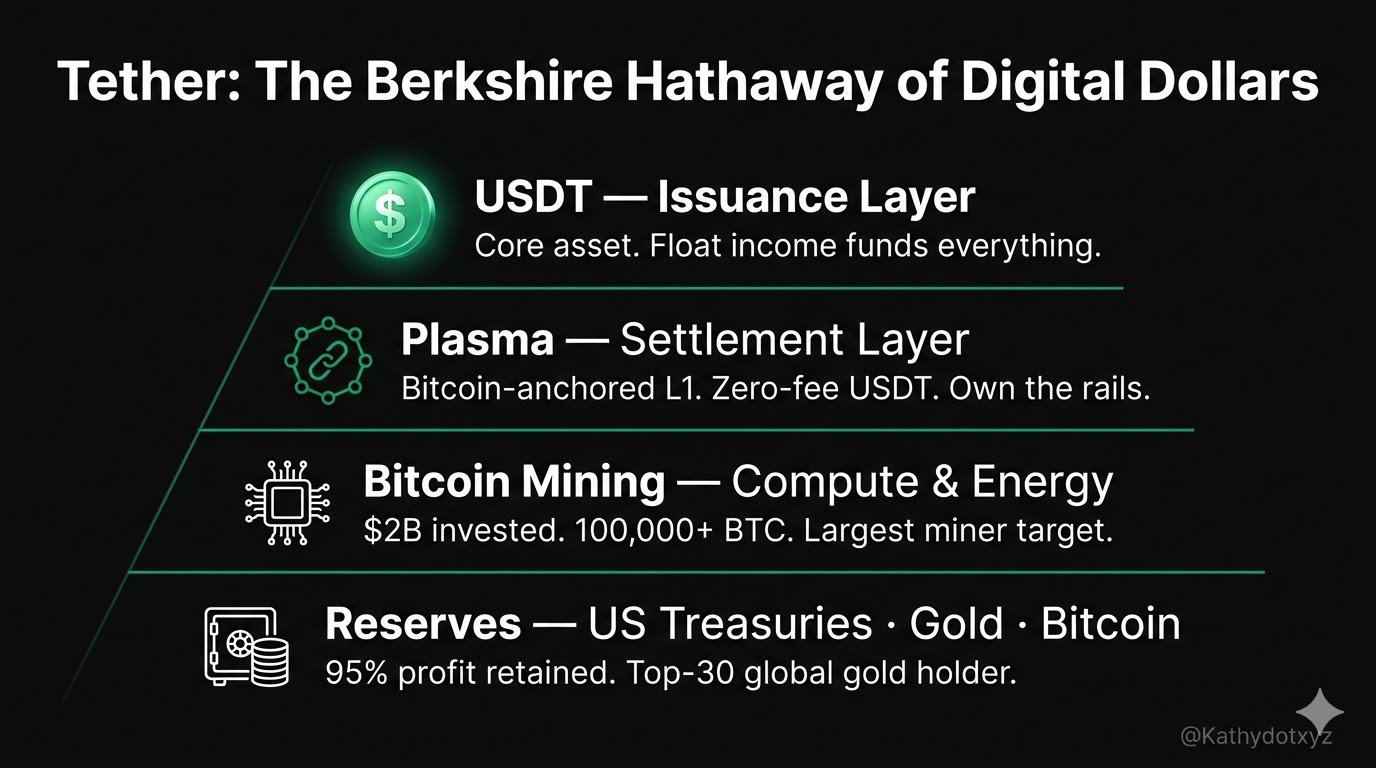
💵 Issuance Layer: USDT
USDT is Tether's core asset and the primary source of funding for all its expansions. Through the float income generated by USDT reserves, Tether is able to continuously invest in new businesses without relying on external financing.
🏦 Settlement Layer: Plasma @Plasma
In 2025, Tether launched its proprietary Layer-1 blockchain, Plasma. Anchored to Bitcoin and designed specifically for stablecoin payments, Plasma supports EVM compatibility, zero-fee USDT transfers, and actively excludes speculative features such as NFTs and meme coins. The strategic significance of this chain lies in Tether no longer relying on third-party networks like Ethereum for USDT settlement, but instead asserting sovereign control over the clearance of its own currency.
⛏️ Hashrate and Energy Layer: Bitcoin Mining
Tether has invested over $2 billion in Bitcoin mining and energy infrastructure and currently holds more than 100,000 Bitcoin. CEO Paolo Ardoino publicly stated that Tether aims to become the world’s largest Bitcoin miner by the end of the year. Geographically, Tether has established mining operations in Uruguay, Paraguay, and El Salvador.
In the fourth quarter of 2025, Tether open-sourced its proprietary mining operating system, MOS, further strengthening its influence in the mining ecosystem.
🪙 Reserve Layer: Diversified Asset Allocation
Tether retains 95% of its profits for reinvestment, forming a diversified reserve portfolio primarily composed of U.S. Treasuries, supplemented by gold and Bitcoin. This allocation strategy closely mirrors Berkshire Hathaway’s "float-driven investment" logic.
Strategic investment positioning
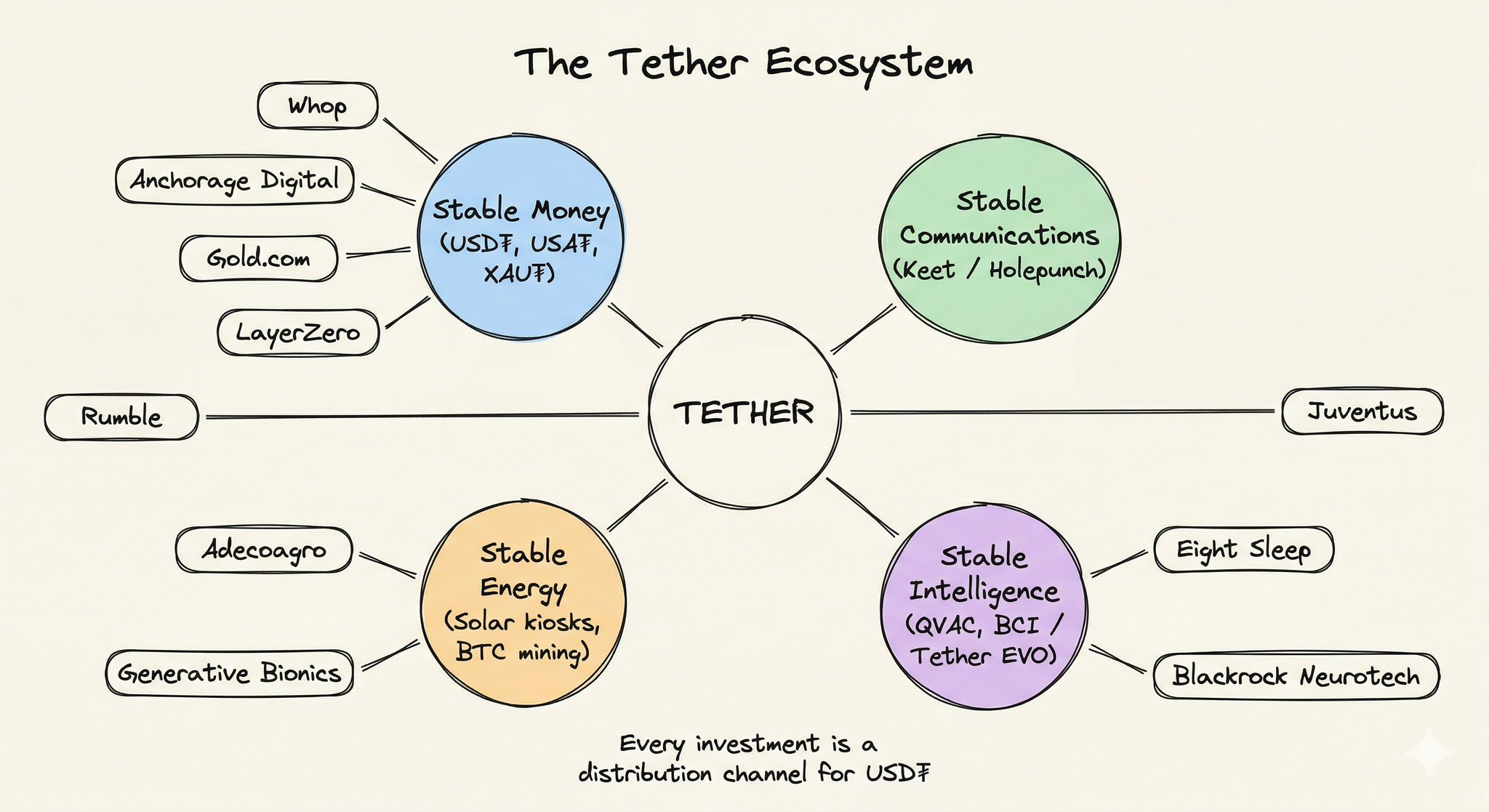
Tether has invested in over 100 companies across a diverse range of sectors:
Plasma financing: Led by Peter Thiel, with a total raise of $500 million, reflecting top-tier capital’s endorsement of Tether’s infrastructure strategy.
Energy Infrastructure: Deploying renewable energy mining facilities across multiple countries in Latin America, linking mining costs to clean energy sources;
Open-source ecosystem: Foster industry ecosystem through open-source Mining OS (MOS) and strengthen influence over Bitcoin mining standards.
Financial services in emerging markets: Invested in multiple payment processors and crypto banks in Africa and Latin America to integrate downstream channels.
Precious metals and Bitcoin infrastructure: Positioning assets reserves, including holdings in publicly traded companies Elemental Altu, Gold.com, Twenty One Capital, and the Bitcoin-backed lending platform Ledn.
Emerging technology sectors: Highly diverse, including Generative Bionics (an AI-driven prosthetics and bionics company), Neura Robotics (humanoid robots), Blackrock Neurotech (brain-computer interface medical devices company), and Rumble (video media platform).
Conclusion: The Keys to Tether's Success
Tether's success has completely diverged from Western mainstream funding and investment pathways. Its growth is rooted in the widespread demand for the U.S. dollar across developing nations, which has been successfully translated into adoption of USDT—a phenomenon entirely outside the awareness of Americans accustomed to a dollar-based system.
Tether’s CEO, @paoloardoino, possesses exceptional foresight, and his bold investments and strategic initiatives in recent years have further strengthened Tether’s competitive moat.