




Recently, the AI community's dynamics have been clearly a bit fragmented.
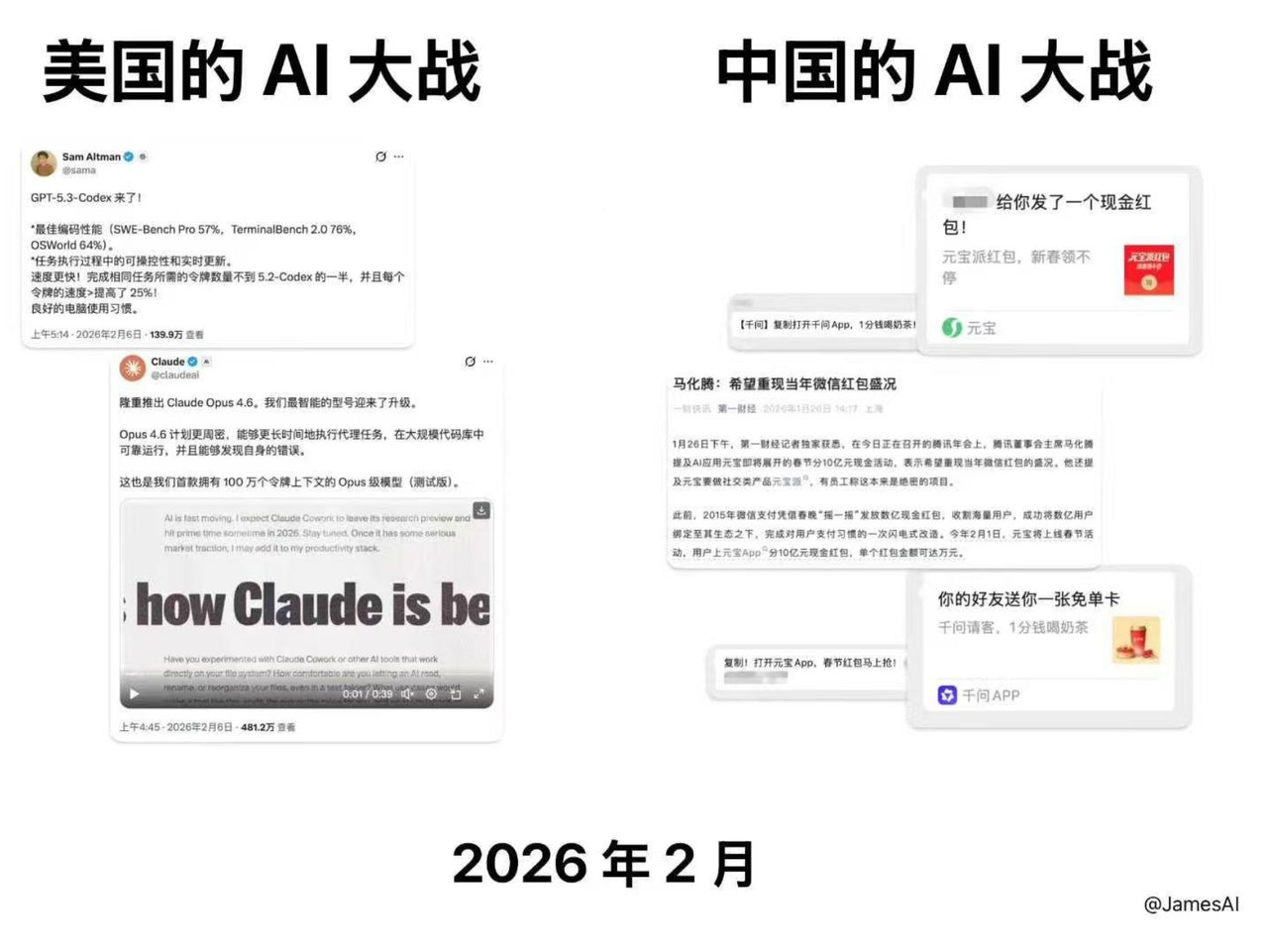
Image source:@JamesAI
On one side, overseas models are almost releasing a new version every day.
You haven't fully deployed OpenClaw yet, and Moltbook and Codex have already been pushed onto a new trend.
On the other hand, AI products from domestic tech giants are aggressively "spending money" during the Spring Festival to conduct holiday marketing.
The Spring Festival remains the most competitive "traffic battlefield" for big companies.
Looking at the scale of investment alone
Ali 3 billion > Tencent 1 billion ≈ ByteDance (unannounced, but Spring Festival Gala sponsorship worth hundreds of millions) > Baidu 500 million
In fact, the Spring Festival, as a national-level, trillion-yuan traffic entry, has already become a must-contest battlefield every year.
If we simply rank the AI marketing strategies of BBAT this year from "solid" to "lame" based on the general opinion of netizens, it would be roughly like this:
- Qwen: Deeply integrated with Alibaba's consumer ecosystem, the path is complex, but the long-term value is the most solid.
- Dou+ uses the Spring Festival Gala and Douyin's ecosystem for mass exposure, with strong brand awareness but weaker conversion.
- Wenxin: Red envelopes + interactive features steadily advancing, has presence but lacks breakthrough points
- Yuanbao: Referral growth is very strong, but tool mindset and retention are clearly insufficient.
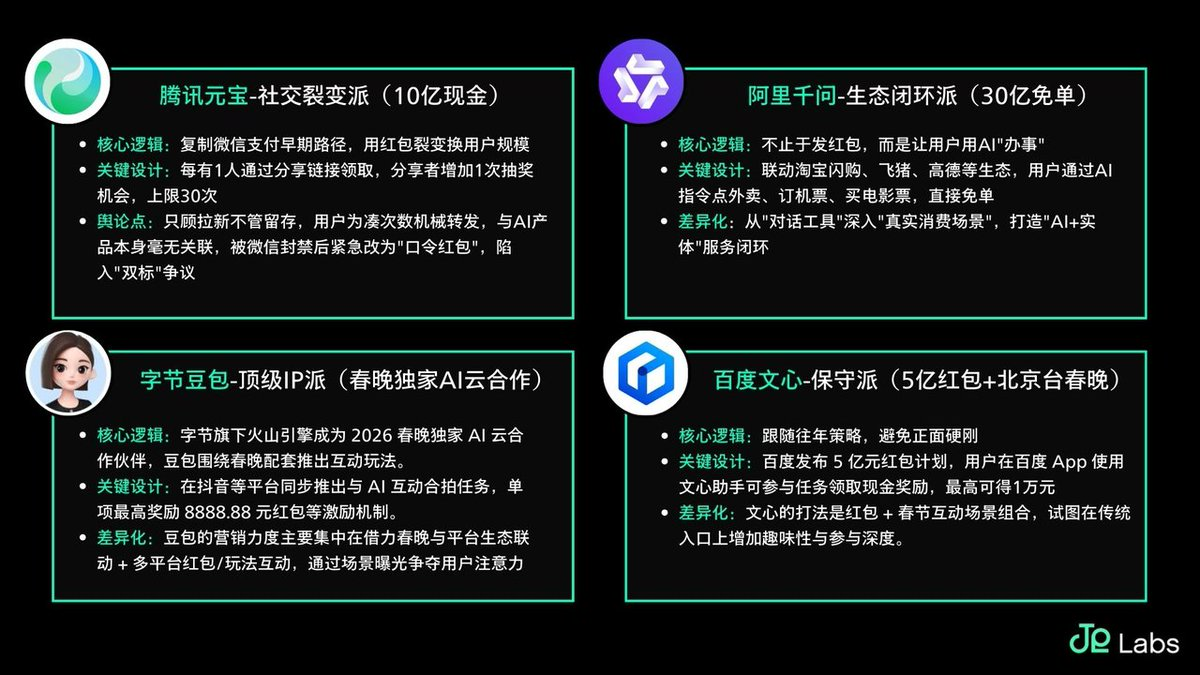
The common methods used every year are more or less the same, but this year some people are happy while others are worried.
Baoyuan Marketing Fiasco: The Essence Is Using Web2 Traffic Era Methods to Create Products in the AI Era
Tencent Yuanbao's 1 billion red envelope plan had just launched for only 3 days when it encountered a dramatic scene - it was blocked by its own WeChat.
On February 4, WeChat Security Center issued a public announcement, pointing out that Yuanbao's Spring Festival marketing campaign involved "inducing users to frequently share links to WeChat groups through methods like 'doing tasks' and 'receiving red packets'," which disrupted the platform's ecosystem and restricted its direct opening within WeChat. Tencent's stock price fell by 3.53% that day.
Ironically, 11 years ago, it was precisely the WeChat red envelope "shake" miracle during the Spring Festival Gala that rewrote the mobile payment landscape. Now, Tencent originally hoped that the ingot would recreate this grand scene, yet forgot that the times have already changed.
On the surface, Yuanbao only touched the red line of WeChat's ecosystem rules. But in depth, this is a classic misconception in AI product marketing:
1. Product and growth strategy logic error
AI is a typical "task-driven tool"—users actively use it only when they encounter problems and need to improve efficiency.
But red envelope viral marketing, at its core, is essentially a "method to stimulate emotions"—users don't act for the product's value, but are driven by immediate benefits.
Red envelope virality has not been unsuccessful before.
Pinduoduo can succeed because its product and strategy are naturally aligned:
Almost no cognitive cost, extremely short path, benefits are immediately visible and redeemable
But AI products are exactly the opposite:
- The learning cost is relatively high.
- Scene understanding is complex.
- Value is deferred realization.
It's a misalignment between product attributes and growth strategies. It's like you opened a top-tier neurosurgery clinic, but instead of promoting how great the lead surgeon's operations are, you're handing out eggs every day at the entrance to attract customers.
2. Only acquiring new users, not retaining them: Data illusion
From a backstage perspective, Yuanbao's current round of fission could be "very successful":
The hierarchy is spreading, DAU is spiking, and the forwarding curve data looks great.
But the reality is: users have long done "waste sorting" for the red envelopes - after receiving the red envelope, they close the app and return to the main group chat to discuss technology, to chat about DeepSeek
This traffic is a one-time "casual user base." After the Spring Festival, what remains is merely the awareness of "that orange-colored app that gives money," rather than a value recognition of the AI assistant.
3. Schemes designed for KPIs, not for users
From an industry perspective, this operation resembles more of a reactive response being chased by data.
Doubao's DAU has exceeded 100 million, Qwen and Wenxin have successively reached the scale of hundreds of millions, while Yuanbao remains at the level of 20 million.
In the "Big Factory AI Ranking Competition," it does indeed seem somewhat unseemly.
Under this pressure, growth targets begin to shift forward; "doing things" becomes more important than "doing things right."
Also reflects a common problem in big companies: as long as the curve is rising, as long as the report looks good, short-term misalignments and long-term side effects can all be temporarily ignored.
Qwen's Order Surge: Implementing Practical Application Scenarios, Offline Order Grabbing Real-time Feedback to Marketing
By comparison, Qwen's strength lies in directly linking AI capabilities to users' real needs and the Spring Festival scenario, rather than merely acquiring new users or boosting traffic. Through Qwen Agents, users can not only claim no-fee coupons, but also connect with Taobao Flash Sales and Hema to place orders and have them delivered directly to their homes, creating immediate and tangible value.
Core advantages lie in:
- Task-driven experience: Users use AI to complete practical consumption or life tasks, with low learning costs and clear rewards.
- The scenario closely addresses festival pain points: Spring Festival shopping, gift-giving, and preparing for the New Year, with AI tools directly solving user's essential needs, rather than just providing interactive games.
- Long-term Mindset Building: While users gain practical value, they develop trust and reliance on AI products, rather than just remembering "the app for red envelopes."
- Reusable Mechanism: This set of scenario-based gameplay can be migrated to other nodes such as daily consumption and discount activities, continuing to enhance user stickiness and activity.
Overall, Qwen has currently achieved making AI "useful" rather than just "fun" in the Spring Festival marketing, forming a closed loop from short-term stimulation to long-term value. If expansion and more practical application scenarios are added, Qwen agents integrated throughout the Taobao ecosystem will become very powerful.
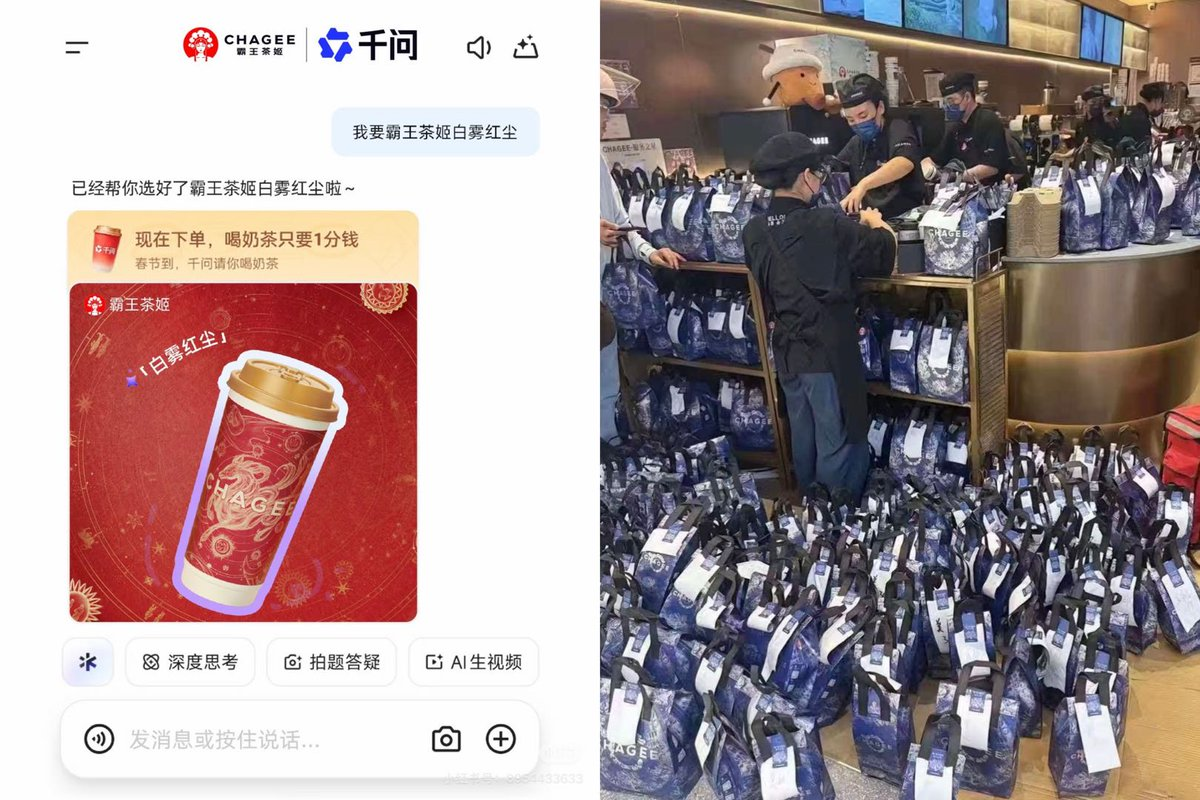
Image source from the internet
How should AI do Spring Festival marketing?
The Spring Festival is indeed a must-contest territory for AI marketing — it covers the widest user base, has the highest usage frequency, and is most suitable for concentrated advertising投放.
Red envelope grabbing conforms to the national conditions, but using AI tools for this purpose is easily criticized; the key lies in whether AI has resolved real pain points.
Based on cases from major companies and industry trends, the correct approach to AI Spring Festival marketing should be:
1. From "Sending Red Envelopes" to "Doing Practical Things"
Negative example: Yuanbao's red envelope is completely separated from AI features, users take the money and leave.
Positive case: Tongyi Qianwen from Alibaba allows users to use AI to order takeout, book flight tickets, and buy movie tickets, directly waiving the payment. This not only lowers the barrier to try, but also lets users experience the value of "AI can get things done."
Suggestions for Spring Festival travel scenarios:
- Smart travel planning: Enter the departure location, destination, and budget, AI automatically plans the optimal way home route (combination of train, flight, and ride-sharing)
- Ticket Grabbing Assistant: Real-time monitoring of remaining tickets, intelligent recommendation of transfer options, providing more cost-effective and implementable options rather than simply accelerated packages
- Packing list generation: Automatically generate a packing list based on destination weather, trip duration, and personal habits.
- Local Custom Quick Guide: For users bringing their partners/children back to their hometown, provide quick dialect learning, one-click compilation of gift preferences of locals, making New Year greetings easier
2. From "Spending Money to Gain Users" to "Saving Money to Retain Users"
Big companies spending money to buy users has become an arms race, but users are getting smarter— you give away 1 billion, I'll take it and leave.
Cost-effective strategy:
- AI-generated personalized New Year greetings: Based on the closeness of family and friend relationships and their preferences, generate heartfelt New Year messages + AI greeting cards, solving the "mass-sending embarrassment"
- Smart Family Album Organization: Upload photos from the whole year during the Spring Festival, AI automatically categorizes and generates an annual memory video, solving the pain point of "phone storage explosion"
- Relative Q&A Rehearsal: Input potential questions relatives might ask (salary, relationship, having children), AI generates appropriate responses, solving "Chinese New Year social anxiety"
3. From "Social Fission" to "Word-of-Mouth Fission"
WeChat's ban on Yuanbao is essentially to protect the social experience. AI marketing should not break the relationship chain, but strengthen the relationship chain.
Innovative gameplay:
- AI family group manager bot: Automatically organizes important information in the family group chat (changes in gathering time and location), and grabs red envelopes in a timely manner to avoid missing out.
- Intergenerational Games: Design AI interactive games suitable for grandparents, parents, and children to play together (such as AI guessing riddles, AI writing couplets), allowing AI to bridge the generation gap.
- New form of AI red envelopes: instead of sending money, send "AI-generated personalized blessing videos" and "AI customized family tree maps" to make sharing more face-saving.
4. From "Spring Festival Rush" to "Long-termism"
All Spring Festival marketing efforts face the same challenge: after the initial heat fades, how to retain users?
Retention mechanism suggestions:
- Continuation of Spring Festival Tasks: AI tasks completed during the Spring Festival (such as generating New Year greeting videos) will automatically remind "Use AI to create holiday content" at key points like the Lantern Festival and Qingming Festival.
- Habit Formation Challenge: "7-Day AI Life Challenge" - Use AI to solve a practical problem each day (checking the weather, creating itineraries, writing emails), and earn points upon completion (points can be redeemed for cash withdrawals to WeChat/Alipay wallets without transaction fees)
- Personalized Memory: AI remembers the user's needs during the Spring Festival (e.g., "I have to return to my hometown in Henan every Spring Festival"), and proactively provides relevant services and plans travel in advance the following year.
The best marketing is to make AI seem genuinely useful in the context of "Chinese New Year."
One flower blooming alone is not spring; when all flowers bloom, spring is full.
I hope domestic big companies can also strive to catch up and optimize their models while actively engaging in marketing. After all, a good product is king. I look forward to the next shining star of domestic AI.