





Original Title: "Telegram's 'Encrypted Accounting': Surging Revenue Behind the Net Loss, and the 450 Million Dollar Coin Sale Controversy"
Original Author: Zen, PANews
Telegram has recently found itself back in the spotlight due to financial information shared with investors: revenue is rising, but net profit has turned downward. The key variable here is not a slowdown in user growth, but rather the decline in the price of TON, which has "pierced through" asset value fluctuations into the income statement.
Selling over $450 million worth of TON tokens has led the outside world to reassess its interests and boundaries with the TON ecosystem.
Despite a surge in revenue from Telegram, net losses persist due to the low price of TON.
According to a report by the Financial Times, Telegram experienced a significant surge in revenue during the first half of 2025. Unaudited financial statements show that the company earned $870 million in revenue during this period, representing a 65% year-over-year increase and far exceeding the $525 million it generated in the first half of 2024. Additionally, the company achieved an operating profit of nearly $400 million.
In terms of revenue structure, Telegram's advertising revenue increased by 5%, reaching $125 million, while premium subscription revenue surged by 88%, reaching $223 million, nearly doubling compared to the same period in the previous year. More importantly, the key factor driving Telegram's revenue growth was the exclusive agreement signed with the TON blockchain. TON became the exclusive blockchain infrastructure for the Telegram app's mini-program ecosystem, generating nearly $300 million in related revenue for Telegram.

Overall, Telegram continued its strong growth driven by the mini-game trend it sparked in 2024 during the first half of last year. In 2024, Telegram achieved its first annual profit, earning $540 million in profit, with total annual revenue reaching $1.4 billion—far exceeding the $343 million in 2023.
Of the $1.4 billion in revenue in 2024, approximately half came from its so-called "partnerships and ecosystem," roughly $250 million came from advertising, and $292 million came from its premium subscription service. Clearly, Telegram's growth has been driven in part by a surge in paying users, but even more so by the income generated from its cryptocurrency-related partnerships.
However, the high volatility of cryptocurrencies has also brought risks to Telegram. Despite achieving nearly $400 million in operating profit in the first half of 2025, Telegram still recorded a net loss of $222 million. Insiders said this was because the company had to revalue its holdings of Ton tokens. Meanwhile, due to the continued slump in altcoins in 2025, the price of Ton tokens continued to fall throughout the year, dropping more than 73% at its lowest point.
Shipment of $450 million — is it cashing out or implementing the decentralization concept?
Retail investors are not particularly surprised to see Telegram suffering losses due to the depreciation of its virtual assets, as they are used to the long-term price stagnation of copycat coins and the widespread paper losses among numerous DAT-listed companies. What is more surprising and troubling to the community, however, is a report by the Financial Times claiming that Telegram has offloaded a large volume of tokens, with TON token sales exceeding $450 million. This figure is already more than 10% of the current circulating market capitalization of the token.
As a result, the continuous decline in TON's price, combined with Telegram's disposal of its massive token holdings, has sparked doubts and controversies among some members of the TON community and investors regarding its "cash-out" behavior and alleged betrayal of TON investors.
According to a public statement by Manuel Stotz, Chairman of the Board of TON Strategy (NASDAQ: TONX), the TON tokens sold by Telegram are subject to a four-year vesting schedule. This means that these tokens cannot be circulated on the secondary market in the short term and will not create immediate selling pressure.
In addition, Stotz stated that the main buyers of the Telegram token offering are long-term investors such as TONX, a company led by Stotz. These investors are purchasing the tokens for long-term holding and staking purposes. TONX, led by Stotz and listed in the U.S. as a specialized investment company focused on the TON ecosystem, will primarily use its purchase of Telegram tokens for long-term strategic purposes, not for speculative trading.
Stotz also emphasized that Telegram's net holdings of TON tokens did not significantly decrease after the transaction and may have even increased. This is because Telegram exchanged part of its existing holdings for tokens with lock-up periods, and it continues to generate new TON revenue through business activities such as advertising revenue sharing. When these factors are taken into account, its overall holdings remain at a high level.
Telegram's long-term business model for holding TON tokens has previously raised concerns among some members of the community, who worry that the company's ownership of a disproportionately high percentage of tokens could be detrimental to TON's decentralization. Telegram founder Pavel Durov has taken this concern very seriously, and as early as 2024, he stated that the team would keep Telegram's ownership of TON tokens at no more than 10%. If the holdings exceed this threshold, the excess will be sold to long-term investors, promoting broader token distribution while also raising funds for Telegram's development.
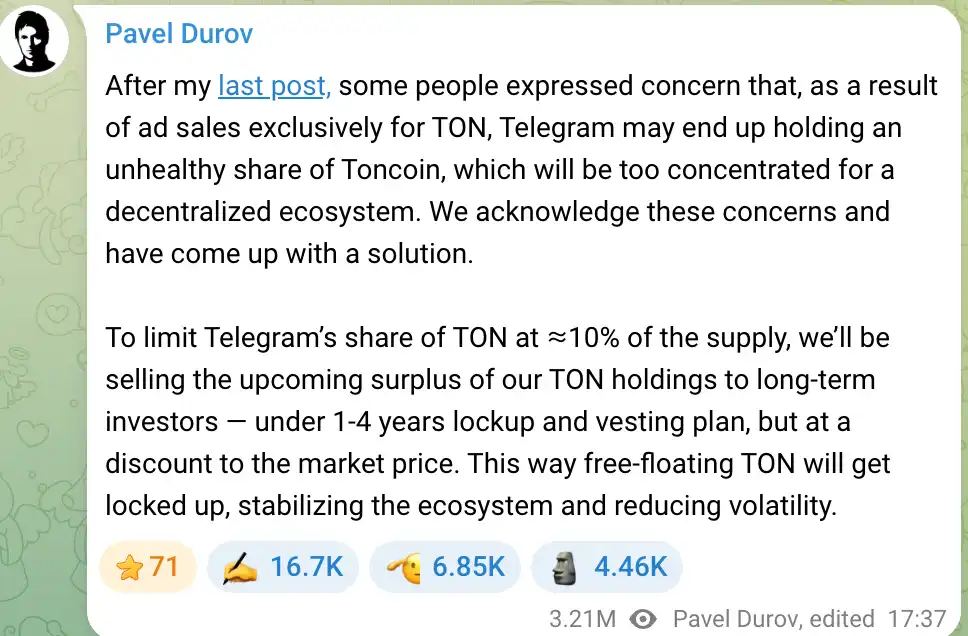
Durov emphasized that these sales will be conducted at a slight discount to market price, with lock-up and vesting periods in place to avoid short-term selling pressure and ensure the stability of the TON ecosystem. This plan aims to prevent TON from becoming concentrated in Telegram's hands, which could raise concerns about price manipulation, and to uphold the project's decentralized principles. Therefore, Telegram's token sales are more akin to asset portfolio adjustment and liquidity management, rather than a simple high-price cash-out for profit.
It is worth noting that the continued decline in the TON price in 2025 has indeed placed impairment pressure on Telegram's financial statements. However, in the long term, Telegram's close integration with TON has created a situation of shared prosperity and risk.
Telegram has gained new revenue sources and product highlights through its deep involvement in the TON ecosystem, but it also faces financial impacts from the volatility of the cryptocurrency market. This "double-edged sword" effect is a crucial factor investors must consider when evaluating Telegram's value, especially as Telegram contemplates an IPO.
The IPO Prospects of Telegram
With improved financial performance and business diversification, the prospect of Telegram's initial public offering (IPO) has become a focal point for the market. Since 2021, the company has raised over $1 billion through multiple bond issuances. In 2025, it issued another $1.7 billion in convertible bonds, attracting participation from renowned international institutions such as BlackRock and Abu Dhabi's Mubadala.
These financing initiatives not only provide Telegram with much-needed capital but are also seen as preparations for an IPO. However, Telegram's path to going public is not without challenges; its debt arrangements, regulatory environment, and founder-related factors will all influence the IPO process.
Currently, Telegram has two major outstanding bonds: one is a 7% coupon bond maturing in March 2026, and the other is a 9% coupon convertible bond maturing in 2030. In the second bond issuance of $1.7 billion, approximately $955 million was used to refinance existing bonds, while $745 million provided new funding for the company.
The special feature of this convertible bond is the inclusion of an IPO conversion clause: if the company goes public before 2030, investors can redeem or convert the bonds at approximately 80% of the IPO price, which represents a 20% discount. In other words, these investors are betting that Telegram will successfully conduct an IPO and achieve a significant valuation premium.
Currently, Telegram has already redeemed or repaid the majority of its bonds maturing in 2026 through debt refinancing for 2025. Durov publicly stated that the old debts from 2021 have essentially been settled and will not pose a current risk. Regarding the impact of the $500 million Russian bond freeze on Telegram, he responded that Telegram does not rely on Russian capital, and there were no Russian investors in the recently issued $1.7 billion in bonds.
Therefore, Telegram's primary debt now consists of convertible bonds maturing in 2030, leaving a relatively wide window for an initial public offering (IPO). However, many investors still expect Telegram to pursue an IPO around 2026–2027, converting debt into equity and opening new financing channels. Missing this window would mean the company would face long-term interest burdens in the future and potentially lose a valuable opportunity to transition from debt to equity financing.
When investors assess the market value of Telegram, they also pay attention to its profit potential and revenue-sharing model. Currently, Telegram has approximately 1 billion monthly active users, with an estimated 450 million daily active users. This large user base provides significant commercial potential. Although the platform has experienced rapid business growth in recent years, it still needs to demonstrate that its business model can achieve sustainable profitability.

The good news is that Telegram currently has absolute control over its own ecosystem. Recently, Durov emphasized that he remains the company's sole shareholder, and creditors have no involvement in company governance.
Therefore, Telegram has the potential to sacrifice some short-term profits in order to gain long-term user retention and ecosystem prosperity, without being constrained by the short-sighted interests of shareholders. This "delayed gratification" strategy aligns with Durov's consistent product philosophy and will also serve as the core narrative for telling a growth story to investors along the IPO path.
However, it should be emphasized that an IPO is not solely dependent on financial and debt structures. The Financial Times noted that Telegram's potential listing plans are still affected by ongoing judicial proceedings in France against Durov. The associated uncertainties make it difficult to establish a clear timetable for the IPO. Additionally, in communications with investors, Telegram has acknowledged that this investigation could pose an obstacle.
Click to learn about BlockBeats' job openings.
Welcome to join the official Lulin BlockBeats community:
Telegram Subscription Group:https://t.me/theblockbeats
Telegram discussion group:https://t.me/BlockBeats_App
Official Twitter account:https://twitter.com/BlockBeatsAsia