





Sun Yuchen invested $75 million in exchange for an advisory title, a large number of frozen tokens, and a federal court complaint.
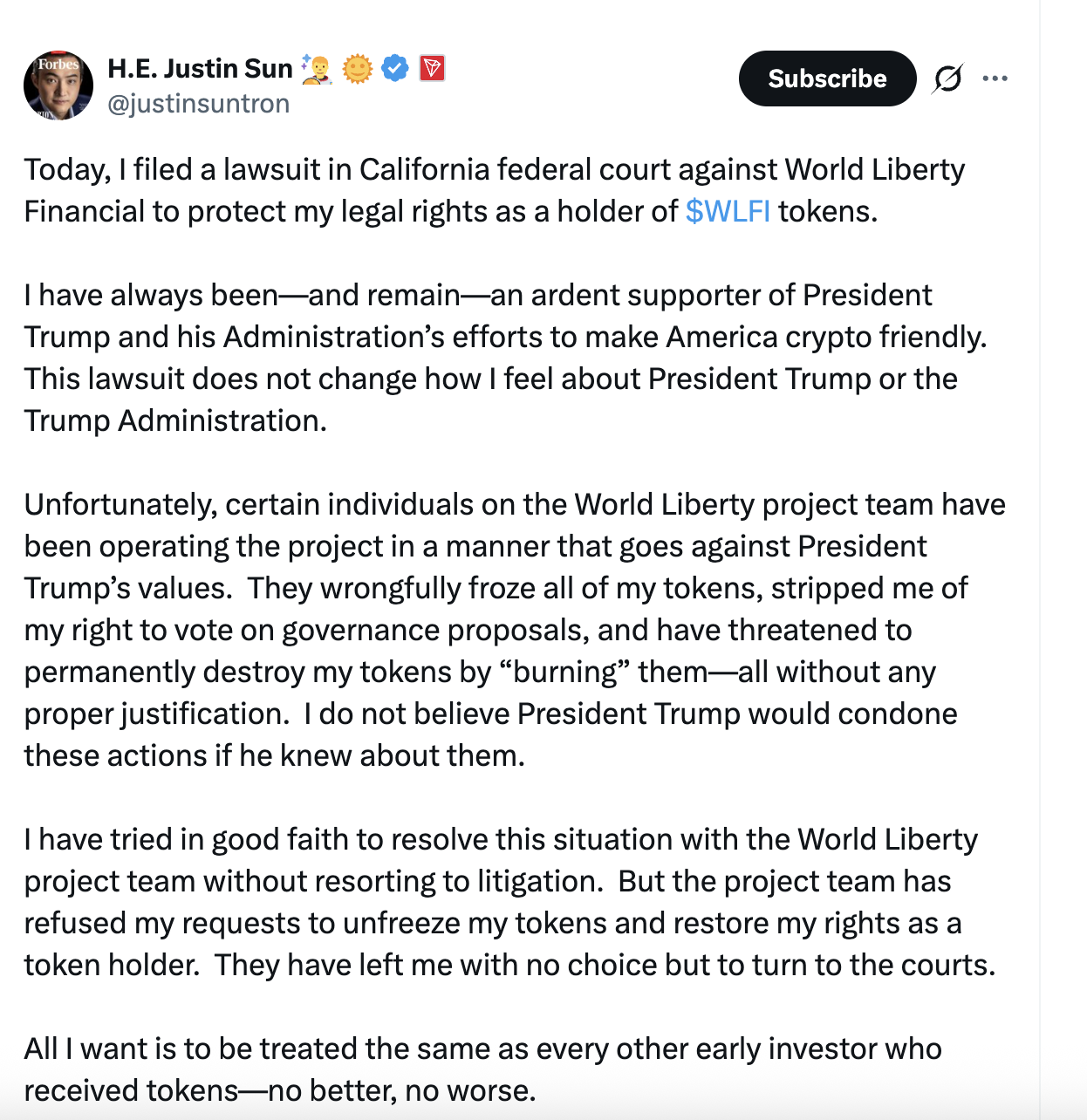
On April 22, the founder of Tron formally sued World Liberty Financial in the U.S. District Court in San Francisco, accusing it of making him “the primary target of its fraudulent scheme,” resulting in “hundreds of millions of dollars in losses” to him and his company. He also alleged that WLF is currently “on the brink of collapse” and “severely insolvent,” and plans to pay “95% of token sale proceeds to insiders.”
The person best at crunching numbers in the crypto world got tricked this time.
75 million "oath of allegiance"
Go back to the end of 2024.
World Liberty Financial just launched the sale of WLFI tokens, but the event was painfully underwhelming, with first-month sales totaling only $22 million.
Sun Zhenyu has made his move. He initially invested $30 million, later increasing it to $45 million, plus an additional 1 billion tokens received as advisory compensation, bringing his total investment to approximately $75 million. He has become the largest public investor in World Liberty.
After Sun Yuchen made his purchase, other investors followed suit, and the project ultimately raised approximately $550 million. World Liberty Financial later publicly acknowledged that Sun Yuchen helped the project make a comeback.
At that time, the SEC was suing Sun Yuchen, accusing him of market manipulation, selling unregistered securities, and paying celebrities to promote his projects without disclosure. However, after Trump took office in January 2025, the SEC voluntarily paused the legal proceedings against Sun Yuchen. In March 2026, both parties reached a $10 million settlement, with Sun Yuchen admitting no wrongdoing.
A $30 million investment replaced a lawsuit that could have left him bankrupt. Sun Yuchen did the math clearly.
Refuse blood transfusion, block immediately
The honeymoon period is short.
According to the complaint, World Liberty Financial continuously requested Sun Zhen to make additional investments in 2025, including requiring him to mint World Liberty Financial’s USD1 stablecoin on the Tron network. Sun Zhen refused.
By July 2025, the relationship had completely broken down.
What happened next was less a business dispute and more a on-chain manhunt.
In August 2025, World Liberty Financial modified the WLFI token's smart contract to include a "blacklist" function, allowing the project team to unilaterally freeze any holder's tokens without notice, justification, or governance voting.
One month later, Sun Zhen attempted to transfer his WLFI tokens, but the wallet was blacklisted, freezing approximately $107 million in governance tokens and revoking voting rights.
Subsequently, World Liberty Financial threatened to "burn" his tokens. In the blockchain world, burning means permanently destroying assets so they no longer exist.
Sun Yuchen stated that he had attempted to "resolve the matter in good faith," but the other party refused to unfreeze the tokens or restore his rights.
"They left me no choice but to take it to court," he wrote on X.
Zach Witkoff, CEO of World Liberty Financial, responded that Sun Yuchen's allegations were "completely unfounded" and stated that Sun Yuchen engaged in "misconduct," forcing World Liberty Financial to take action to "protect itself and its users."
No one explained what this "misconduct" specifically entails.
The president's ATM
To understand why Sun Yuchen was frozen, you first need to understand what World Liberty Financial actually is.
On the surface, this is a "decentralized finance" project that claims to empower retail investors to take control of their own funds. It features a governance token, WLFI, a stablecoin, USD1, and DeFi lending products.
But beneath this surface, the core structure is a profit pipeline.
The Trump family receives 75% of the net proceeds from the WLFI token sale. By December 2025, the family had earned $1 billion in profits from this sale while holding unsold tokens valued at $3 billion. The reserves backing the USD1 stablecoin are invested in U.S. Treasury securities, and the interest income generated also flows to family entities. Based on a market capitalization of $4.2 billion and current Treasury yields, the stablecoin alone generates approximately $160 million in annual income.
This isn't even the largest transaction.
In January 2025, four days before Trump’s inauguration, an investment entity affiliated with Sheikh Tahnoon bin Zayed, a member of the Abu Dhabi royal family, acquired a 49% stake in World Liberty Financial for $500 million. The agreement was signed by Eric Trump. Of this amount, $187 million flowed directly to entities controlled by the Trump family, and at least $31 million went to entities associated with the Witkoff family.
Zach Witkoff, CEO and co-founder of World Liberty Financial. His father, Steve Witkoff, is the U.S. Special Envoy to the Middle East.
Senator Elizabeth Warren called it "outright corruption." The House subsequently launched an investigation. Trump himself said he was "unaware" of the transaction.
Dolomite: Borrowing your own money
In early 2026, on-chain data showed that World Liberty Financial deposited 500 million of its own WLFI tokens as collateral into the DeFi lending platform Dolomite, borrowing approximately $75 million in stablecoins. Over $40 million of this was transferred to Coinbase Prime, which typically indicates the tokens were exchanged for fiat currency.
Corey Caplan, co-founder of Dolomite, is also an advisor to World Liberty Financial.
Your own token, deposited into a platform opened by your advisor, lending your issued stablecoin, then converted into cash.
This transaction pushed the utilization rate of Dolomite's USD1 lending pool to 100%. Regular depositors are locked in and unable to withdraw their funds. Meanwhile, World Liberty Financial's collateral accounts for 55% of Dolomite's total locked value.
World Liberty Financial responded: "We created attractive yields for the platform as anchor borrowers."
In other words, they use their own issued tokens as collateral on their own advisor’s platform to borrow their own stablecoin. In traditional finance, this is called a related-party transaction and requires separate auditing and disclosure. In DeFi, there isn’t even a public announcement.
On April 12, Sun Yuchen publicly accused the World Liberty Financial team of treating users as "personal ATMs," stating that he was the "first and largest victim." Three days later, World Liberty Financial released a governance proposal.
Ultimatum
The governance proposal on April 15, nominally titled "Governance Restructuring," actually states that 6.228 billion WLFI tokens (62% of the total supply) will be subject to a new unlocking schedule. The 45.2 billion tokens held by founders, team members, and advisors must undergo a 10% burn (approximately 4.5 billion tokens), followed by a two-year lock-up period and a three-year linear vesting schedule.
Holders who do not accept the new terms will have their tokens frozen indefinitely.
Sun Zhenyu called the proposal "one of the most absurd governance scams I've ever seen." However, he could not vote against it because his tokens have been frozen.
Now consider the distribution of voting power. In a USD1 governance proposal passed in January 2026, the top nine wallets controlled nearly 60% of the voting power.
WLFI's price movement speaks for itself. It reached an all-time high of $0.46 in September 2025, followed by a steady decline, hitting an all-time low of $0.0767 on April 11—a drop of 84% from its peak.
Those who bought at $0.015 still have unrealized gains. But if you were Sun Zhen, the tokens acquired with a $75 million investment once exceeded $1 billion in value, but now they are frozen and could be permanently destroyed.
The same mirror
Sun Yuchen is not an innocent victim.
He was accused by the SEC of market manipulation and fraud, and his investment timing precisely coincided with his legal troubles.
It's precisely because he is not innocent that this case is interesting.
Someone who built their fortune by "cutting the green onions" is now being treated in the same way by a larger power structure. This irony speaks louder than any whitepaper.
World Liberty Financial offers decentralized finance, where users control their own assets with no intermediaries and no censorship.
In reality, the smart contract contains a backdoor, allowing the project team to freeze your tokens at any time, governance votes are controlled by nine wallets, and the founders use your deposits to lend themselves money.
Sun Yuchen's original post on X was: "Unfortunately, certain individuals on the World Liberty Financial project team have been operating the project in a manner contrary to President Trump's values."
Until the moment of the lawsuit, he was still giving Trump face. Despite having spent $75 million, the indictment carefully distinguished between “President Trump” and “certain individuals on the project team” after all assets were frozen.
The most interesting aspect of this case isn't whether Sun Yuchen can recover his tokens—it's how the court will classify WLFI. If it is deemed a security, then World Liberty Financial's actions—amending the contract without a vote and freezing holders' assets—could constitute fraud under federal securities law.
WLFI is currently trading at $0.078, down approximately 84% from its peak. The reserve adequacy of the USD1 stablecoin is under scrutiny. Dolomite’s lending pool risks remain unresolved. The House investigation is ongoing. However, the Trump family has already cashed out over $1 billion.
Sun Yuchen's convertible bonds have an earliest maturity window in 2027. Court scheduling may take over a year. During this time, WLFI tokens will continue to unlock, and individuals will still be forced to choose between "accepting the new terms or remaining frozen indefinitely."