





Podcast: The Round Trip
Compiled and organized by Yuliya, PANews
As the tide of liquidity recedes, crypto narratives have become increasingly scarce and dull, and the market landscape is accelerating its consolidation. During this crypto winter, foundational infrastructure has undergone a transformation marked by greater technical resilience and practical utility, exploring diverse paths to survival.
Sui has also developed its own growth solution, achieving strong growth in its ecosystem and adoption, and completing the critical transition to a fully implemented technology stack.
Recently, in the new series Founder’s Talk by PANews and Web3.com Ventures, titled “The Round Trip,” Evan Cheng, co-founder and CEO of Mysten Labs, the developer of Sui, shared his personal journey from traditional internet entrepreneurship to blockchain, outlined his vision for Web3, and detailed how Sui addresses industry-wide technical bottlenecks and privacy challenges by building from the ground up to create a full-stack operating system designed for AI automation and iOS-level integration, delivering more efficient and secure blockchain solutions for developers and users.

A Silicon Valley veteran, aged fifty, is starting a venture to rebuild the "foundation" of the internet.
PANews: Hello everyone, welcome to another episode of Round Trip. We’re honored to have Evan Cheng, co-founder and CEO of Mysten Labs, who supports the entire Sui ecosystem. Welcome, Cheng—how was your experience at Consensus in Hong Kong recently? Did you meet anyone interesting?
Evan Cheng: Everyone I met at Consensus was fascinating. I met many of our partners, and our business discussions went very smoothly. I’m very pleased because, although the Hong Kong market isn’t as large as Wall Street—America will always be the largest—it’s growing at a faster pace.
PANews: It’s a great honor to have you with us today. I’ve been following the Sui ecosystem for quite some time. Let’s start with your personal background—could you share your journey and how you gradually came to be involved with Sui?
Evan Cheng: OK. I was born in Taiwan, but I left at a very young age and spent most of my life studying and building my career elsewhere. I started with startups, then spent ten years at Apple working on foundational, infrastructure-level projects. 2012 was a major breakthrough for me because I received the ACM Software System Award. ACM is one of the largest associations in computer science, and this award is a tremendous recognition. You should know that previous winners include technologies like TCP/IP, UNIX, web browsers, and Java. Even though everyone is focused on AI today, these are the most fundamental technologies, and I’m proud to have contributed to them.
After Apple, I went to Facebook (which later became Meta). Initially, I managed teams related to programming languages and runtime environments, as well as some AI initiatives. Later, I moved to the Libra (Diem) project, where I led blockchain research and development. Eventually, I decided to leave with my friend to start my own company.
PANews: I’m curious—throughout your entire career at Meta, including your later move to Libra, your professional path was very stable. So why did you suddenly decide during that time to start a startup in what might be the craziest industry on Earth? I think that takes real courage and determination.
Evan Cheng: In fact, I’ve been very interested in blockchain for a long time. I started paying attention around 2015 and have always wanted to contribute my own efforts.
I initially thought the Libra (Diem) project was a great opportunity, but later I realized I couldn’t do what I truly wanted to do there, and it left me feeling drained. My wife and friends asked me, “Are you crazy? Why are you starting a business at this age?” But I told my wife, “Don’t you see how angry and frustrated I am every day when I come home from work? I can’t do what I’m meant to do.” So I’d rather channel my energy into something I can control myself.
Large companies often focus heavily on what kind of results or products can be delivered in a short time. My thinking at the time may have been a bit naive—I wanted to accomplish something much grander: I aimed to build a layer on top of the internet to provide foundational support for full automation in the future, for all forms of collaboration, and for seamless transfers and communication between any person, machine, or agent.
You'll hear us repeat a common point: the web was fundamentally built for humans and is highly unfriendly to automation of all kinds, especially agent-based automation. Middleman scenarios remain severe. You can anticipate friction arising—on one side, AI is driving automation forward; on the other, middlemen still seek to maintain control.
I initially had this idea and felt this was what we needed to do. Even back then, we weren’t entirely clear on what Sui was or what kind of blockchain we wanted to build, but the idea was there. This Layer is enormous, and this choice was necessary. In my previous career, I worked on similar ultra-low-level Layers (where all runtime operations were built on top), and now billions—even hundreds of billions—of devices and hundreds of millions of developers use what I helped build. I wanted to do it again. So, starting a company in my fifties is certainly challenging, but I felt I couldn’t wait any longer—I stepped out.
PANews: It sounds like a journey of self-discovery, a mission that must be completed.
Evan Cheng: I wouldn’t go as far as calling it a “soul search,” but I’ve always believed that at the right time, I should build something of my own. In fact, age has never been a factor for me. Look at Morris Chang of TSMC in Asia—he didn’t start his own company until his fifties, and look how successful he became! As long as you have an idea and a group of trusted partners around you, you can absolutely make it happen. So I said, “OK, let’s do it.”
Reject both “crypto is dead” and blind optimism—what matters is having clear goals and vision.
PANews: Over the years in Crypto, how much of your original dream have you achieved—or how much of your initial vision has the industry itself realized?
Evan Cheng: Just a little. I often meet partners from Asia who say, “You’re the founder of Sui, we’re honored to meet you.” But personally, I feel we’ve only accomplished a tiny fraction of what we originally set out to achieve. So far, we’ve gained some brand recognition, become a default choice for many, and people now know about the Sui brand and what we’re doing. Technically, we’ve made significant progress, but in other areas, we’re still very early stage—so really, we’ve only completed a tiny bit.
However, after more than four years of entrepreneurship, all five of us founders are still here, working hard every day. Not a single one of us has thought, “It’s too hard, I don’t want to do this anymore”—this makes me very happy.
PANews: I asked this question because I entered this industry around the 2022 bear market. I often reflect on how much this industry has progressed compared to four years ago. I feel we are currently at a moment of “soul-searching,” with a profound sense of division: on one hand, we have a clearer regulatory environment and widespread institutional adoption; on the other, market performance is devastating—I can’t even bring myself to check the prices. Where do you think this divide comes from?
Evan Cheng: This is the first industry in history where, as soon as you have a slight product-market fit and a bit of traction, people can directly assign a valuation to your token without going through traditional intermediary processes.
This has both advantages and disadvantages. The benefit is that the market reacts immediately to what you do, giving you plenty of feedback; but the downside is that you can’t set expectations too high, and sometimes you can’t set them too low either—it’s really hard to strike the right balance. Because your token gains value immediately, it naturally attracts people focused solely on short-term profits. I think this is also one of the reasons we’re currently in a bear market: expectations are too high, there’s too much noise, and many haven’t delivered anything substantial.
Every so often, people become disillusioned and say, “This whole industry is a scam.” We have a saying: “Not everyone in Crypto is a scammer, but it seems like all scammers are in Crypto.” And that’s truly the case. I think it’s because our industry is still immature, and many of the necessary regulations haven’t been put in place yet. The market isn’t very efficient and is easily influenced by various events. Over time, these issues will be resolved. But the characteristic of needing an immediate reaction is extremely hard to deal with—it takes strong resilience to get through it.
PANews: Having gone through so many market cycles, as a team leader in this industry, how would you guide your team through this bear market? What do you think are the most important tips?
Evan Cheng: The most important point is that everyone needs to understand where our goals and vision lie. If you understand what we aim to achieve in 10, 20, or 30 years, and you’re excited about it, you’ll see market ups and downs as part of the journey. You won’t abandon this dream just because the market performs poorly in the short term.
Of course, we can't expect everyone to have such a large commitment and determination. But so far, our progress has been quite good. Our team are all builders, each with big dreams, hoping that in the future we will achieve great success and deliver meaningful results to the world. We've been doing well in this regard.
In market volatility, some people will get tired, others will be frightened, and personal stress is perhaps unavoidable. Over the coming period, some ecosystems may not survive, because the market collapses before you reach a stage where you can sustain yourself—you can’t secure additional funding, and this will have an impact. This is unfortunate. But on the other hand, if we are prepared, we see many opportunities ahead—that’s where our focus lies.
PANews: I recently came across your tweet, and I found it very interesting. You said: “All the 'crypto is dead' posts are silly and annoying. At the same time all the 'this is great for crypto/us' posts are silly, tone deaf, and just as annoying.” I think this topic is deeply insightful—where do you think our industry stands right now?
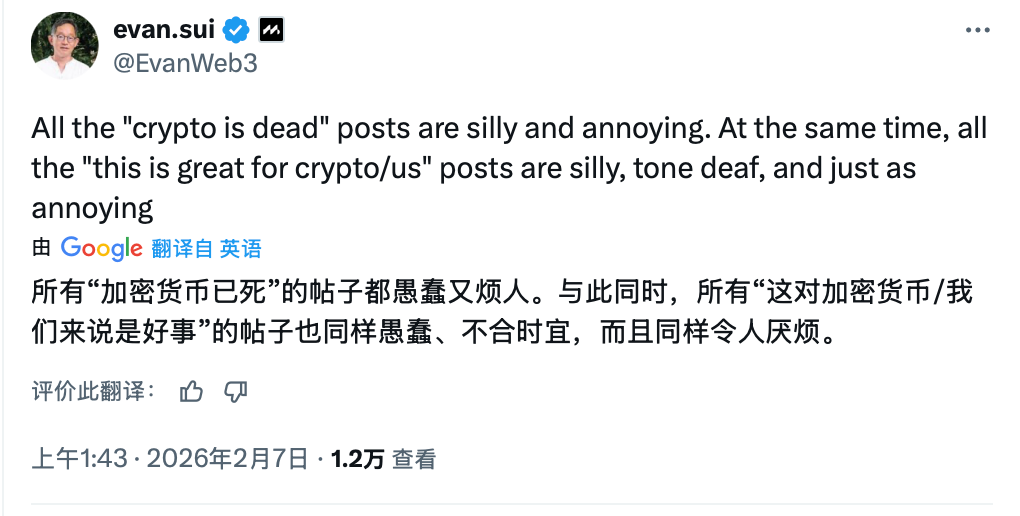
Evan Cheng: Every so often, you either hear “Crypto will change everything,” or during market downturns, you hear “Crypto is a scam with no future.” That’s really snobbish. By that logic, AI would have died out long ago—how many years did it take for AI to get to where it is today?
Often, such major paradigm shifts require going through these phases. Humans consistently underestimate how long it takes to reach the pivotal moment that enables true breakthroughs and widespread real-world adoption; but they also consistently underestimate just how steep the growth curve becomes once that inflection point finally arrives.
We haven’t reached that turning point yet, but we’re certainly not “dead.” Think from first principles: the future world will be automated, and everything will become automated. But existing networks weren’t built for this automation, businesses weren’t built for it, and humans weren’t born for it. Once you understand this is the ultimate form, you’ll know what the outcome will be.
On the other hand, many people jump in saying, "Bear markets are great for us—we should keep building during the bear market." First of all, this is completely inappropriate. Indeed, many people have suffered heavy losses, lost their money, and many outstanding builders will be eliminated—so this is absolutely not a time to celebrate. Some even bang on their chairs in celebration, saying, "We're doing fine," which is truly out of line.
Another point is that these cyclical fluctuations do scare away many people, which is not good for our entire industry. We need time to work through these issues. That’s why I strongly dislike overly optimistic posts.
PANews: Thank you. This is my second bear market, and I feel that this time, compared to the last, I know our fundamentals have improved, and our current fundamentals are stronger than ever before. Now I can tell myself not to worry—this winter won’t last too long; there’s still a lot of hope here.
Three major barriers preventing Web2 developers from entering Web3
PANews: Let’s talk about something more positive and optimistic. Let’s dive into Sui. Before we get into what Sui is specifically doing, I’d like to look at it from a macro perspective—if you had to identify three key bottlenecks that prevent Web2 builders or the world’s best application developers from building dApps on blockchain, what would they be?
Evan Cheng:
The first bottleneck is, in fact, industry reputation and misconceptions about crypto and blockchain.
Over the years, there have been many misconceptions about the industry. First, people believe that Crypto is full of scammers and just a place for quick wealth—this needs to be corrected. Second, many mistakenly think that blockchain can only be used for gambling, trading, and stablecoin exchanges. Some even claim that blockchain architecture suffers from a “trilemma”—every time someone asks me about the “trilemma,” I get angry, because it’s completely wrong! It’s only because the original design of blockchain was flawed; we have already proven that the so-called “trilemma” doesn’t exist at all, and these issues will be resolved.
Everyone is also familiar with Sui’s design. Traditional architectures focus on describing static assets, but we understand that assets are not static—they go through different stages and lifecycle changes. This is completely different from ledger-based models like Ethereum and Solana. This misconception needs to be corrected.
There’s another serious misconception: many believe that EVM and Solidity can solve everything. This is utterly insane! I stake my reputation on this: anything built with that programming language is fundamentally unworkable. You would never, under any circumstances, build any critical business system on this foundation—it’s a ticking time bomb. Ask 100 experts in programming languages and runtime systems, and they’ll all give you the same conclusion: outside this industry, no one even glances at Solidity and EVM, let alone considers using them to build any meaningful system.
The second bottleneck is the maturity of the technology.
Today, there are essentially two types of people building on blockchain: Crypto Natives, who create DeFi protocols or NFTs—these are fundamentally on-chain products. They work at a low level, requiring deep knowledge of smart contracts, managing resources at the blockchain and protocol levels, and understanding how to use RPC and handle various intricate details.
Another is a slightly higher-level application you might see, such as PolyMarket. We know it’s built on blockchain, but they hide a lot of the complexity—many operations are actually handled off-chain because they don’t need to deal with these cumbersome details.
The current stack is not good enough and is too low-level. Think about external financial products, social media, games, and so on—they shouldn’t have to deal with this level of complexity; they need a higher-level solution. This is indeed a serious issue.
The third bottleneck is the fragmentation of privacy and cybersecurity models.
Today’s blockchains are largely transparent, with all activities public and often limited to a single purpose. For example, Ethereum or Solana can handle smart contracts and asset transfers; but if you need data storage, secure storage of sensitive data, or role-based policies for decryption, viewing, and access control, you may need to turn to an entirely different system like Filecoin. And if you need privacy features, that’s another protocol altogether.
There are too many specialized blockchains out there. To build a product, you might need to stitch together a bunch of different pieces: use Ethereum here, an L2 for privacy there, and another protocol entirely to hide balances or sender/receiver information. It’s insane—it doesn’t work! Because they don’t offer a unified programming interface (API). This is the only industry where people think you can just glue together random software and make it work. No, it doesn’t work.
Therefore, conceptual misunderstandings, architectural issues, and immature fragmentation technologies are major bottlenecks hindering developers from entering.
Attract gaming giants to build the true "Evergreen Game"
PANews: I strongly agree with what you just said. I’ve noticed that when some highly reputable Web2 gaming companies enter Web3, they don’t want to step out of their comfort zone—they want a stack that’s fully ready and complete, something they can pick up and use immediately. For example, earlier with CCP Games, I spoke with them in 2023 and 2024 as an investor, when they hadn’t yet decided which chain to choose; ultimately, they selected Sui. In your view, what specific traits of Sui appealed to them?
Evan Cheng: They understood that they were creating an "eternal game"—one that would keep the economic system running indefinitely, even if the company ceased to exist or the people behind it were gone. They aimed to automate everything, and they were smart enough to recognize that this game was fundamentally a virtual environment designed for automation.
In games, many of the things you do involve world-building, resource management, battles, and more. These are not the first-person shooter games you might think of, but rather a vast array of programmatic logic, especially in AI management. The automated AI workflows are precisely what our Sui stack platform is designed to build.
After speaking with them, they realized that if they used another chain, they would only be able to handle cash management and payments, while other logic would require piecing together a lot of additional tools. They had previously tried building on Ethereum but found it unworkable.
So they are excellent partners. On one hand, they have previously operated games with hundreds of thousands of players for several years; on the other hand, they are themselves a developer platform where many people run a wide variety of applications. Therefore, they are a perfect fit for Sui. This is actually the first example demonstrating what a fully automated world might look like—not entirely automated, since it includes both real players and Agents. It’s a kind of simulation, and I’m personally extremely excited to see what amazing games they create on Sui.
Deliver an iOS-level experience for Web3—DeepBook is the liquidity hub.
PANews: You just mentioned the point of "privacy." I think privacy was once just an overused narrative, but at this moment, it’s critically urgent to build a strong Layer for it. Over the past few weeks, we’ve seen many funds and whales get wiped out because their positions were exposed publicly. What is Sui doing in terms of privacy?
Evan Cheng: First, people often confuse confidentiality with privacy—they are not the same thing, and privacy is not a one-size-fits-all solution.
In this space, there are several models of privacy. Some believe that "anonymity" on a public blockchain is sufficient, but in reality, all details are publicly recorded on the chain. So some say, "OK, let’s go entirely with permissioned or private blockchains." When the internet first emerged, people thought the same way—but that’s completely foolish. This all-or-nothing approach—either fully closed or fully open with reliance on pseudonymity—we now know simply doesn’t work.
It's great that people are interested in privacy now. But as I mentioned earlier, current privacy payments and private transfers often involve entirely separate blockchains. Do you really want to operate on Ethereum, then switch to another blockchain just for privacy payments, and transfer your assets over? That’s too complicated.
There are also models like Canton that allow institutions—such as JP Morgan or other funds—to run all their private data and privately negotiate business terms. But is there still an independent step involved in asset settlement? Regardless of who operates the private pool, they control matching and all off-chain activities.
You can't tell me to use one blockchain with one privacy model and another blockchain with a different privacy model, and then configure them yourself. Our approach is completely different. We built a unified Layer from the start—you configure the privacy settings you need directly on it.
In fact, we were the first to address data privacy issues. Walrus is the data storage. From a technical architecture standpoint, you can use Seal to store encrypted data, and your decryption policies can be directly written into Sui smart contracts. For example, if you’re a subscribed user of PANews, the article is automatically decrypted for you; if someone else doesn’t have the same email permissions, the smart contract will require them to pay 50 cents to view the article. As your data moves, so does its access policy.
This is a data-level confidential privacy model that we can apply to various different models, all controlled through Sui’s unified interface, enabling you to build complex products.
If you have only one model, your capabilities are very limited. All value must be captured at the protocol layer. If your assets are not on the main chain, you’ll encounter problems when doing finance: first, without a shared infrastructure and transparency, your liquidity becomes fragmented, reducing capital efficiency; second, you cannot see the full picture, which increases the cost of risk management.
We’ve spent a lot of time on this—over four years to build all of this. This year, we’ll be launching Nautilus, a framework for secure and verifiable off-chain computation on Sui, along with several other projects. Whether you’re building for privacy or engaging in DeFi and other areas, everything can be done on Sui. Crucially, full control over asset issuance rests entirely with developers.
Due to Sui's Object model, these properties are all embedded within the asset itself. Unlike the ERC-20 model, where assets are static, an asset can be acted upon and signed by its owner, its state can change, and its entire lifecycle can evolve.
So we are very confident because our model works, while other models don’t. Thinking from first principles, you’ll understand: the more automation you introduce, the more complex the system becomes—and other models simply don’t hold up. We’ll soon launch some relatively simple features, such as privacy payments and hidden balances, and begin gradually integrating them into our product to deliver real value to users.
PANews: The biggest takeaway I got is that Sui provides a fully integrated stack. Other blockchains are very fragmented—users or developers have to piece together solutions from many different places, resulting in an unintuitive experience. If I want to build an application or construct an economic system, I need a complete stack where everything is controllable. As you mentioned before, others are building ledgers, but you’re building a stack—Sui is a true platform.
Evan Cheng: Yes. In fact, if you look at any major platform—whether it’s Apple’s iOS, Microsoft’s platform, or Google’s Android—you’ll see the richness of the platform: all the features, interactions, and SDKs are integrated. You can’t expect developers to piece together a stack themselves. Our core mission is to build the Sui Stack, and from the very beginning, our vision has been to create such a comprehensive toolkit.
PANews: Finally, there's one very interesting question—could you explain to my grandmother what DeepBook is?
Evan Cheng: OK, DeepBook is like a "central bank".
On Sui, all exchanges or swap applications can directly access liquidity from DeepBook. You can access a unified liquidity pool and execute price matching, as it is a centralized order book.
On other platforms, without this centralized shared infrastructure, each project must find its own "bank" and build its own liquidity pool.
Why does this matter? Because it prevents fragmentation and improves efficiency. With DeepBook, everyone sees the same prices and has access to the same liquidity pool. When every company can share the same liquidity pool, DeFi on Sui becomes extremely efficient, significantly boosting capital efficiency.